6 min read

Pharaoh Prophesied His Own Drowning at the Sea

He told his own soldiers he had spent years holding them back out of royal manners. From tonight, he said, we all share alike in the spoil.

Curated by Arthur · Told by Maggid ·
Table of Contents
  1. The Speech He Made to His Own Army
  2. Three Sides Shut
  3. Five Things He Shouted at the Water
  4. Paid in the Coin They Minted
  5. Lead, Stone and Straw
Pharaoh Prophesied His Own Drowning at the Sea Click for full size

The Speech He Made to His Own Army

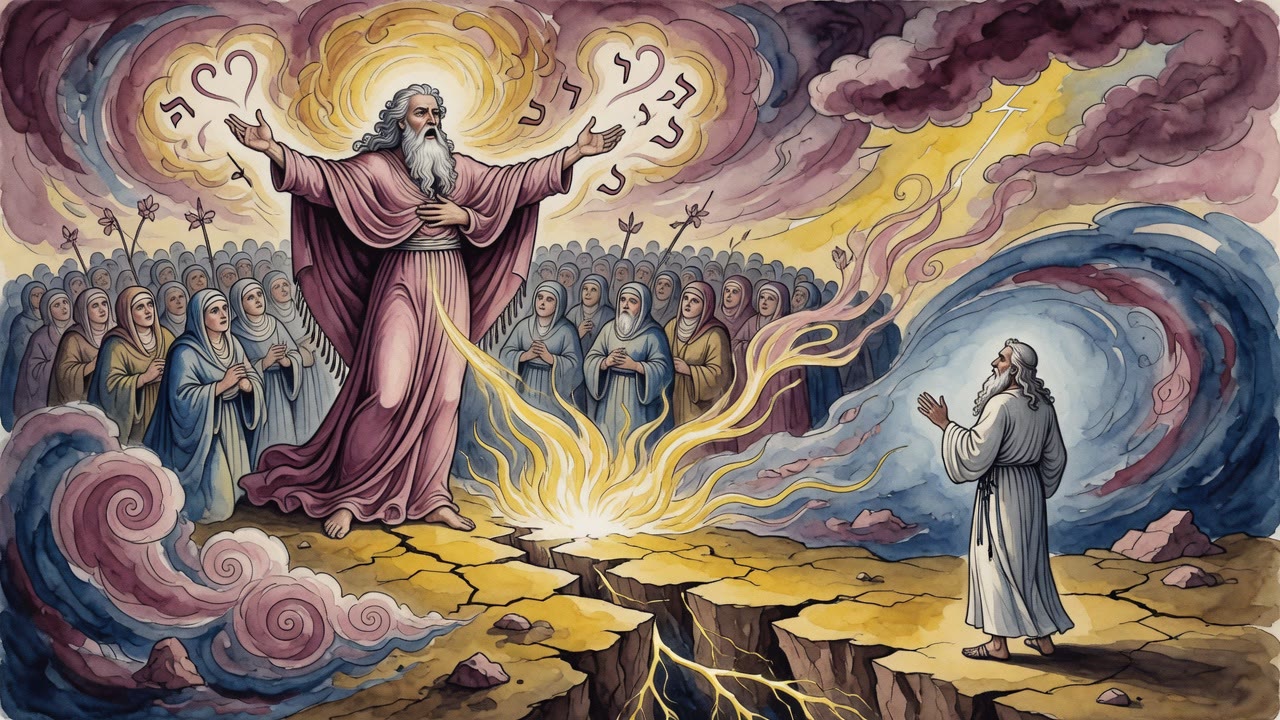
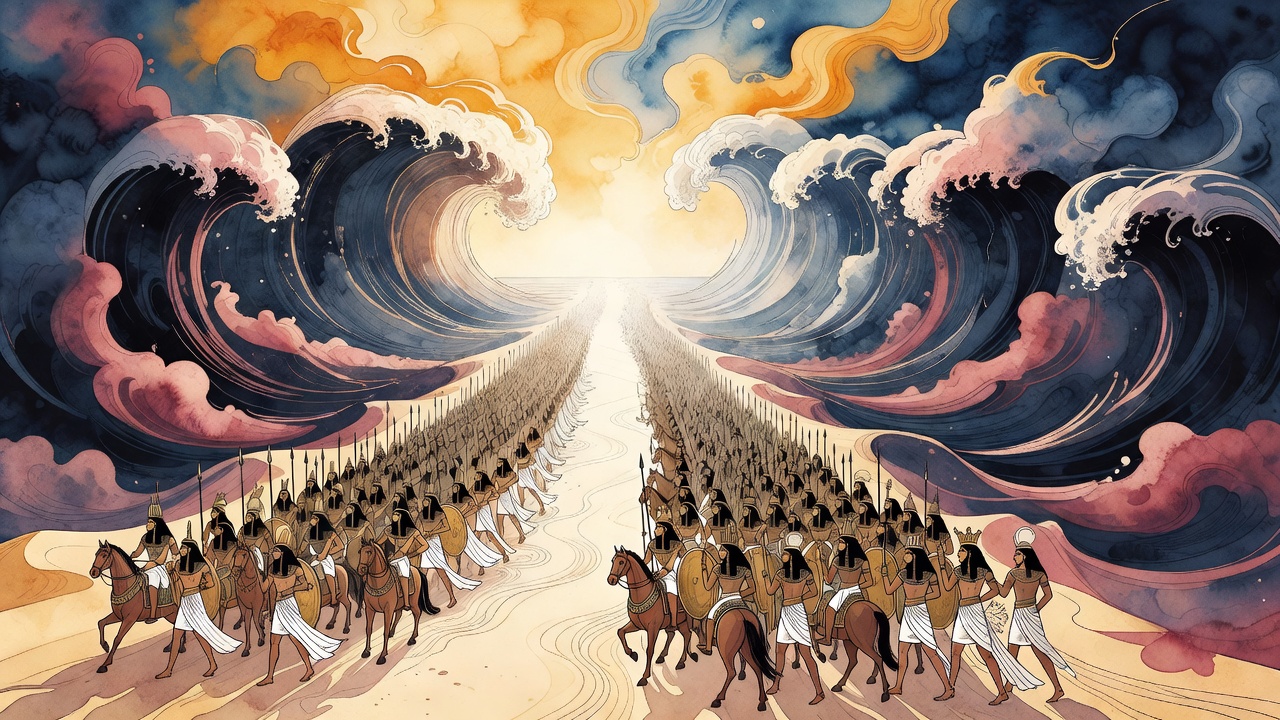
Pharaoh stood in front of his troops and started with money. Even if we ride after these people for nothing but the silver and gold they walked out of here with, he said, it is worth the trip.

Part of the army was not moved. Men shifted, looked at the horses, said nothing. So he raised the offer. Every man rides, and every man shares alike in the spoil, and the king takes no larger portion than the driver of the last chariot.

Then he opened the other door.

In the past you stripped their houses and I stopped you, he said, because a kingdom has to keep up appearances. In the past you killed them and I stopped you, for the same reason. In the past you wanted to lay hands on their sons and their daughters and I stopped you. Tonight nobody is stopping anybody. I will divide the spoil. My desire will have its fill of them. I will draw my sword and my own hand will take everything they have.

The army went out in three minds. One group wanted the property and no killing. One group wanted the killing and would leave the property. One group wanted both. Six hundred chosen chariots went down the road toward the water with those three appetites riding in them, and inside Egypt the slaves already knew every word of it, because the spirit of holiness had settled on them and they heard what was said in rooms they had never entered.

Three Sides Shut

The people reached the water and stopped. The sea lay across the whole front of them. Behind them the dust of the chariots was already visible on the road.

So they turned their heads to the open side, the wilderness, the one direction with nothing in it, and God filled it with wild animals. Whatever came out of that emptiness stood between them and the sand and would not let a single family through. The desert had shut around them like a mouth closing, the way the lions' mouths were shut on Daniel, and the shutting came from the same hand that had brought them out of Egypt.

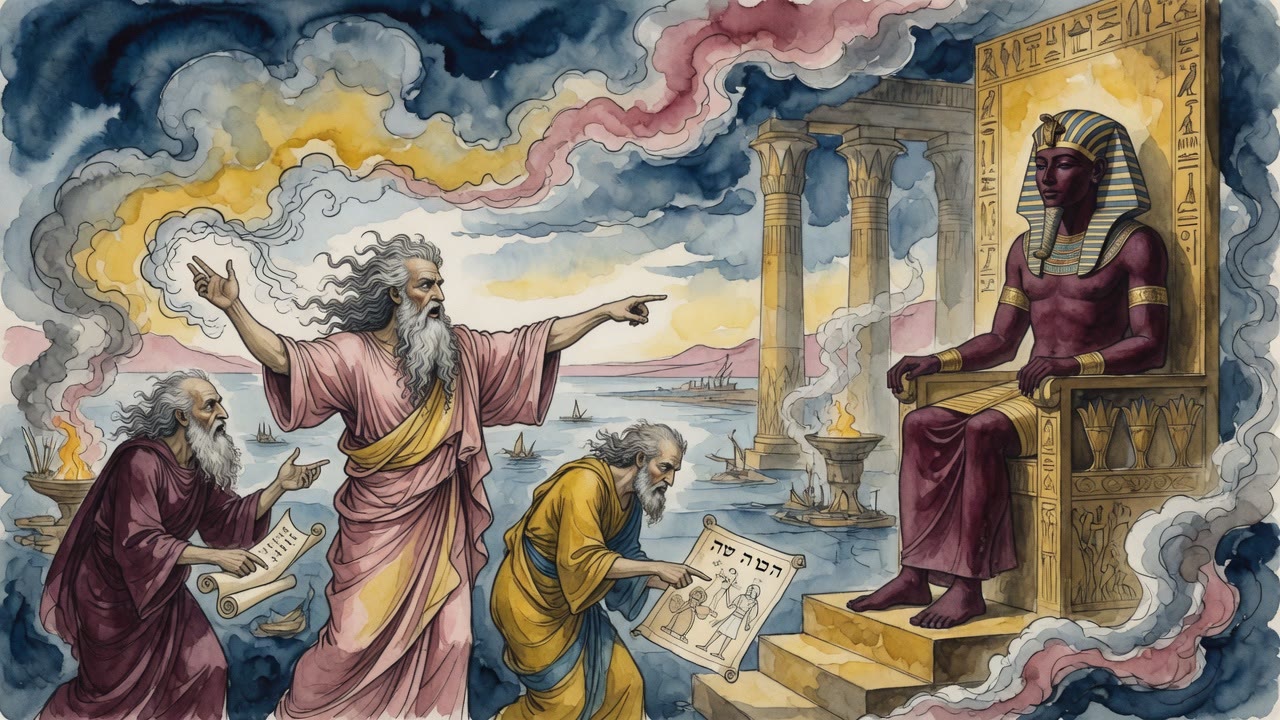
Pharaoh, riding up behind them, saw the same three sides and laughed. They are tangled in the land, he said. Their guide has loaded them up and has no idea where he is taking them. The wilderness has closed on them and my god Baal Zephon has penned them in with beasts.

Every one of those sentences prophesied something he had no intention of saying. The guide would in fact die on a mountain outside the land. The people would in fact weep all night in that wilderness after the scouts came back. Their bodies would in fact fall in it, forty years of them. He was reading out their future while he thought he was insulting them, and the beasts he credited to his idol had been posted in that sand by God.

Five Things He Shouted at the Water

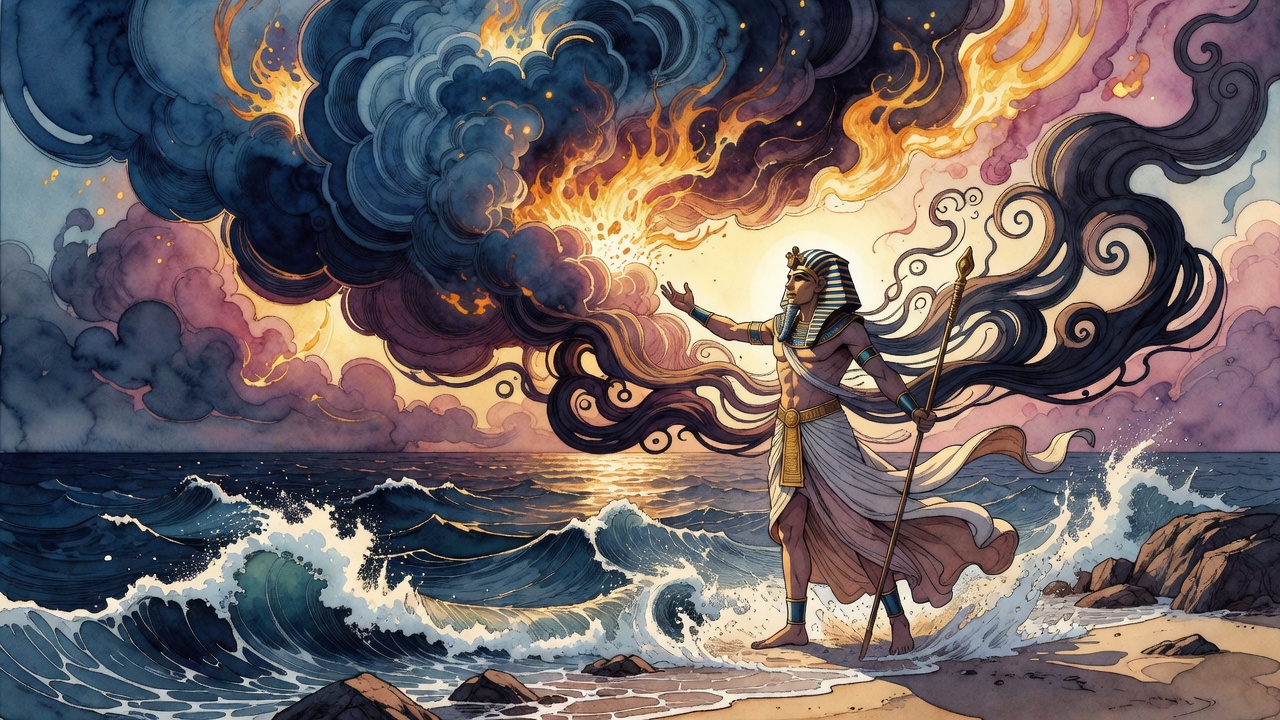
Five times he opened his mouth on that shore, and the spirit of holiness stood over him and mocked every one.

I will pursue. I will overtake. I will divide the spoil. My desire will have its fill of them. I will draw my sword and my hand will dispossess them.

He should have said we, the way a commander speaks. He said I five times, and the words came apart in his mouth as he said them, because each one can be turned around and read the other way. He is the one who gets pursued. He is the one who gets caught. The spoil is what they divide, and it is his. They are the ones who take their fill, and they take it from him. My hand will dispossess them was, read the second way, a will. He was standing on the beach reciting the terms by which his wealth and his glory passed to the people he was chasing, and he shouted his own drowning at the water five times before he rode into it.

Who is the Lord that I should listen to his voice, he had asked years earlier, in a throne room, with an audience.

He found out at the water.

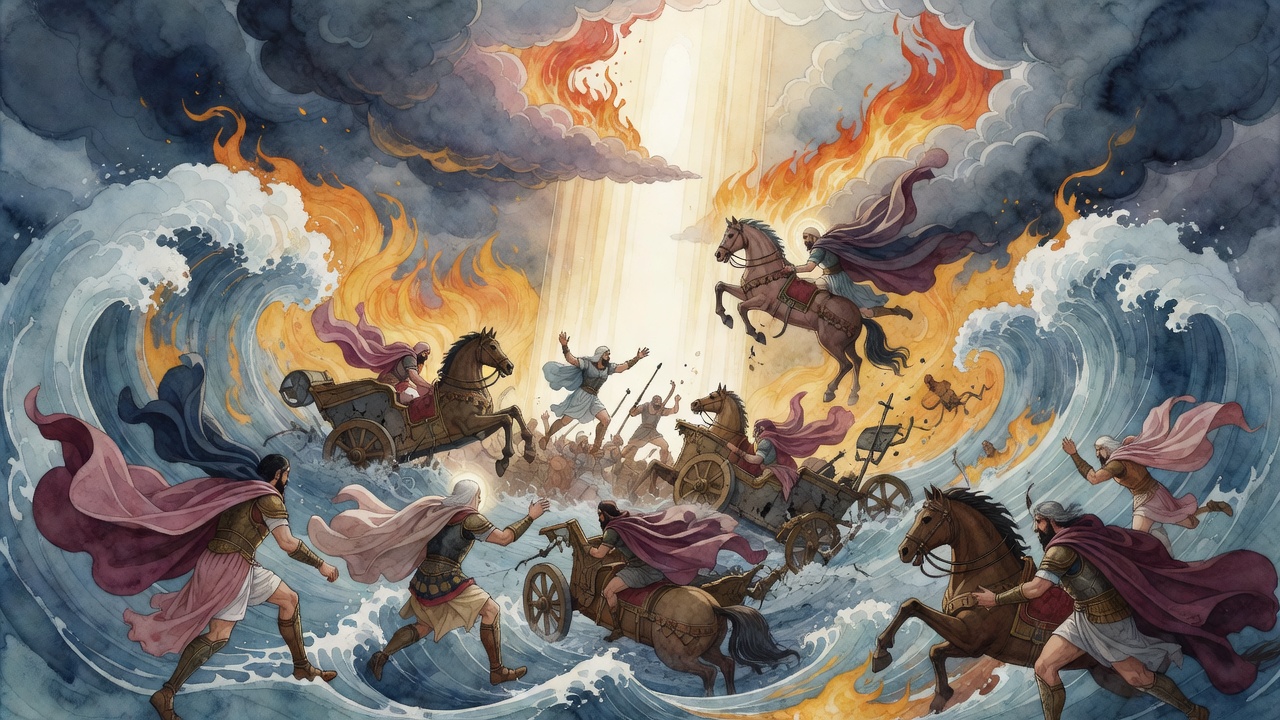
He had ordered every newborn boy thrown into the river. His chariots and his army were thrown into the sea. He had set his best officers over the work gangs with whips. The choicest of his officers went down in the Sea of Reeds. He had made their lives bitter with mortar and brick, so the water over them thickened and pulled like mortar, and they went down in it the way a man goes down in mud, the way Jeremiah sank in the pit and could not get his feet under him.

There was no deep water at that crossing. It was a sandbank, a shallow shelf a man could walk across. The lower deep came up anyway and the upper deep came down anyway and the two of them met over the Egyptians and fought them with every kind of ruin at once. The sky went black over their heads. Sun, moon and stars all shut off together. Jonah went down into one deep. These men went down into two.

Lead, Stone and Straw

The water sorted them as it took them.

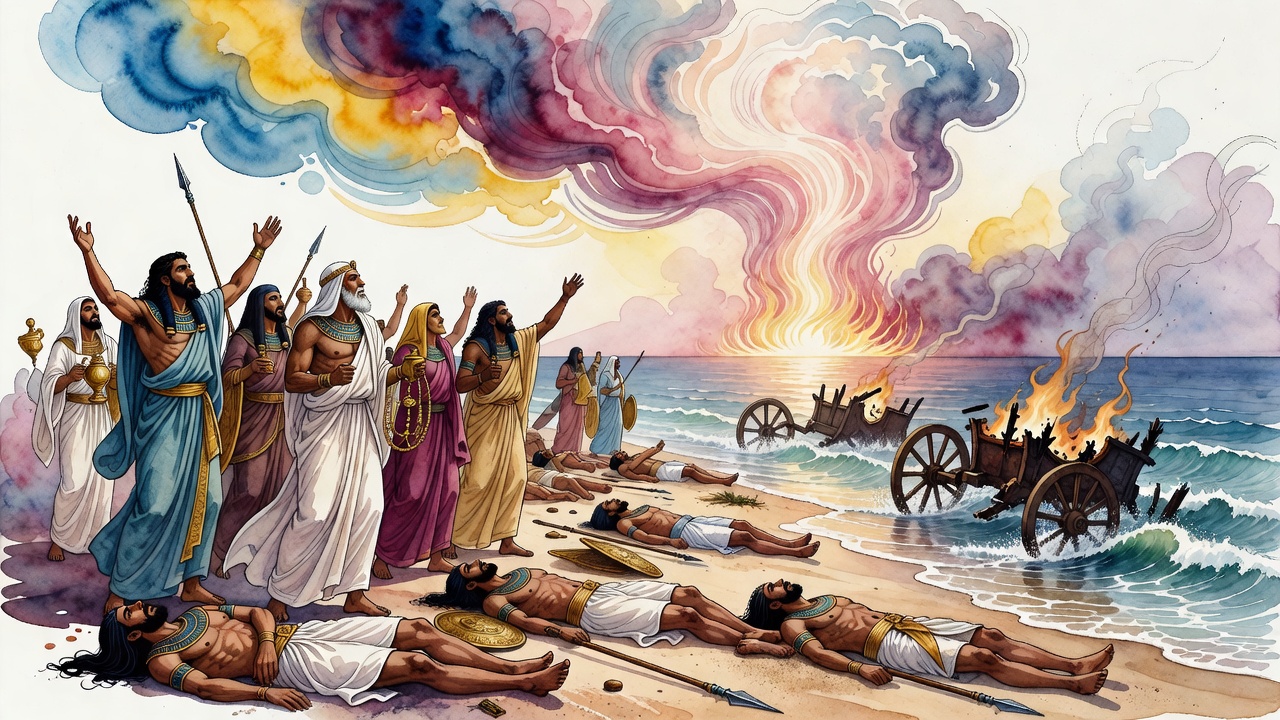
The worthier ones among them were tossed along the surface like straw. The middling ones went down like stones. The worst of them dropped straight through the mighty waters like lead, fast, without turning over.

On the far shore the spoil was divided, exactly as he had promised his soldiers it would be.


← All myths
From the tradition

Sources

4 sources

The texts behind this telling. Some cards carry a translation of the source; others are our own retelling of it, and each card says which. Every card links out to the original.

Mekhilta DeRabbi Shimon Ben Yochai 14:3Mekhilta DeRabbi Shimon Ben Yochai

Translation of the source text.Mechilta de-Rabbi Simon b. Jochai, ed. D. Hoffmann, Frankfurt 1905 · Public Domain

"And Pharaoh will say of the children of Israel, They are confounded in the land" (Exodus 14:3). "Confounded [nevuchim]" means nothing other than bewildered, as it is said, "How the beast groans! The herds of cattle are confounded" (Joel 1:18). Another interpretation: "confounded" means nothing other than thrown into confusion, as it is said, "And the city of Shushan was confounded" (Esther 3:15). Another interpretation: "confounded." Pharaoh said, "Moses has led them astray and does not know where he is leading them"; "Nevo" refers to Moses, as it is said, "Go up this mountain of the Abarim, Mount Nebo" (Deuteronomy 32:49). Another interpretation: "confounded." Pharaoh said and did not know what he was saying, that Israel were destined to weep [yivku] in the wilderness, as it is said, "And all the congregation lifted up their voice, and the people wept that night" (Numbers 14:1).

"The wilderness has shut them in." Pharaoh said and did not know what he was saying, that Israel were destined to fall in the wilderness, as it is said, "In this wilderness your carcasses shall fall" (Numbers 14:29). Another interpretation: "The wilderness has shut them in." Pharaoh said, "Baal-Zephon has gathered wild beasts against them, and they will not let them pass." And so it was: once Israel saw the sea shutting them in and the enemy pursuing, they lifted their eyes to the wilderness, and the Holy One, blessed be He, gathered wild beasts against them, and they would not let them pass, as it is said, "The wilderness has shut them in." "Shutting in" means nothing other than a wild beast, as it is said, "My God sent His angel and shut the mouths of the lions" (Daniel 6:23).

Full source
Mekhilta DeRabbi Shimon Ben Yochai 15:4Mekhilta DeRabbi Shimon Ben Yochai

Translation of the source text.Mechilta de-Rabbi Simon b. Jochai, ed. D. Hoffmann, Frankfurt 1905 · Public Domain

"Pharaoh's chariots and his army He cast into the sea." By the measure with which he measured, You measured back to him. He said, "Who is the LORD that I should obey His voice?" (Exodus 5:2); You too showed them Your fear and Your dread at the Sea, "Pharaoh's chariots and his army He cast into the sea." He said, "Cast every newborn son into the river" (Exodus 1:22); You too measured back to them in that same measure, "Pharaoh's chariots and his army He cast into the sea." He said, "and officers over all of them" (Exodus 14:6); You too measured back to them in that same measure, "and his chosen officers were sunk in the Sea of Reeds."

Because it is said, "And they made their lives bitter with hard labor, in mortar and in bricks" (Exodus 1:14), You too hardened the water upon them like clay, and they sank into it; for "sinking" applies only to mire, as it is said, "And Jeremiah sank in the mire" (Jeremiah 38:6), and it says, "I have sunk in deep mire, and there is no foothold" (Psalms 69:3).

Full source
Mekhilta DeRabbi Shimon Ben Yochai 15:5Mekhilta DeRabbi Shimon Ben Yochai

Translation of the source text.Mechilta de-Rabbi Simon b. Jochai, ed. D. Hoffmann, Frankfurt 1905 · Public Domain

"The deeps covered them." Were there deeps there? Rather, it teaches that the lower deep rose and covered them and darkened the firmament over them and dimmed the luminaries over them. And so it says, "All the bright lights of heaven I will darken over you, and I will set darkness over your land, says the Lord GOD" (Ezekiel 32:8-9), and it says, "For the stars of heaven and their constellations will not give their light; the sun will be dark at its rising, and the moon will not shed its light... I will punish the world for its evil" (Isaiah 13:10-11), and it says, "At Tehaphnehes the day shall be dark when I break the yoke-bars of Egypt" (Ezekiel 30:18). Another interpretation: "the deeps covered them", were there deeps there? Was it not a sandbank? Rather, it teaches that the lower and the upper deep rose and made war upon the Egyptians with every kind of calamity. Jonah went down to one deep, as it is said, "the deep surrounded me" (Jonah 2:6); but they went down to two deeps, as it is said, "the deeps covered them."

"They went down into the depths." Were there depths there? Was it not a sandbank? Rather, it teaches that the Great Sea was broken open into it and made war upon them with every kind of calamity. Jonah went down to one depth, as it is said, "You cast me into the depth" (Jonah 2:4); but they went down to two depths, as it is said, "They went down into the depths."

"Like a stone." This is the middling group among them. The fittest among them were tossed about like straw; the middling like a stone; the wicked sank like lead in the mighty waters. Another interpretation: "like a stone", he said, "and look upon the birthstones" (Exodus 1:16); You too hardened the water upon them like stones, and they were struck upon the place of their own stones. Another interpretation: "like a stone", because they hardened their hearts like stones. But You, in Your kindness and goodness and abundant mercy, and with Your right hand that is extended to all who come into the world, as it is said, "For Your right hand and Your arm and the light of Your face, because You favored them" (Psalms 44:4).

Full source
Mekhilta DeRabbi Shimon Ben Yochai 15:9Mekhilta DeRabbi Shimon Ben Yochai

Translation of the source text.Mechilta de-Rabbi Simon b. Jochai, ed. D. Hoffmann, Frankfurt 1905 · Public Domain

"The enemy said" (Exodus 15:9). This is actually the beginning of the passage, except that there is no earlier or later in the Torah [events are not always recorded in chronological order]. Similarly you find: "And it came to pass on the eighth day that Moses called" (Leviticus 9:1) is the beginning of that account, except that there is no earlier or later in the Torah. Similarly: "In the year that King Uzziah died" (Isaiah 6:1) is the beginning of that book, except that there is no earlier or later in the Torah. Similarly: "Go and cry in the ears of Jerusalem" (Jeremiah 2:2) was the beginning of that book, except that there is no earlier or later. Similarly: "Son of man, stand upon your feet, and I will speak with you" (Ezekiel 2:1), and some say, "Son of man, put forth a riddle and speak a parable concerning the land of Israel" (Ezekiel 17:2) was the beginning of that book. Similarly: "Israel is an empty vine, he brings forth fruit for himself" (Hosea 10:1) was the beginning. Similarly: "I, Koheleth, was king over Israel in Jerusalem" (Ecclesiastes 1:12) was the beginning of that book, except that there is no earlier or later in the Torah. Another interpretation: "The enemy said." And from where did Israel know what Pharaoh was plotting against them back in Egypt? The Holy Spirit rested upon them, and they knew what Pharaoh was plotting. What did Pharaoh say to his armies? He said to them, "Even if you pursue Israel only for the silver and gold we lost from them, it is worth our while." When part of the people heard this they said, "Enough; let us not pursue Israel," until he said to them, "Behold, we are all equal in the spoil."

Another interpretation: Pharaoh spoke and did not know what he was saying: "The preparations of the heart are man's, but the answer of the tongue is from the LORD" (Proverbs 16:1). He should have said, "We will pursue, we will overtake," but he did not say so; rather, "I will pursue, I will overtake" -- pursued and overtaken shall he be by them. He should have written, "I will divide their spoil," but it is not so written; rather, "I will divide spoil" -- the spoil shall be divided to them. It is not written, "my desire shall be filled with them," but "my desire shall be filled of them" -- they shall fill their desire from him. It is not written, "my hand shall dispossess them," but "my hand shall dispossess for them" -- I bequeath my wealth and honor to them. Another interpretation: Pharaoh said to them: "In the past you would plunder property, and I held you back because of royal custom; now, 'I will divide spoil.' In the past you would kill among them, and I held you back because of royal custom; now, 'my desire shall be filled.' In the past you sought to violate their sons and daughters, and I held you back because of royal custom; now, 'I will draw my sword, my hand shall dispossess.'"

In three companies the Egyptians came upon Israel. One said, "Let us take their money but not kill them." One said, "Let us kill them but not take their money." One said, "Let us kill them and take their money." The one that said, "Let us take their money but not kill them" -- "I will divide spoil." The one that said, "Let us kill them but not take their money" -- "my desire shall be filled." The one that said, "Let us kill them and take their money" -- "I will draw my sword, my hand shall dispossess." Five things did the wicked Pharaoh stand and blaspheme in Egypt: "The enemy said, I will pursue, I will overtake, I will divide spoil, my desire shall be filled, I will draw my sword, my hand shall dispossess." And against each of them the Holy Spirit mocked him.

Full source