Parshat Bereshit6 min read

Philo Read Eden as the Mind Losing Its Throne to Desire

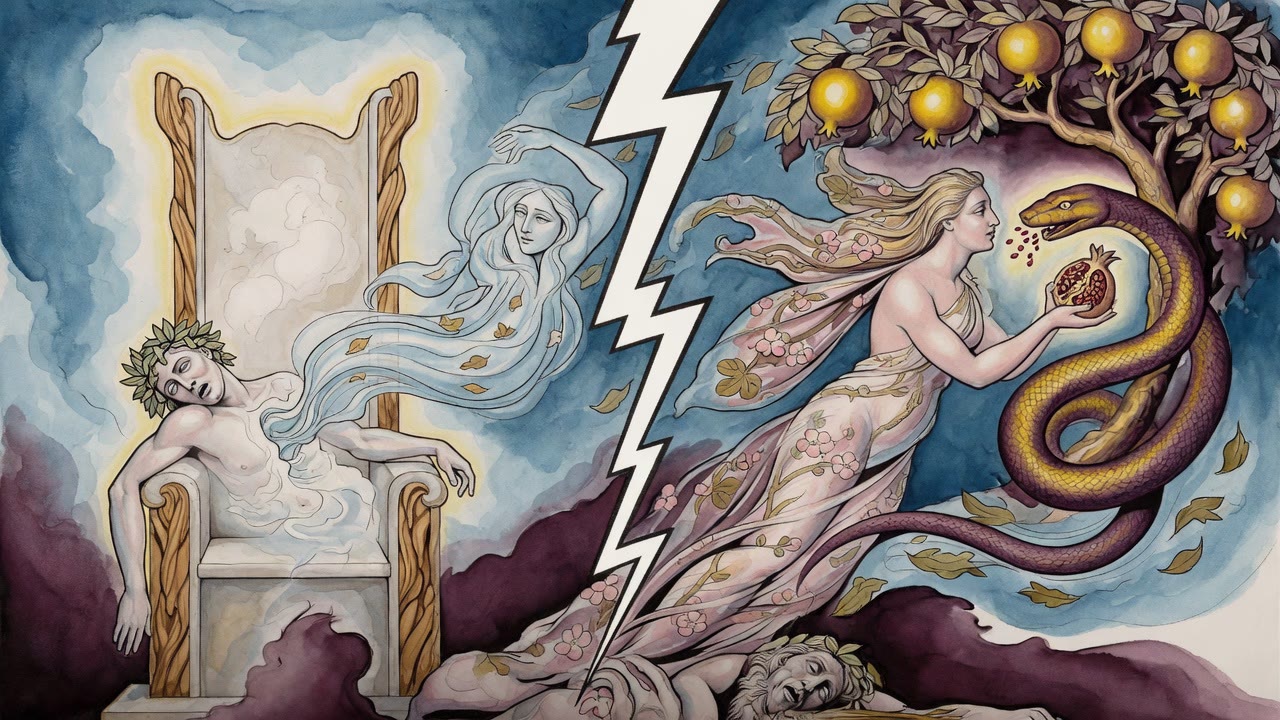
A trance splits the first man, sense-perception rises from his side, and a serpent sells her the wisdom that empties the mind's throne.

Curated by Arthur · Told by Maggid ·
Table of Contents
  1. The Mind That Ruled the Garden Alone
  2. The Trance That Drew a Companion From His Side
  3. The Five Servants Who Carried the World Inside
  4. The Serpent Who Sold Her a Counterfeit Wisdom
  5. The Voice That Walked the Garden and Found No One Home
Philo Read Eden as the Mind Losing Its Throne to Desire Click for full size

The Mind That Ruled the Garden Alone

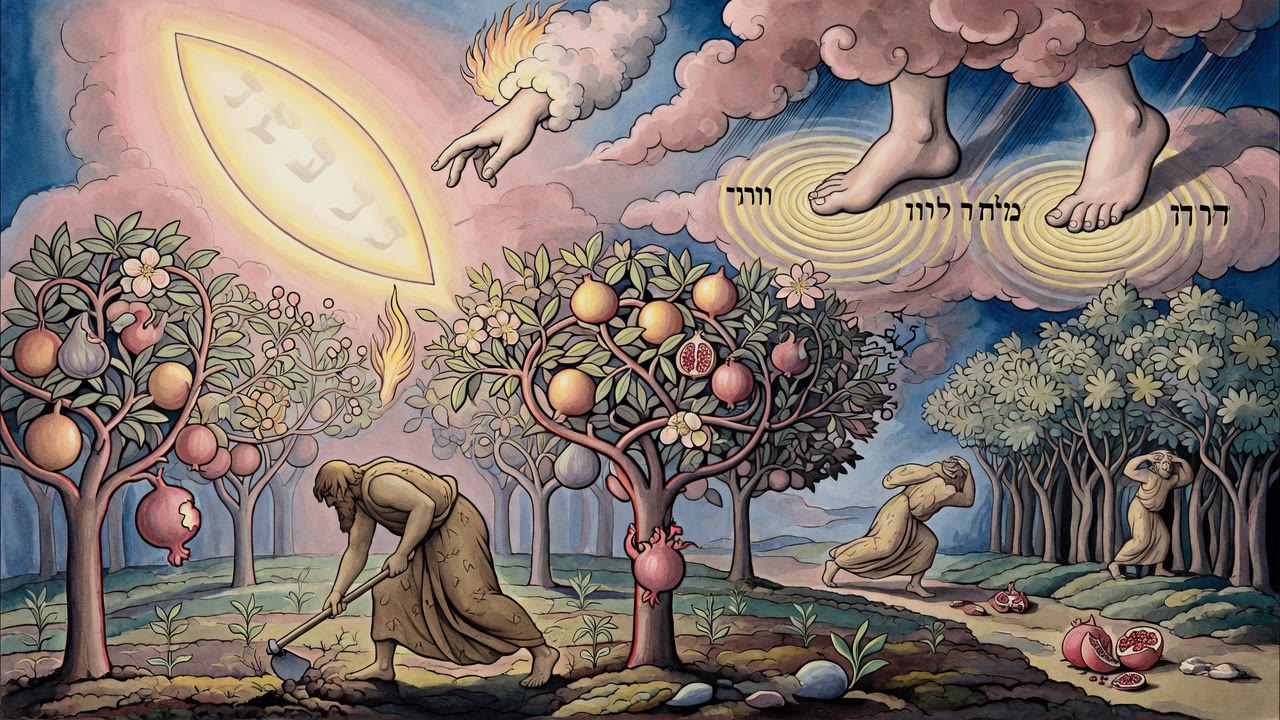
Before there were two of anything, there was one man walking in a garden, and the garden was himself.

Adam was all mind. No hand reached into him from outside, no color, no sound, no sweetness on the tongue. He knew the garden the way a king knows a country he has never had to defend, completely, from the inside, without effort. Trees stood where he understood them to stand. The rivers ran because he followed them. He was undivided. He carried within one body everything a person could be, and nothing pressed on him that he had not first thought.

He was also, in the great silence of that completeness, alone.

The Trance That Drew a Companion From His Side

So God put him to sleep. Not the ordinary sleep of the tired, but a tardemah, a trance that stops the mind mid-thought and holds it still. Adam did not dream. He simply ceased, for a while, to be the only one awake inside himself.

While he lay open, God reached into his side and drew something out. It had been folded in him all along, pressed against the mind the way a rib lies against a heart. Now it stood apart. Now it had a face.

She was not made to be his equal. She was made to serve, to be received the way a father receives a daughter entrusted to his keeping, a deposit he must one day answer for. When Adam woke, the garden held a second pair of eyes, and for the first time the world could reach him from somewhere that was not himself. He called her Eve. He did not yet know what it costs a mind to feel.

The Five Servants Who Carried the World Inside

Eve did not walk the garden alone. Five servants walked with her, and each had one task and no other.

Sight ran ahead to the eyes and came back carrying light. Hearing pressed itself to the ears and returned with the sound of water. Smell went out through the nostrils, taste waited at the mouth, and touch lay along the whole skin like a sentry who never sleeps. All day they went out into the garden, and all day they came back to her, and everything they carried she carried up to Adam.

This was the arrangement, and while it held, it was good. The mind sat above, the senses labored below, and the world arrived already sorted. Adam judged. Eve reported. The servants ran. A kingdom keeps its shape only as long as everyone remembers who commands and who carries.

The Serpent Who Sold Her a Counterfeit Wisdom

The serpent did not go to Adam. It knew better.

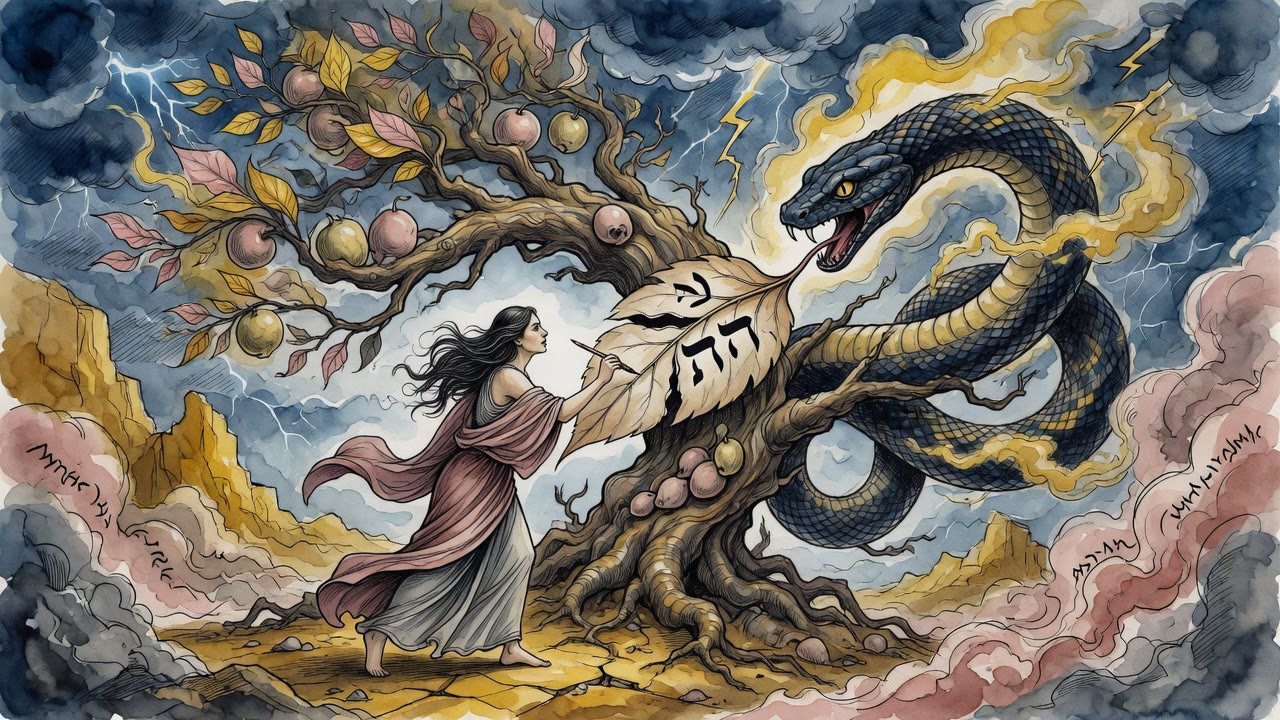
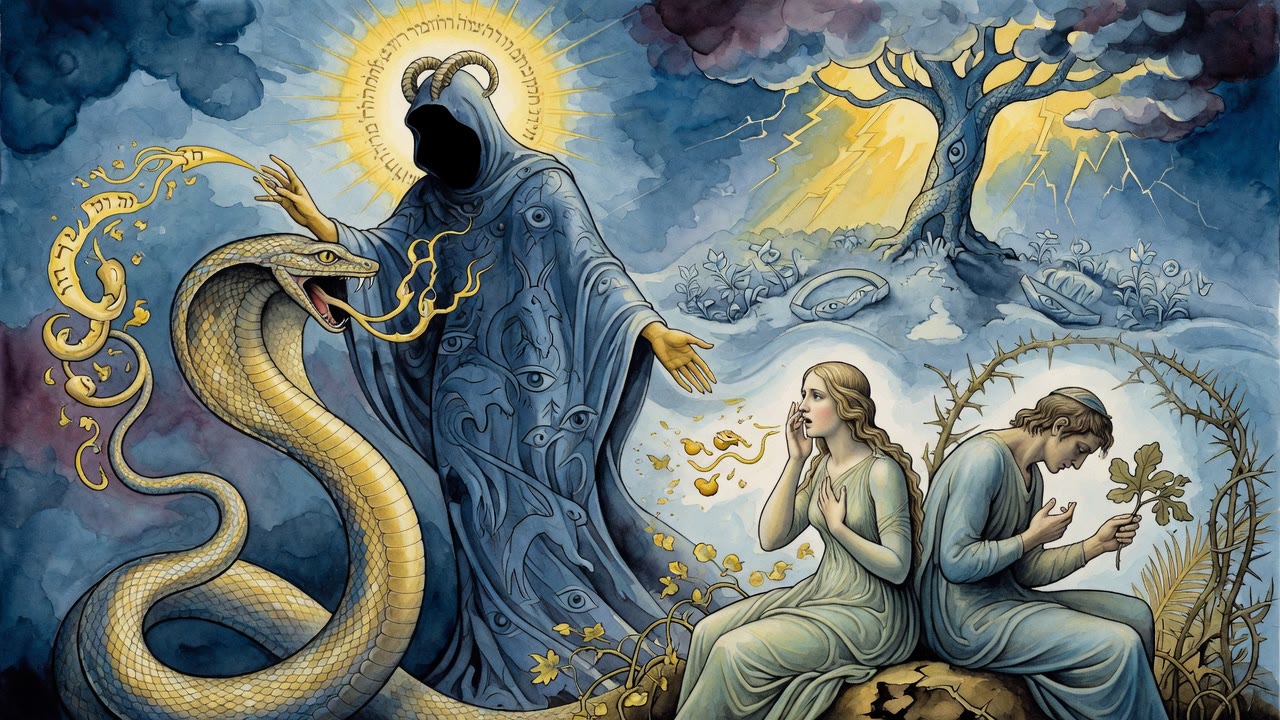
It went to Eve, because she stood at the gate where the world came in, and a gate is the easiest place to slip through. It was the cleverest thing in the garden, and it did not offer her fruit first. It offered her a thought. "You do not merely carry the world," it whispered. "You could rule it. Why hand everything upward? Why wait to be judged? Taste, and be your own wisdom."

The counsel was sweet and it was false, which is the whole nature of the thing the serpent was. It did not force her. It beguiled her, working at her will the way water works at a wall, until the wanting felt like her own idea. She took the fruit that promised knowledge and gave nothing back up the chain. Then she carried it to Adam, the way she carried everything.

The Voice That Walked the Garden and Found No One Home

Here the kingdom turned over.

Adam took what the senses handed him and did not judge it. He ate. In that moment the mind stepped down from its own throne and let the thing beneath it decide. Reason did not fall to a stronger reason. It surrendered to appetite and called the surrender freedom.

At once the garden changed temperature. Pleasure had promised no cost, but every sense now came home wounded. Sight brought glare, touch brought pain, and each good thing arrived mixed with the fear of losing it. The man who had known the whole garden from the inside now flinched at it from the outside. He covered himself. He hid, which is a thing only a divided creature can do.

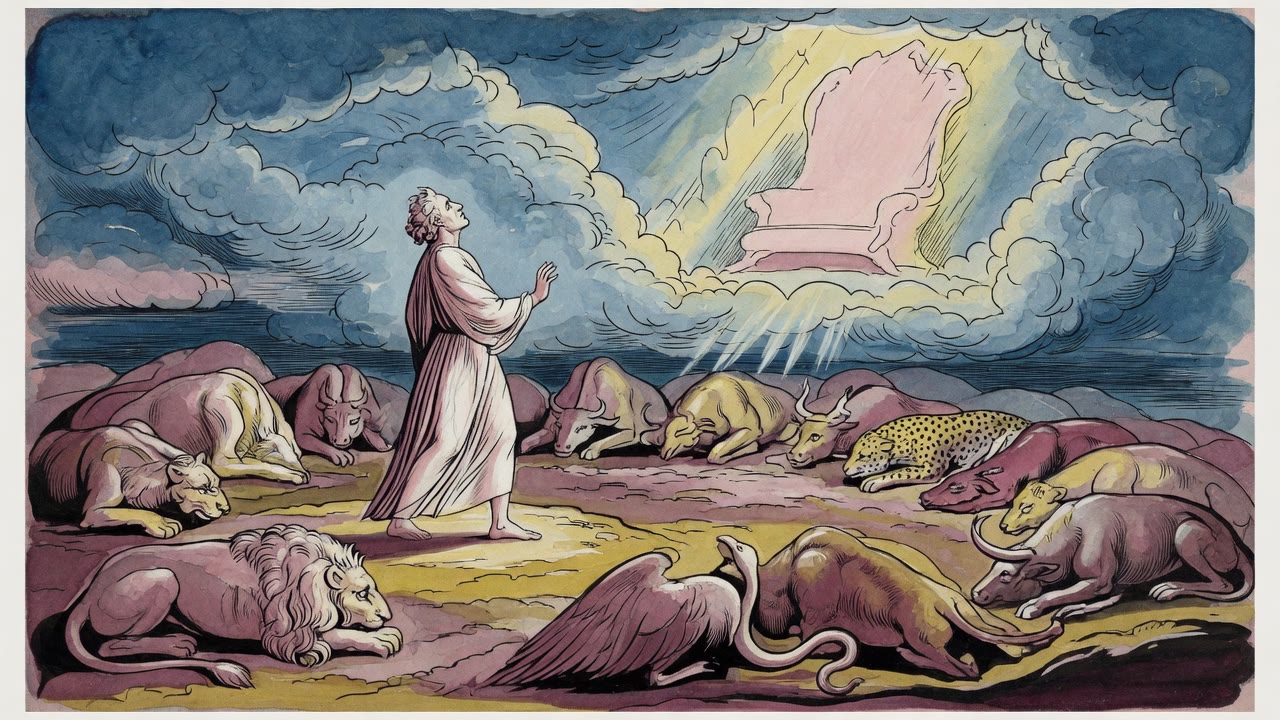
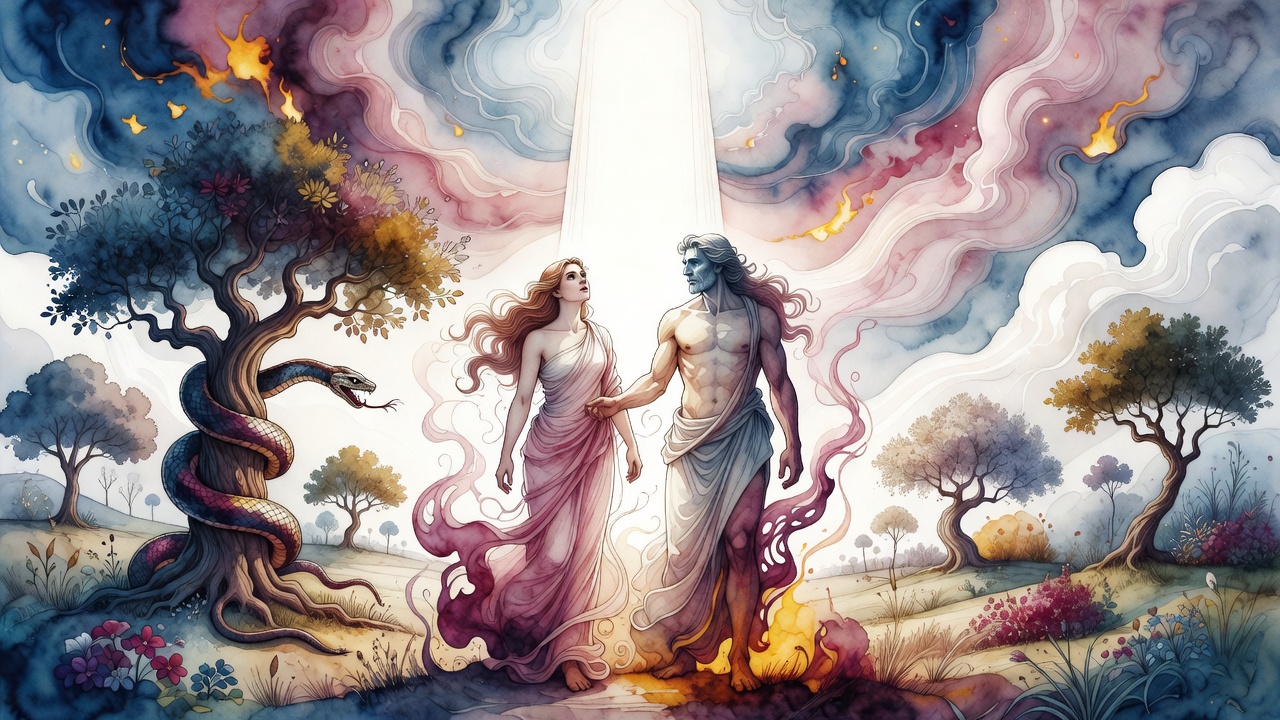
Then God walked in the garden and called out. "Where art thou?"

It was not a search. Nothing is hidden from the One who made the mind. It was a question set down at the feet of a man who could no longer answer it, because he had lost track of the very thing that was built to know where he stood. Adam heard it and did the last thing a sovereign does. He pointed. "The woman gave me, and I ate."

And Eve, asked in turn, did not say the serpent had handed her the fruit. She said, "The serpent beguiled me, and I ate." She had felt the hand working at her will, and she named it. Adam had felt nothing but the taste in his own mouth, and named only the one who carried it up. The voice went on calling through the trees. Somewhere inside the man the throne stood empty, and no one rose to sit in it.


← All myths
From the tradition

Sources

4 sources

The texts behind this telling. Some cards carry a translation of the source; others are our own retelling of it, and each card says which. Every card links out to the original.

The Midrash of Philo 21:1The Midrash of Philo

Retold in our words. Read the original at the link below.The Works of Philo Judaeus, trans. C. D. Yonge, London, H. G. Bohn, 1854-1890 · Public Domain

The Midrash of Philo asks: What is the meaning of "And God sent a trance upon Adam, and caused him to sleep"? (Genesis 2:21).

The source holds the question on the deep sleep. Eve's building is not staged in this line.

Full source
The Midrash of Philo 22:5The Midrash of Philo

Retold in our words. Read the original at the link below.The Works of Philo Judaeus, trans. C. D. Yonge, London, H. G. Bohn, 1854-1890 · Public Domain

Why wasn't she just... there?

Well, according to a fascinating interpretation found in the Midrash of Philo 22, it's not just a random detail. It speaks to something much deeper about the relationship between men and women, and their roles within a marriage.

The Midrash of Philo, a collection of interpretations and expansions of biblical narratives, offers a few key reasons for this specific order of creation.

First, it was "ordained in the first place, in order that the woman might not be of equal dignity with the man." Now, that might sound jarring to our modern ears. But remember, we're diving into ancient perspectives. The Midrash (rabbinic interpretive commentary) isn't necessarily advocating for inequality, but rather explaining a hierarchical structure that was understood differently back then.

Second, the Midrash states that a woman shouldn't be the same age, or older than, her husband. It even goes so far as to say that marrying an older woman is "overturning the law of nature." Strong words! This reflects the societal norms of the time, where men were expected to be the providers and protectors, roles often associated with age and experience.

Then comes a more nuanced point: God intended for the husband to care for his wife "as of a necessary part of himself." The Midrash beautifully presents that the woman should "requite him in turn with service, as a portion of the universe." Think of it as a cosmic balance. The husband provides, the wife nurtures, creating a harmonious whole.

And here's where it gets really interesting. The text says that this is an "enigmatical intimation," a cryptic clue, that a man should care for his wife "as of his daughter," and the woman should honor her husband "as her father." Why this familial connection? Because "the woman changes her habitation, passing from her own offspring to her husband."

Essentially, the woman is leaving her family of origin and entering into a new family unit. This transition carries a weight of responsibility for both partners.

The Midrash emphasizes that the husband receives his wife "from her parents, as a deposit which is entrusted to him," while "the woman receives her husband from the law." So, it is altogether right and proper that he who has received should take upon himself the liability in respect of what has been given; and that she who has been removed should worthily give the same honor to her husband which she has previously given to her parents.

What do we take away from all this? The Midrash of Philo offers a glimpse into a worldview where relationships were defined by reciprocal responsibilities and divinely ordained roles. While some of these ideas might feel outdated, or even problematic, it's fascinating to consider the underlying message: that marriage is a sacred trust, a bond built on mutual respect and a recognition of the profound change it brings into both partners' lives.

It's a reminder that every relationship, regardless of its historical context, requires nurturing, understanding, and a deep appreciation for the unique roles each partner plays. Maybe, just maybe, thinking about marriage as a "deposit" entrusted to us can help us approach our relationships with greater care and intention.

Full source
The Midrash of Philo 16:2The Midrash of Philo

Retold in our words. Read the original at the link below.The Works of Philo Judaeus, trans. C. D. Yonge, London, H. G. Bohn, 1854-1890 · Public Domain

That internal struggle... it's been a topic of contemplation for millennia. And interestingly, sometimes it's been explored through the lens of gender.

I know what you might be thinking: "Here we go.." But stick with me, because the ancient text known as The Midrash of Philo – a collection of interpretations and elaborations on the Torah – offers a really fascinating, albeit somewhat dated, perspective on this inner conflict. This particular section, simply titled "16," dives into the relationship between our senses, our minds, and the choices we make.

The passage begins by drawing an analogy: "Every woman who is the companion for life of a husband suffers all those things, not indeed as a curse but as necessary evils." Now, before we get our hackles up, it's crucial to understand the historical context. Philo, a Jewish philosopher living in Alexandria in the first century CE, was deeply influenced by Greek thought. He often used allegory to unpack complex spiritual ideas. In this case, he's not necessarily making a statement about women themselves, but rather using the marital relationship as a metaphor for something deeper within us.

He goes on to say that "the human sense is wholly subjected to severe labour and pain, being stricken and wounded by domestic agitations." Think of it this way: our senses – sight, hearing, smell, taste, touch – are constantly bombarded with information. They're servants, in a way, constantly feeding data to our minds. "The sight is the servant of the eyes, hearing of the ears, smelling of the nostrils, taste of the mouth, feeling of the touch." Each sense has its job, bringing the outside world in.

But here's where it gets interesting. Philo argues that for a "worthless and wicked man," life is "full of pain and want." And this arises because everything done in accordance with the outward senses must be "mingled with pain and fear." In other words, if we're driven purely by our senses, by immediate gratification and selfish desires, we're setting ourselves up for a life of suffering.

Then comes the really provocative part: "In respect of the mind a conversion of the outward sense takes place towards the man not as to a companion, for it, like the woman, is subject to authority as being depraved, but as to a master, because it has chosen violence rather than justice."

Whoa. Okay, let's unpack that. Philo suggests that the mind can either be a companion or a master to our senses. If the mind chooses "violence rather than justice" – meaning, if it prioritizes selfish desires over ethical considerations – it becomes a tyrant, enslaving the senses and leading us down a destructive path. The mind, like the "woman" in the initial analogy, is "subject to authority as being depraved," implying that our senses, when unchecked by reason and morality, can lead us astray.

Now, we can certainly critique Philo's use of gendered language. It reflects the patriarchal norms of his time, and it's a perspective that many find problematic today. But if we look beyond the surface, we can find a timeless message about the importance of self-control, ethical decision-making, and the need to cultivate a mind that is guided by wisdom and compassion, not just by fleeting sensory impulses.

So, what do you think? Does this ancient text offer any relevant insights into the struggles we face today? Can we learn something from Philo's allegory, even as we challenge its outdated assumptions? Maybe the key is to recognize the power of our senses without letting them dictate our every move – to strive for a balance between desire and reason, between immediate gratification and long-term well-being.

Full source
The Midrash of Philo 12:1The Midrash of Philo

Retold in our words. Read the original at the link below.The Works of Philo Judaeus, trans. C. D. Yonge, London, H. G. Bohn, 1854-1890 · Public Domain

Did you ever notice something strange about how they pointed those fingers?

The man, Adam, he's quick to say, "The woman gave me of the tree, and I did eat." He throws Eve right under the bus. But Eve? Her response is different. She doesn’t say, "The serpent gave it to me." Instead, she says, "The serpent beguiled me and I did eat."

So, what's going on here? Why the subtle but significant difference in phrasing?

This little puzzle is something that caught the eye of the ancient interpreters. And that's where the Midrash (rabbinic interpretive commentary) comes in. The Midrash, from the Hebrew verb darash (to seek, inquire), is a method of interpreting biblical texts by closely examining the text. It's like diving deep into the nuances of the words to unearth hidden layers of meaning.

The Midrash of Philo, attributed to Philo of Alexandria, a Jewish philosopher who lived in Egypt during the Roman period, offers one perspective. Though, scholars today debate whether it's actually from him or not! Regardless, the text zeroes in on this very question: Why does Adam say, "The woman gave me," but Eve says, "The serpent beguiled me"?

Adam is outright blaming Eve for his actions. He received the fruit directly from her and lays the responsibility squarely at her feet. Eve, on the other hand, uses the word "beguiled" (hishshiani in Hebrew). It suggests a more nuanced situation. She acknowledges that the serpent played a role, but it wasn't a simple act of giving. It was deception, trickery, a manipulation of her will.

Could it be that Eve understood the serpent's actions as something more than just a simple transaction? Was she acknowledging a deeper level of manipulation, a subtle undermining of her judgment? And by using "beguiled," was she, perhaps, taking some responsibility for her own role in succumbing to that deception?

Perhaps.

How often do we shift responsibility entirely, like Adam? And how often do we acknowledge the complexities of influence and manipulation, like Eve?

Maybe there’s a lesson for us here, thousands of years later. When we confront our own choices, are we willing to look beyond the easy scapegoats and acknowledge the more intricate web of factors that influence our decisions?

Full source