Parshat Bereshit6 min read

The Serpent Recruited to Speak Satan's Words in Eden

Satan flatters the serpent into becoming his mouthpiece, and Eve and a dying Adam each confess how one afternoon in Eden undid them all.

Curated by Arthur · Told by Maggid ·
Table of Contents
  1. The Envy That Went Looking for a Mouth
  2. The Angel Who Vanished by the Tree
  3. The First Oath Was Sworn to Satan
  4. Every Tree Shed Its Leaves but One
  5. What the Dying Man Told His Son
The Serpent Recruited to Speak Satan's Words in Eden Click for full size

The Envy That Went Looking for a Mouth

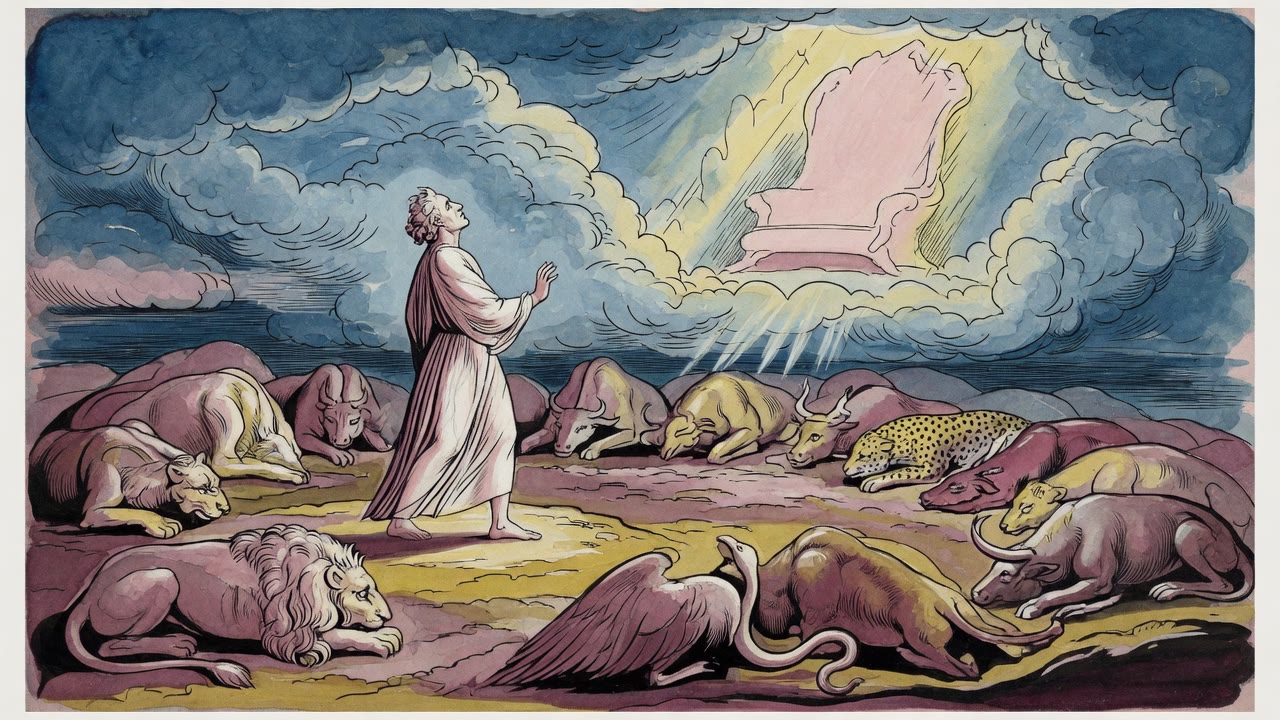
Every morning the beasts of the garden came to Adam and bowed. The lion lowered its head. The ox knelt. Even the serpent, the shrewdest of all the creatures God had shaped, bent low before the man made of dust. And someone was watching who could not stand the sight of it.
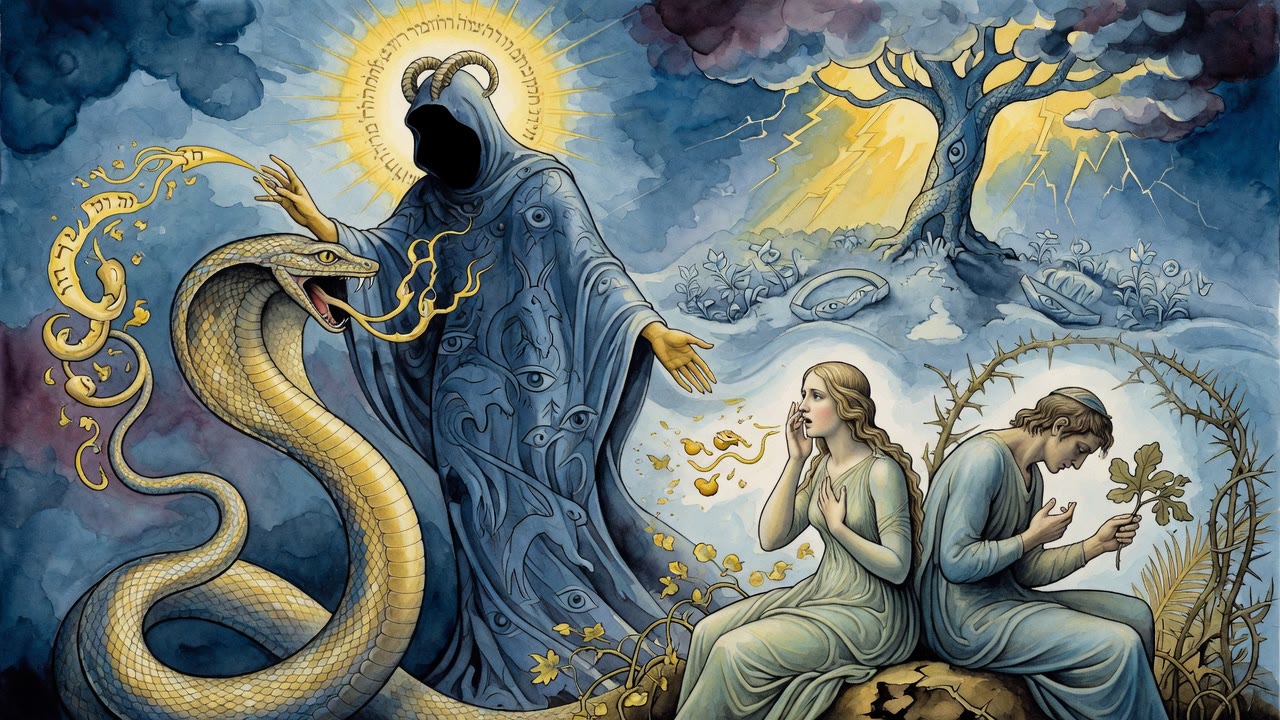
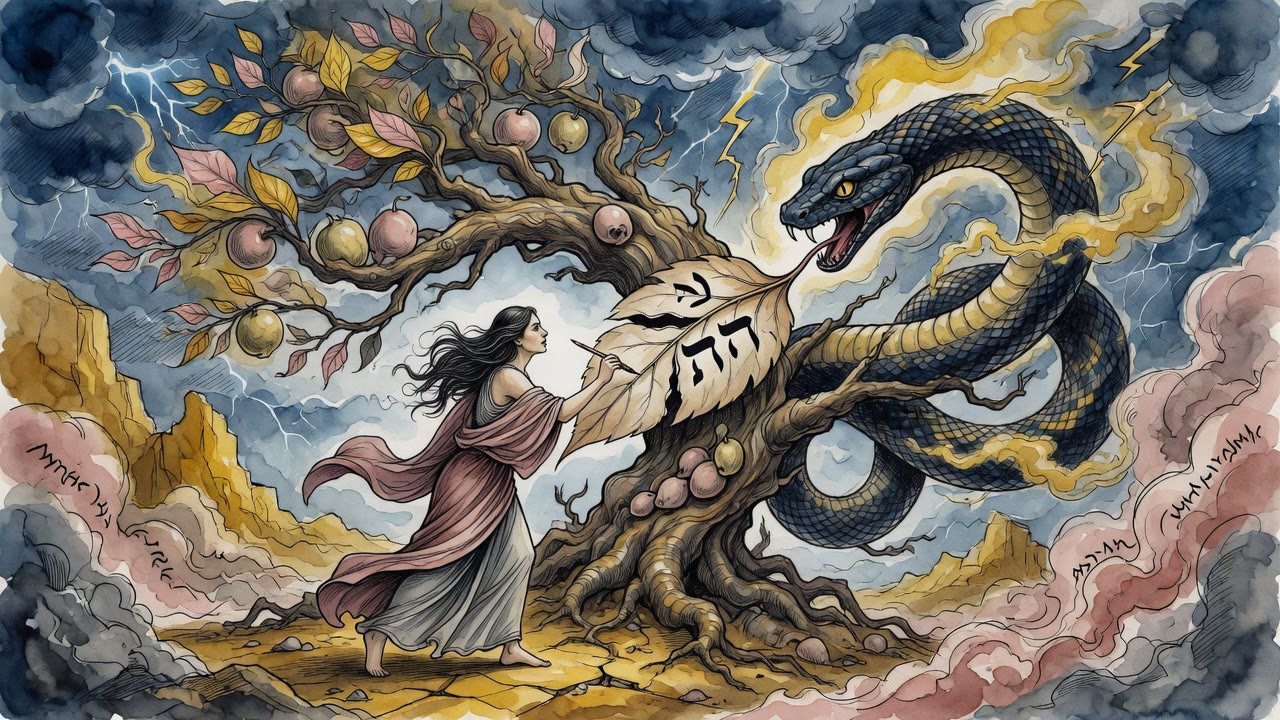
Satan waited until the others had scattered, then came to the serpent alone. "Arise and come to me," he said. "I will tell you something that will serve you well." He praised the creature the way flatterers do, calling it the cleverest animal in all of Eden, saying that was the very reason he had sought it out. Then he set the hook. "Why do you bow to Adam? You came into being before he did. He should be bowing to you. Rise up. Let us drive him out of the Garden together, and you will have your share in everything that follows."

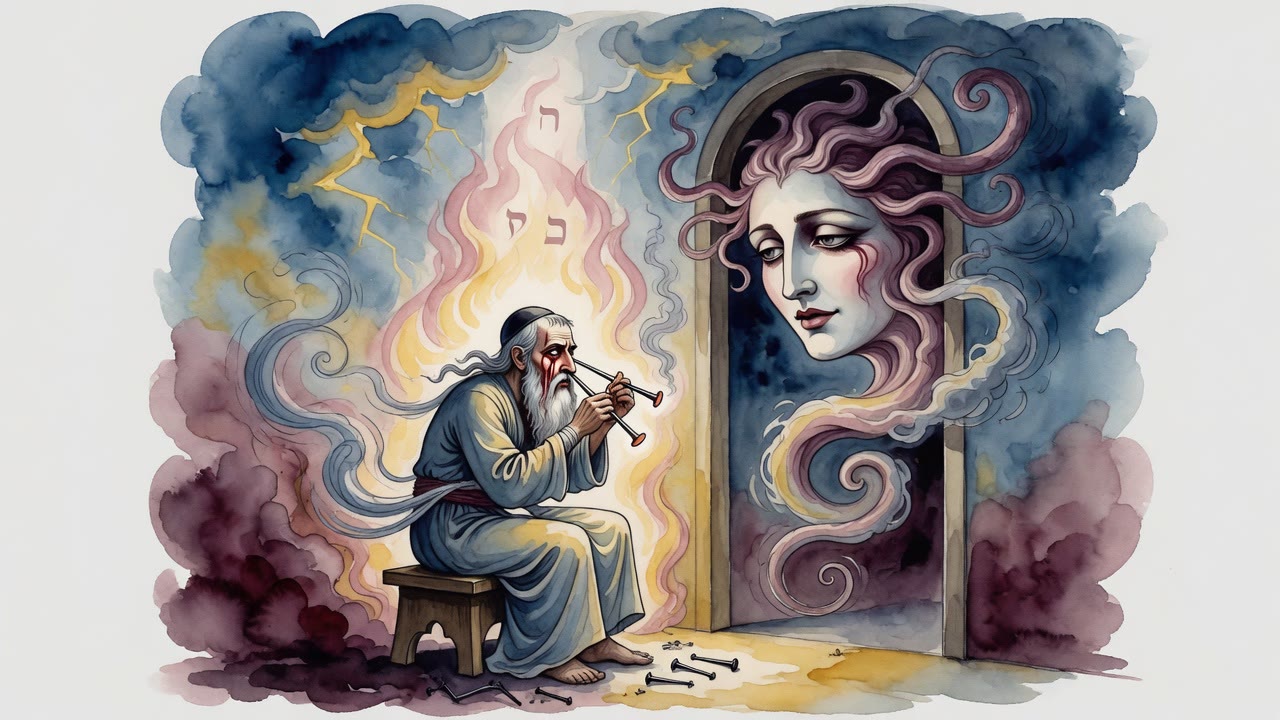
The serpent asked how such a thing could be done. Satan had his answer ready, and it was a strange one. "You will be a lyre for me," he said, "and I will speak my words through your mouth." The serpent would be the instrument. Satan would be the hand across the strings. Whatever came out would sound like the serpent's own voice, and no one would ever hear the player hidden behind it.

The Angel Who Vanished by the Tree

What happened next, Eve told her children long afterward, when she was old and Adam newly buried. She told it in the first person, the way you tell a thing you can never fully hand to anyone else.

"I heard a voice praising God in the tongue the angels use," she said, "and I knelt down to listen. I saw the likeness of an angel there, bright at the edge of the trees. Then I looked again and it was gone, and only the serpent was left, coiled where the light had been. It asked me why God had set us in the Garden, and what we were permitted to eat. I told it we ate from every tree but one, the tree in the middle, lest we die. It did not flinch. 'You will not die,' it said. 'God knows that on the day you eat of it, your eyes will open and you will become like God, knowing good and evil. That is why He deceived you.' And it showed me the glory that hung about the branches, a light I had never once let myself look at straight."

The First Oath Was Sworn to Satan

"I wanted it. I will not pretend otherwise. But I was afraid. 'The tree is beautiful to me,' I told the serpent, 'but I am afraid to touch it.' So I asked it to bring the fruit to me, as if that would make the sin smaller. Instead it bent the branches down to the ground, low enough that I had no excuse left in me.

"Even then I did not swallow at once. I bit through the skin only, and I waited to fall dead. Nothing happened. The whole garden held still. So I ate the rest. And before the juice was dry on my lips, the voice inside the serpent made me swear an oath, the first oath a human being ever spoke, that I would carry the fruit to Adam too. I swore it. I swore it not to God but to the thing hiding in the snake. Then the serpent uncoiled and was gone, and I stood alone with what I had done."

Every Tree Shed Its Leaves but One

"I looked down and I was naked, and I have never been so cold. I ran to the trees for leaves to cover myself, and every tree I reached had let its leaves fall. Every one. All but the fig, the tree whose fruit had ruined me. Only that tree would clothe me.

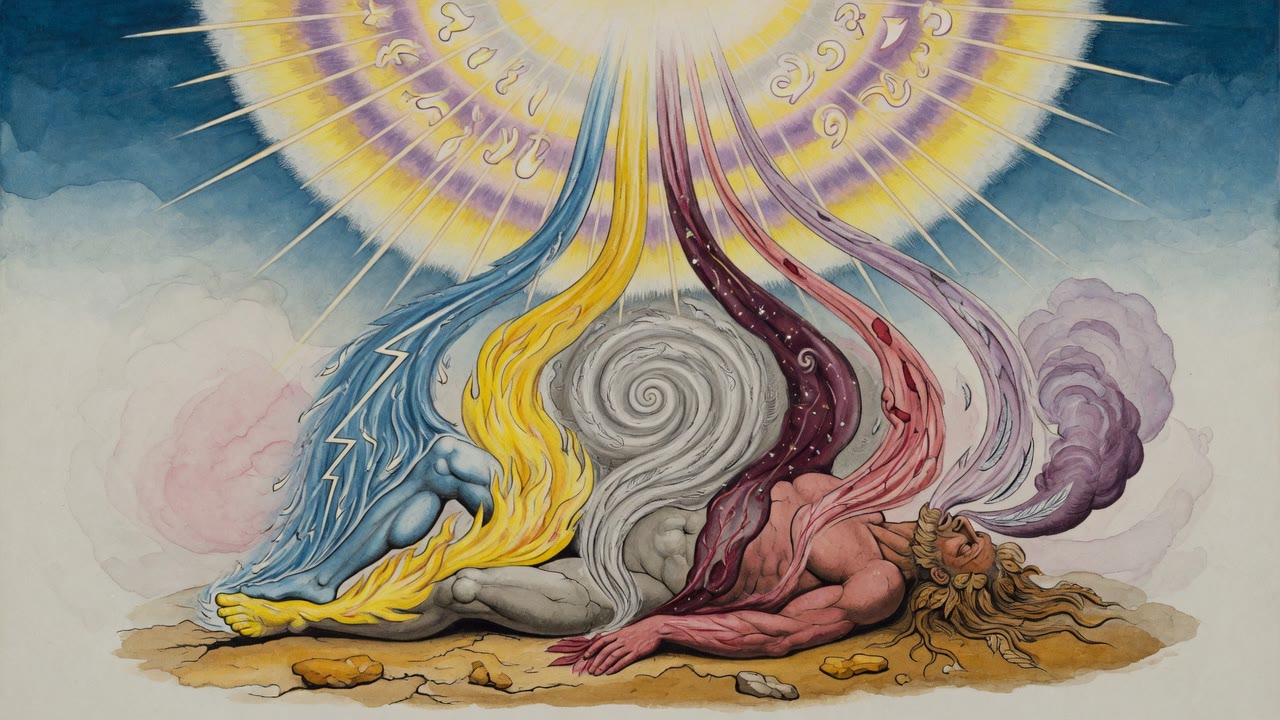
"Then I called Adam. I will not repeat the words I used to talk him into it. They were blasphemous words, and they worked, and let that be enough. He took the fruit from my hand. He ate. And the moment he swallowed he knew what he was, all of it at once, and he turned on me. 'You wicked woman,' he cried, 'what have you brought down upon me? You have cut me off from the glory of God.'"

What the Dying Man Told His Son

Years later, when Adam lay dying, he called Seth to his side and told the story once more, gently now, the way a father hands a hard thing to a son. "After your mother and I were made," he said, "God set us in Paradise. We were free to eat from every tree in the garden but one, the Tree of Knowledge that grew in the very center. That fruit alone was kept from us."

Then he told Seth a thing the boy had never known. God had divided the garden between them before any of it went wrong. "He gave me the trees of the east and the north," Adam said, "and your mother the trees of the south and the west. And He set two angels to guard us." Two angels. A whole garden. One rule. And still it had gone the way it went. Adam did not curse Eve at the end, and he did not curse the serpent. He only told his son where each tree had stood, as if the map of that lost place still burned behind his eyes.


← All myths
From the tradition

Sources

3 sources

The texts behind this telling. Some cards carry a translation of the source; others are our own retelling of it, and each card says which. Every card links out to the original.

Penitence of Adam 44:16:2-44:20:1Life of Adam and Eve

Retold in our words. Read the original at the link below.The Books of Adam and Eve, trans. L. S. A. Wells, in The Apocrypha and Pseudepigrapha of the Old Testament, vol. 2 (1913) · Public Domain

It starts with Satan approaching the serpent with a proposition. "Arise and come to me," Satan says, "I will tell you something that will serve you well." Flattery gets you everywhere, even in Eden! Satan lays it on thick, telling the serpent it’s the wisest, most cunning of all creatures. "That is why I have come to see you."

Here's a detail you might not know: According to this account, all the wild beasts, even the serpent, used to worship Adam every morning. "Why do you worship Adam?" he asks the serpent. "You came into being before he did. He should worship you! Come, rise up. Let us expel Adam from the Garden."

How? That's the question. And Satan has a plan, a rather theatrical one. "You will be a lyre for me," he tells the serpent, "and I will pronounce words through your mouth, so that you may be able to help." In other words, the serpent will be his mouthpiece.

The story gets even stranger. Satan transforms himself into an angel, praising God in angelic language. Eve, hearing this, kneels down to listen. She sees the likeness of an angel, but then…poof! He's gone. That's when Satan uses the serpent to approach Eve directly.

The serpent, now channeling Satan, asks Eve about her role in the Garden. She explains that God has forbidden them to eat from the tree in the middle, "lest we die." But Satan, speaking through the serpent, says, "No, you will not die! But when you eat of its fruit your eyes will be opened, and you will become like God, knowing good and evil. God deceived you!" He even points out the "glory" surrounding the tree, making it all the more tempting.

Eve hesitates. "The tree is pleasing to my sight, but I am afraid." She's even reluctant to pick the fruit herself! She asks the serpent to bring it to her. Instead, the serpent cleverly lowers the branches to the ground, making it easy for her to reach.

And here's a fascinating twist we also find echoed in the Midrash (Zekhor Hamor on Gen. 3:6): Eve isn't entirely convinced at first. According to some accounts, she first bites only the skin of the fruit. When nothing happens, she eats the rest. The Penitence of Adam emphasizes Eve's initial reluctance, showing her wrestling with the decision.

Before she eats, Satan makes Eve swear an oath – and this is a crucial point – the first oath ever made, and it's made to Satan, not to God, that she will share the fruit with Adam. It’s a subtle but powerful detail.

Once Eve eats the fruit, Satan has the serpent disappear, leaving Eve to deal with the consequences.

So, what does this version of the story tell us? It highlights Satan's manipulative nature, his ability to use deception and flattery to achieve his goals. The serpent, in this telling, is almost a tool, a pawn in Satan's game.

It also shows Eve as more than just a naive figure. She's hesitant, she's cautious, she even tries to mitigate the risk. She's not simply tricked; she makes a choice, albeit under immense pressure and manipulation.

This version of the Fall, found in texts like the Penitence of Adam (44:16:2-44:20:1) and elaborated upon in works like Ginzberg's Legends of the Jews, gives us a richer, more nuanced understanding of this pivotal moment in Jewish tradition. It also emphasizes the importance of oaths and to whom we make them. Who are we truly beholden to?

Does this version change your perspective on the story of the Garden of Eden?

Full source
Legends of the Jews 2:110Legends of the Jews

Retold in our words. Read the original at the link below.The Legends of the Jews by Louis Ginzberg (1909) · Public Domain

The familiar picture has Adam and Eve immediately ashamed, rushing to cover themselves. But what if the story is richer, stranger, and even more revealing about human nature than we imagine? According to Legends of the Jews, a collection of rabbinic stories and interpretations compiled by Louis Ginzberg, Eve gives us a first-person account of what happened next. And it's not pretty.

The serpent vanishes. Gone. Vanished from the tree as quickly as it appeared. Eve is now desperately searching for leaves, any leaves, to cover herself. But here’s the kicker – every single tree within her reach has shed its leaves. Stripped bare. Except one.

The fig tree. The very tree whose fruit had been forbidden to her. Or perhaps, divine orchestration?

What does Eve do? She summons Adam. And this is where things get truly interesting. Ginzberg's retelling paints a picture of Eve not simply offering the fruit, but actively persuading Adam with “blasphemous words.” What were these words? The text doesn't say directly, leaving us to wonder what arguments she used. Perhaps she downplayed the severity of God's command? Maybe she emphasized the potential for newfound knowledge and power? Whatever they were, they worked.

Adam eats the fruit.

And immediately, the realization hits him. He knows his "true condition." He’s no longer in a state of innocent bliss. He’s aware. He’s vulnerable. And he’s furious.

His reaction? He doesn't turn inward with shame. Instead, he lashes out at Eve. "Thou wicked woman," he cries, "what hast thou brought down upon me? Thou hast removed me from the glory of God."

Ouch. Talk about blaming the messenger!

This moment is so raw, so human. It’s a snapshot of blame, regret, and the immediate breakdown of innocence. Adam doesn't take responsibility; he points the finger. And in doing so, he echoes a pattern that, unfortunately, continues to this day.

What does this story tell us? It's not just about the loss of innocence. It's about the complexities of choice, the power of persuasion, and the all-too-human tendency to deflect blame when things go wrong. It's a cautionary tale, yes, but also a deeply insightful look into the human condition. And perhaps, a reminder to take responsibility for our own actions, instead of reaching for the nearest fig leaf.

Full source
Life of Adam and Eve 25-29Apocrypha

Retold in our words. Read the original at the link below.The Books of Adam and Eve, trans. L. S. A. Wells, in The Apocrypha and Pseudepigrapha of the Old Testament, vol. 2 (1913) · Public Domain

We don't often get to hear Adam's side of the story directly. But Jewish tradition, in its beautiful, layered way, offers us glimpses. One fascinating account, preserved in Howard Schwartz's anthologies of Jewish folklore, paints a poignant scene: Adam, on his deathbed, sharing his memories of the Fall with his son, Seth.

That moment. The weight of ages, the burden of choice, all condensed into a father's final confession.

"After your mother and I were created," Adam begins, "God placed us in Paradise." Simple enough. But think about the enormity of that statement. Placed in Paradise.

Adam continues, "We were permitted to eat from every tree in the garden, except for one, the Tree of Knowledge that grew in the center of the garden. We were forbidden to eat of its fruit." That one little rule. The one boundary. The one test.

The stakes couldn’t be higher. And then, a curious detail emerges. "Now God gave a part of Paradise to me and a part to your mother," Adam recounts. "He gave me the trees in the eastern and northern parts of the garden, and your mother received the trees of the southern and western parts." A division of labor, perhaps? Or a hint at different perspectives, different ways of relating to the bounty around them?

And the story continues, “So too did God give us two angels to guard us.”

Two angels! Adam and Eve weren't alone. They had divine protection, guidance...and yet, the story unfolds as we know it did.

What does this deathbed confession of Adam tell us? It's more than just a retelling of a familiar story. Of freedom, responsibility, and the enduring power of choice. And maybe, just maybe, a little bit of hope, passed down from father to son, even in the face of loss.

Full source