5 min read

Rabbi Tarfon Heard the Name Inside the Blessing

Rabbi Tarfon leaned close during the Temple blessing and heard the divine Name hidden inside the priests' chant, guarded by many voices.

Curated by Arthur · Told by Maggid ·
Table of Contents
  1. The Blessing Had a Hidden Center
  2. The Name Was No Longer Spoken Openly
  3. Tarfon Bent His Ear Toward the High Priest
  4. The Hands Rose Higher in the Temple
  5. The Blessing Still Reached Everyone

Rabbi Tarfon was young enough to lean in and old enough, later, to remember exactly what he had heard.
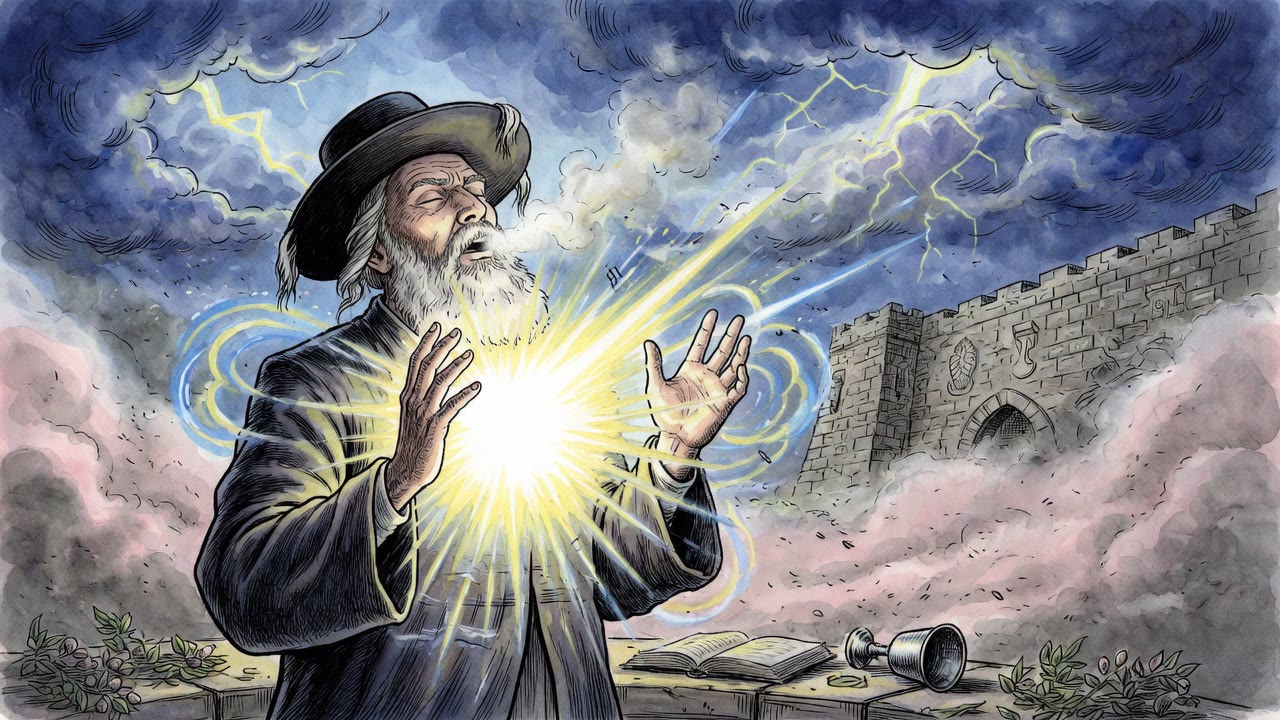
He stood among his brother priests in the Temple while the blessing rose over Israel. Hands were lifted. Voices moved together. The words were familiar, the priestly blessing given in the Torah, but inside the familiar words there was a sound ordinary places did not carry.

The divine Name was being placed on Israel. Not a title. Not a substitute. The Name as written, guarded because it was too holy to become casual speech.

The Blessing Had a Hidden Center

The priests blessed the people with three lines of mercy, protection, shining favor, and peace.

In the Temple, the blessing held more than the public heard. The Name itself stood at its center. Outside the Temple, the Name was pronounced by an appellation, a reverent replacement. Inside the dwelling place of God's Name, the fuller pronunciation could be used, because the place, the service, and the priests formed a vessel strong enough to hold it.

The blessing was not only speech over Israel. It was the placing of God's Name upon them.

The Name Was No Longer Spoken Openly

Even in the Temple, the sound had become dangerous.

The midrash says corruption increased, and the priests narrowed the practice. The Name was entrusted only to the circumspect, the ones whose caution matched the holiness of what they carried. Sacred knowledge can be lost by silence, but it can also be ruined by careless exposure. The priests chose concealment inside worship rather than publicity outside reverence.

So the Name was still said, but hidden. It passed through the service like a flame cupped against wind.

Tarfon Bent His Ear Toward the High Priest

Rabbi Tarfon knew where to listen.

He inclined his ear toward the High Priest while the other priests chanted. Their voices formed a screen. The Name moved within that screen, not shouted above it. Tarfon caught it because he was close, attentive, and already inside the line of priestly service. He did not seize a secret from the outside. He received a fragment from within the structure that protected it.

The memory stayed with him because some sounds are events. A word can enter the ear and change the shape of prayer forever.

The Hands Rose Higher in the Temple

The difference between Temple and outlying places showed even in the body.

Outside Jerusalem, the priests lifted their hands only to their shoulders. In the Temple they lifted them above their heads, except for the High Priest, who did not raise his hands higher than the frontplate that bore holiness to God. Gesture, place, and Name all had boundaries. The closer the service came to the center, the more carefully every motion was measured.

Holiness was not vague intensity. It was ordered nearness.

The Blessing Still Reached Everyone

The passage does not close the blessing around a narrow circle.

It asks who is included when God says He will bless them. The answer widens the room: converts, women, servants, priests, Israel, all those standing under the blessing that God Himself completes. The priests speak, but God blesses. The Name is guarded, but the blessing is not hoarded.

Rabbi Tarfon heard the hidden center, and the midrash made sure the center did not become a locked door. The holiest Name was protected so that the blessing attached to it could reach the people.

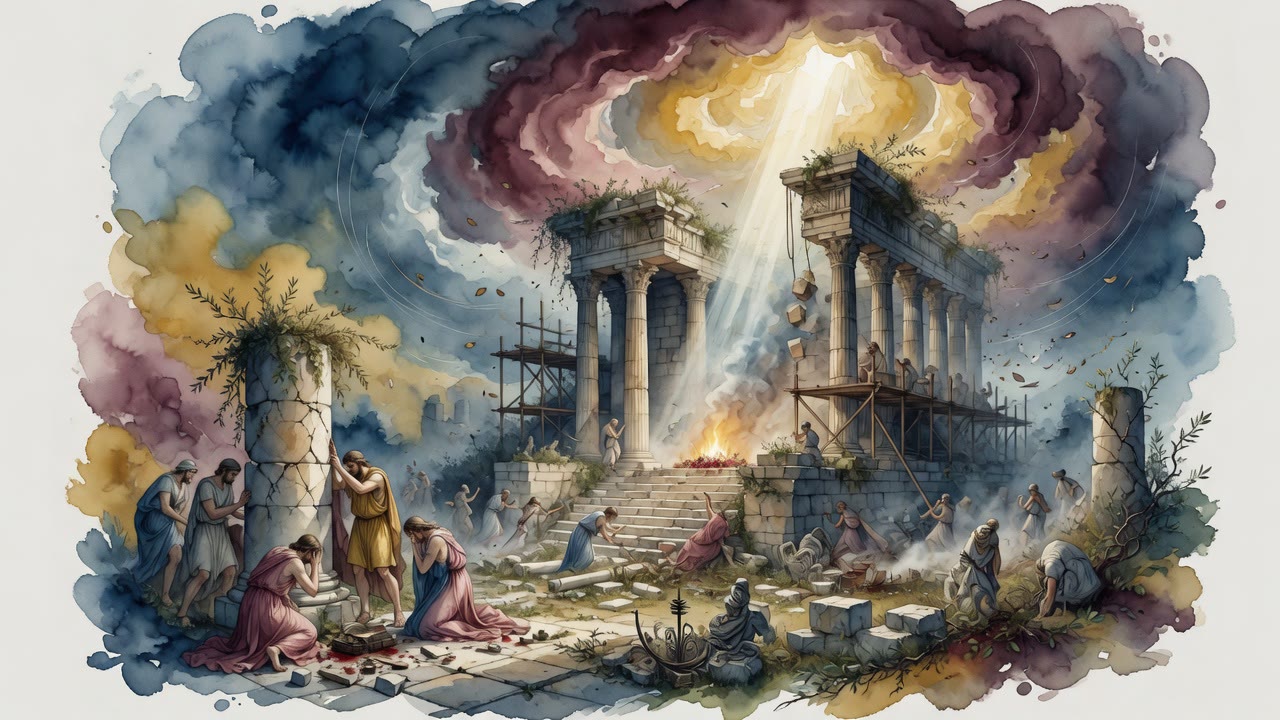
The scene also shows why memory mattered after the Temple's destruction. Rabbi Tarfon's recollection preserves a practice that could no longer be performed in the same way once the sanctuary was gone. The line of priests, the High Priest's guarded voice, the raised hands, and the gathered people all belonged to a place whose absence made every detail precious.

By telling what he heard, Tarfon does not make the Name common. He records the discipline that kept it from becoming common. The holy sound remains unnamed in the story, but the conditions around it are remembered with care. That restraint is part of the testimony. The midrash lets later generations know that the Name once moved through the blessing while still refusing to turn the Name into an object of display.

What survives is not pronunciation. What survives is reverence shaped into law, posture, place, and communal memory.


← All myths
From the tradition

Sources

6 sources

The texts this telling draws on, in full. Open a card to read inline, or expand it for a wider, quieter read.

Bamidbar Rabbah 11:8Bamidbar Rabbah

Protected, in ancient times.

The passage begins with a verse from (Numbers 6:27): “And they shall place My name upon the children of Israel, and I will bless them.” So, what does it mean to "place My name" upon someone? Bamidbar Rabbah interprets this to mean blessing the people with the ineffable Name of God. But the rabbis immediately ask: does this apply everywhere?

To answer that, they turn to another verse, this time from (Nehemiah 1:9): “To cause My name to dwell.” The text draws a parallel: just as the dwelling place of God's name is the Temple in Jerusalem, so too the full blessing with the ineffable Name was primarily associated with the Temple.

Here’s where it gets really interesting. As corruption increased, the priests began restricting the use of the Name, entrusting it only to the most circumspect among them. We even hear a story from Rabbi Tarfon: "There was an incident where I and my brethren the priests were in a line, and I inclined my ear toward the High Priest, and I heard that he recited it in the midst of the intoning of the priests." The High Priest was careful to ensure God's name wouldn't be casually overheard.

So, was the blessing with the Name limited only to the Temple? Not quite. The text quotes (Exodus 20:21): “In every place I mention My name, [I will come to you and I will bless you].” This suggests that God's blessing is available even in "outlying areas," outside the Temple. However, there's a difference in how the blessing was recited. In the Temple, the Name was recited as it was written, while in the outlying areas, it was recited with an appellation – a substitute or title. In the outlying areas the priests would also lift their hands only to their shoulders, whereas in the Temple they would lift their hands above their heads.

This distinction highlights the special sanctity of the Temple and the care taken in invoking the Divine Name.

But what about those who aren't born into the Israelite community? The text anticipates this question. The initial verse, (Numbers 6:23), says "So you shall bless the children of Israel," which seems to exclude converts, women, and slaves. But the verse continues, "And I will bless them." This "them," Bamidbar Rabbah explains, includes everyone.

And who blesses the priests? After all, they are bestowing blessings, but where do theirs come from? The answer, again, is in the verse: "And I will bless them.” The priests bless Israel, and God blesses both. As (Deuteronomy 15:6) says: “For the Lord your God has blessed you…”

This passage from Bamidbar Rabbah isn't just about ancient rituals. It's about the power and sanctity of God's name, the importance of intention and reverence, and the inclusivity of divine blessing. It reminds us that even today, the way we approach the sacred – whether through prayer, study, or acts of kindness – should be done with care, humility, and an awareness of the profound mystery we are engaging with. And maybe, just maybe, we'll catch a glimpse of that ineffable Name ourselves.

Full source
Megillat Antiochus 1:70Megillat Antiochus

The familiar story centers on the Maccabees, the brave Jewish warriors who fought against the oppressive decrees of the Seleucid king Antiochus. But what happened after they won?

Well, Megillat Antiochus, also known as the Scroll of Antiochus, gives us a glimpse into that immediate aftermath. It's a relatively short text, believed to have been composed sometime in the early Middle Ages. It’s not considered part of the biblical canon, but it’s a valuable historical narrative that fills in some of the blanks.

The scroll tells us that after their victories, the Ḥashmonaim – that's the family name of the Maccabees – entered the Beit HaMikdash, the Sanctuary, in Jerusalem. Can you imagine the scene? After all the fighting, the destruction, the desecration... They had so much work to do!

The text emphasizes their dedication to restoring holiness. They repaired the gates, patched up the breaches in the walls, and, crucially, cleansed the hall of the dead and all its impurity. This wasn't just about fixing a building; it was about restoring the spiritual heart of Judaism. They were reclaiming their sacred space.

And then comes the part we all know and love, the miracle of the oil. They searched for pure olive oil to light the Menorah, the sacred lampstand. Finding ritually pure oil was essential. According to Megillat Antiochus, they found only a single, small vessel. It was sealed with the seal of the Kohen Gadol, the High Priest, guaranteeing its purity. But here's the catch: it only held enough oil for a single day.

Think about the implications. To relight the Menorah, to rededicate the Temple, was paramount. But they faced a daunting problem. What to do?

And here's where the miracle comes in. Megillat Antiochus states plainly: "But the God of Heaven Who caused His presence to dwell in the Sanctuary, gave His blessing and it sufficed to light the Menorah eight days."

That's it. Simple, direct, powerful. It wasn't just a lucky coincidence. It was a divine act, a clear sign of God's favor and presence. God, whose Shekhinah, divine presence, dwelled in the Sanctuary, made the impossible possible.

The story, as related in Megillat Antiochus, reminds us that even after great victories, the work of restoration and dedication continues. And sometimes, when we face seemingly insurmountable challenges, a little bit of faith – and a little bit of oil – can go a long, long way. It's a story not just of military triumph, but of faith, resilience, and the enduring power of the divine.

Full source
Mekhilta Tractate Vayehi Beshalach 6:5Mekhilta DeRabbi Yishmael

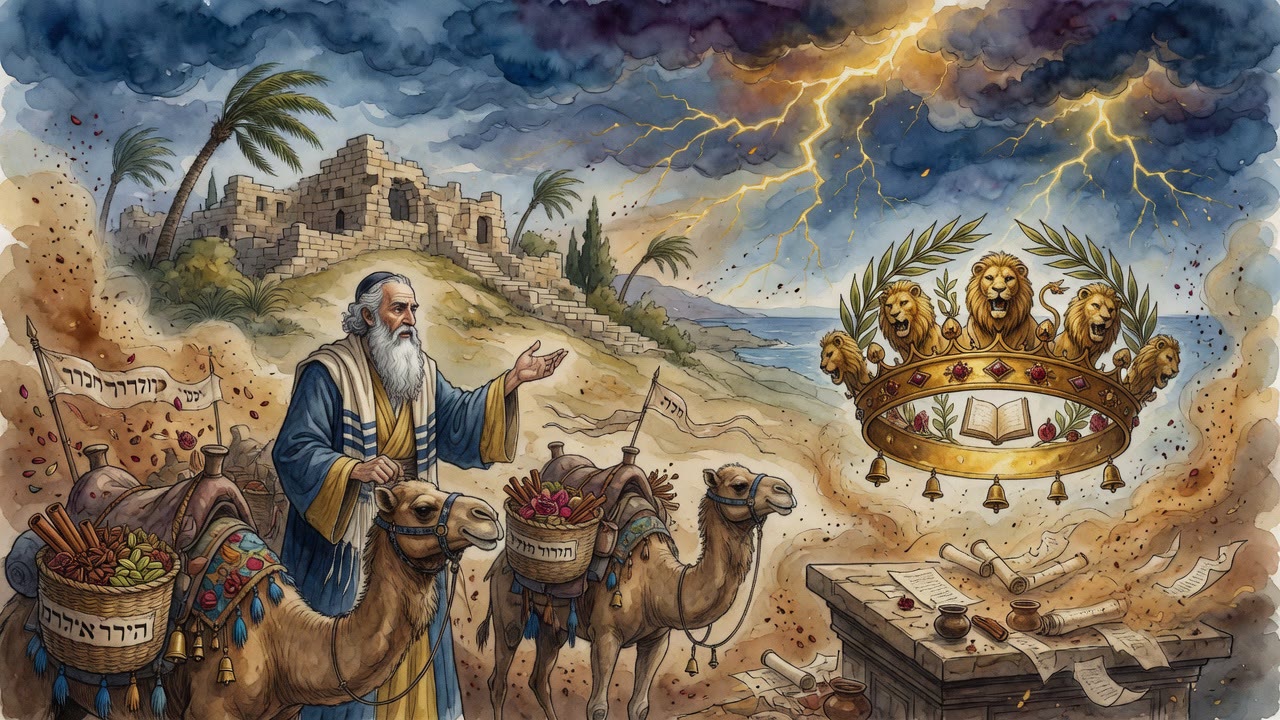
R. Tarfon and the elders were once sitting in the shade of the grove of Yavneh when this question was once asked before them: Why need it be written (Genesis 37:25) "and their camels laden with spices, balm, and myrrh"? (He answered:) To apprise us of the extent to which the merit of the righteous comes to their aid. For if this "loved one" (Joseph) had gone down with (the usual wares of) the Arabs, would he not have died of the stench of the camels and the itran (a kind of resin)? But the Holy One Blessed be He "arranged" for him (a transport of) sacks full of spices and all goodly fragrances so that he not perish of their stench. (At this,) they said to him: You have taught us, our master, that this transpired in the merit of Joseph. They asked him: Our master, what is the blessing for one who drinks water to slake his thirst? He answered: "Who creates manifold beings and (supplies) their wants. (We thank you for) all that You have created. Life of the worlds!" They: You have taught us, our master, the blessing for one who drinks water to slake his thirst. Our master, in what merit did Judah attain to kingdom? R. Tarfon: You say. They: In the merit of his saying (Genesis, Ibid. 26) "What profit is it if we kill our brother, etc." by which he saved him from death. R. Tarfon: It suffices that this saving atone for his counsel to sell Joseph and not return him to his father.

Full source
Kiddushin 71aHebraic Literature (1901)

There was a time, the sages taught, when the Divine Name of twelve letters was taught openly to anyone who came to learn. A student could carry it home the way he carried any other piece of Torah.

Then the antinomians began to multiply, those who used holy knowledge for unholy ends. And the teachers grew cautious. The name was entrusted only to the most discreet among the priestly families, and even they began to swallow it. During the priestly blessing in the Temple, one priest would pronounce the Name so rapidly, so softly, that the congregation's own singing covered the sound. Rashi, centuries later, admits that by his own day no one remembered what the twelve letters had been.

Once, Rabbi Tarphon told the story this way: "I was standing in the Temple courts, close to the high priest. While the other priests were blessing the people, I leaned in and listened very carefully, and I heard the high priest pronounce the hidden Name." He had pressed his ear against a door that only the discreet are allowed to open.

The lesson is not that sacred knowledge must be hoarded, but that not every tongue is ready to carry it. A Name too powerful for a careless heart is protected by silence, not by lock and key.

(From the 1901 Hebraic Literature anthology, drawing on Kiddushin 71a.)

Full source
Petichah LeChokhmat HaKabbalah 3:1Petichah LeChokhmat HaKabbalah

Kabbalah, the Jewish mystical tradition, offers a fascinating answer. The key, it suggests, lies in the will to receive.

In Petichah LeChokhmat HaKabbalah, the difference isn't about location, but about the state of this will to receive. As long as the desire to receive, which is latent within God's shefa (divine flow or abundance), hasn't fully manifested, it remains in the higher, spiritual worlds. These worlds are considered loftier, more refined, than our own.

Think of it like potential energy. The possibility is there, but it hasn't yet been released. The shefa is flowing, but the vessel to fully contain and experience it isn't yet complete.

What happens when that will to receive does fully materialize? That's when, Kabbalistically speaking, we enter the realm of "this world." This world, then, is the arena where the will to receive is expressed in its most complete – and perhaps most challenging – form.

How does this process of manifestation occur? Kabbalah teaches that it unfolds according to a specific order, mirroring the structure of the Tetragrammaton, the four-letter name of God: Yod-Heh-Vav-Heh (יהוה).

Why this name? Because, as the verse states, these four letters encompass all of reality, down to the smallest detail. Nothing is excluded. The Yod-Heh-Vav-Heh, in Kabbalistic thought, acts as a kind of blueprint, a divine template for creation and existence. The four letters represent stages in the unfolding and revelation of God's essence, and by extension, the manifestation of the will to receive.

So, the next time you ponder the divide between the spiritual and the material, remember this: it's not about physical distance, but about the degree to which the will to receive has taken shape. And that, perhaps, is a profound thought to carry with us as we navigate our own experience in this world.

Full source
Tikkunei Zohar 100:15Tikkunei Zohar

The Tikkunei (spiritual repair) Zohar, a central work of Kabbalah, is absolutely brimming with that feeling. a particularly intriguing passage.

" But hold on, what does that even mean? The Hebrew word for "my heart," libiy (לִבִּי), has a numerical value of 42. This isn't just wordplay; it's a doorway into a deeper understanding of how God's very essence is connected to redemption.

In this passage in the, Tikkunei Zohar, God used specific Names, combinations of Hebrew letters, to perform miracles and ultimately redeem the Israelites from Egypt. The Name A-V-G-Y-T-Tz (actually a permutation of letters), is associated with the Exodus itself. Then there's Q-R-’A S-T-N, the Name connected to the second day of creation and the splitting of the Red Sea. As it says in (Genesis 1:6), "Let there be a firmament in the midst of the waters…" That firmament, that separation, is tied to this powerful Name.

It doesn't stop there. N-G-D-Y-Kh-Sh is another Name, linked to the verse in (Exodus 34:10), "...in front of (neged) all your people, I shall do wonders.." Each of these Names, the Tikkunei Zohar suggests, was instrumental in enacting divine justice upon Egypt.

But here's the really fascinating part: redemption, according to this passage, hinges on the heart. As Kohelet Rabbah 1:36 states, "the heart sees." It's not just about intellectual understanding, but about a deep, visceral connection. The prophet Isaiah echoes this sentiment, declaring, "For a day of vengeance is in My heart..." (Isaiah 63:4). But vengeance with what? The text pointedly asks. With My heart...

And that "heart" leads us to another Name: Y-H, a shortened form of the Tetragrammaton, the unspeakable Name of God. (Psalm 150:6) proclaims, "Every soul will praise YaH." And (Exodus 17:16) adds, "...for a hand is upon the throne of YaH..."

So what's the takeaway here? It's not just about memorizing esoteric Names. It’s about understanding that redemption is a deeply personal and internal process, rooted in the very heart of both God and humanity. It’s about recognizing that the divine Names are not just abstract symbols, but active forces in the world, constantly working to bring about healing and transformation. The power to see these names lies within our hearts, within our ability to understand and find meaning within them.: The next time you encounter a seemingly obscure passage in Jewish text, remember that it might be a hidden key, waiting to unlock a deeper understanding of yourself, and the world around you. Maybe, just maybe, the secret to redemption lies within your own heart, too.

Full source