5 min read

Rav Yehuda Removed One Shoe and Rain Fell

In a drought fast, Rav Yehuda barely began the rite of removing a shoe before the sky opened, while later sages cried and the clouds stayed shut.

Curated by Arthur · Told by Maggid ·
Table of Contents
  1. The Shoe and the Sky
  2. Later Mouths, Closed Clouds
  3. Purity Before Volume
  4. Ships Under a Palace
  5. Rain as Answered Binding
  6. After the First Drop
Rav Yehuda Removed One Shoe and Rain Fell Click for full size

The Shoe and the Sky

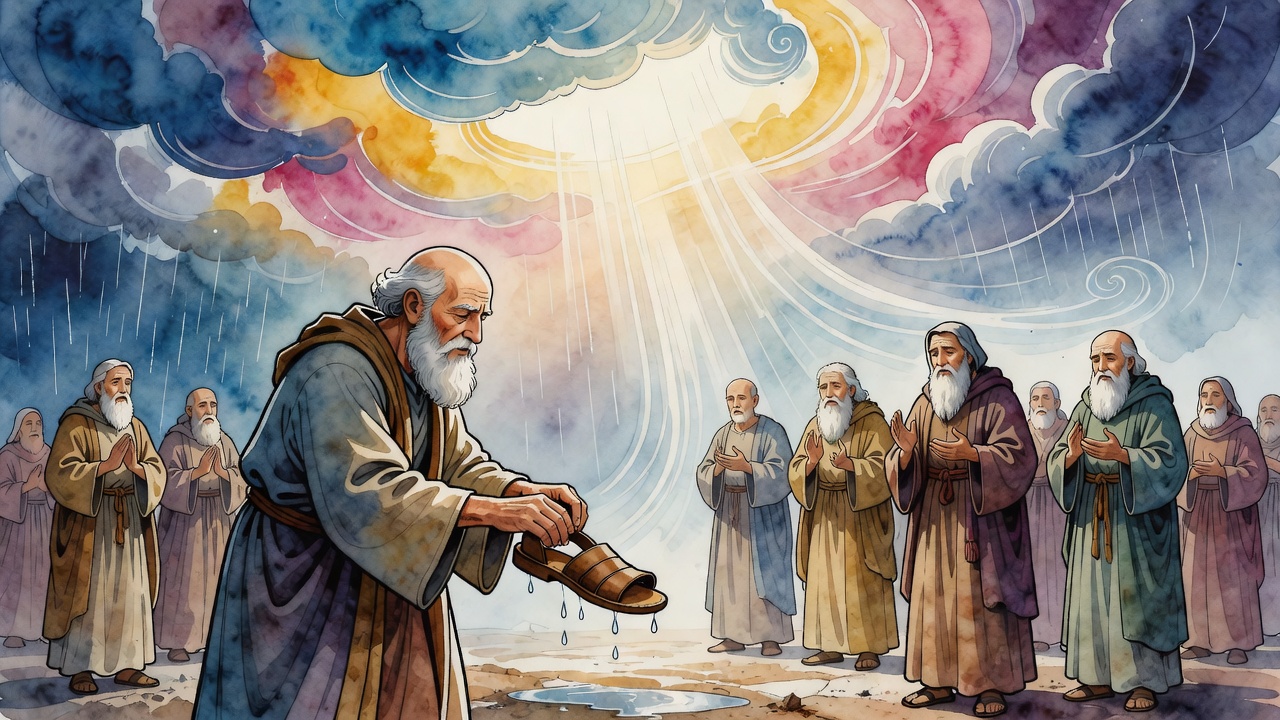
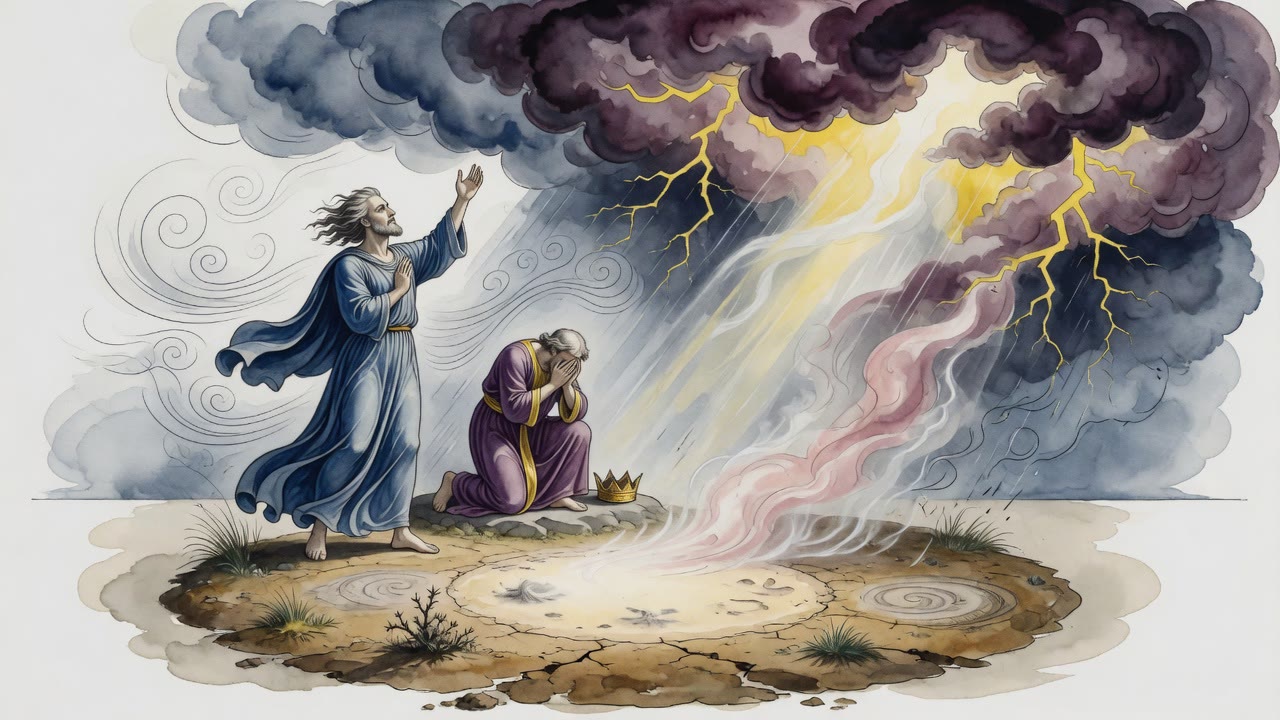
The fast had already thinned the faces in the courtyard. Dust coated the lips of children. Fields beyond the town looked like old bread left too long on a shelf. Rav Yehuda stood among the community and began the gestures of affliction that mark a public plea for rain. He reached for a shoe with the calm of a man who had done this before and still did not treat it as theater.

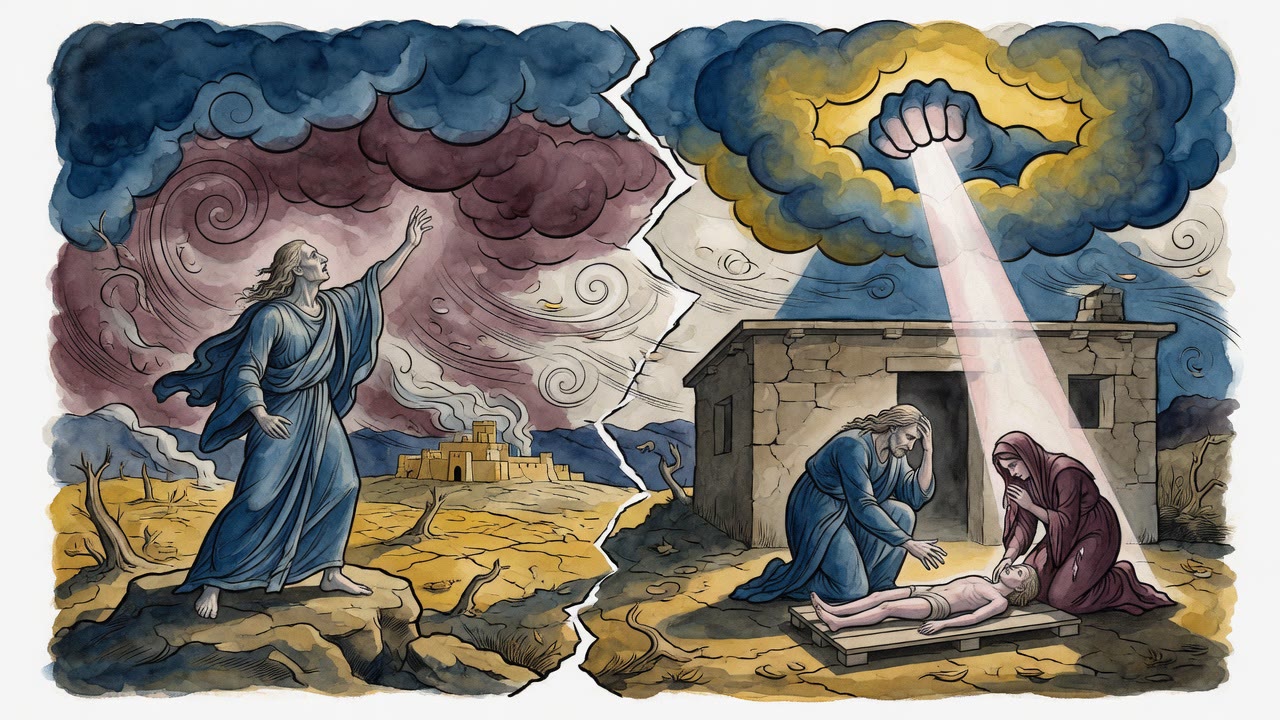
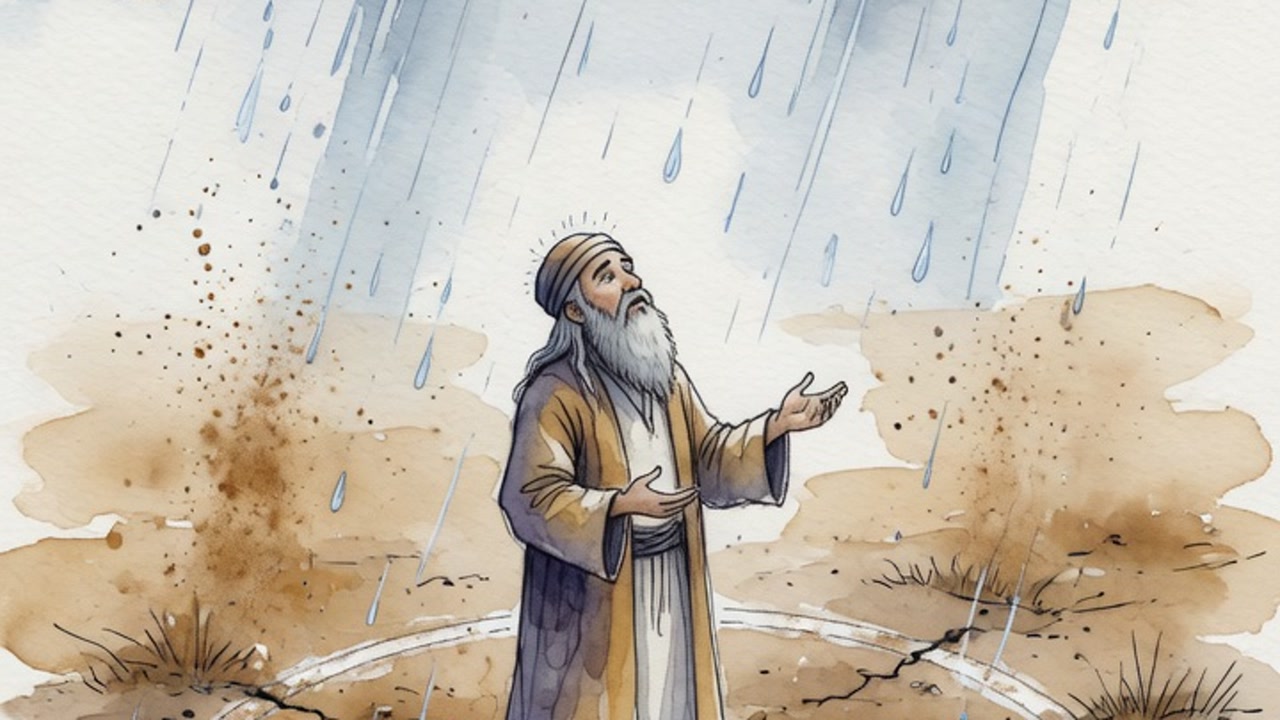
He did not finish the pair. One shoe came off, leather releasing the heel, and the sky broke. Rain fell as if it had been leaning on the roof of heaven waiting for a hinge. People lifted their faces into water they had stopped believing in. Women laughed with the sound of coughing. Men watched mud form between their toes like a verdict reversed. The drought ended on a half-completed rite.

Later Mouths, Closed Clouds

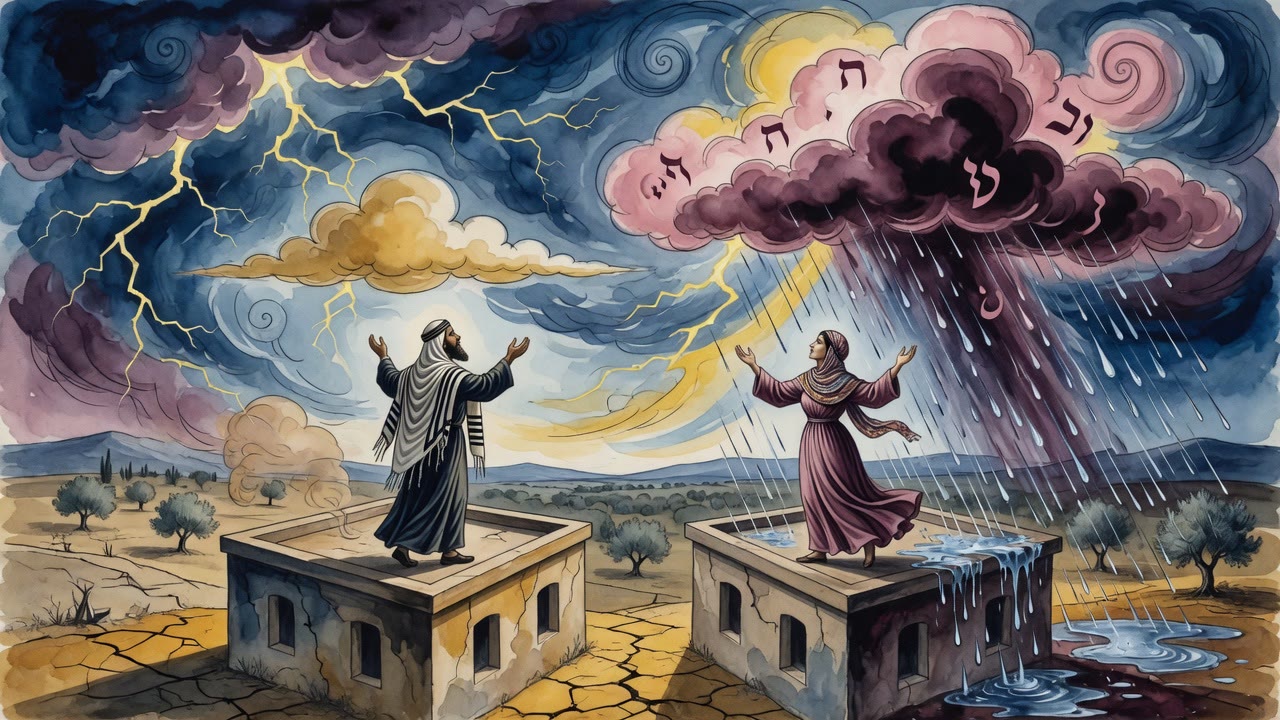
Generations afterward, Abaye and Rav Pappa stood in their own hard seasons and cried out with learning thick in their throats. They knew the tractates. They knew the orders of fasting. The clouds did not move for them the way they had moved for one shoe. The Talmud keeps their bewilderment honest and unflattering. Why did a simpler generation open heaven with less speech, while greater mastery of Torah met a locked sky?

Abaye offered a bitter clarity that still stings the ear. The earlier ones devoted themselves wholly to the sanctification of God's name. We are not as dedicated. Knowledge had grown like a library after a fire is rebuilt bigger. The pure drop at the spring's first pour had mixed with later streams, boots, and arguments. Power to move rain, in this accounting, tracked not the size of the shelf but the thickness of devotion when the town went hungry together.

Purity Before Volume

The mystical reading presses further without insulting the later sages' minds. Early souls, it says, held an unadulterated nearness, like first water from the rock before traffic churns the pool. Later teachers could out-argue them in the study hall, stack distinctions, win debates, and still lack the simple conduit that turns a public fast into weather.

Rav Yehuda's shoe was not magic leather from a hidden market. It was a body joining a community in need without leftover self posing for the record. The rain answered the joining. When the self grows loud, even fluent prayer can sound like noise to a sky that listens for sanctification more than for cleverness.

Rav Pappa and Abaye were not small men. The comparison is meant to hurt and to instruct. Greatness in dialectic and greatness in answered fasting are not always the same crown, and heaven does not always award both to the same head in the same century.

Ships Under a Palace

Another midrash pictures God's upper chambers as a palace set on ships at sea. As long as the ships are bound together, the palace stands steady on the water. When the bindings loosen, the glory above rocks and the passengers below feel the tilt. "Who builds His upper chambers in the heavens and established His group on earth" (Amos 9:6). The group, the agudah, the bound bundle of Israel, is the mooring line.

When Israel gathers as one, heaven has a place to rest its weight. When leaders assemble in Yeshurun, kingship below and kingship above align (Deuteronomy 33:5). The assembly of the righteous is a benefit for them and for the world. The assembly of the wicked is a calamity for them and for the world. Gathering is never neutral weather. It either anchors the palace or loosens the ropes until the upper house sways.

Rain as Answered Binding

Rav Yehuda's fast was not a private trick performed for admirers. It was a town bound into one need, one hunger, one Name spoken without leftover performance. The shoe came off inside that binding. The rain fell on fields that belonged to all of them, on roofs that leaked on rich and poor alike. Later generations sometimes gathered with more words, more orders of service, and less cord. They could fill a study house to the beams and still leave the ships drifting a handbreadth apart.

Heaven's response, in both pictures, tracks connection. One person's pure act can tilt a world. One community's true knot can hold a palace. One half-removed shoe can outrun a shelf of unanswered sermons if the knot is real and the Name is not a prop.

After the First Drop

The courtyard changed in minutes. Dust turned to paste. Children ran with mouths open. Someone shouted a psalm and lost the tune to rain noise. Rav Yehuda still held the other shoe in his hand, as if finishing the pair might be rude to a sky that had already answered. He may never have put the first one back on until the puddles formed deep enough to reflect faces.

The story remains because droughts return and so do gatherings. Some will come with full liturgy and empty cord. Some will come with one gesture and a town behind it, thin from fasting and thick with shared need. The sky, in this tradition, still knows the difference between noise and a knot.


← All myths
From the tradition

Sources

2 sources

The texts behind this telling. Some cards carry a translation of the source; others are our own retelling of it, and each card says which. Every card links out to the original.

Baal HaSulam's Introduction to Zohar 64:4Baal HaSulam's Introduction to Zohar

Retold in our words. Read the original at the link below.Sefaria-hosted English translation · CC-BY

Baal HaSulam's Introduction to Zohar turns to Rav Yehuda's Prayer.

The Talmud (Ta'anit 24b) touches on this very question. It tells of a time when Rav Yehuda, a sage of old, could end a drought simply by removing one shoe during a communal fast. Rain would fall immediately. Meanwhile, the later sages, Abaye and Rav Pappa, lamented that their prayers seemed to go unanswered, their cries unheard. What gives?

Abaye offers a simple, yet profound explanation: "The previous generations were wholly dedicated to the sanctification of God’s name, while we are not as dedicated to the sanctification of God’s name.” In other words, their profound connection to the divine, their absolute commitment to holiness, made them conduits for miracles in a way that later generations struggled to match.

Here's where it gets interesting. Even though the earlier sages possessed this seemingly greater spiritual power, Rav Pappa and Abaye were actually considered greater in terms of Torah knowledge and wisdom. How can this be?

The Baal HaSulam, in his introduction to the Zohar, offers a fascinating perspective. He suggests that the souls of earlier generations possessed a certain purity, an unadulterated essence that made them inherently closer to the divine. Think of it like this: the first drops of water from a spring are often the purest, before they mingle with the impurities of the world.

However, the Baal HaSulam continues, the world itself is constantly evolving, progressing towards greater perfection. As time goes on, the "lights," the divine energies that flow into the world, become more refined and complete. And these refined lights, paradoxically, flow through the later sages, even though their souls may not possess the same initial purity as their predecessors.

So, while the earlier generations may have had a more direct connection to the miraculous, the later generations had access to a deeper, more comprehensive understanding of Torah. They were able to build upon the foundations laid by those who came before, illuminating new facets of wisdom.

It's a beautiful and complex idea. It acknowledges the unique spiritual gifts of the past while also affirming the potential for growth and enlightenment in the present. It suggests that we are all part of an ongoing process, each generation contributing its own unique piece to the interplay of Jewish tradition.

Perhaps, then, it's not about lamenting our lack of miracle-working abilities, but about striving to deepen our own connection to the divine, to dedicate ourselves to the sanctification of God’s name in our own way. And to appreciate that we stand on the shoulders of giants, inheriting a legacy of wisdom that continues to unfold with each passing generation.

Full source
Bamidbar Rabbah 15:18Bamidbar Rabbah

Retold in our words. Read the original at the link below.The Sefaria Midrash Rabbah, 2022 · CC-BY

Jewish tradition teaches that there's a profound spiritual power in gathering together, a power that even resonates in the heavens. But is any gathering automatically holy?

The Midrash (rabbinic interpretive commentary), specifically Bamidbar Rabbah 15, explores this very idea. It starts with a verse from Amos (9:6): "Who builds His upper chambers in the heavens and established His group [agudato] on earth." Now, the word agudato here is key. It means "group" or "assembly," but it also carries a sense of being bound together, an organic whole.

The Midrash asks, what's the connection between God's heavenly abode and our earthly gatherings? It uses a striking image: a palace built on ships. A magnificent palace, resting on the precarious foundation of ships at sea. The Midrash explains that as long as the ships are firmly tethered together, the palace stands strong. So too, says the Midrash, God's Throne of Glory is firmly established when Israel forms an organic group, an agudah. The verse implies that God builds His upper chambers in the heavens when His group is established on earth.

That our unity, our coming together in a spirit of shared purpose, actually strengthens the very fabric of the heavens. It’s as if our collective energy, our shared intention, provides the anchor for the divine presence in the world.

Bamidbar Rabbah then cites another verse, this time from Deuteronomy (33:5): "He became king in Yeshurun [when the leaders of the nation assemble]." Yeshurun is a poetic name for Israel, and the verse highlights the importance of communal leadership and assembly. It's when the leaders come together, when the community gathers, that God's kingship is fully realized.

So, what does this all mean? The text concludes that God said to Moses, "Gather to Me." Why? Because, the Midrash asserts, "the assembly of the righteous is a benefit for them and a benefit for the world." There's a palpable sense of the gathering being intrinsically good here, as if goodness attracts more goodness.

But there's a crucial flip side. The Midrash doesn't shy away from the darker potential of collective action. It warns that "the assembly of the wicked is a calamity for them and a calamity for the world." A gathering can amplify negativity, creating a destructive force that harms both the individuals involved and the wider world.

This begs the question: what kind of gatherings are we creating? Are we building "palaces on ships" that are tethered to goodness, to shared values, to a vision of a better world? Or are we contributing to assemblies of negativity, division, and harm?

The Bamidbar Rabbah 15 ultimately challenges us to be mindful of the power of collective action. When we choose to gather in a spirit of righteousness, unity, and shared purpose, we become partners in building a more stable and blessed world.

Full source