Parshat Lech Lecha5 min read

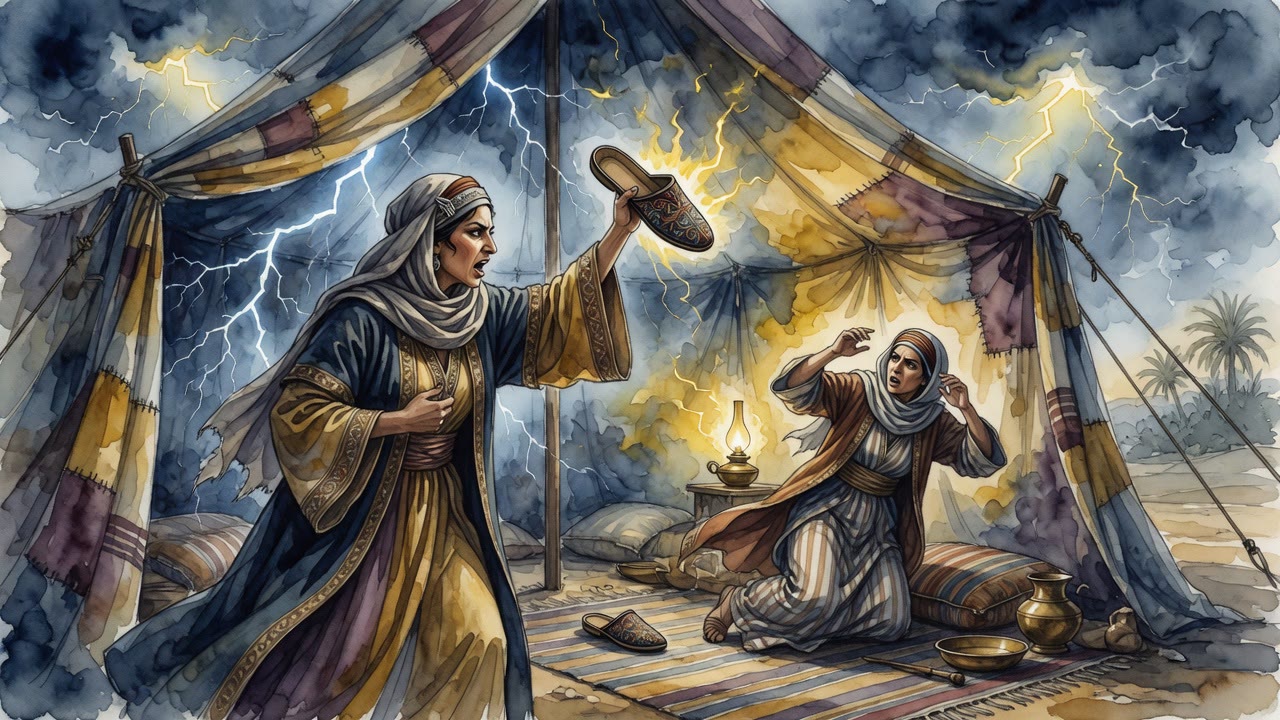
Sarai Struck Hagar in the Face With a Slipper

Abram quoted two verses about women who may not be sold or enslaved. Sarai answered that she cared neither for Hagar's good nor her harm, three times.

Curated by Arthur · Told by Maggid ·
Table of Contents
  1. Your Maid Is in Your Hand
  2. Twice He Quoted the Law and Twice She Said the Same Thing
  3. The Slipper and the Buckets
  4. The Spring on the Road to Shur
  5. The Well That Kept the Name

Hagar knew the moment her body changed, and so did everyone else in the tents. She had been handed to Abram as a wife because Sarai could not conceive, and now she was carrying the household's first child while the woman who owned her was still empty. Something went out of Sarai's standing that afternoon and did not come back. Hagar looked at her mistress and her mistress became small in her eyes (Genesis 16:4).
Sarai Struck Hagar in the Face With a Slipper Click for full size

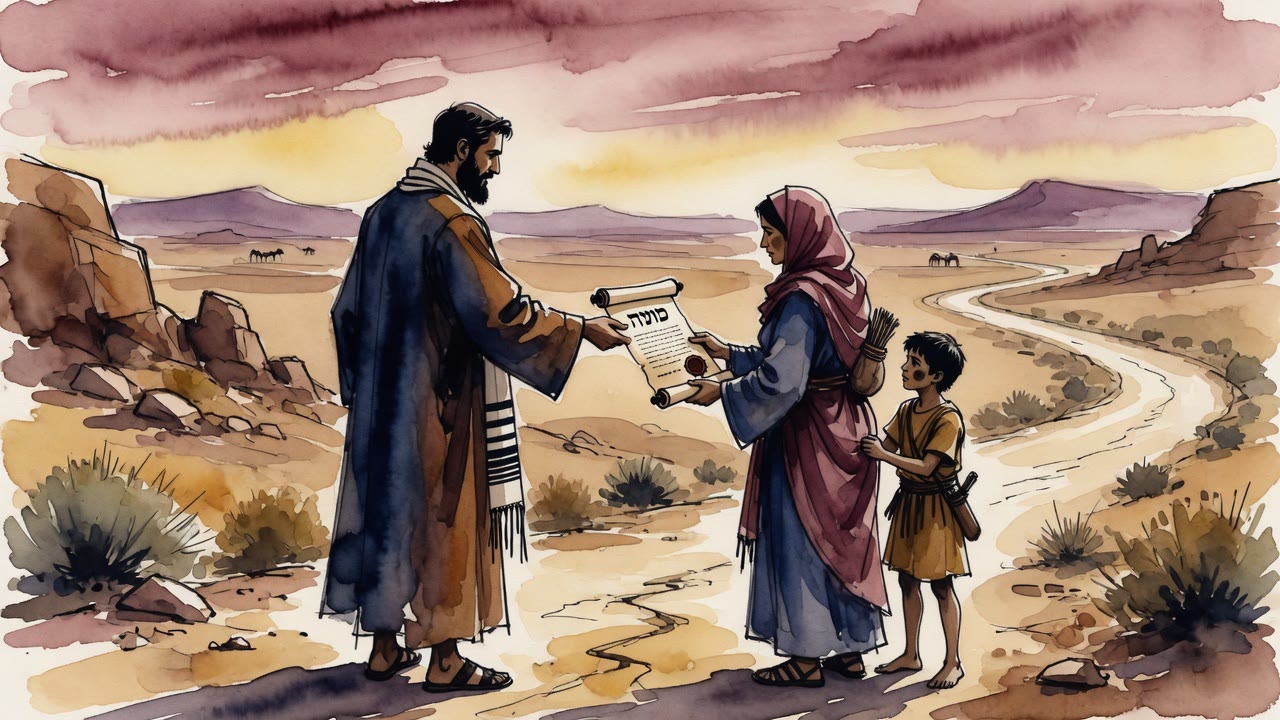
Sarai went to Abram. "My wrong is on you," she said. "I put my maid in your arms, and the moment she saw she had conceived I became nothing to her. Let the LORD judge between me and you."

Your Maid Is in Your Hand

Abram gave her one sentence and it settled nothing. "Your maid is in your hand. Do to her what is good in your eyes" (Genesis 16:6).

Sarai answered with a line so cold the sages kept it word for word. "I care neither for her good nor for her harm."

It is the sentence of a woman who has stopped counting someone as a person. Not hatred, which at least admits the other exists. Indifference, with a slave in the room.

Twice He Quoted the Law and Twice She Said the Same Thing

Abram tried the law on her. There is a verse about a woman taken in war, he said, and it says you may not sell her and you may not work her as a slave, because you have already put her through enough (Deuteronomy 21:14). This woman, after what we did to her, are we going to make her a slave again?

"I care neither for her good nor for her harm."

He tried once more. There is a verse about a bondwoman a man has taken for himself, and it says he has lost the power to sell her on, because he dealt with her deceitfully (Exodus 21:8). This woman, after we made her a mistress in the house, are we going to make her a maid again?

"I care neither for her good nor for her harm."

Three times the same words, in a tent, in front of the man who had gone along with the whole arrangement and would not stop it now.

The Slipper and the Buckets

Scripture spends two words on what happened next. Sarai afflicted her, and she ran. The sages would not let two words cover it, and each of them named a different thing his teacher had heard.

Rabbi Abba bar Kahana said she shut the pregnant woman out of Abram's bed, taking back by force the one thing that had raised her.

Rabbi Berekhya said she struck her in the face with a slipper.

Rabbi Berekhya said in the name of Rabbi Abba bar Kahana that she made her carry the buckets and the towels to the bathhouse behind her, so that everyone on the path could watch the wife walk back down into a servant.

A slipper is what is closest to a woman's hand when she is sitting down. It is not a weapon anyone plans. It is what gets used when the person in front of you has stopped counting.

Hagar took the road out of the camp with the child still inside her.

The Spring on the Road to Shur

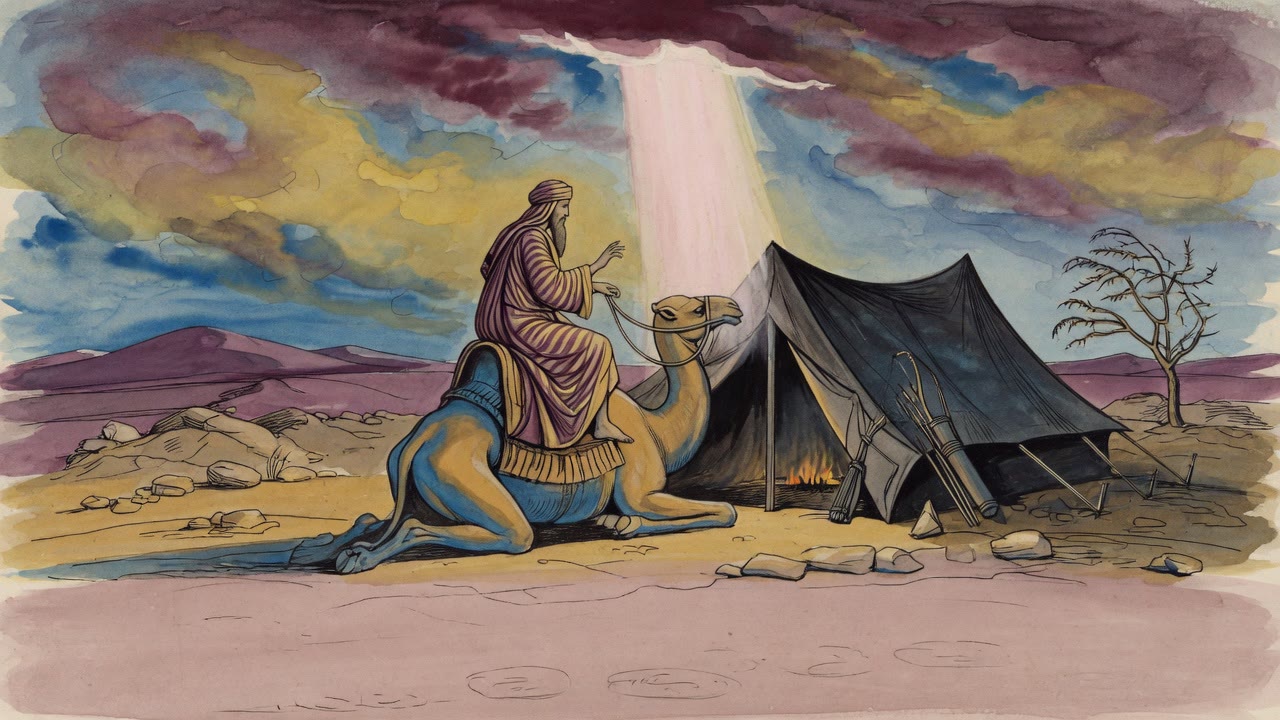
An angel found her at a spring in the wilderness, on the road that runs down to Shur, which is the road back to Egypt and the house she had come from (Genesis 16:7).

He used her name and her title together, both at once, the way nobody in that camp had bothered to. "Hagar, maid of Sarai. Where have you come from, and where are you going?"

She answered only the first half. "I am running away from Sarai my mistress."

She did not curse the woman. She did not describe the slipper. She named her and stopped, which is its own kind of testimony.

The angel told her to go back and put herself under her mistress's hand again, and then, in the same breath, told her what nobody in the tents had told her. Her seed would be too many to count. She was carrying a son. She would call him Ishmael, God hears, because the LORD had heard her while she was being ground down and nobody in the house had said a word on her behalf (Genesis 16:11).

The Well That Kept the Name

So she gave God a name of her own, which no one else in the book had done. "You are the God who sees me" (Genesis 16:13). She said it standing at the water, still a runaway, with the road to Egypt open behind her and the road back to Sarai open in front.

She took the road back. The well kept her name for it, Beer-lahai-roi, the well of the Living One who sees me, and it sat there between Kadesh and Bered for anyone to drink from (Genesis 16:14). Abram was eighty-six years old when the boy was born, and it was Abram who gave him the name the angel had already given him at the spring.

The slipper stayed in the tradition too. Nobody scrubbed it out to protect the matriarch.


← All myths
From the tradition

Sources

3 sources

The texts behind this telling. Some cards carry a translation of the source; others are our own retelling of it, and each card says which. Every card links out to the original.

Bereshit Rabbah 45:6Bereshit Rabbah

Retold in our words. Read the original at the link below.The Sefaria Midrash Rabbah, 2022 · CC-BY

It's not always the idyllic picture we might imagine. to a fascinating, and frankly, a bit uncomfortable, passage from Bereshit Rabbah 45, a Midrashic (rabbinic interpretive commentary) collection interpreting the Book of Genesis. It centers on Hagar, Sarai's maidservant, and the unfolding drama around her pregnancy with Abram’s child.

The story kicks off with Sarai, barren at the time, offering Hagar to Abram. As (Genesis 16:6) tells us, “Abram said to Sarai: Behold, your maidservant is in your hand; do to her what is favorable in your eyes. Sarai treated her harshly, and she fled from her.” But what exactly did "treating her harshly" entail? That’s where the Rabbis of the Midrash step in to examine the nuances.

The dialogue between Abram and Sarai is particularly telling. Sarai, in a rather chilling statement, declares she cares "neither for her benefit nor for her detriment." Ouch. Abram, seemingly trying to mitigate the situation, brings up legal and ethical points. He reminds Sarai of the Torah's protections for women, specifically referencing laws about a woman captured in war (Deuteronomy 21:14) and a Hebrew bondswoman (Exodus 21:8). He argues, essentially, that they can't mistreat Hagar, especially after having elevated her status. He asks, how can they enslave her after having "subjected her to conjugal relations," as some commentaries put it, or "after we made her a mistress" as others explain.

Sarai remains unmoved, repeating her icy indifference. What's going on here? Is this about jealousy? Power? A desperate attempt to control a situation that’s spiraling beyond her grasp?

The Midrash then offers different interpretations of Sarai’s harsh treatment. Rabbi Abba bar Kahana suggests she prevented Hagar from engaging in conjugal relations. Rabbi Berekhya offers a more visceral image: she hit her in the face with a slipper! And Rabbi Berekhya, again in the name of Rabbi Abba bar Kahana, adds that Sarai forced Hagar to carry heavy loads, like buckets and towels, to the bathhouse.

These interpretations, while varied, paint a picture of abuse, both physical and emotional. They highlight the vulnerability of Hagar's position and the imbalance of power within the household. We see Sarai struggling with her own pain and projecting it onto Hagar.

This passage isn’t just a historical anecdote. It raises profound questions about how we treat those who are vulnerable, the responsibilities that come with power, and the complexities of human relationships.

Perhaps it's a reminder to examine our own biases, to be mindful of the power dynamics in our relationships, and to strive for compassion, even when it’s difficult. The Torah, as interpreted by the Rabbis, doesn't shy away from the messy realities of human existence. It invites us to confront them, to learn from them, and to become better people because of them.

Full source
Book of Jubilees 44:33Book of Jubilees

Retold in our words. Read the original at the link below.Sefaria Community Translation · CC-BY

Back the curtain on a seemingly simple passage from the Book of Jubilees, chapter 44. It’s a passage that, At first, reads like a dry family register. But stick with me, because within these names lies a story of migration, loss, and the quiet perseverance of a people.

The Book of Jubilees. Sheffield: Sheffield Academic Press, 2001). And in chapter 44, we find ourselves focusing on the sons of Bilhah, the handmaid of Rachel, and the children she bore to Jacob: Dan and Naphtali.

"And the sons of Bilhah, the handmaid of Rachel, the wife of Jacob, whom she bare to Jacob, were Dan and Naphtali. But already, there's a hint of complexity. Bilhah's status as a handmaid, Rachel's heartbreak… these are stories within stories.

The text continues, "And these are the names of their sons who went with them into Egypt. And the sons of Dan were Hushim, and Sâmôn, and Asûdî, and ’Îjâka, and Salômôn--six." A list of names. Hushim, Sâmôn, Asûdî… these aren't just names; they were people who packed their belongings, said goodbye to their homeland, and embarked on a journey into the unknown. They represent the tribe of Dan’s initial hope in a new land.

Then comes the twist: "And they died the year in which they entered into Egypt, and there was left to Dan Hushim alone." Imagine that. The hope of a new beginning, crushed in a single year. A family decimated. And Hushim, left alone. This detail is unique to Jubilees and doesn't appear in the Genesis account, lending a unique perspective on the hardships faced by Jacob's family.

Then we turn to Naphtali: "And these are the names of the sons of Naphtali: Jahziel, and Guni, and Jezer, and Shallum, and ‘Îv." More names. More potential. More lives intertwined with the destiny of the Israelite people.

And then, another shadow falls: "And ‘Îv, who was born after the years of famine, died in Egypt." The famine, a recurring theme in the early books of the Torah, casts its long shadow even here. Even a child born after the worst of it is touched by its effects.

The passage concludes with a finality: "And all the souls of Rachel were twenty-six." A seemingly simple count, but it speaks volumes about loss and the consolidation of a family lineage.

So, what do we take away from this brief glimpse into the Book of Jubilees? It’s a reminder that behind the grand narratives of the Torah, there are individual stories of hardship, resilience, and the enduring power of family. It's a reminder that even in the face of loss, life goes on, names are remembered, and the story continues. And isn't that, in itself, evidence of the enduring spirit of the Jewish people?

Full source
Yalkut Shimoni on Torah 402:3Yalkut Shimoni on Torah

Translation of the source text.Torat Emet (Yalkut Shimoni) · CC-BY-NC

"Every firstborn of your sons you shall redeem" (Exodus 34:20). One who set aside the redemption money for his son and it was lost is responsible for it. From where do we know this? Rav said that Rabbi Yonatan said: "Every firstborn of your sons you shall redeem" is joined to "and they shall not appear before Me empty" (Exodus 34:20). Just as there, the heirs are obligated, so here, the heirs are obligated. The Rabbis taught: all commandments concerning the son that are placed upon the father to do for his son, men are obligated and women are exempt: to circumcise him, to redeem him, to teach him Torah, to marry him to a woman, and to teach him a trade. From where do we know redemption? As it is written, "Every firstborn of your sons you shall redeem." And where his father did not redeem him, he is obligated to redeem himself, as it is written, "you shall redeem"; read it as "you shall be redeemed." And from where do we know that she is not commanded? As it is written, "you shall redeem" and "you shall be redeemed": whoever is commanded to redeem himself is commanded to redeem others. And from where do we know that she is not commanded to redeem herself? As it is written, "you shall redeem" and "you shall be redeemed": whoever others are commanded to redeem is commanded to redeem himself, and whoever others are not commanded to redeem is not commanded to redeem himself. And from where do we know that others are not commanded to redeem her? Scripture says, "Every firstborn of your sons you shall redeem": your sons, and not your daughters.

The Rabbis taught: if he has to redeem himself and his son has to be redeemed, he comes before his son. Rabbi Yehudah says: his son comes before him, because his own commandment lies upon his father, while his son's commandment lies upon him. Rabbi Yirmiyah said: all agree that wherever there are only five sela, he comes before his son. What is the reason? The commandment of his own body is preferable. They disagree where there are five encumbered sela and five free sela. Rabbi Yehudah holds that a debt written in the Torah is like a debt written in a document: with these five free sela he redeems his son, and the priest goes and seizes the five encumbered sela, and redeems him. The Rabbis follow their reasoning, for they say a debt written in the Torah is not like a debt written in a document; therefore, the commandment of his own body is preferable. The Rabbis taught: if he has to redeem his son and go up for the pilgrimage festival, he redeems his son and afterward goes up for the pilgrimage festival. Rabbi Yehudah says: he goes up for the pilgrimage festival and afterward redeems his son, for this is a commandment that passes away, and this is a commandment that does not pass away. This is understandable according to Rabbi Yehudah, for he stated his reason. But what is the Rabbis' reason? Scripture says, "Every firstborn of your sons you shall redeem," and afterward, "and they shall not appear before Me empty" (Exodus 34:20). The Rabbis taught: from where, if he had five sons from five wives, is he obligated to redeem all of them? As it is said, "Every firstborn of your sons you shall redeem." This is obvious, for the Merciful One made it depend on the opening of the womb. One might have said: let us learn firstborn from firstborn regarding inheritance; just as there it means the first of his strength, so here it means the first of his strength. Therefore it teaches us otherwise.

"In plowing and in harvest you shall rest" (Exodus 34:21). Rabbi Akiva says: it does not need to speak of plowing and harvest of the seventh year, for it has already been said, "you shall not sow" (Leviticus 25:4). Rather, it speaks of plowing on the eve of the seventh year that enters into the seventh year, and the harvest of the seventh year that goes out into the year after the seventh. Rabbi Yishmael says: just as plowing is optional, so harvest is optional; this excludes the harvest of the Omer, which is a commandment. And Rabbi Yishmael, from where does he know that one adds from the profane onto the holy? He derives it from what was taught on "and you shall afflict your souls," and so forth. One of the Rabbis said to Rava: from where do you know that the plowing is optional? Perhaps it is plowing for the Omer, which is a commandment, and even so the Merciful One says, "you shall rest." Rava said: harvesting is like plowing. Just as with plowing, if he finds it already plowed he does not plow, so with harvesting, if he finds it already harvested he does not harvest. And if it enters your mind that it speaks of the harvest of a commandment, if he finds it already harvested, does he not harvest? It is a commandment to harvest and bring it.

Full source