5 min read

Schools Rose Before Mansions in the Land of Goshen

Seventy souls enter Egypt as famine refugees, and the first walls they raise are not for comfort but for Torah study and vineyards after.

Curated by Arthur · Told by Maggid ·
Table of Contents
  1. Mansions Wait Their Turn
  2. Jacob Already Knew the Cost of Delay
  3. Esau Chooses Other Houses
  4. What the Schools Protected

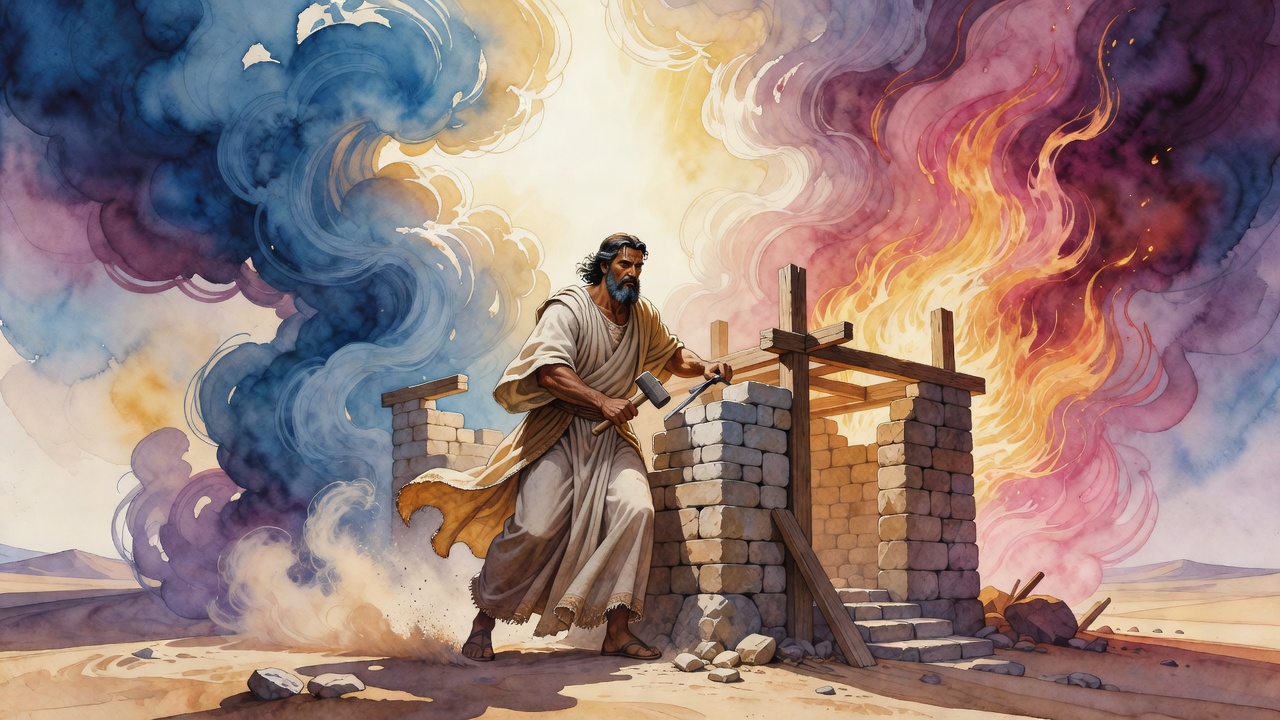
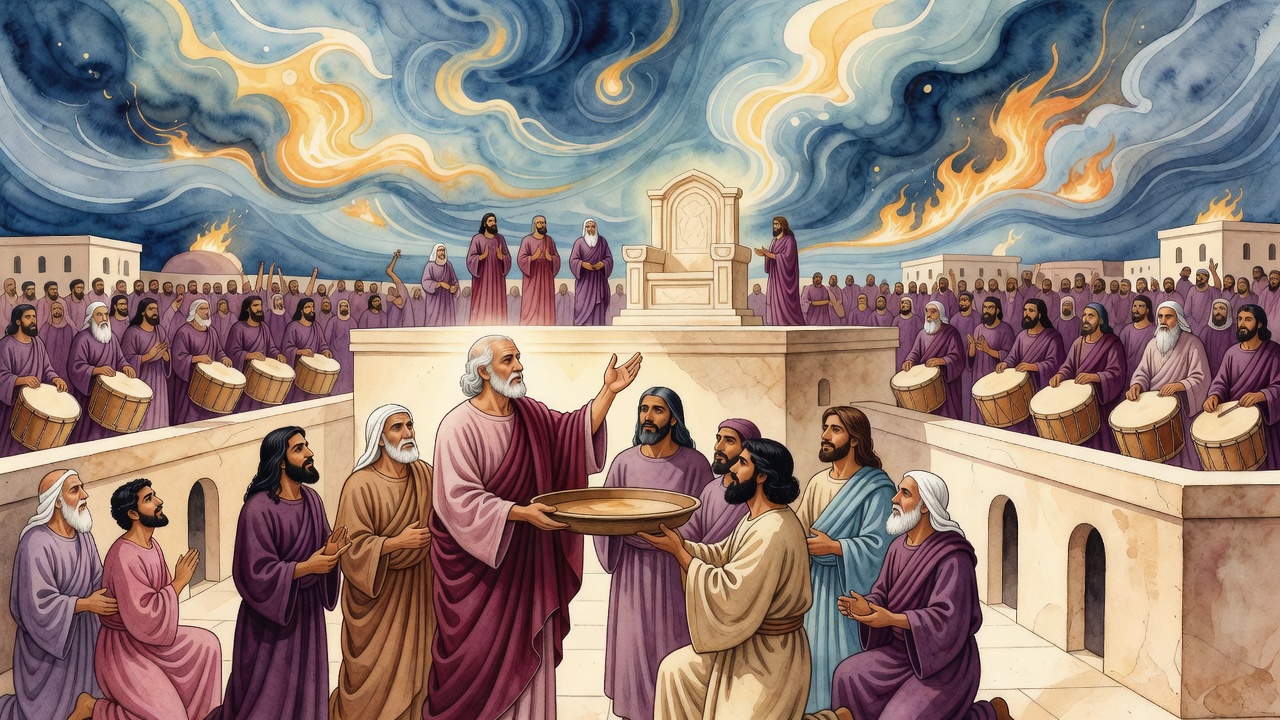
Dust still clung to the carts when the first beams went up. Not for a banquet hall. Not for a cool inner room where a man could forget the road. The posts were set for a house of study in the land of Goshen, and the men who held the ropes were sons of a shepherd who had just kissed Pharaoh's hand and blessed him with a stranger's blessing.

Schools Rose Before Mansions in the Land of Goshen Click for full size

Jacob had sent Judah ahead for a reason. Before the family of seventy settled into Egypt's fat pasture, someone had to open a place where the words of the covenant would still be spoken aloud (Genesis 46:28). The famine had driven them south. Grain was the excuse. Continuity was the plan. The Targum will not let them arrive as mere survivors with empty bowls. They come as builders of schools.

A child asked why the walls went up before the soft beds. Judah, if he answered, answered with work.

Mansions Wait Their Turn

The Torah's summary is brief: Israel dwelt in Egypt, in Goshen, gained possessions, and multiplied (Genesis 47:27). Pseudo-Jonathan hears the concrete order inside that line. They built schools and mansions. They inherited fields and vineyards. They increased greatly.

Schools first. Mansions second.

A people who had arrived hungry put learning before luxury. Only after the batei midrash stood did comfortable houses rise and vines take root in foreign soil. The sequence is the story. Diaspora begins not with assimilation's soft chairs but with a room where a child can still hear Hebrew verses while Egyptian market noise rides the wind outside the shutters. Fields matter. Wine matters. They are second because a full stomach without a book is how a family dissolves into an empire's averages.

Neighbors in Goshen watched the odd priority and shrugged. Shepherds had their ways. The shepherds kept measuring beams for study halls.

Jacob Already Knew the Cost of Delay

Jacob had lived the other path. After the stolen blessing, when Esau's fury made Beersheba unsafe, Jacob fled not only toward Laban but, in the Book of Jasher's telling, into the house of Eber, son of Shem. There he stayed fourteen years, learning the ways of the Lord and His commandments while his brother's anger cooled and soured by turns.

Fourteen years in a house of study before the long road to Haran. Nights of recitation. Days of work under a roof that asked nothing of him except attention. The man who later sends Judah to plant Torah in Goshen is the man who once hid inside Torah to stay alive. He knows what a roof over learning can do when the world outside wants your throat or your name or both.

When Jacob finally left Eber's house, he carried more than a traveler's pack. He carried a habit: when danger rises, build a place where the commandments can still be heard.

Esau Chooses Other Houses

While Jacob sat with Eber, Esau took wives from the daughters of Heth and moved toward Seir. Those wives, Jasher says, walked in the ways of wood and stone gods. Houses filled with other worship. No fourteen-year apprenticeship in Shem's line. Tables heavy with grievance. When Jacob later fled again toward Laban, Esau even sent Eliphaz with a sword and orders to finish the rivalry on a mountain road.

Jacob bought his life with everything he carried. Silver, gold, the goods of Beersheba. Eliphaz and his men left him nothing but breath. Esau kept the stolen goods and still raged that the killing had failed. Two brothers. Two architectures of survival. One builds a life around the commandments even while empty-handed. One builds a life around grievance, foreign altars, and the hope that the next ambush will finally settle the score.

Goshen will test which architecture can hold a family of seventy until it becomes a nation that walks out counting six hundred thousand men of war.

What the Schools Protected

Without those first study halls, seventy souls become a rumor in three generations. Names blur. The covenant thins into a private superstition. With the halls, the count that walks out at the Exodus still remembers the old tongue and the old promises. Vineyards matter for joy and trade. Mansions matter for rest after labor. They come second because a minority that eats well and forgets its book disappears as surely as a minority that starves.

Joseph's brothers had come for grain. They stayed to plant something harder than wheat: a schedule of learning in an empire that would one day forget Joseph's name and invent brick quotas. The posts of that first school are long gone under Nile mud and centuries. The order they announced is not. Torah first. Then the house. Then the vine. Then the long, dangerous multiplication under a sky that is not yet home, until the sky itself darkens with plagues and the road opens east.

On a quiet evening in Goshen, a boy recites by lamp oil while Egyptian carts rattle past. He does not know he is the reason the beams went up before the couches. He only knows the verse for tonight.


← All myths
From the tradition

Sources

2 sources

The texts behind this telling. Some cards carry a translation of the source; others are our own retelling of it, and each card says which. Every card links out to the original.

Targum Pseudo-Jonathan on Genesis 47:27Targum Pseudo-Jonathan on Genesis

Retold in our words. Read the original at the link below.The Targum of Jonathan ben Uzziel, trans. J. W. Etheridge, London, 1862 · Public Domain

27: And Israel dwelt in the land of Mizraim, and they built there schools and mansions in the land of Goshen, and inherited therein fields and vineyards; and they increased and multiplied greatly.

Full source
Jasher 29Book of Jasher

Retold in our words. Read the original at the link below.The Book of Jasher, J. H. Parry edition (1887) · Public Domain

There are so many fascinating texts just lurking on the fringes, offering alternative perspectives and filling in the gaps in ways you wouldn't expect. one of those: a chapter from the Book of Jasher.

The Book of Jasher, also called Sefer haYashar (ספר הישר), isn't part of the Hebrew Bible, but it's an ancient Jewish text referenced in the Bible itself (Joshua 10:13 and (2 Samuel 1:1)8). The version we're exploring today is a medieval Hebrew work that claims to be that lost book. Now, whether it truly is..well, that's a debate for another day. But regardless, it offers some incredible stories that add layers to the familiar biblical tales.

Our story today focuses on Isaac, Jacob, and Esau. Remember them? Isaac, now old and with failing eyesight, asks Esau to hunt game and prepare a meal so he can give him his final blessing. As the Book of Jasher tells it, Isaac says, "Get I pray thee thy weapons, thy quiver and thy bow, rise up and go forth into the field and get me some venison, and make me savory meat and bring it to me, that I may eat in order that I may bless thee before my death, as I have now become old and gray-headed."

Rebekah overhears. And, as we know, she favors Jacob. She instructs Jacob to deceive his father and receive the blessing instead. She tells him, "Rise up and go, I pray thee, to the flock and fetch me two fine kids of the goats, and I will get the savory meat for thy father, and thou shalt bring the savory meat that he may eat before thy brother shall have come from the chase, in order that thy father may bless thee." Jacob obeys, tricks Isaac, and gets the blessing intended for Esau.

When Esau returns, he's understandably furious. "Is he not rightly called Jacob?" Esau cries, according to the Book of Jasher, "for he has supplanted me twice, he took away my birthright and now he has taken away my blessing." The animosity is palpable.

Jacob, fearing Esau's wrath, flees to the house of Eber, the son of Shem. According to the Book of Jasher, he remains there for fourteen years, learning the ways of the Lord. We find that "Jacob was concealed in Eber's house fourteen years on account of his brother Esau, and he there continued to learn the ways of the Lord and his commandments."

Esau, meanwhile, is also not doing so well. He's angry at his parents and takes a wife from the daughters of Heth, adding to his existing marital woes, and moves away. The verse reads, "Esau grieved exceedingly, and he was also vexed at his father and mother; and he also rose up and took his wife and went away from his father and mother to the land of Seir, and he dwelt there." His wives vex Isaac and Rebekah, because "they walked not in the ways of the Lord, but served their father's gods of wood and stone as their father had taught them, and they were more wicked than their father." Ouch!

Later, Jacob returns home, and Esau's anger reignites. He plots to kill Jacob after Isaac's death. Rebekah, ever vigilant, sends Jacob away again, this time to her brother Laban in Haran.

Before Jacob leaves, Isaac gives him a blessing and instructions: "Take not a wife from the daughters of Canaan, for thus did our father Abraham command us according to the word of the Lord..arise, go to Haran to the house of Bethuel thy mother's father, and take unto thee a wife from there from the daughters of Laban thy mother's brother." He’s essentially telling Jacob to keep the faith within the family.

Here’s where the story takes a really interesting turn. As Jacob journeys to Haran, Esau sends his son, Eliphaz, to kill him and take all his possessions. Talk about family drama! The Book of Jasher paints a vivid picture of Esau's rage, "Now hasten, take thy sword in thy hand and pursue Jacob and pass before him in the road, and lurk for him, and slay him with thy sword in one of the mountains, and take all belonging to him and come back."

Eliphaz catches up to Jacob, but Jacob pleads for his life, offering all his possessions in exchange. Surprisingly, Eliphaz relents! The text explains that "the Lord caused Jacob to find favor in the sight of Eliphaz the son of Esau, and his men, and they hearkened to the voice of Jacob, and they did not put him to death, and Eliphaz and his men took all belonging to Jacob together with the silver and gold that he had brought with him from Beersheba; they left him nothing."

Eliphaz returns to Esau, who is furious that he didn’t kill Jacob. Eliphaz explains that he was moved by Jacob's plea, and Esau keeps the stolen goods anyway.

Finally, realizing the daughters of Canaan are a problem, Esau tries to rectify his marital situation. "Then he went to the house of Ishmael his uncle, and in addition to his older wives he took Machlath the daughter of Ishmael, the sister of Nebayoth, for a wife." It's a complicated family, to say the least!

So, what are we to make of this chapter from the Book of Jasher? It highlights the themes of deception, sibling rivalry, and the consequences of choices. It also reveals that sometimes, even in the midst of anger and vengeance, compassion can prevail.

And perhaps most importantly, it invites us to consider the stories that shape our understanding of faith and tradition. Are there other perspectives, other narratives that could enrich our understanding? What happens when we look beyond the well-trodden paths and explore the hidden corners of our heritage? Just something to think about.

Full source