Shekhinah Leaves Heaven for the Calendar Court
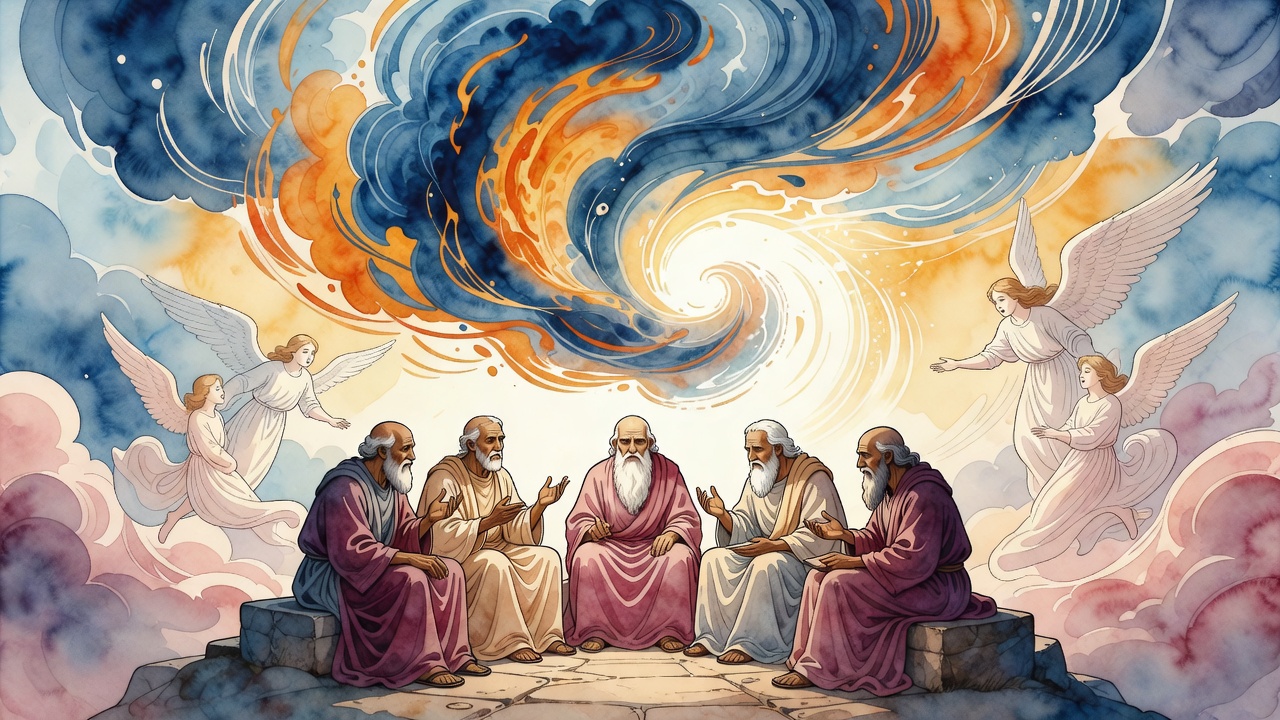
Five elders sit to fix the months, and God contracts His Presence to join them while angels ask if this is fitting.
Table of Contents
 Click for full size
Five Seats, One Calendar
Five elders took their places to intercalate the year. The room was ordinary, wood and ink and the grit of travel on their cloaks. The stakes were not ordinary. On their ruling hung the festivals, the fasts, the blast of the shofar, the day the people would stand and be judged. Happy are the people who know the blast, the psalm says, who walk in the light of Your countenance (Psalms 89:16). Rabbi Abahu heard in that verse these five men, because the light of the countenance was about to leave heaven and sit with them.
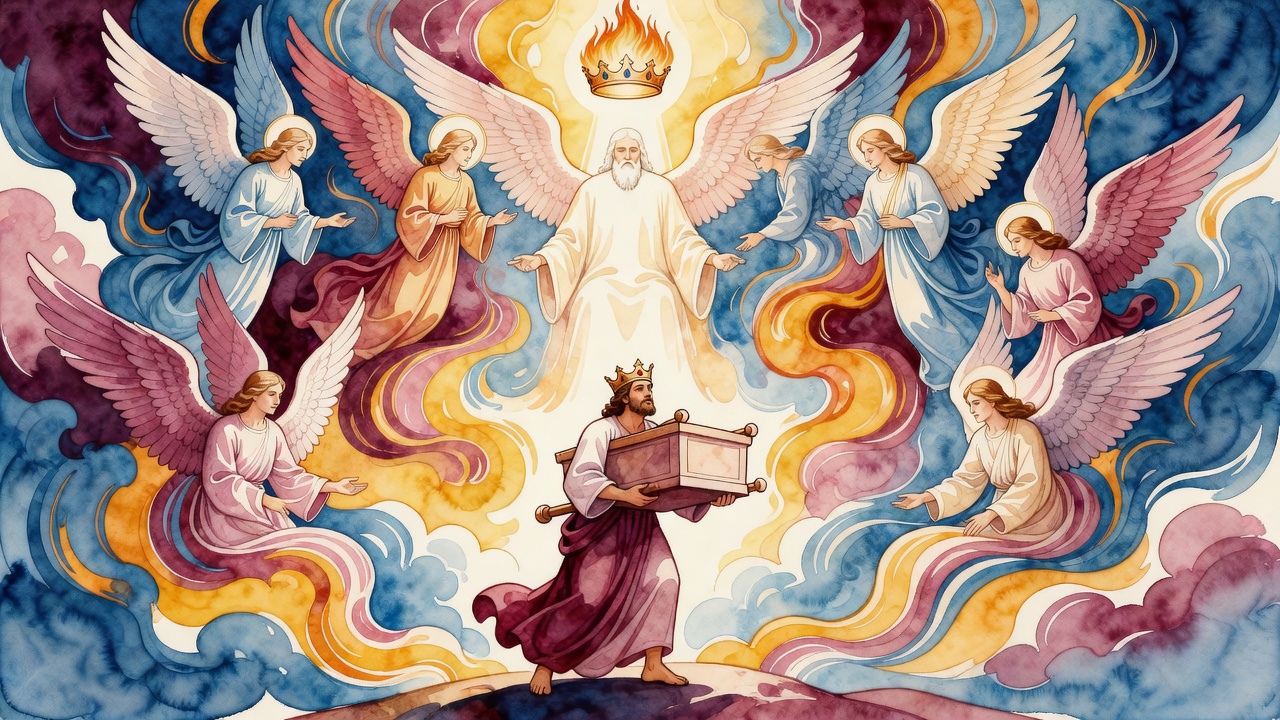
God contracted the Shekhinah (שכינה), the Divine Presence, and came down to their session. The ministering angels stared. "Is this the Mighty? Is this the God?" They knew the verse that says the Almighty is revered in the great assembly of the holy (Psalms 89:8). Now the Holy One had left that assembly for a human table where months would be lengthened or left alone. A missing day in a human ledger would move heaven's own appointments on earth.
One elder cleared his throat. Another checked a calculation against the sky they had watched the night before. No thunder announced the guest. The room only grew more exact, as if the air itself refused a careless number.
Why Heaven Descends
Two reasons pressed close. First, so that if the elders erred in a matter of law, He would illuminate their faces and steer them. Second, even if they erred, He would ratify what they decided. The calendar is not a private hobby of the academy. It is the clock of holiness on earth, and God chooses to bind Himself to the human ruling rather than float free of it.
That is a strange kingship. Not the king who shouts from a distance, but the king who pulls His chair up to the wood where ordinary men argue about a missing day. Angels measure dignity by height. God measures partnership by willingness to sit low enough to be wronged by a rounding error and still say amen to the court's word.
Outside, farmers waited to know when to rest. Mothers waited to know which night the candles of a festival would be lit. Soldiers of no army, only time, stood at the door. The five mouths in the room held all of them.
Anger Left Off the Scroll
On Rosh Hashanah the court of earth and the court of heaven both speak of kingship. The liturgy wants ten verses of God's reign. It will not take verses of pure punishment for that list. "As I live, declares the Lord God, I will reign over you with a strong hand" carries overflowing fury in Ezekiel, and though Rav Nahman once said of such anger, let the Master of the world get angry and redeem us, the way of the world is not to put that fury in the New Year's mouth.
Elders once came to Ezekiel hoping to slip the yoke, arguing they had left God's jurisdiction like a slave sold away from a priest's house. He answered that they had not been sold for a price. "You were sold for free, and you shall be redeemed for no money" (Isaiah 52:3). The reign would hold with a strong hand whether they liked the terms or not. Kingship, in that hour, was refusal to let Israel resign from the covenant.
The calendar court and Ezekiel's hard answer are two rooms of the same palace. In one room God sits with human math. In the other He refuses human resignation. Presence and insistence, both are crown.
Blast and Light
Back in the calendar room the shofar 's (a ram's horn) happiness is not noise for its own sake. The people who know the blast are the people who walk in light because heaven has already decided to sit among them. Angels may call the descent unseemly. The elders keep working. Months will turn. Festivals will fall on the days human mouths declare, and the Presence that left the upper council will not abandon the lower one mid-argument.
A year is a rope of days. Someone has to tie the knot. On that day God ties it with them. When the shofar later cuts the air of Tishrei, the sound carries a secret the angels once questioned: the King is not only above the blast. He has already been in the room where the date of the blast was fixed.
Ink dries on the ruling. Five men stand. Somewhere above, the heavenly council resumes without the One who chose, for a stretch of hours, the company of calculators over the company of pure fire. The festivals move when they move because a human court spoke and heaven agreed to be bound.
← All myths