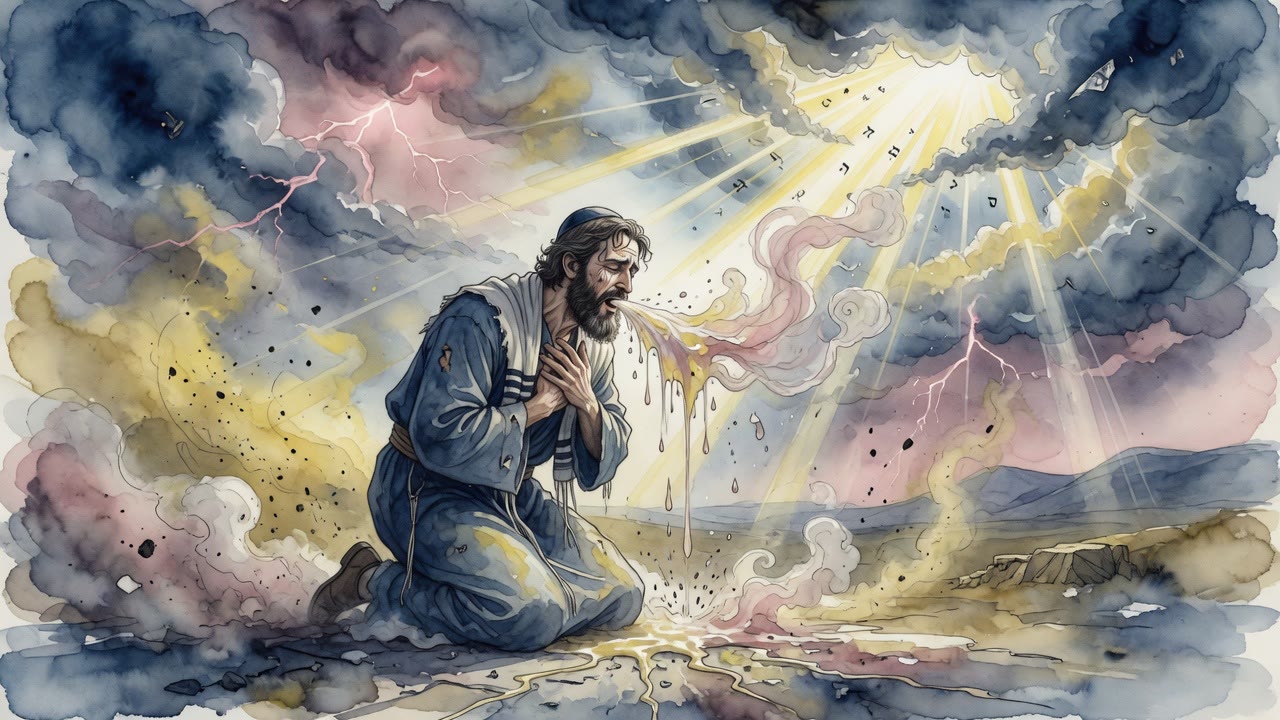
5 min read

David's Harp Played Itself Every Midnight

At midnight the north wind played the harp above David's bed. Ten melodies began with Ashrei, and even a frog claimed to out-sing the king.

Curated by Arthur · Told by Maggid ·
Table of Contents
  1. The Hour Only God Can Stand On
  2. Scholars Woke to a King's Music
  3. Ashrei Hidden in the First Word
  4. The Frog That Out-Sang the King
  5. The King Who Finished at Dawn

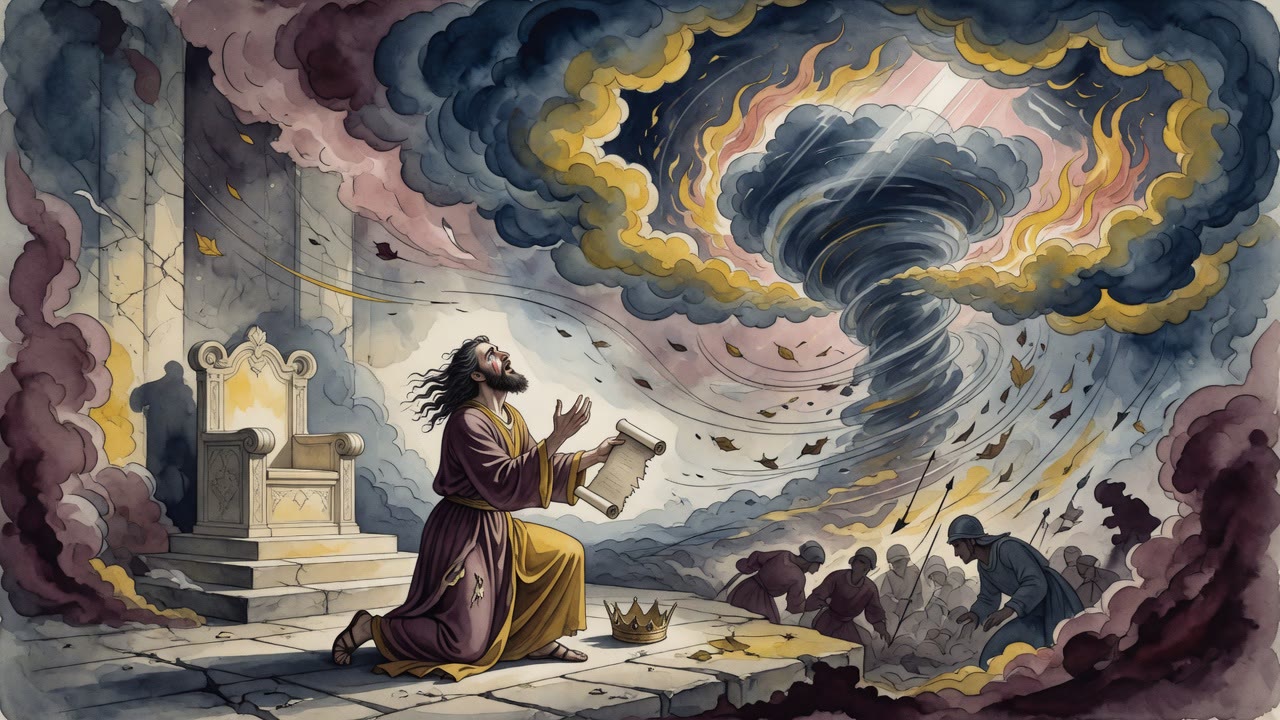
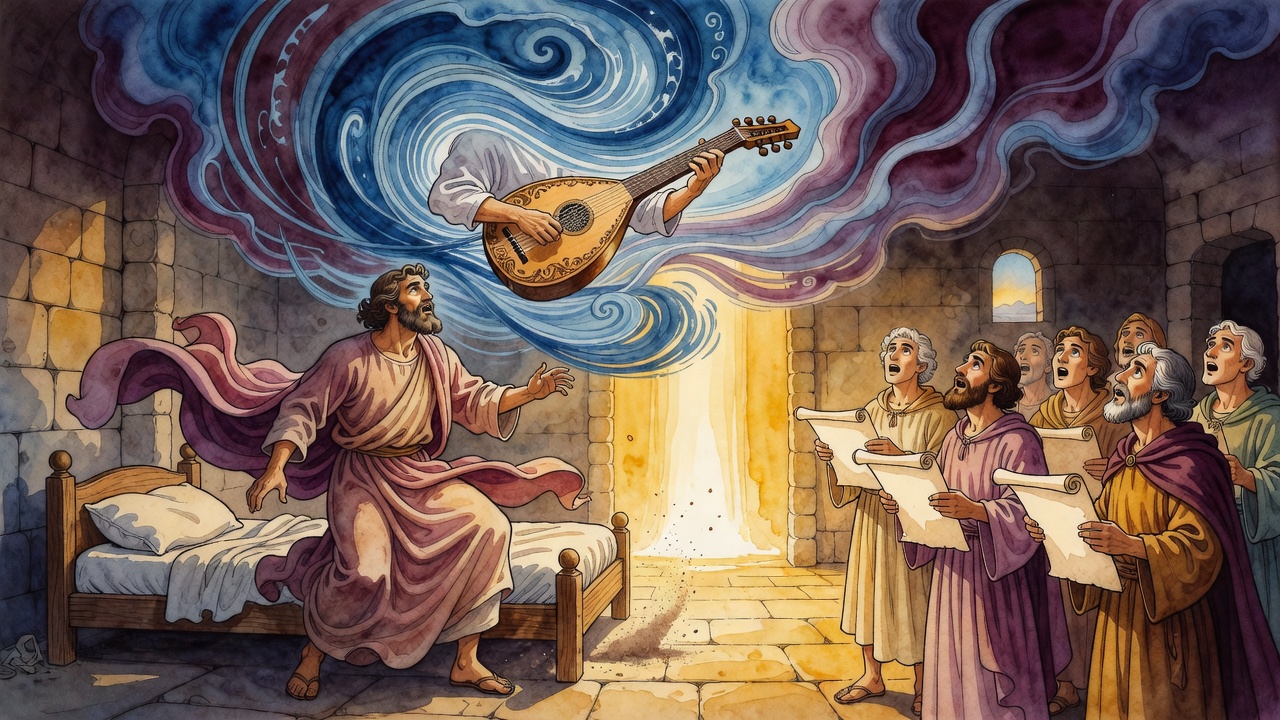
David hung a harp above his bed and slept with one ear open to the north window. Until midnight he slept the way a horse sleeps, lightly, never far from waking. Then the north wind entered the chamber without a servant's knock, found the strings, and drew them as cleanly as a finger with no flesh. No hand of man touched the wood. The king sat up in the dark, strengthened himself like a lion, and studied Torah until dawn came through the shutters.
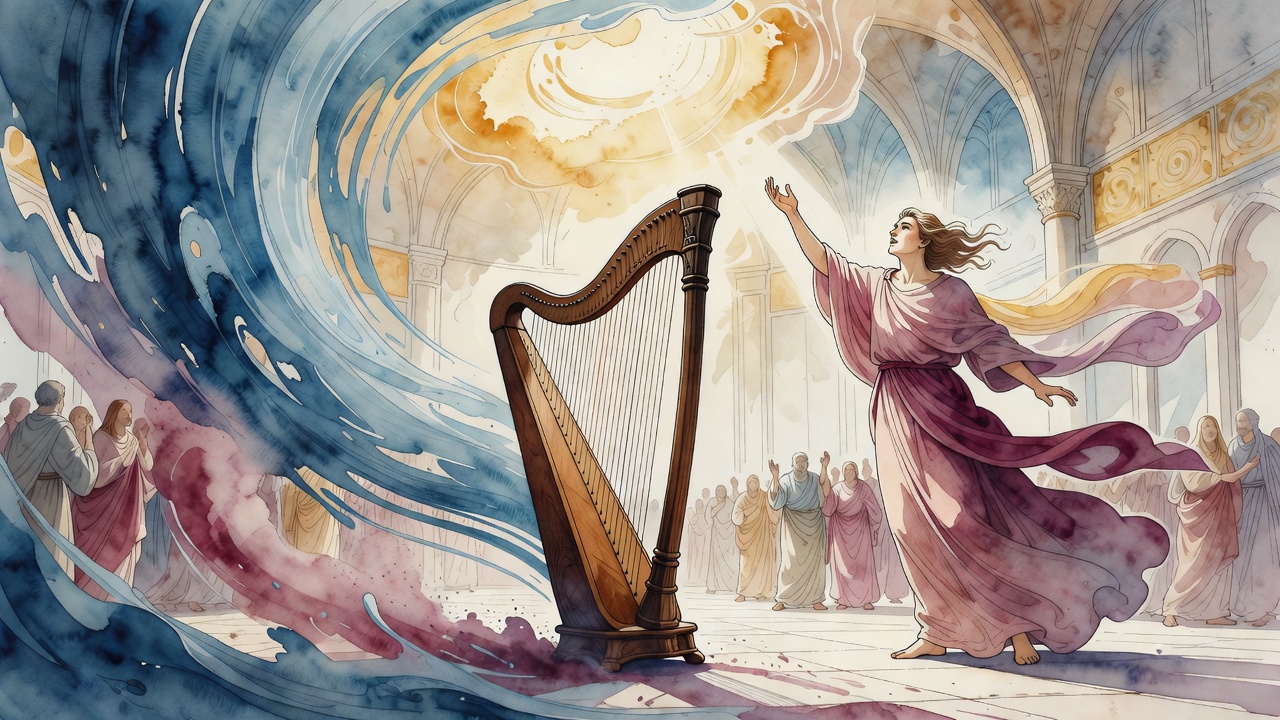
David's Harp Played Itself Every Midnight Click for full size

The Hour Only God Can Stand On

Midnight was not an arbitrary alarm. The plague of the firstborn had struck "at midnight" (Exodus 12:29), at the exact center of the night, the moment Egypt's grip on Israel cracked open. The sages taught that no created being can stand on that instant and know it; only the Holy One, blessed be He, divides the night at its true middle. David pondered the problem until it wearied his eyes (Psalms 73:16), then arranged his life around a moment he could not measure. "At midnight I rise to give thanks to You" (Psalms 119:62). If a man cannot find the hour, let the hour find him. The wind knew. The harp answered. David got out of bed.

Scholars Woke to a King's Music

Rabbi Pinchas told it one way: David kept harp and lyre beside his bed and rose at midnight to play them himself, and the sound carried. Scholars of Israel heard it in their houses and said, "If the king busies himself with Torah at this hour, how much more should we," and lamp answered lamp across Jerusalem until the whole city was studying in the dark. Rabbi Levi told it another way: a window stood open above David's bed, the harp hung across from it, and at midnight the wind came through and the instrument played itself, no fingers at all. Scripture does not say the instrument was played, the sages noticed; it says "when the instrument played" (2 Kings 3:15), as if the strings had their own intention. In one telling the king wakes the nation. In the other, heaven wakes the king. Either way, a city learned Torah at night because of a sound from one bedchamber.

Ashrei Hidden in the First Word

Later masters counted ten melodies waiting in those strings, and said the first of them was Ashrei. Fortunate. The word landed in the king's chest before it became a psalm, "Fortunate is the man" (Psalms 1:1). Then they found the same Hebrew letters folded into the first word of the Torah: Be-reshit, "In the beginning" (Genesis 1:1), carries Ashrei inside it the way a seed carries a tree. Creation opens on a blessing no throat has yet spoken. David sang it anyway, because the wind had already begun.

The mystics went further, into the body itself. The heart understands, the heart sees, the heart hears, they taught, and a wind lives in it, rising from the left ear of the heart like the breath behind speech. The five strings of the harp answered the five lobes of the lungs. When the north wind crossed the strings, it was playing the same instrument God strings inside every human chest. Breath became music, music became Torah, and there was no seam anywhere in it.

The Frog That Out-Sang the King

When the last of the hundred and fifty psalms was finished, David let himself feel the size of the work. "Master of the world," he said, "is there another creature in the universe that proclaims Your praise as I do?" A frog hopped up to him. "Do not be so proud," it said. "I have composed more songs than you, and every song I utter I accompany with three thousand parables." The croaking in the reeds, relentless, unpaid, performed for no court, praised God past counting. David heard it and understood what the harp had been telling him all along: the praise does not end because the songbook does. No finite number of psalms would ever finish it.

The King Who Finished at Dawn

When first light entered the room, the strings went quiet like a servant whose watch is done. David washed, dressed, and walked into the hall of judgment, where the elders and the cases were already waiting: poor men, rich men, women with torn claims. He judged until the sun found the eastern wall. A guard at the door saw only a king who rose early. He did not see the night half of the man, the student and the singer, walking ahead of the throne into the day's arguments.

The nights belonged to the harp. The days belonged to Israel. The wind kept the border between them exact, every midnight, for a lifetime. Jerusalem learned to sleep to the rumor of an instrument that needed no player, and a king learned that the heart is an instrument before it is a metaphor.


← All myths
From the tradition

Sources

7 sources

The texts behind this telling. Some cards carry a translation of the source; others are our own retelling of it, and each card says which. Every card links out to the original.

Berakhot 3bTalmud Bavli, Berakhot

Translation of the source text.William Davidson Edition - Vocalized Aramaic · CC-BY-NC

David had a sign for himself, for Rav Acha bar Bizna said that Rabbi Shimon the Pious said: A harp was hung above David's bed, and when midnight arrived, a north wind would come and blow upon it, and it would play of itself. Immediately he would arise and occupy himself with Torah until the rising of the dawn.

When the dawn rose, the sages of Israel would come in to him. They said to him: Our master the king, your people Israel need sustenance. He said to them: Go and sustain one another. They said to him: A handful does not satisfy the lion, and a pit is not filled from its own diggings. He said to them: Go and stretch out your hands with a troop.

Full source
Pesikta DeRav Kahana 7:1Pesikta de-Rav Kahana

Translation of the source text.Sefaria-hosted English translation · CC-BY

"And it came to pass at midnight" (Exodus 12:29). Rabbi Tanchum of Jaffa in the name of Rabbi Nunya of Caesarea opened: "When I sought to know this, it was too wearisome in my eyes" (Psalms 73:16). David said: No creature is able to fix the exact midpoint of the night except the Holy One, blessed be He; but as for me, it is too wearisome in my eyes. And since no creature is able to fix the exact midpoint of the night except Him, therefore it says, "And it came to pass at midnight" (Exodus 12:29).

Full source
Pesikta DeRav Kahana 7:4Pesikta de-Rav Kahana

Translation of the source text.Sefaria-hosted English translation · CC-BY

[4] "At midnight I rise to give thanks to You for Your righteous judgments" (Psalms 119:62). Rabbi Pinhas in the name of Rabbi Elazar son of Rabbi Menahem: What did David do? He would take a harp and a lyre and place them at his head, and rise at midnight and play upon them; and the sages of Israel would hear his voice and say, "If David the king occupies himself with Torah, we all the more so," and it would turn out that all Israel was occupied with Torah. Rabbi Levi said: There was a window over David's bed that opened to the north, and the lyre was hung opposite it, and the north wind would come forth at midnight and blow upon it, and the lyre would play of itself. This is the meaning of what is written, "And it came to pass, as the musician played" (2 Kings 3:16); "as one plays upon an instrument" is not said, but rather "as the musician played"; the lyre played of itself. And all Israel would hear his voice and say, "If David the king does so, we all the more so," and it would turn out that all Israel was occupied with Torah. This is what David said, "Awake, my glory; awake, O harp and lyre; I will awaken the dawn" (Psalms 57:9); awake, my honor, before the honor of my Creator; my honor is reckoned as nothing before the honor of my Creator. "I will awaken the dawn" (there), I awaken the dawn, and the dawn does not awaken me.

And his evil inclination would provoke him and say to him: David, it is the way of kings that the dawn awakens them, and you say, "I will awaken the dawn"; it is the way of kings to sleep until the third hour, and you say, "At midnight I rise to give thanks to You" (there, 119:62). And what is "for Your righteous judgments" (there)? For the judgments You brought upon Pharaoh the wicked and the righteousness You did with Sarah my grandmother, as it is written, "And the LORD afflicted Pharaoh with great plagues," and so forth (Genesis 12:17). Another interpretation: "for Your righteous judgments" (Psalms, there), for the judgments You brought upon the nations of the world, and for the righteousness You did with my grandfather and with my grandmother; for had she let slip down to her a single curse from below, from where would I have been standing? Rather, You placed in his heart a blessing: "Blessed are you to the LORD, my daughter" (Ruth 3:10). Another interpretation: "for Your righteous judgments" (Psalms, there), for the judgments You brought upon the Egyptians in Egypt, and for the righteousness You did with our fathers in Egypt; for they had no commandments in their hands by which to be redeemed except two commandments, the blood of the Passover offering and the blood of circumcision, as it is written, "And I passed by you and saw you wallowing in your blood, and I said to you, 'In your blood, live'" (Ezekiel 16:6); "in your blood," the blood of the Passover offering and the blood of circumcision.

Full source
Legends of the Jews 4:49Legends of the Jews

Retold in our words. Read the original at the link below.The Legends of the Jews by Louis Ginzberg (1909) · Public Domain

The Legends of the Jews, that monumental collection of rabbinic lore compiled by Louis Ginzberg, gives us a glimpse into David's life, painting him as both divinely inspired and wonderfully human. After pouring his heart and soul into completing the Psalter, David, overcome with joy, exclaimed, "O Lord of the world, is there another creature in the universe who like me proclaims thy praise?"

He'd crafted these beautiful, timeless poems of praise, lament, and everything in between. Surely, he thought, no one could match that.

Then, as the story goes, a frog hopped up to him. Yes, a frog. And this wasn't just any frog; this frog was apparently a master poet in its own right. "Be not so proud," the frog croaked, "I have composed more psalms than thou, and, besides, every psalm my mouth has uttered I have accompanied with three thousand parables."

That! ) out there with their own unique talents and contributions.

This little anecdote speaks volumes about David's character. While he was certainly capable of feeling pride in his accomplishments, as we all are, he was, for the most part, a model of humility.

We see further evidence of this in the coins minted during his reign. These coins bore a simple shepherd's crook and pouch on one side, and the Tower of David on the other. It was a deliberate choice, a constant reminder of his humble beginnings as a shepherd boy. Even as a king, he never forgot where he came from.

His bearing, too, remained humble, "as though he were still the shepherd and not the king." This wasn't just some act. It was a reflection of his inner character, his understanding that true greatness lies not in power or status, but in remaining grounded and connected to one's roots.

Perhaps it's a reminder to celebrate our achievements, to take pride in our work, but also to remain humble, to recognize the talents and contributions of others, and to never forget where we came from. After all, even a king can learn a thing or two from a frog.

Full source
Ein Yaakov, Berakhot 1:13Ein Yaakov, Berakhot

Retold in our words. Read the original at the link below.En Jacob, Agada of the Babylonian Talmud, S. H. Glick (1916-1921) · Public Domain

David did not trust himself to wake before dawn. He let the wind wake him.

In Ein Yaakov, Berakhot 1:13, the sages ask how David could say, "At midnight I rise to thank You" (Psalms 119:62). One answer says he never let half the night pass in sleep. Another says that until midnight he slept lightly, like a horse, and after midnight he strengthened himself like a lion.

Then the passage gives the image that made the story live. A harp hung above David's bed. At midnight, a north wind came and played it. The strings sounded on their own, and David rose to study Torah and sing praise.

The king's night is split in two. Before midnight, he gathers strength. After midnight, music turns his room into a sanctuary. He does not rise because servants shake him awake. He rises because creation itself has entered the chamber and touched the strings.

The myth makes prayer feel less like discipline alone and more like an appointment with the world. The wind knows when to arrive. The harp knows how to answer. David hears both and gets out of bed.

Full source
Tikkunei Zohar 53:21Tikkunei Zohar

Retold in our words. Read the original at the link below.Sefaria-hosted English translation · CC-BY

The Tikkunei (spiritual repair) Zohar, a mystical commentary on the Zohar, that foundational text of Kabbalah, invites us into just that kind of treasure hunt. It urges us to look beyond the surface, to find the interconnectedness of everything. In Tikkunei Zohar 53, we’re given a glimpse into the profound unity at the heart of creation.

The passage speaks of seven sephirot, divine emanations or attributes, that are included in the unity of the groom and the bride. This union, the text implies, is where holiness, blessing, and true unity reside. And where do we find this unity expressed? In the very bedrock of Jewish faith: the Shema, "Hear O Israel, the Lord our God, the Lord is One" (Deut. 6:4). It's not just a declaration; it's an invitation into oneness.

The passage doesn't stop there. It gets even more intriguing, delving into the mystical significance of King David's harp. Now, this isn't just any harp. The Talmud (BT Berakhot 3b) describes it as "the harp which plays by itself," awakening David with ten different melodies. The first of these melodies? Ashrei – "Fortunate."

This is where the wordplay begins, a classic Kabbalistic technique called Notarikon, where we unpack a word to reveal hidden meanings. The Tikkunei Zohar points out that the Hebrew word for "In the beginning," Be-REiShYT (Gen. 1:1), contains the letters of ASHReY, "Fortunate." It's as if the very act of creation is infused with this sense of blessedness, of good fortune!: the first word of the Torah, holding within it a blessing. It echoes in (Psalm 1:1), "Fortunate is the man.." Ashrei ha-ish. And the connections ripple outwards. The text then links this to the famous verse from (Exodus 3:14), God's self-declaration to Moses: EHYeH ASHER EHYeH, "I am that which I am." Or, as the Tikkunei Zohar puts it, EHYeH, "I am," is the head, the source, of all things. The passage equates this name with ASHeR EHYeH.

What's so powerful here? It's the idea that these seemingly disparate verses, these familiar phrases, are all interconnected. They're all part of a larger tapestry, woven together by the divine hand. It’s a potent reminder that everything is connected, that the beginning holds the seeds of blessing, and that the very essence of God is found within the fabric of creation.

According to Ginzberg's retelling in Legends of the Jews, the harp that played by itself was a gift imbued with divine power. As we find in Midrash Rabbah, everything in the world, even inanimate objects, can be imbued with the divine spark.

So, what does this all mean for us? Perhaps it's an invitation to listen more closely to the music of the universe, to see the hidden connections, to find the "fortunate" within the "beginning" of every day. Maybe it's a call to recognize that even in the simplest of phrases, the most familiar of stories, there are profound truths waiting to be discovered. Can we tune our own "harps" to hear the music of creation?

Full source
Tikkunei Zohar 55:12Tikkunei Zohar

Retold in our words. Read the original at the link below.Sefaria-hosted English translation · CC-BY

Tikkunei Zohar turns to David's Spiritual Journey.

It all starts with the heart. Not just as a metaphor for emotion, but as the very engine of understanding, perception, and even sound. The Masters of the Mishnah (the earliest code of rabbinic law) understood this intuitively, telling us that "the heart understands, the heart sees, the heart hears" (Berakhot 61a, Qohelet Rabbah 1:36). Three aspects, three ways the heart connects us to the world.

The Tikkunei Zohar takes this a step further. It sees in these three aspects a reflection of the Hebrew letter Hei (ה), which it links to breath itself. And then there's the "ruḥa of the mouth," the spirit-wind through which voice, utterance, and speech ascend. This, the text says, is the letter Vav (ו). image for a moment.

The mystery deepens as we consider (Ezekiel 1:12): "To wherever the ruaḥ was to go, they would go..." Just as in Ezekiel's vision, the arteries of the heart follow the spirit's lead. We find the ruaḥ – the wind, the spirit – residing within the heart, specifically emerging from the left "ear" of the heart.

And here’s where it gets really fascinating. The Talmud (Berakhot 3b) tells us it was "the northern wind that strummed upon David's harp." That same spirit, that same wind within the heart, is what allowed David to create his beautiful music.

But it doesn't stop there. With this spirit, David strummed the five strings of his harp, which the Tikkunei Zohar equates to the five "wings" or lobes of the lung. So, the breath, the spirit, the heart, the lungs, the harp – all interconnected, all working in harmony to create music.

What does it all mean? Perhaps that true creativity, true art, originates from the deepest, most vital parts of ourselves. It's not just about skill or technique, but about connecting to that inner ruaḥ, that divine spark within our own hearts. The music is already there, waiting for us to listen, to feel, and to let it flow. Maybe, just maybe, the song is already inside us all.

Full source