Parshat Emor6 min read

North Wind Played David's Lute at Midnight

Disciples slept near the threshold and woke to the scrape of the king's feet. No herald, no procession. They lit lamps and read until the morning star.

Curated by Arthur · Told by Maggid ·
Table of Contents
  1. The Wind That Would Not Let Him Sleep
  2. Trumpets for the Temple, Strings for the King
  3. Eight Strings and a Number That Climbs
  4. Until the Morning Star

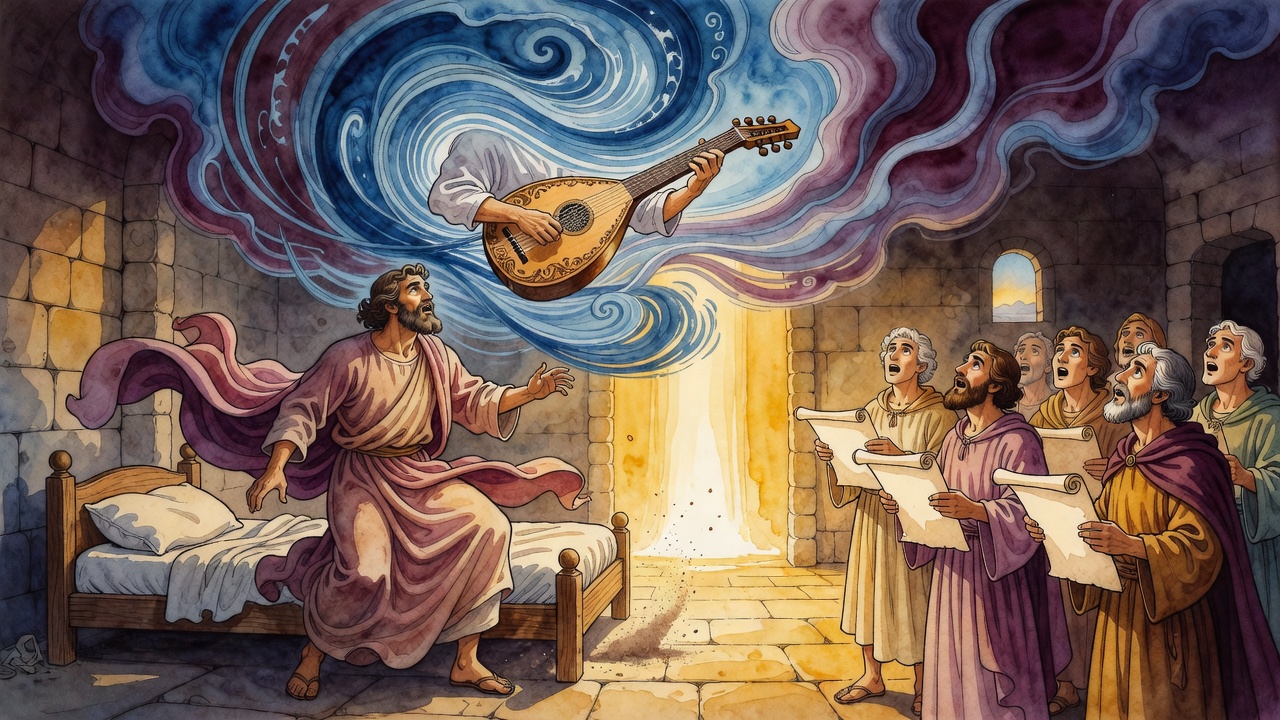
The lute hung on a peg above the royal bed, strings slack in the dark like a sleeping animal. David lay still, crown set aside, breath slow. Outside the palace the city of Jerusalem slept under a hard sky. Inside, something waited for midnight.
North Wind Played David's Lute at Midnight Click for full size

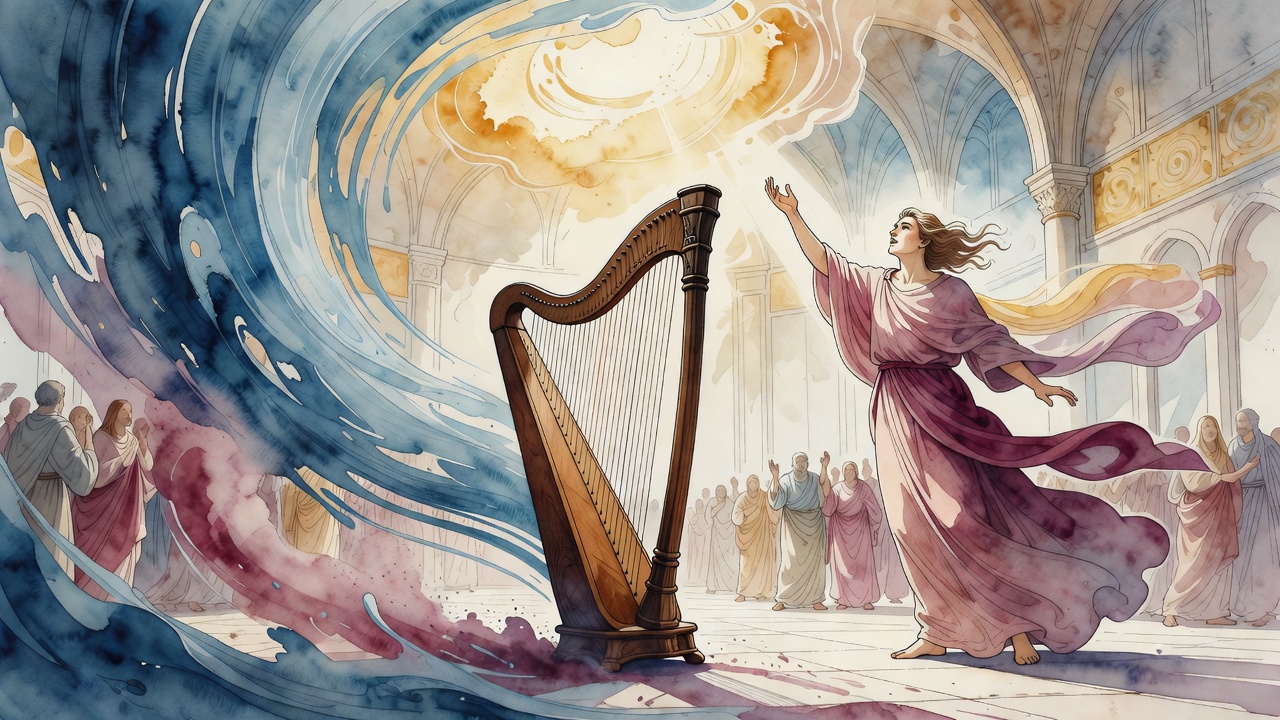
At the hour when the night divides, a north wind slid through the lattice. It found the strings. The instrument sang without a human hand.

The Wind That Would Not Let Him Sleep

Rabbi Pinhas the priest, son of Hama, kept the picture sharp. The lute did not wait for the king's mood. The wind played it, and the sound rose like a call more intimate than any trumpet blast from the Temple courts. David opened his eyes. The yetzer hara (evil inclination) that loves soft beds and long sleep had already lost the first argument of the night.

He rose. Disciples who slept near the threshold stirred at the scrape of his feet. No herald shouted. No courtier arranged a procession. The king who once calmed Saul with music now answered music that heaven had borrowed from the weather. They lit lamps. Scrolls came out. Until the morning star, the house that ruled Israel became a study hall with a crown on a chair.

"Awaken my honor. Awaken the harp and lute, I will awaken dawn" (Psalms 57:9). The verse was not poetry for festivals only. It was the order of the night: honor means the service of God first, sleep second. David did not wait for dawn to prove devotion. He forced dawn to find him already awake.

Trumpets for the Temple, Strings for the King

Elsewhere the law of instruments ran tighter. Certain blasts belonged to the Sanctuary. A king might craft silver for ceremony, yet the tradition draws a line: some sounds are Temple sounds, reserved, counted, not casually borrowed. Rav taught that those trumpets stayed bound to the holy place. David, for his private hours, turned to the lute.

The difference is not contempt for the Temple. It is the opposite hunger. The Sanctuary holds public time, national time, the hour of sacrifice. The lute holds the hour when no crowd watches and a man still decides whether his soul will keep pace with the wind. David claimed that hour as fiercely as he ever claimed a fortress.

His disciples learned the claim by imitation. A student who watches a king leave a warm bed for Torah does not need a sermon about priorities. The cold floor teaches. The unplayed silence after the wind dies teaches. When the last string stills, the work of speech and argument continues until light bleeds under the door.

Eight Strings and a Number That Climbs

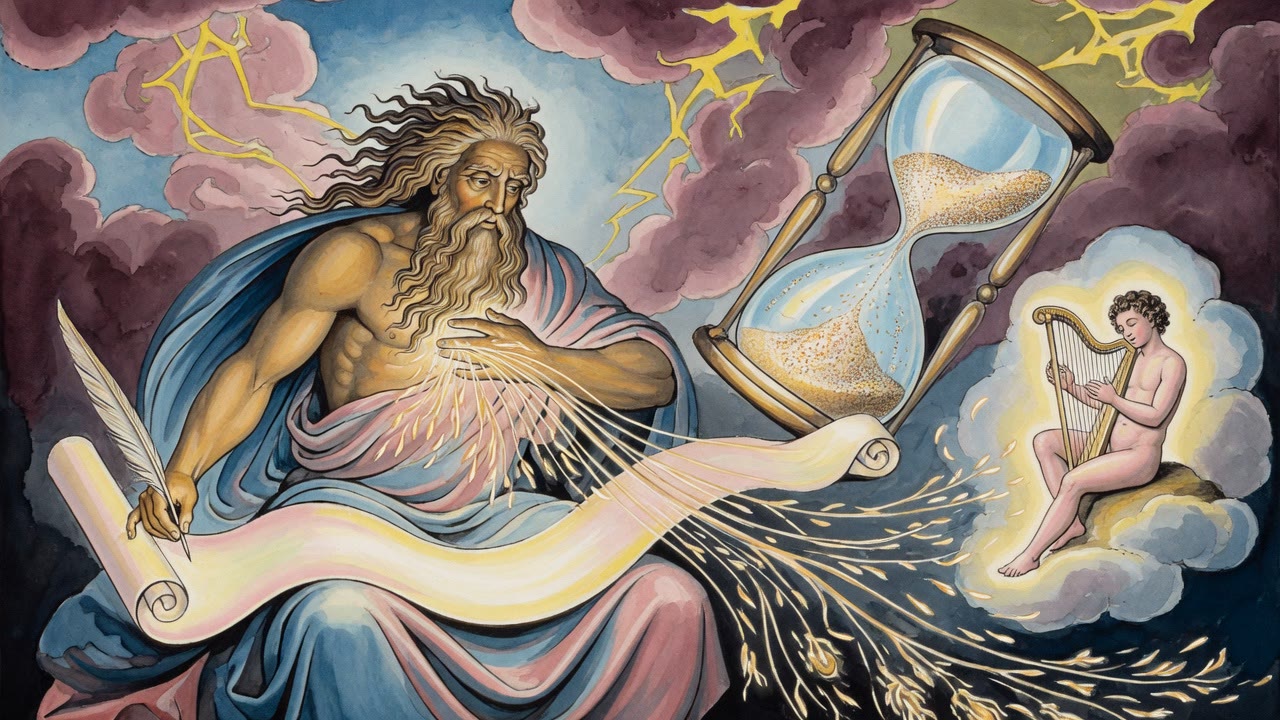
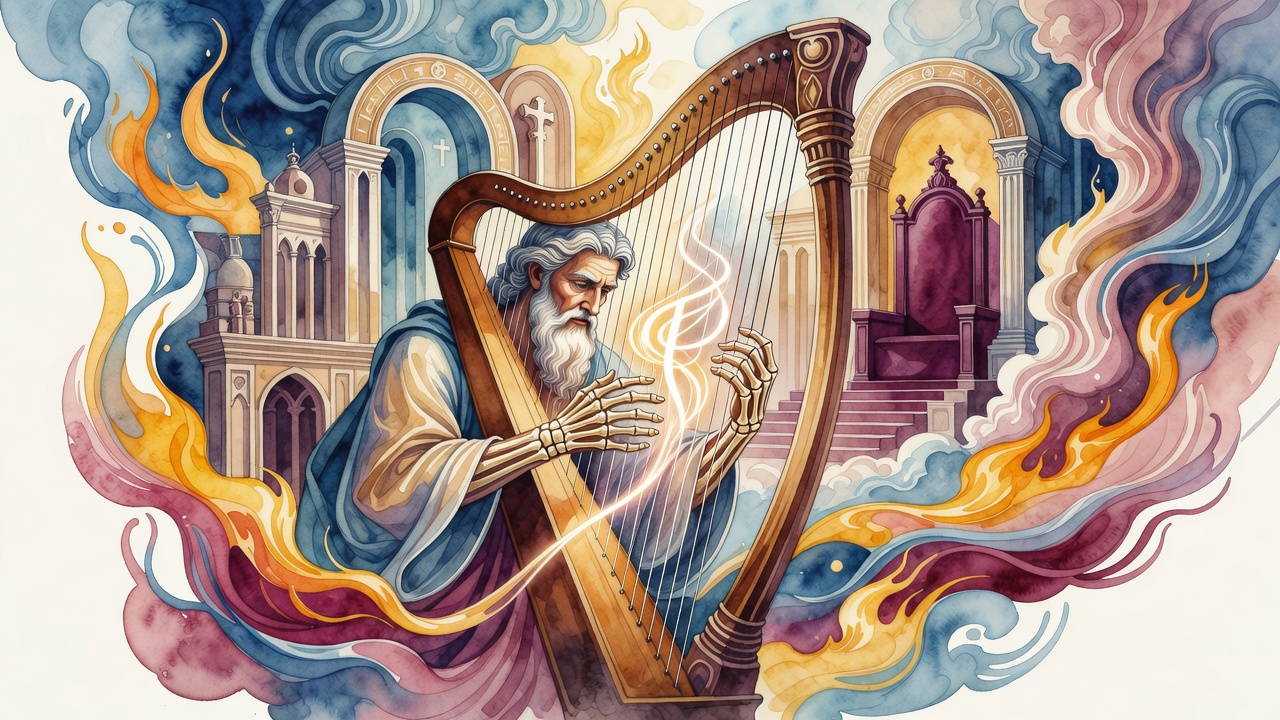
Later mystics heard more in David's craft. The Tikkunei Zohar speaks of a harp of eight strings, music aimed straight at the Holy One. Eight is not a random count. Psalm 12 opens with the conductor's mark "on the eighth," al ha-sheminit, and the sages of the Zohar treat the number as a gate into layered letter-work, eights nesting into eights until the count reaches seventy-two and the secret of hashmal (the amber brilliance of Ezekiel's vision) shimmers behind the math.

Whether the midnight lute and the eight-string harp are one instrument or two images of the same devotion, the pressure is identical. Music is not decoration for a pious reputation. It is a tool that wakes the body when the body would rather sink. David built an instrument that could receive a wind and answer heaven before the first sacrifice of morning.

A courtier might have called the habit eccentricity. The tradition calls it kingship. A ruler who can be summoned by a draft of air is a ruler who still knows he is ruled.

Until the Morning Star

Night after night the pattern held. Midnight. Wind. Song. Rise. Study. The evil inclination that argues for one more hour of sleep met a king who had already chosen the other side of the argument. When the morning star finally showed, the disciples closed the scrolls with hands that smelled of oil and dust, not of wasted hours.

Jerusalem woke to a city that did not know its king had already spent half the dark on Torah. The public day began. Courts opened. Messengers ran. Somewhere a priest prepared a Temple trumpet that only the Sanctuary may own. Somewhere else the lute hung again above the bed, quiet, waiting for the next north wind.

David's honor, the honor he ordered to awaken, was never a gold chain or a conquered hill alone. It was the refusal to let midnight pass without answering. The wind still moves across the hills of Judah. The story insists that once, at least, a king let that wind play him into rising, and kept rising until the light.

Some nights the wind failed, and David rose anyway. The peg above the bed held a quiet instrument, and the king treated silence as another kind of call. Disciples learned that heaven's nudge is a gift, not a requirement for obedience. A man who only prays when the weather helps him has not yet made honor his own.

In the hours before dawn the arguments of Torah ran long: cases of damages, songs of ascent, the memory of sheepfolds and caves when Saul hunted him. The lute had been with him in those years too, though the midrash loves the palace scene best. What began as a shepherd's tool became a royal alarm clock powered by air from the north, the direction of judgment and clear cold in many old maps of meaning.

When the morning star finally cut the dark, David sometimes set his hand on the strings himself and finished what the wind had started. The disciples heard both teachers: weather and king. Between them the city still slept, unaware that its ruler had already given half the night to the Name.


← All myths
From the tradition

Sources

2 sources

The texts behind this telling. Some cards carry a translation of the source; others are our own retelling of it, and each card says which. Every card links out to the original.

Bamidbar Rabbah 15:16Bamidbar Rabbah

Retold in our words. Read the original at the link below.The Sefaria Midrash Rabbah, 2022 · CC-BY

The verse reads, "Craft for you – you use them, as you are king, but no one else may use them other than King David." This refers to instruments, likely trumpets, initially reserved for the Temple. However, the narrative quickly focuses on King David and his extraordinary devotion.

Rav says these trumpets were only for the Temple, but David used a lute. Why? Because, as it says in (Psalms 57:9), "Awaken my honor. Awaken the harp and lute, I will awaken dawn." But this wasn't just David strumming a tune before sunrise. Rabbi Pinḥas HaKohen (a priest) bar Ḥama paints a vivid picture: a lute hung above David's bed, and at midnight, a north wind would cause it to play on its own! This wasn't magic, but rather a symbol, a divine nudge. Immediately, David and his disciples would rise, dedicating themselves to Torah study until the morning star appeared.

David's words, "Awaken my honor," become a powerful mantra. What does it mean to "awaken my honor"? The text explains that it means prioritizing the service of God above all else. David's yetzer hara (the evil inclination), his "evil inclination" or inner critic, would whisper, "David, you're a king! Sleep in!" But David would respond, "Awaken my honor. My honor is nothing before the honor of my Creator."

The king, the most powerful person in the land, choosing to deny himself earthly comforts for spiritual devotion. This passage challenges us to consider what truly motivates us. What are we willing to sacrifice for what we believe in?

David's commitment extended even further. "At midnight, I rise to give thanks to You," he proclaims in (Psalms 119:62). He felt obligated to rise at midnight to praise God for the wonders performed for his grandmother, Ruth, as described in the Book of Ruth (3:8-9). Remember the story? Ruth approaches Boaz at night. "It was midnight, and the man was startled and recoiled…she said: I am Ruth, your maidservant."

The story takes an unexpected turn. Rabbi Yehoshua ben Levi ben Rabbi Shalom explains that when Boaz tells Ruth to "sleep tonight" (Ruth 3:13), she interprets it as a dismissal. Boaz then swears an oath, "As the Lord lives" (Ruth 3:13), to reassure her. This oath, the text emphasizes, wasn't just for Ruth's benefit. It was a way for Boaz to control his own yetzer hara. The text makes the bold claim that "all the righteous people administer oaths against their evil inclination."

This idea of the oath resurfaces with David and Saul. When Saul falls into David's hands, David proclaims, "As the Lord lives; rather, the Lord will strike him, or his day will come…[Far be it from me, before the Lord, to extend my hand against the anointed one of the Lord]" (I (Samuel 26:10)–11). Rabbi Shmuel bar Naḥmani explains that David took two oaths because his yetzer hara tempted him with the justification of self-preservation.

The passage then broadens its scope, addressing the universal struggle against the yetzer hara. Israel pleads before God, acknowledging the overwhelming power of this inner voice. God responds with a promise: "Clear it away a little in this world, and I will remove it from you in the future," as it is stated in Isaiah (62:10 and 57:14). This idea culminates with the promise of ultimate redemption: "I will remove the heart of stone from your flesh, and I will give [you a heart of flesh]" (Ezekiel 36:26).

So, what are we left with? The story of David and Ruth, of oaths and midnight awakenings, ultimately points to the ongoing battle within ourselves. It’s a reminder that even the most righteous figures faced temptation and had to actively fight against their baser instincts. And it offers a glimmer of hope: that one day, we will be freed from this internal struggle, and our hearts will be truly open to the divine. Perhaps the real question isn't if we have a yetzer hara, but how we choose to confront it.

Full source
Tikkunei Zohar 102:11Tikkunei Zohar

Retold in our words. Read the original at the link below.Sefaria-hosted English translation · CC-BY

The Tikkunei (spiritual repair) Zohar, a central text of Kabbalah, unlocks some fascinating mysteries about King David’s instrument and the music that rises to the heavens. According to this mystical work, David crafted a harp with eight strings, and through it, he sang praises to the Holy One, blessed be He.

The number eight itself is significant. The Tikkunei Zohar connects it to the verse from Psalm 12, "To the conductor: on the eighth..", al ha-sheminit in Hebrew. But it doesn't stop there. The text explores a complex numerical and linguistic code. There are eight letters, and associated with each one are eight more, totaling 72. These are represented by the Hebrew letters Yod-Aleph-Qof-Dalet-Vav-Nun-Qof-Yod. Each letter has eight connected to it, totaling 72, and this, the Tikkunei Zohar reveals, is the secret of ḥashmal.

Ḥashmal… It’s one of those Kabbalistic terms that’s hard to pin down with a single word. It evokes a sense of shimmering, divine energy, a connection between the earthly and the celestial. This number game isn't just arbitrary; it’s about understanding the hidden architecture of creation.

The music doesn't stop at eight. The Tikkunei Zohar also speaks of music ascending through ten. This is linked to the letters Yod-Qof-Vav-Qof, and it is connected to the verse in Song of Songs (5:14): "His hands are rods of gold." It's a vision of divine beauty and power, expressed through musical ascent.

And then, there’s the music that ascends through six. This, the Tikkunei Zohar says, is alluded to in another verse from Song of Songs (5:15): "His thighs are pillars of 'shesh' [marble/six]." Here, shesh can be understood both as the material – marble – and the number six. It's like a hidden layer of meaning, embedded within the words themselves.

So, what does all of this mean? It’s not just about math or music theory. The Tikkunei Zohar is revealing to us that there are pathways, musical pathways, that lead us closer to understanding the divine. King David’s harp, with its carefully chosen number of strings and the songs he played upon it, was a vehicle for ascending through these numerical and spiritual realms.

It invites us to listen more deeply, to look beyond the surface, and to find the hidden harmonies within ourselves and the world around us. Maybe, just maybe, we can all find our own instruments, our own songs, to help us ascend.

Full source