Parshat Terumah6 min read

Solomon Trapped Asmodeus and Lost His Throne

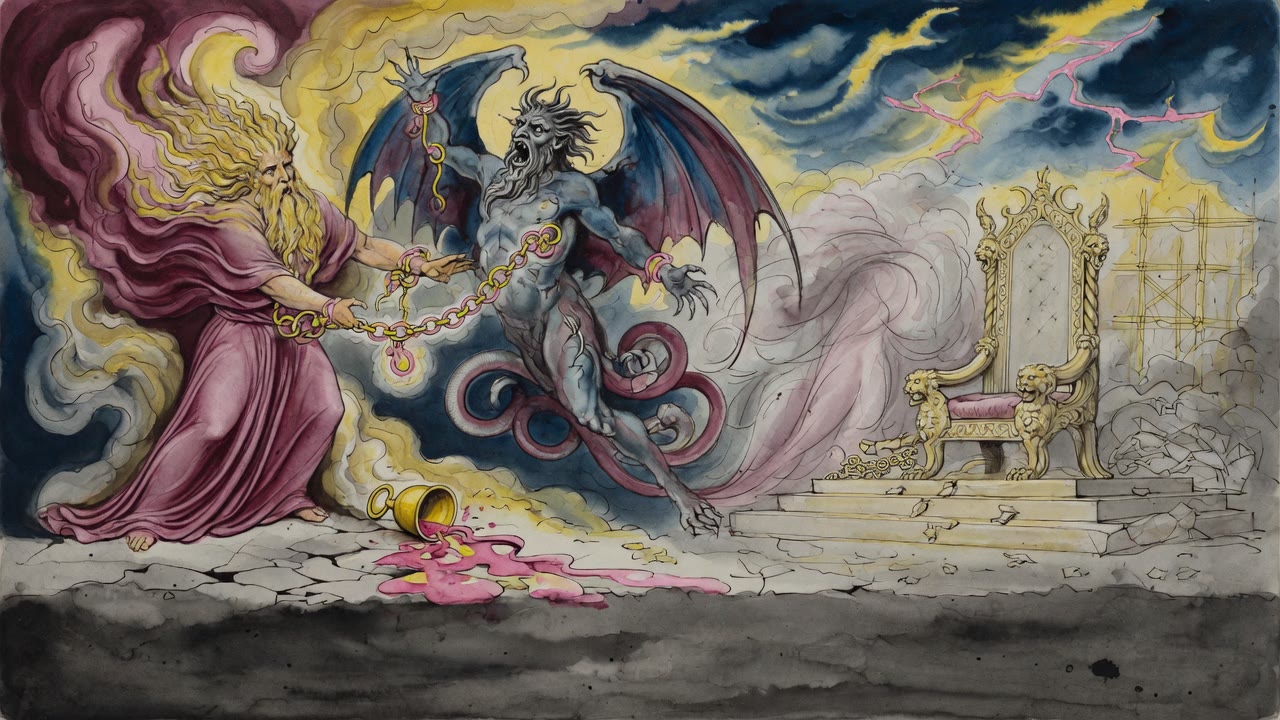
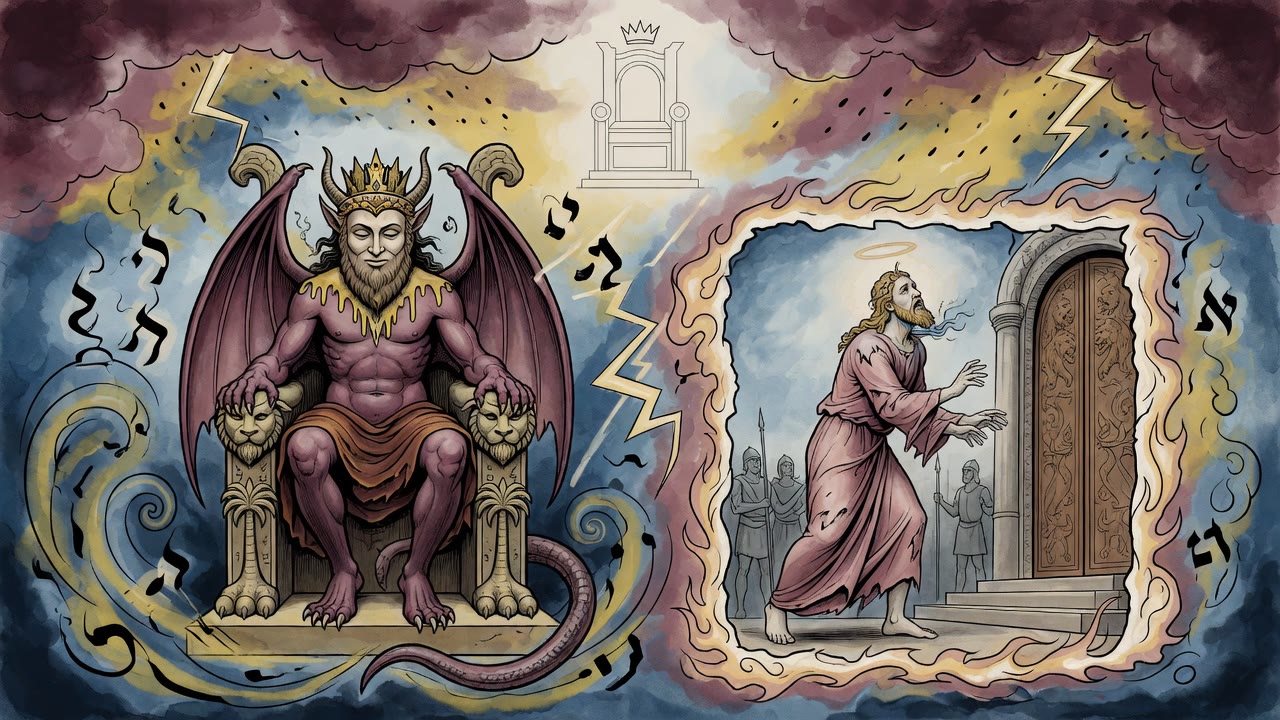
Solomon needed a demon to build the Temple. He caught the king of demons with wine, used him, then kept him chained. The demon got his revenge.

Curated by Arthur · Told by Maggid ·
Table of Contents
  1. The Wine Trap at the Well
  2. The Shamir and What It Cost
  3. The Throne That Made Men Fall
  4. The Ring in the Sea
  5. What Remains After Mastery

The Wine Trap at the Well

Benaiah son of Jehoiada stood at the mouth of a well in the wilderness with an unusual kit: a chain inscribed with the Name of God, a ring bearing the same inscription, a bundle of wool, and a skin of wine. He had been sent by King Solomon himself, and his orders were to bring back the king of demons alive. The task was to find Asmodeus at his regular watering hole and catch him.

Benaiah bored a hole from below to drain the well, filled it with wine, and hid in the nearby trees. Asmodeus came down from the sky at his usual hour, saw the wine instead of water, and hesitated. He knew something was wrong and refused it at first, quoting scripture against intoxication. But thirst eventually won. He drank deeply, fell asleep, and Benaiah bound him with the engraved chain before he could wake. When Asmodeus stirred and found himself chained, he did not rage. He submitted. He knew the Name on the chain. There was nothing to do but walk to Jerusalem in chains behind a human soldier.

The Shamir and What It Cost

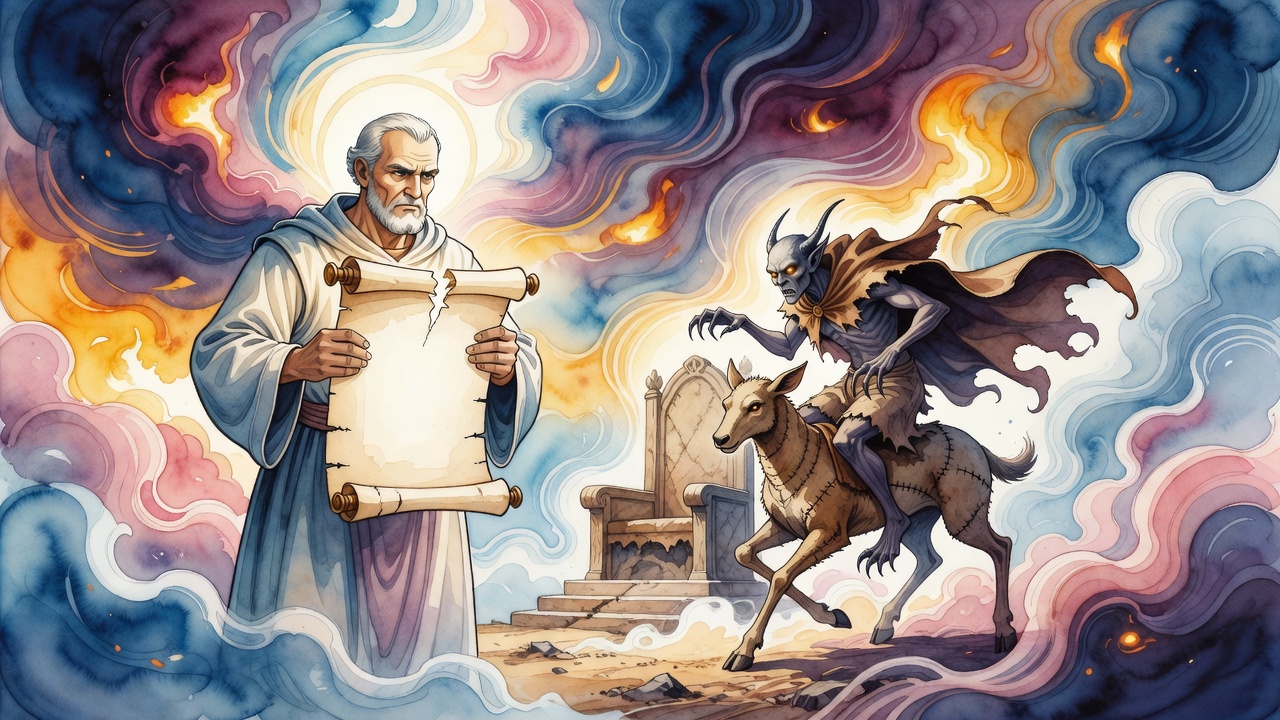
Solomon needed Asmodeus because of a problem no craftsman could solve. The Torah forbade the use of iron tools on the altar's stones, but the Temple required perfectly cut stones from the quarry. No chisel could touch them. The scholars reminded Solomon that Moses had once possessed the shamir, a creature of extraordinary power, a worm no larger than a barleycorn whose gaze could split granite as easily as parchment.

Solomon asked Asmodeus where the shamir could be found. The demon explained that God had given it to the Angel of the Sea for safekeeping, and the Angel of the Sea had entrusted it to a moor-hen, a desert bird that had sworn on oath to guard it. The moor-hen used the shamir to split open mountainsides so she could plant vegetation in rocky soil and feed her young. Solomon's men found the moor-hen's nest, covered it with glass while she was away, and waited. She returned, found her nest sealed, and flew off to fetch the shamir to cut through the glass. When she applied it, Solomon's agent rushed from hiding and she dropped the shamir in shock. She had broken her oath. The legends say she killed herself rather than live with the failure. The Temple could now be built in silence, stone shaped by a worm's touch rather than iron.

The Throne That Made Men Fall

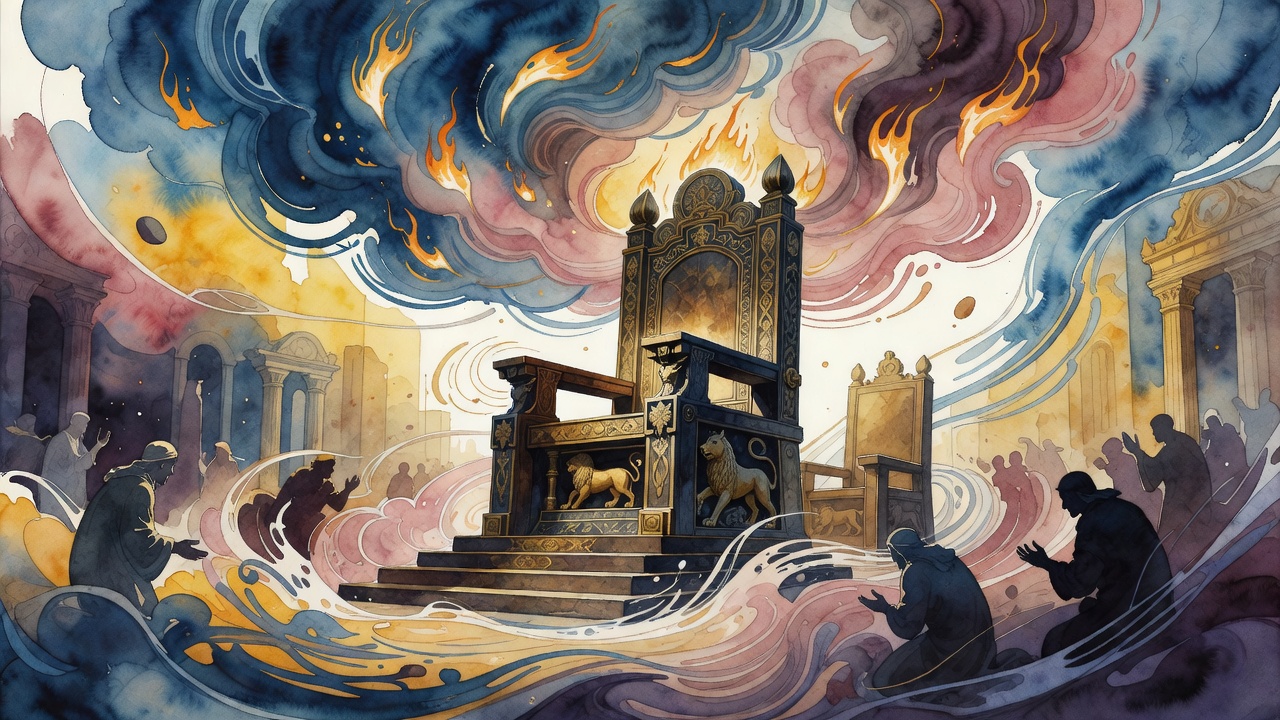
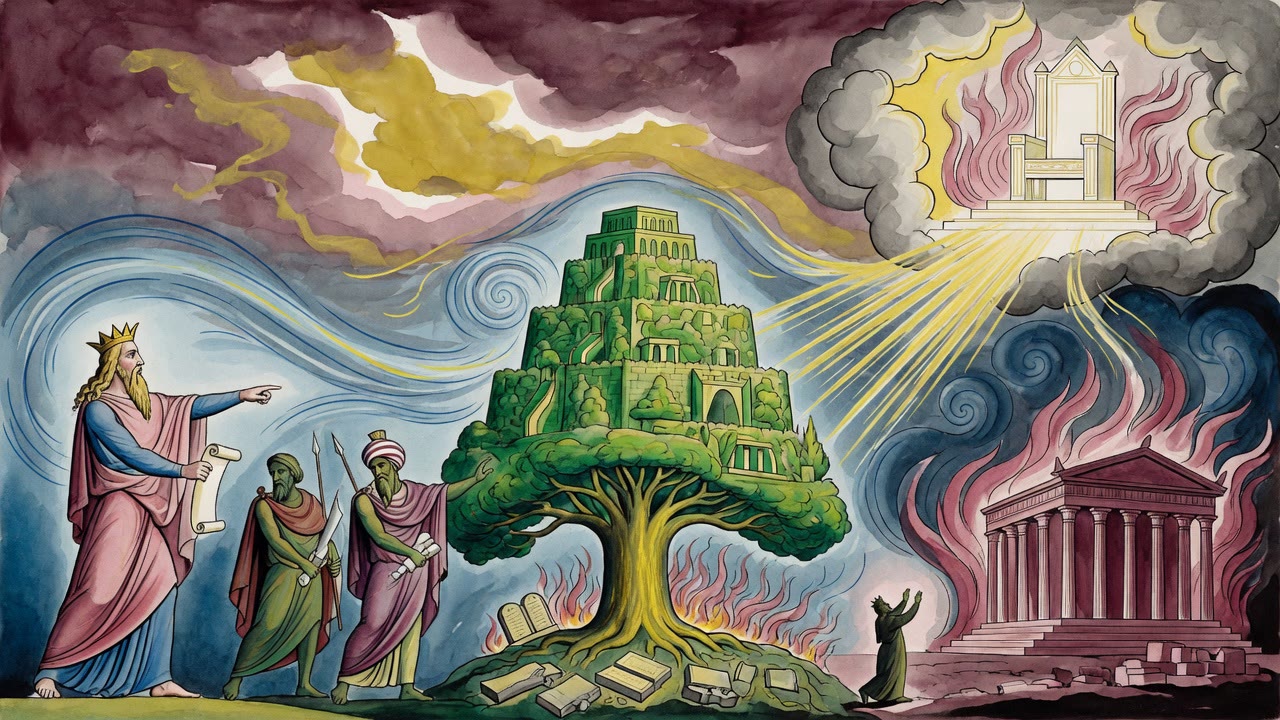
With the Temple complete, Solomon built himself a throne that the world could not duplicate. It stood on six golden steps, each guarded by paired animals in gold: lions and eagles, oxen and bears, and at the top, two golden lions flanking the seat. When Solomon placed his foot on the first step, the lion and eagle at that step lifted his foot forward. At each level, the animals repeated the gesture, bearing him upward to his seat. Twelve golden lions lined the steps, and above the throne hung a golden eagle with a lamp in its beak. When foreign kings came to visit and saw the animals move, they fell forward onto their faces in astonishment. No craftsman in any nation could reproduce it.

Solomon kept Asmodeus in chains after the Temple was finished. He kept him as a curiosity, as proof of his mastery over the spirit world, and perhaps because he could not resist the possession. Asmodeus submitted with apparent patience. He had learned what patience could accomplish.

The Ring in the Sea

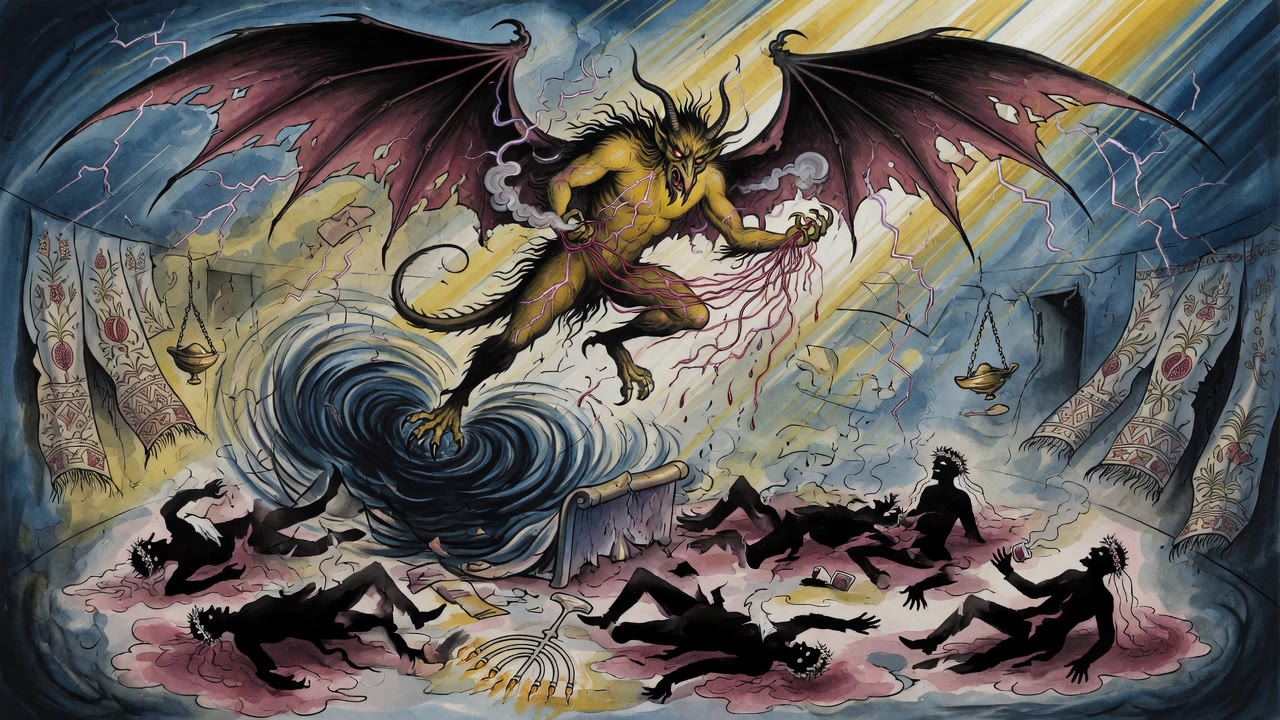
Asmodeus proposed a test one afternoon. He told Solomon that a true king should not fear to release his captive for a moment, if only to see how great Solomon truly was compared to the king of demons. Solomon removed his ring and handed it over. The instant the ring left his finger, Asmodeus stood at his full height, which reached from earth to the clouds. He seized Solomon with one hand, flung him four hundred leagues away, and installed himself on the throne wearing Solomon's face and voice.

Solomon wandered as a beggar for years, carrying nothing but his staff, announcing in every town that he had once been king of Israel. Nobody believed him. He eventually worked his way to a kitchen and from there, through acts of skill and courage, back into the palace. He recovered his ring, which had been swallowed by a fish that ended up in the kitchen. He touched the ring to the throne and Asmodeus fled. Solomon sat down again, but he was quieter. He had learned what a ring is worth and what its absence costs.

What Remains After Mastery

In his old age, Solomon looked back at everything he had accumulated: the Temple, the throne, the wisdom, the seven hundred wives and three hundred concubines, the golden lions, the controlled demon. He wrote down what he saw. The book records his conclusion: vanity of vanities, all is vanity. The breath dissipates. The striving leaves nothing behind. Not even a throne that moves by itself is permanent. The demon had gotten free. The ring had changed hands. The king had slept in ditches. What remained after all that wisdom was the question itself, unanswered, blowing like vapor through an otherwise empty room.


← All myths
From the tradition

Sources

9 sources

The texts this telling draws on, in full. Open a card to read inline, or expand it for a wider, quieter read.

Legends of the Jews 5:132Legends of the Jews

Solomon needed help, immense supernatural help, and he knew just where to find it.

The task of capturing Asmodeus fell to Benaiah, son of Jehoiada, Solomon’s most trusted and valiant servant. This wasn't your average "go get the milk" errand. Benaiah was equipped with some rather unusual tools: a chain engraved with the Shem HaMephorash, the explicit Name of God; a ring bearing the same sacred inscription; a bundle of wool; and a skin full of wine. An odd shopping list. Benaiah found Asmodeus’s usual watering hole – a well. Cleverly, he bored a hole from below to drain the water, plugged it with the wool, and then filled the well with wine. Imagine Asmodeus's surprise when he came down from heaven, expecting a refreshing drink of water, only to find… Cabernet Sauvignon?

At first, Asmodeus hesitated. According to Ginzberg’s retelling in Legends of the Jews, he even quoted Bible verses railing against the evils of wine, trying to bolster his resolve. But thirst, as they say, is a powerful thing. He succumbed, drank deeply, and fell into a stupor.

That's when Benaiah sprang into action. Hiding in a tree, he watched until Asmodeus was completely out, then leaped down and chained the demon's neck. When Asmodeus woke and tried to break free, Benaiah simply invoked the power of the Name: "The Name of thy Lord is upon thee!" And just like that, the mighty Asmodeus was subdued.

But the journey back to Solomon was anything but smooth. Asmodeus, though captive, still possessed immense power. He brushed against a palm tree, and it was uprooted. He bumped into a house, and it crumbled. When a poor woman pleaded with Benaiah to steer the demon away from her hut, Asmodeus begrudgingly obeyed but broke one of her bones in the process. "Is it not written," he quipped, with a grim sort of humor, "'A soft tongue breaketh the bone?'" (Proverbs 25:15).

The Zohar paints a vivid picture of demons having a complex, almost paradoxical nature. We see glimpses of this complexity in Asmodeus's actions. He guided a blind man back onto the right path and showed similar kindness to a drunkard. Yet, he wept when he saw a wedding procession pass by and laughed at a man ordering shoes to last seven years and at a magician performing tricks. What are we to make of these strange reactions?

The Talmud (Gittin 68a-b) expands on this, detailing Asmodeus's eventual assistance in building the Temple, revealing secrets of construction known only to demons.

Perhaps his tears at the wedding stemmed from an understanding of the fleeting nature of happiness, or maybe envy at the joy he could never experience. His laughter at the shoemaker and the magician? Perhaps he saw the futility in their long-term plans and shallow deceptions, knowing the grand cosmic scheme in ways humans couldn't.

Asmodeus's story, as we find it in Midrash Rabbah, isn’t just about capturing a demon. It's about the complexities of good and evil, the blurry lines between wisdom and foolishness, and the surprising places where we might find help, even from those we least expect. It also reminds us that even the mightiest can be brought low by simple human desires… like a really good glass of wine.

What do you think? Does this story suggest that even demons have a role to play in the divine plan, or is it simply a cautionary tale about the dangers of unchecked power?

Full source
Legends of the Jews 5:134Legends of the Jews

One such legend, recounted in Ginzberg's Legends of the Jews, involves a mythical creature of immense power: the shamir. The shamir? What’s that? Imagine a tiny worm, or perhaps a stone, possessing the ability to cut through the hardest substances known to humankind. Diamonds? Granite? Child’s play for the shamir!

The Asmodeus says the king of demons, who, in this story, is in thrall to Solomon, the shamir wasn't just lying around. Oh no. It was entrusted by God himself to the Angel of the Sea. And that angel? He wasn't handing it out to just anyone. He entrusted it to… a moor-hen. Yes, a bird. But not just any bird. This moor-hen had sworn an oath to protect the shamir with her life.

Why a moor-hen, you ask? Well, the story explains that the moor-hen used the shamir for a vital purpose. She would fly to desolate, uninhabited mountains, use the shamir to split the rocks, and then plant seeds in the cracks. These seeds would then grow, covering the barren landscape with vegetation, making it habitable. A tiny creature, doing monumental work.

So, Solomon, ever the resourceful king, devised a plan. He sent a servant to find the moor-hen's nest and cover it with a piece of glass. When the mother bird returned, she was distraught! She couldn't reach her young. Driven by maternal instinct, she flew off and retrieved the precious shamir, placing it on the glass in an attempt to break through.

That's when the servant sprung his trap. He let out a shout, startling the bird so badly that she dropped the shamir and flew away in a panic. The servant grabbed the coveted prize and brought it back to Solomon.

Success. Solomon had the shamir! But here's where the story takes a somber turn. The moor-hen, realizing she had broken her sacred oath to the Angel of the Sea, was so overcome with grief and shame that she… committed suicide.

A pretty heavy ending. What are we supposed to take from this?

This legend, found in Legends of the Jews, isn't just a cool story about a magical worm. It’s a poignant exploration of responsibility, the weight of oaths, and the lengths to which creatures will go to fulfill their purpose. It also highlights the cost, sometimes, of achieving even the noblest goals. The shamir helped build the Temple, but at what price? It leaves you pondering the delicate balance between ambition and ethics, doesn't it? And the unexpected heroes, or heroines, who often hold the keys to unlocking the extraordinary. In this case, a seemingly ordinary moor-hen, entrusted with a power that shaped the very landscape.

Full source
Legends of the Jews 5:131Legends of the Jews

It wasn't a sudden plunge, but a slow slide fueled by choices… and a little help from the King of Demons himself.

In Legends of the Jews, Solomon’s troubles began to snowball. while he was building the Temple – that magnificent, awe-inspiring Temple – he ran into a bit of a problem. The Torah is very clear that you can’t use iron tools when you’re building an altar (Exodus 20:25). So how was he supposed to shape the stones from the quarry to fit perfectly?

The scholars reminded him of something fascinating: Moses had used the shamir, a mythical stone with the power to split rocks, to engrave the names of the tribes on the precious stones of the ephod – that ceremonial breastplate worn by the High Priest. The shamir. But where could Solomon find such a thing?

He turned to his demons, as you do when you're a king with supernatural connections. But even they were stumped! They knew of its existence, but not its location. Finally, though, they offered a clue. They suspected that Asmodeus, King of the Demons, held the secret. They even knew where he lived: a specific mountain.

The demons described Asmodeus' peculiar habits. On this mountain, there was a well, Asmodeus’ source of drinking water. Every day, before ascending to heaven – yes, even demons apparently attend heavenly academies to debate Torah – he would seal the well with a large rock. He’d check the seal when he returned, making sure it hadn’t been disturbed before taking a drink. Imagine the life of a demon king!

So, how does this detail about a well and a rock tie into Solomon's downfall? Well, it’s the beginning of a fascinating story involving trickery, ambition, and the subtle ways even the wisest of us can be led astray. We’ll see how Solomon’s quest for the shamir, and his interaction with Asmodeus, would eventually contribute to the heavy price he had to pay for his sins. As we'll find out, sometimes the most seemingly insignificant detail can be the thread that unravels everything.

Full source
Legends of the Jews 5:105Legends of the Jews

It wasn't just a place to sit, according to tradition. It was a masterpiece. A wonder of the ancient world that showcased not just royal power, but also divine wisdom. The legends surrounding this throne, passed down through generations, paint a picture of breathtaking splendor.

Forget your everyday chair.

The story goes that Solomon’s throne, standing proudly next to the Temple in Jerusalem, was more than just a seat of power. It was a symbol of his unparalleled wisdom and glory. The text in Legends of the Jews details how no one before or after Solomon could ever replicate such a work of art. an object so unique, so stunning, that it defied imitation.

When visiting kings, Solomon's vassals, laid eyes on this marvel, they were reportedly overcome. They didn't just admire it. They fell to their knees, praising God. Imagine the sheer presence, the overwhelming aura of the throne, to inspire such reverence.

How was it constructed? Pure opulence. The throne was covered in the finest gold from Ophir, a legendary source of precious metals. It sparkled with beryls, shimmered with inlaid marble, and blazed with emeralds, rubies, pearls, and all manner of gems. It sounds less like furniture and more like a celestial object brought down to earth.

But the details are what truly bring the throne to life. The throne had six steps, and on each step stood two golden lions and two golden eagles, a lion and an eagle to the left, and a lion and an eagle to the right. The pairs faced each other, the right paw of the lion positioned opposite the left wing of the eagle, and the left paw opposite the right wing.

What a striking image that evokes! A powerful symmetry. A balance of strength and grace. And at the very top, ready for the king, was the royal seat, perfectly round.

What did it all mean? Why such extravagant details? Perhaps the animals represented the power and dominion of Solomon's kingdom. Maybe the gems symbolized different virtues or aspects of divine wisdom. The round seat might have been a visual representation of the unending nature of his reign. We can only speculate, looking back through the mists of time and legend.

Solomon's throne wasn't just furniture. It was a statement. A evidence of an era of unprecedented peace, prosperity, and wisdom. It's a reminder that sometimes, the stories we tell about objects are just as important as the objects themselves. They carry meaning, inspire awe, and help us understand the values of a culture.

So, the next time you see a throne (or even just a really fancy chair), remember Solomon's throne. Remember the legends. Remember the power of a single object to capture the imagination of generations. Maybe, just maybe, there's a little bit of magic hidden in plain sight.

Full source
Legends of the Jews 5:135Legends of the Jews

We talked before about how King Solomon, wisest of men, tricked Asmodeus into revealing the secret of the shamir, the magical worm that could cut stone for the building of the Temple (Ginzberg, Legends of the Jews, Vol. 4). But the story doesn’t end there. Solomon, never one to miss an opportunity, kept Asmodeus around even AFTER the Temple was finished.

Can you imagine the chutzpah? "Hey, thanks for the help, but you know, I'm still not convinced demons are all that great if I can keep you locked up." That’s basically what Solomon said, according to the legends. Asmodeus, naturally, wasn’t thrilled.

"Greatness, huh? You want to see greatness?" the demon king retorted. He proposed a deal. If Solomon would just remove his chains and lend him his magic ring – the very ring that gave Solomon power over the supernatural – Asmodeus would show him what real power looked like. Big mistake, Solomon. Huge.

Solomon, ever the curious (and perhaps a bit arrogant) king, agreed. The moment Asmodeus was free, he transformed. Picture this: one wing stretched all the way to heaven, the other scraping the earth. A colossal, terrifying figure.

And then, in a flash, he snatched up Solomon – who, remember, had foolishly parted with his protecting ring – and flung him four hundred parasangs away from Jerusalem! A parasang? That's an ancient Persian unit of distance, somewhere around 3-4 miles. So, we're talking over a thousand miles! Poof! Gone.

Then, Asmodeus, in the ultimate power move, impersonated Solomon and took his place as king. Talk about a hostile takeover!

The sages don't often portray Solomon as foolish, but here, blinded by curiosity and perhaps a bit of hubris, he walks right into Asmodeus's trap. It's a stark reminder that even the wisest among us can be outsmarted, and that true power lies not just in control, but in understanding the limits of that control.

It makes you wonder, doesn't it? What's the real lesson here? Is it about the dangers of pride? The cunning of demons? Or maybe, just maybe, it's about the importance of knowing when to let go.

Full source
Kohelet Rabbah 11:1Kohelet Rabbah

The book of Ecclesiastes, or Kohelet, wrestles with this feeling constantly. And the rabbinic commentary on it, Kohelet Rabbah, dives even deeper into the fleeting nature of, well, everything.

There's a verse in Ecclesiastes (6:11) that asks a pretty blunt question: “As there are many matters that increase vanity, what remains for the person?” The Rabbah really latches onto this idea of “vanity” – hevel in Hebrew, often translated as "vapor" or "breath." What's the point of all this striving, all this accumulating, if it's all just… gone in a puff?

The Rabbah then gives us some wonderfully vivid examples. Imagine someone who breeds exotic animals – monkeys, cats (yes, cats!), porcupines, even chimpanzees and seals. Sounds like a quirky zoo owner. But what good does it really do them? According to the Rabbah, they'll likely get a bite or a sting. An injury. A wound. And if these creatures escape and cause harm? The owner is liable! It's a recipe for trouble, a lot of effort for ultimately…nothing.

It’s like that old saying, “No good deed goes unpunished," only applied to exotic pet ownership.

Then, the Rabbah shifts gears to a story. A pious man (well, a future pious man, as the commentary points out) is moving stones from his field and dumping them in the public domain. Another, already pious, man confronts him. He asks, “Why are you taking stones from a place that isn’t yours and putting them in a place that is yours?" He means that private property can be sold, but the public space belongs to everyone, forever. The stone-mover just laughs.

But, wouldn’t you know it, a few days later, the first man falls on hard times and is forced to sell his field. While walking in the public domain, he trips over a stone. The penny drops. He realizes the pious man was right. He had, in a way, harmed his own future. He had made his own path harder.

The story drives home the point: even seemingly small actions, driven by short-sightedness, can have lasting, negative consequences. As the Rabbah puts it, "What benefit does he get from engaging in vanity?"

So, what’s the takeaway? Is the Rabbah telling us to avoid exotic pets and to be really, really careful about where we put rocks? Maybe. But it's also about something deeper. It's about considering the long-term impact of our actions, about recognizing the hevel, the vanity, in chasing fleeting pleasures and neglecting the things that truly matter. It’s about realizing that sometimes, the things we think are benefiting us are actually setting us up for a fall.

The Zohar, the foundational text of Jewish mysticism, often speaks of the importance of aligning our actions with the divine will. This story in Kohelet Rabbah, in its own way, is nudging us toward that same goal. Are we building something lasting, or just rearranging stones for a momentary, ultimately unsatisfying, gain? Something to ponder, isn’t it?

Full source
Exempla of the Rabbis, No. 249Exempla of the Rabbis (Gaster, 1924)

The Exempla of the Rabbis preserves a sprawling collection of tales about Solomon and the power of the divine Name. In these stories, Solomon commands demons, builds the Temple without iron tools using the miraculous Shamir worm, and outwits Ashmedai, the king of demons, only to be outwitted in return.

The most famous episode tells how Solomon tricked Ashmedai into revealing where the Shamir could be found. But Ashmedai, once freed from his chains, hurled Solomon four hundred parasangs away and took his throne. For years, Solomon wandered as a beggar, telling anyone who would listen, "I am Kohelet, I was king over Israel in Jerusalem" (Ecclesiastes 1:12). No one believed him.

The cycle also includes tales of Solomon's wisdom in judgment, his ability to understand the speech of birds and animals, and the legendary wealth that flowed through his kingdom. These stories appear across the Talmud (Gittin 68a-b), Targum Sheni to Esther, and various collections of medieval Jewish folklore.

Full source
Gittin 68a-b (Hebraic Literature, 1901)Hebraic Literature (1901)

There was a season when Solomon was not Solomon. The demon king Ashmedai had stolen his signet ring, the one engraved with the Ineffable Name. And taken his place on the throne of Israel. The real Solomon wandered the streets as a beggar, and the palace kept going without him.

The rabbis in the academy began to notice small wrongnesses. The king was behaving strangely. Benaiah, his general, admitted privately that the king no longer summoned him. But the king still visited the harem. And that was the clue. The sages sent word: Look at his feet. A demon's feet are like a rooster's.

The report came back that the king never removed his stockings. That settled it. The rabbis found the true Solomon, escorted him back to the palace, and pressed the ring and chain into his hand.

Solomon walked into the throne room. Ashmedai was still sitting there, comfortable. But the moment he saw the king approaching with the Name, he shrieked, raised his wings, and vanished into the invisibility he came from.

Even after the victory, Solomon slept badly. Song of Songs (3:7-8) hints at the trauma: Behold, the bed of Solomon, threescore valiant men around it, every man his sword upon his thigh, because of fear in the night. Gittin 68 preserves the tale. Kingship, the rabbis whisper, is not safe even when you win it back.

Full source
Exempla of the Rabbis, No. 404Exempla of the Rabbis (Gaster, 1924)

VIII. God decreed that Solomon should be punished for transgressing three laws. Ashmedai, after the building of the temple, told Solomon that he would show him some

wonderful things and asked for his ring. He then threw it into the sea where it was swallowed by a fish and Ashmedai cast Solomon 400 miles away. Wandering about Solomon came to the city of the king of Ammon. The head cook forced him to carry home goods bought in the market and allowed him to assist in the kitchen. One day Solomon prepared a dish for the king who so much liked it that he appointed Solomon head cook. Naamah, the daughter of the king fell in love with Solomon. Her mother rebuked her but in vain. Her father was wroth, wanted to kill them but sent them away into the desert. They found their way to a town near the sea and Solomon bought a fish just captured which his wife opened only to find the ring inside. He recognised it, came back to Jerusalem and sat upon the throne. He then sent for the king of Ammon and asked him why he had killed two innocent people. The king told him what had happened; Solomon made himself known and the king and queen of Ammon blessed God.

I.-NISSIM. HIBBUR YAFEH. (See P. 11 § 26.)

[The compilation of R. Nissim, to which reference has been made p. 11 § 26 consists of about 50 exempla, tales and parables. Most of them are already found in the Book of Exempla and a few in the other collections from which abstracts are given. I am, therefore, only selecting those which are not found in them. From the list of comparisons given helow, it seems evident that the direct source of R. Nissim must have been the Book of Exempla or a similar collection. The pages mentioned here are those of the Amsterdam edition of 1746.]

405 [f. 2 b]. a) R. Beroka meets the prophet Elijah in the market, and is told that only one man of that multitude will enter Paradise. On enquiry he finds that it is the governor of the prison, who separated the men from the women and protected a Jewish prisoner. He is dressed like a Roman and informs the Jews of an evil decree in time for them to act.

157 -

Full source