2 min read

The Soul That Put On Flesh in Order to Rule It

A pure soul refuses a coarse body until clothed in likeness. Inside flesh it meets the evil urge and learns that mitzvot, the commandments, are weapons.

Curated by Arthur · Told by Maggid ·
Table of Contents
  1. Clothes That Translate
  2. Rule According to the Nature of the Body
  3. Why the Arena Is Flesh
  4. Struggle That Means Redemption

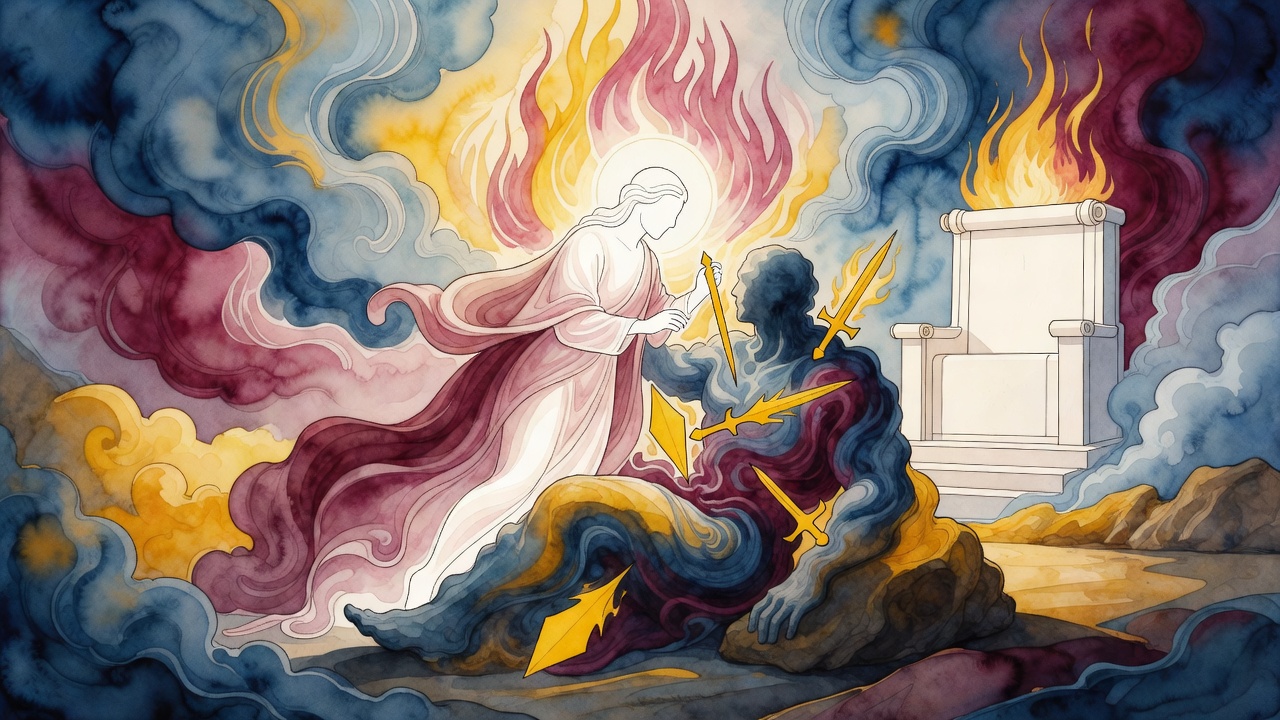
The soul hung above a body and said no, fearing coarseness. From that height it looked angelic: pure, without yetzer, without choice's knife-edge.

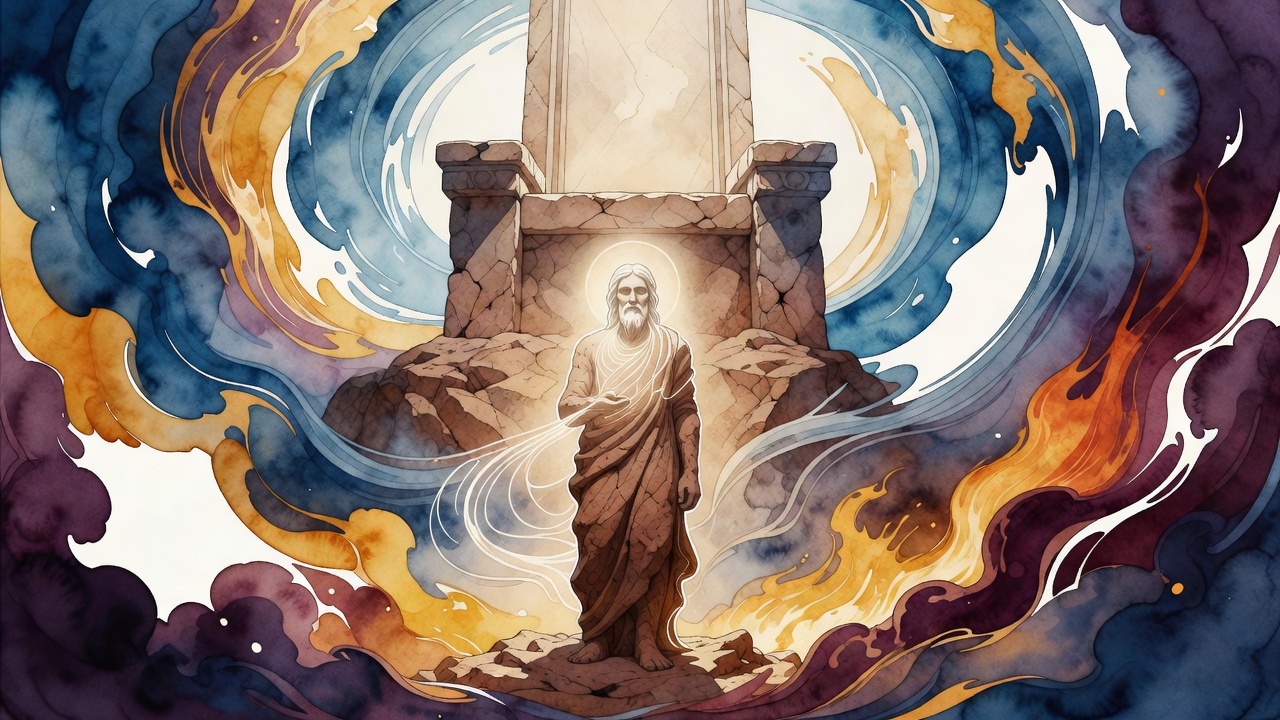
The Soul That Put On Flesh in Order to Rule It Click for full size

Then levush and tzelem were brought, a likeness cut to limbs. The soul entered. Breath met bone. The first cry was also a declaration of war.

Clothes That Translate

Without the garment, no purchase on flesh. With it, hunger and free will arrive together. The soul is dressed for combat, not for a fall by accident.

Rule According to the Nature of the Body

The soul governs according to the body's nature, animating what is rooted there, teaching two arms mitzvot (commandments) rather than growing a third. Hating the body loses the only arena where evil can flip to good.

Why the Arena Is Flesh

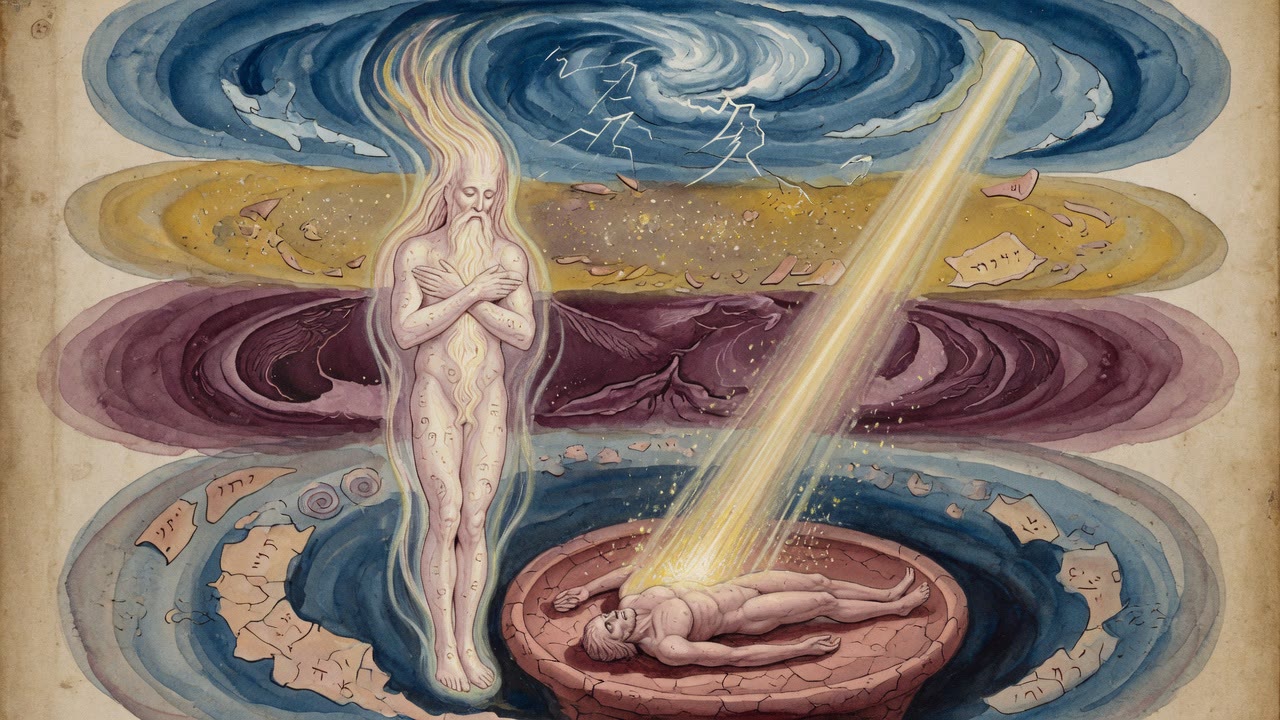
Negativity roots in thickness. Mitzvot are tools. Adam Kadmon holds the blueprint; living people finish the task. Rectification, not annihilation of flesh, is the goal.

Struggle That Means Redemption

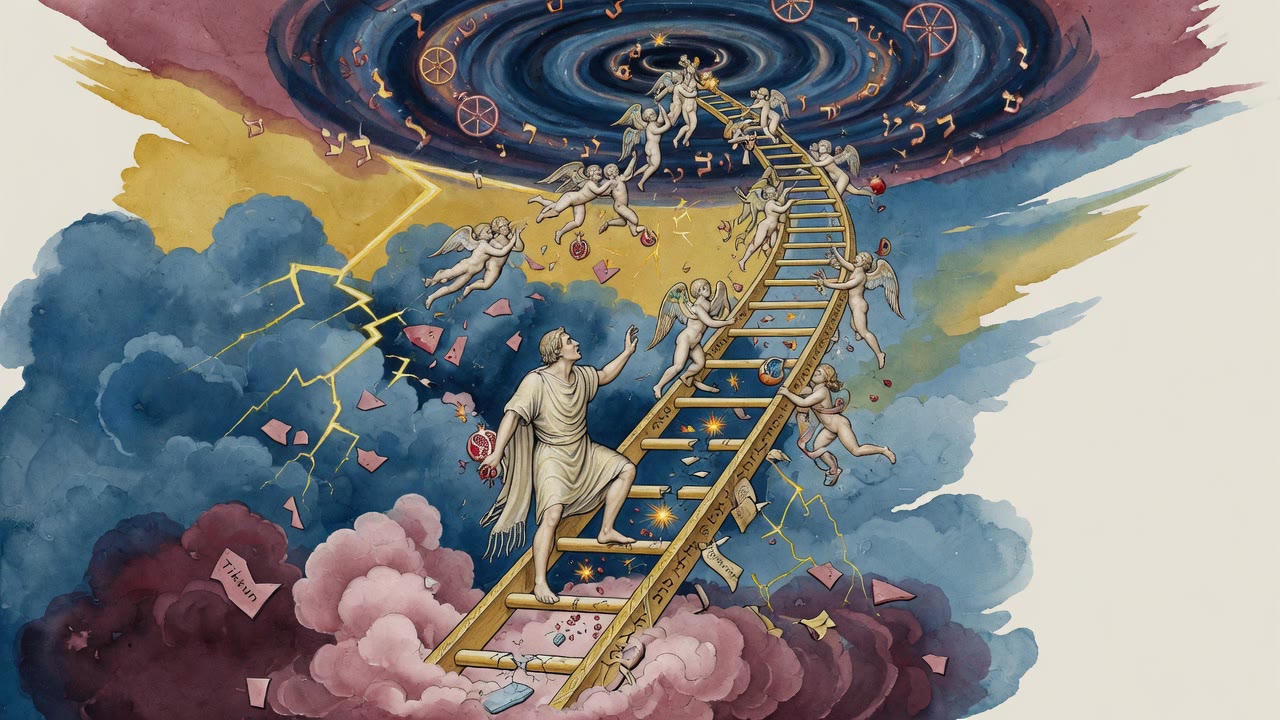
Hafichah is the labor: turn evil to good. The garment holds. The yetzer whispers. The first mitzvah of the day votes who rules the house. The soul that said no now stays on purpose.


← All myths

From the tradition

Sources

4 sources

The texts behind this telling. Some cards carry a translation of the source; others are our own retelling of it, and each card says which. Every card links out to the original.

Kalach Pitchei Chokhmah 27:21Kalach Pitchei Chokhmah

Retold in our words. Read the original at the link below.138 Openings of Wisdom, trans. Rabbi Avraham Greenbaum, Azamra Institute (2005) · CC-BY

The Kabbalists grappled with this same question, and the text Kalach Pitchei Chokhmah ("138 Openings of Wisdom") offers a beautiful analogy: the soul and the body. You have this incredible, boundless, and ethereal thing – the soul. And then you have the body, a physical form with its own limitations and needs. How does the soul, something so different, actually interact with the body?

Kalach Pitchei Chokhmah suggests that the soul governs the body "solely according to the nature of the body." What does that mean exactly? Well, it means a couple of things.

First, when the Unlimited (that is, Eyn Sof, the Infinite) interacts with the Residue (the created world, sometimes referred to as the Reishimu), it doesn't inject something completely foreign or new into it. Instead, it rearranges and animates what's already there, what was already "rooted in it." The soul doesn't give the body new organs or limbs. It breathes life into what already exists. It gives it purpose. Your soul doesn't give you a new nose or an extra finger. It works with what you've got! It animates your senses, your thoughts, your actions. It’s not adding something new so much as it's activating something that was already latent.

Here’s where it gets really interesting. The text continues by saying that the very presence of the "Line of Eyn Sof" (a concept in Kabbalah referring to the initial emanation of divinity) within the Residue is, itself, the root of the soul in the body in this world. In other words, the spark of the Infinite within creation is what allows for the soul-body connection to even exist!

What happens to one is parallel to what happens to the other. The way the Infinite interacts with the finite universe mirrors the way the soul interacts with the physical body.

So, what does this all mean for us? Maybe it's a reminder that we are already imbued with the divine spark. We don’t need to search for something external to make us whole. We already possess the potential for connection, for meaning, for purpose. It's simply a matter of recognizing that inherent potential, that "root of the soul," and allowing it to animate our lives.

And perhaps, just perhaps, understanding this delicate dance between the infinite and the finite, the soul and the body, can help us appreciate the profound beauty and mystery of existence itself.

Full source
Kalach Pitchei Chokhmah 29:15Kalach Pitchei Chokhmah

Retold in our words. Read the original at the link below.138 Openings of Wisdom, trans. Rabbi Avraham Greenbaum, Azamra Institute (2005) · CC-BY

The Kabbalists, those Jewish mystics who plumbed the depths of existence, have a beautiful and intriguing answer.

They describe the soul as being clothed. Imagine a radiant, pure light, too intense to interact directly with the material world. So, what does it wear?

Kalach Pitchei Chokhmah says the soul is clothed in a levush (לבוש), a “garment.” This levush corresponds to the tzelem (צלם), often translated as "form" or "likeness." It's the soul's way of relating to the body.

When the soul is nestled within this garment, it can perform its functions according to the body's needs. But when the soul is not in the body, it operates in an entirely different way. It’s as if the levush acts as a translator, allowing the soul to speak the body's language.

The Zohar, that foundational text of Kabbalah, in Mishpatim 96b, goes even further. It explains that without this garment, the soul would have absolutely no connection to the body. That’s a pretty strong statement!: before entering this world, the soul is considered to be like an angel. Pure. Without the pull of the yetzer hara (יצר הרע), the "evil inclination," and without the burden of free will. It simply is.

But everything changes upon entering the body. The soul becomes invested with this yetzer hara and with the power of choice. Why? Because of this levush, this garment of the body.

It’s a profound idea. The very thing that allows the soul to interact with the physical world also introduces the potential for struggle, for choosing between good and evil. The garment, the levush, is not just a passive covering; it's an active participant in the soul's journey here on Earth.

So, the next time you're confronting a difficult decision, or feeling the push and pull of your own desires, remember the Kabbalistic image of the soul and its garment. It's a reminder that we are complex beings, spiritual entities navigating a physical world, all thanks to this mysterious and vital connection.

Full source
Kalach Pitchei Chokhmah 35:6Kalach Pitchei Chokhmah

Retold in our words. Read the original at the link below.138 Openings of Wisdom, trans. Rabbi Avraham Greenbaum, Azamra Institute (2005) · CC-BY

The Kalach Pitchei Chokhmah, a Kabbalistic text, dives deep into the secret of the soul and the body, arguing they're locked in a cosmic dance. Think of it like this: all the messy, less-than-ideal parts of ourselves, the potential for negativity – that's rooted in the body. The body, in this view, is the arena where we wrestle with our yetzer hara (the evil inclination), our "evil inclination."

The soul? Ah, the soul is placed within the body precisely to gain control over those darker aspects and, crucially, to transform them into good. How do we do that? Through the unique power of mitzvot (commandments), commandments. These aren’t just arbitrary rules; they're the tools the Divine prepared for us to elevate the physical, to sanctify the mundane.

Pause for a moment and consider that. Everything in creation, according to this teaching, exists for the sake of the soul and the body. It is precisely here, in this earthly realm, that evil can be turned into good in reality.

Physical humanity, then, is at the end of all existence, the final point, the goal for which everything was brought into being. The purpose of it all? To turn evil back to good. But where does it all begin?

With Adam Kadmon.

Adam Kadmon, primordial man, is the head and the start of all existence, the beginning of this incredible goal. All the aspects required to serve as the root of this goal were established in Adam Kadmon, so that in the end, they would function in reality, here, with us.

Think of Adam Kadmon as the blueprint. The source of the light. The ideal. All the lights emanating from Adam Kadmon proceed in stages, one after the other, in accordance with the hidden connection between the soul and the body. Adam Kadmon is the root of the soul and the body.

Eventually, this process leads to the emergence of the actual body and soul of man, here below. We are, in a way, the culmination of a divine process that began in the highest realms.

It suggests that every action, every choice, every mitzvah we perform is not just a personal act, but a cosmic one. We're not just living our lives; we're actively participating in the ongoing work of transforming darkness into light. It's a powerful, and humbling, thought.

Full source
Kalach Pitchei Chokhmah 41:6Kalach Pitchei Chokhmah

Retold in our words. Read the original at the link below.138 Openings of Wisdom, trans. Rabbi Avraham Greenbaum, Azamra Institute (2005) · CC-BY

In the mystical text, Kalach Pitchei Chokhmah (Wisdom), we encounter a powerful idea about the relationship between the body and the soul. It's a relationship defined by struggle, purification, and ultimately, redemption.

Before anything else can happen, before we can even begin to understand our place in the universe, there’s this fundamental completion that needs to occur. This idea ties into what we've discussed before about the Kav (Line) and the Reshimu (Residue) – these foundational elements that the text describes as the roots of both the soul and the body. Think of the Kav as the divine light reaching down, and the Reshimu as the trace, the imprint left behind.

The text breaks it down like this: our physical body, this earthly vessel, is inherently… well, a little rough around the edges. It’s described as "coarse," and it’s considered the root of all things negative. Every sin, every bad habit, every undesirable trait? They’re all connected to this physical form.

The soul – the neshama – that’s a different story. It's pure, untainted. But here’s the catch: it’s trapped inside this less-than-perfect body. It's like a brilliant light bulb stuck inside a lampshade that's a bit too opaque. The body acts as a barrier, preventing the soul from fully expressing its inherent radiance and connecting to the "supreme light," to God.

So, what's the soul's job in all of this? It’s not just a passive passenger. Its mission is to cleanse the body, to purify it from its inherent "coarseness." It’s a process of refinement, of turning the negative into the positive. This idea of turning evil to good - Hafichah - is central to many Jewish mystical traditions.

The ultimate goal? It's not about annihilating the body or escaping it. It’s about transformation. It’s about rectifying what was once considered "evil" and transmuting it into something good. The aim is for the soul to shine forth, its radiance unobstructed, illuminating both itself and the body it inhabits.

When this happens, the soul takes its rightful place as the primary force, its light illuminating everything around it. The soul, body, and connection to the divine are all intertwined. The soul then, finally, can fully attach itself to the supreme light, experiencing complete and utter joy, together with the very body it once struggled against. We are not meant to exist in a state of constant internal conflict. The goal is integration, harmony, and the radiant expression of our truest selves. What would it look like for you to let your soul shine a little brighter today?

Full source