2 min read

The Face Where the Soul Broke Four Doors

In the dark of the womb the spirit punches openings for eyes, ears, nose, and mouth. Later light leaks through those doors, and a face maps radiance.

Curated by Arthur · Told by Maggid ·
Table of Contents
  1. Doors the Soul Chooses to Use
  2. Four Fissures, Four Powers
  3. First Glow and Second Glow
  4. Why the Map Matters

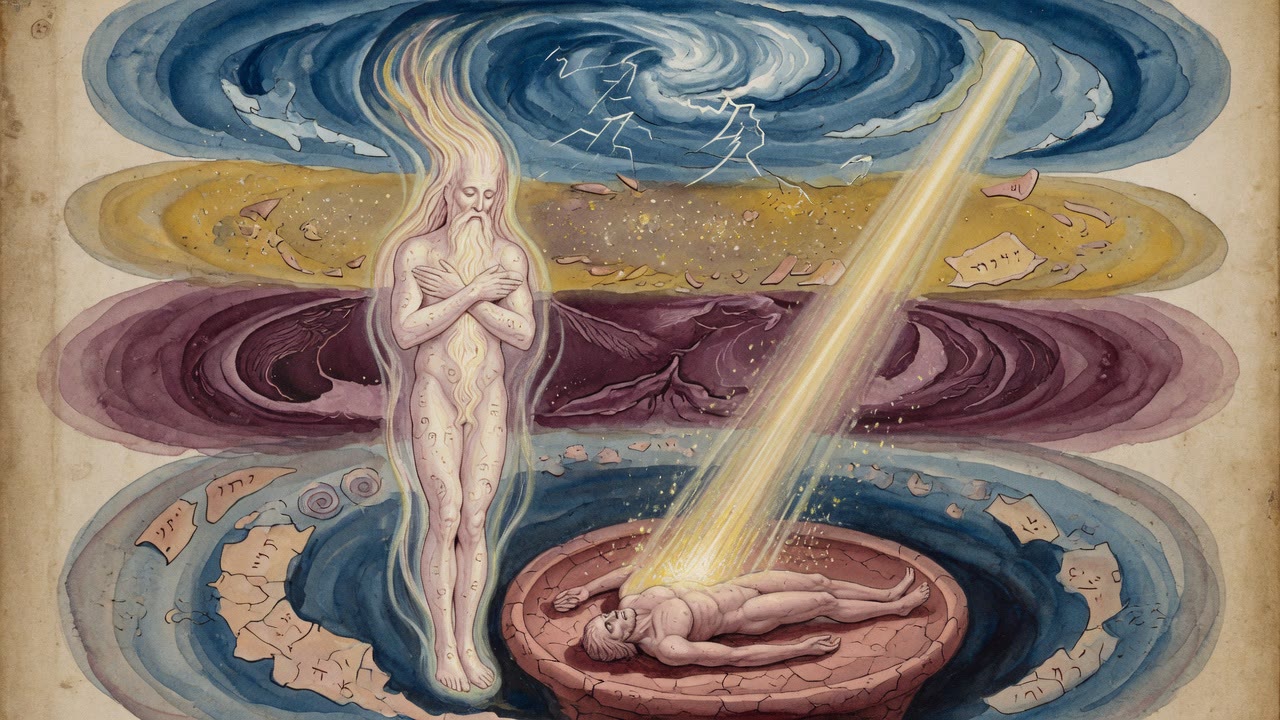
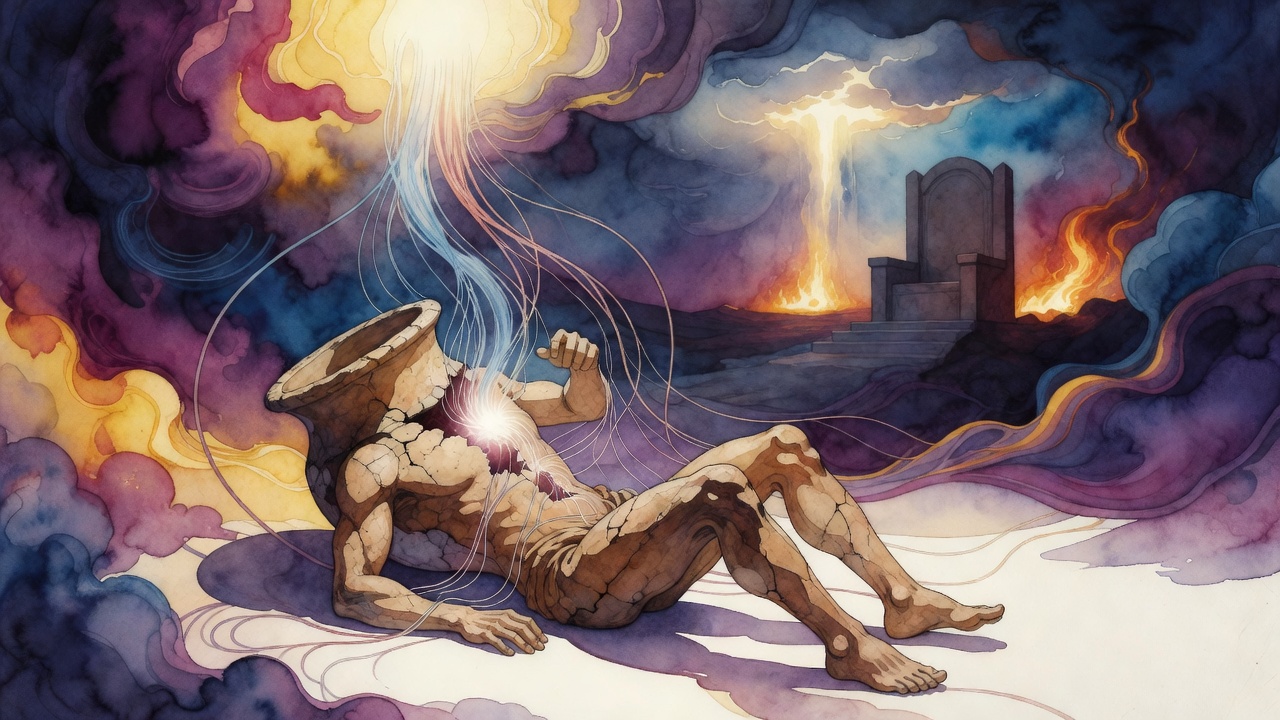
In the closed dark, ruach pushed and broke through the face: eye, ear, nostril, mouth. Elsewhere it shaped from within. Only in the face did it burst outward.

The Face Where the Soul Broke Four Doors Click for full size

After breakthrough, a world could enter. The soul had built its own windows.

Doors the Soul Chooses to Use

Organs are potential. The soul decides when to engage. Consent to see or hear is already a moral act, older than speeches about morality.

Four Fissures, Four Powers

Each sense roots in a distinct fissure, no less and no more. Specialized lights exit through specialized doors. The face is a control board of distinct currents.

First Glow and Second Glow

First radiant splendor is general dawn on the face. Second splendor presses through the four fissures, finer and more particular. Weariness and joy become readable without mind-reading.

Why the Map Matters

Face as interface, not only meat or only mask. Sight can hunt or heal; speech can wound or repair. The face is where the soul refused to stay sealed, and that refusal begins responsibility.


← All myths

From the tradition

Sources

5 sources

The texts behind this telling. Some cards carry a translation of the source; others are our own retelling of it, and each card says which. Every card links out to the original.

Kalach Pitchei Chokhmah 32:6Kalach Pitchei Chokhmah

Retold in our words. Read the original at the link below.138 Openings of Wisdom, trans. Rabbi Avraham Greenbaum, Azamra Institute (2005) · CC-BY

Consider two crucial elements: the existence of the nekavim (נקבים) – the apertures, or openings, in our face – and how the soul itself utilizes them. Think of them as the windows and doors through which our soul interacts with reality.

Here’s the twist: according to Kalach Pitchei Chokhmah, these apertures aren't just random holes. They are actually created by the soul itself!

The formation of an embryo. The ruach (רוח), often translated as spirit or breath, is the force that builds the body. The text describes how this ruach actually breaks through the developing form to create these openings in the face – the eyes, the ears, the mouth. In other parts of the body, the ruach remains inside, shaping from within. Only in the face does it burst forth.

After these apertures are formed, sensory experience becomes possible. We can see the vibrant colors of a sunset, hear the gentle rustling of leaves, taste the sweetness of honey. These experiences flood into our consciousness through these soul-made openings.

Now, here’s where it gets even more interesting. The text emphasizes that this "breaking through" by the soul isn't dependent on the senses themselves. What does that mean?

Well, consider this: a person might have a perfectly formed eye, but still lack the ability to see. Or, to use another example, we don't constantly hear every sound, smell every scent, or speak every thought that crosses our minds, even though our ears, nose, and mouth are always "open."

Why is that?

It suggests that the physical organ is merely a potential. The soul, in its own mysterious way, chooses when and how to engage with the world through these apertures. It's as if the soul has a volume knob, a filter, a selective focus that determines what enters our awareness.

So, the next time you gaze at a beautiful vista, listen to a moving piece of music, or savor a delicious meal, remember the nekavim, the apertures of wisdom. And remember the ruach, the spirit that not only shaped your body, but also forged the very pathways through which your soul experiences the world.

What is our soul focusing on right now? And what wonders might we be missing, just beyond the threshold of our awareness?

Full source
Kalach Pitchei Chokhmah 32:14Kalach Pitchei Chokhmah

Retold in our words. Read the original at the link below.138 Openings of Wisdom, trans. Rabbi Avraham Greenbaum, Azamra Institute (2005) · CC-BY

The soul, or neshama, and its connection to our physical senses. It proposes something quite remarkable: that each of our senses – hearing, sight, smell, and speech – originates from a unique "fissure" or pathway within the soul itself. if the soul, this incredible, many-sided entity, is the source of these four distinct faculties, wouldn't that imply a tremendous power at play? A power capable of generating these differences, "no less and no more," as the text emphasizes. It suggests that the soul doesn’t just passively experience the world, but actively engages with it through these specialized channels.

So, if that's true, then the act of hearing is fundamentally different from the act of seeing. The experience of a fragrant spice is distinct from the sound of a melody. Why? Because each sense is rooted in a different "fissure," a different aspect of the soul's expression.

Kalach Pitchei Chokhmah (Wisdom) argues that the inner soul possesses specific powers. Each of these powers is drawn to a particular organ, an organ that is perfectly suited and ready to function as a conduit for that power. The soul "breaks through" that organ and goes out into the world. It's like a river finding its course to the sea, each stream carving its own unique path.

This idea echoes in other Kabbalistic works. For instance, the Otzrot Chaim, or "Treasures of Life," makes a similar distinction. It states, "But the wise will understand that the light of the brain is called AV, while the light of the ear is called SaG." Here, AV and SaG refer to specific emanations or aspects of divine light, each associated with a different sensory organ. This signifies that the spiritual energy animating the brain (and thus, thought) is different from the spiritual energy animating the ear (and thus, hearing).

What does this all mean for us? It suggests that our senses aren't just biological functions; they are spiritual pathways. Each time we see, hear, smell, or speak, we are engaging with the divine on a profound level.

Perhaps the next time you listen to your favorite music, or gaze upon a breathtaking sunset, you can consider it not just a sensory experience, but also a spiritual one. A moment where your soul is actively engaging with the world, expressing itself through the unique fissures of your being. A reminder that we are all interconnected, not just physically, but spiritually, through the very fabric of creation.

Full source
Kalach Pitchei Chokhmah 32:15Kalach Pitchei Chokhmah

Retold in our words. Read the original at the link below.138 Openings of Wisdom, trans. Rabbi Avraham Greenbaum, Azamra Institute (2005) · CC-BY

There's a whole fascinating interplay of soul, light, and… well, apertures.

The Kalach Pitchei Chokhmah, a text steeped in Kabbalistic thought, offers a truly unique perspective. It suggests that the soul doesn't just reside within us; it actively shines through us. And this shining, this emanation, is fundamental to how we perceive the world.

Think of it this way: The soul is meant to radiate, to express itself. It wants to "break through," as the text says, unimpeded, so it can actually operate our senses. But here’s the twist: it’s through this very act of standing and shining in the face that the soul creates the openings, the "fissures," needed for those senses to function.

So, our face is like a vessel designed for two purposes. First, it emits the soul's initial radiance, a general glow that’s still contained. Second, it houses these fissures, or apertures – think of them as the gateways for our senses – giving the soul a place to exert its control and actively supervise our interactions with the world.

Even as the soul remains in its place, its presence is visible through the very fissures it created. And this visibility isn’t just a passive reflection. It produces a second glow, a refined expression of what was initially visible in that first radiant splendor. Now, however, we see the particulars, the details, filtered through the specific lens of each sensory aperture.

What we perceive of the soul through each fissure – through our eyes, our ears, our nose – depends on the nature of that particular fissure. The soul's essence is being refracted, specialized, to give us the experience of sight, sound, smell, and so on.

But the text goes even deeper. All of this, it emphasizes, is besides the actual senses themselves. Even though these senses are produced within these very fissures, they originate within the general radiant splendor of the soul. Each sense is created through the power of a different movement made by the soul, according to the specific laws governing its quality.

So, it's like the soul is a master artist, using light and shadow, opening and closing, movement and stillness, to paint the world onto our consciousness. It's not just about seeing; it's about the soul actively shaping the experience of seeing.

It’s a complex concept, I know, but incredibly beautiful. It suggests that our faces are not merely masks or surfaces, but dynamic interfaces between the infinite potential of the soul and the concrete reality of our sensory experiences.

Maybe you'll catch a glimpse of that radiant splendor, the soul shining through, creating the very apertures through which you experience the world. And perhaps you'll appreciate, just a little bit more, the incredible, intricate dance happening within you, right there on your face.

Full source
Kalach Pitchei Chokhmah 32:8Kalach Pitchei Chokhmah

Retold in our words. Read the original at the link below.138 Openings of Wisdom, trans. Rabbi Avraham Greenbaum, Azamra Institute (2005) · CC-BY

Jewish mystical tradition, specifically the Kalach Pitchei Chokhmah, a Kabbalistic text, offers a fascinating perspective on this very idea. It suggests that our faces aren't just random arrangements of features, but rather carefully constructed interfaces between our inner selves and the outer world. Think of it: your face is the first thing most people see, the primary way we communicate non-verbally.

This teaching breaks down the face into three key aspects. First, there's the face itself, in all its glory. It’s primed, ready to beam. The Kalach Pitchei Chokhmah sees it as a surface designed to radiate the light of our soul.

Then, we have the apertures. What are these? Well, during the formation of the body, the spirit, the ruach (spirit), breaks through. These "breakthroughs" form our sensory organs, our eyes, ears, nose, and mouth. They aren’t just holes; they are portals, carefully constructed openings designed for a specific purpose.

Finally, there's the sensory experience itself. The soul experiences the world through these openings. It’s not just about seeing or hearing, but about the soul actively engaging with and interpreting the information it receives.

The Kalach Pitchei Chokhmah seems to suggest that our faces are not passive masks, but active participants in the ongoing conversation between our inner and outer worlds. They're designed to share our inner light, and equipped to experience the world around us.

Perhaps the next time you look in the mirror, you'll see your face not just as a collection of features, but as a radiant expression of your soul, evidence of the intricate connection between the seen and the unseen.

Full source
Kalach Pitchei Chokhmah 32:13Kalach Pitchei Chokhmah

Retold in our words. Read the original at the link below.138 Openings of Wisdom, trans. Rabbi Avraham Greenbaum, Azamra Institute (2005) · CC-BY

Jewish mysticism certainly thinks so.

In fact, the ancient text Kalach Pitchei Chokhmah (which translates to "Key to the Gates of Wisdom") offers a fascinating glimpse into just how that inner spark manifests – how our inner soul interacts with the world, and how its radiance becomes visible.

The passage speaks of the neshamah, the inner soul, as something initially hidden, unseen within the body. But it doesn't stay hidden forever. The Kalach Pitchei Chokhmah tells us that the soul eventually makes itself known. How? Through the expression of the face.

That first glimpse, that subtle shift in expression, is described as the "first" or "inner" radiant splendor. It's like the faintest dawn, a hint of the light that's about to break through. The soul, still nestled within, gathers strength. It pushes, it strives, and it eventually breaks through.

And here's where it gets really interesting.

The text speaks of these "four fissures" – openings, pathways – through which the soul's light shines. What are these fissures? Some understand them as the eyes, nostrils, and mouth – the very portals through which we perceive and interact with the world. It’s through these openings that our inner world begins to meet the outer world.

From these openings emerges a "second radiant splendor." This isn't just a faint glow; it's a powerful emanation that stands above the initial, "inner" radiance. This second splendor becomes the source of our senses, fueled by the soul's movement within it.

So, why does this radiant splendor exist on the outside? Why does our inner light become visible? Because, according to the Kalach Pitchei Chokhmah, the soul itself broke through to create those openings. It's an active, intentional process. Our soul yearns to connect, to express itself, to share its light with the world.

The soul actively working to reveal itself, to illuminate the world through our very being. It suggests that our expressions, our senses, our interactions are not merely superficial. They are the direct result of our soul's desire to shine.

Remember the hidden soul within, the spark that yearns to connect. And ask yourself: what kind of light am I choosing to shine?

Full source