2 min read

The Soul Locked in Battle With Its Coarse Vessel

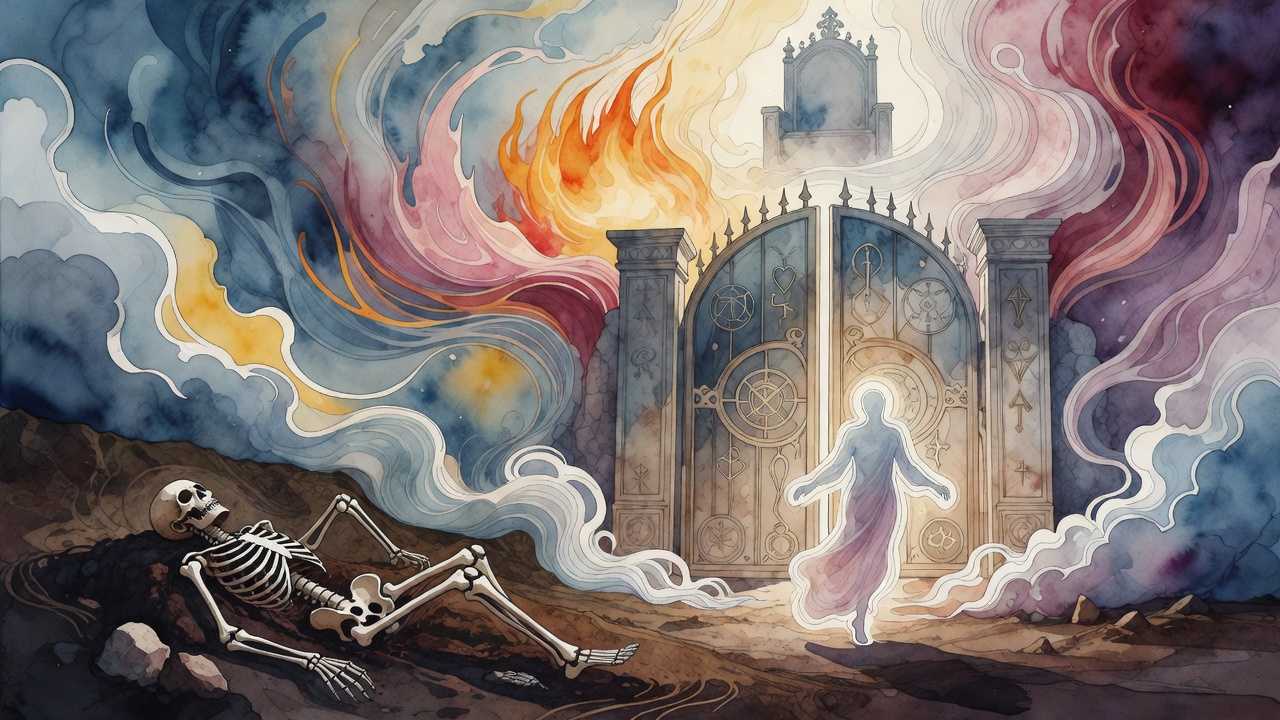
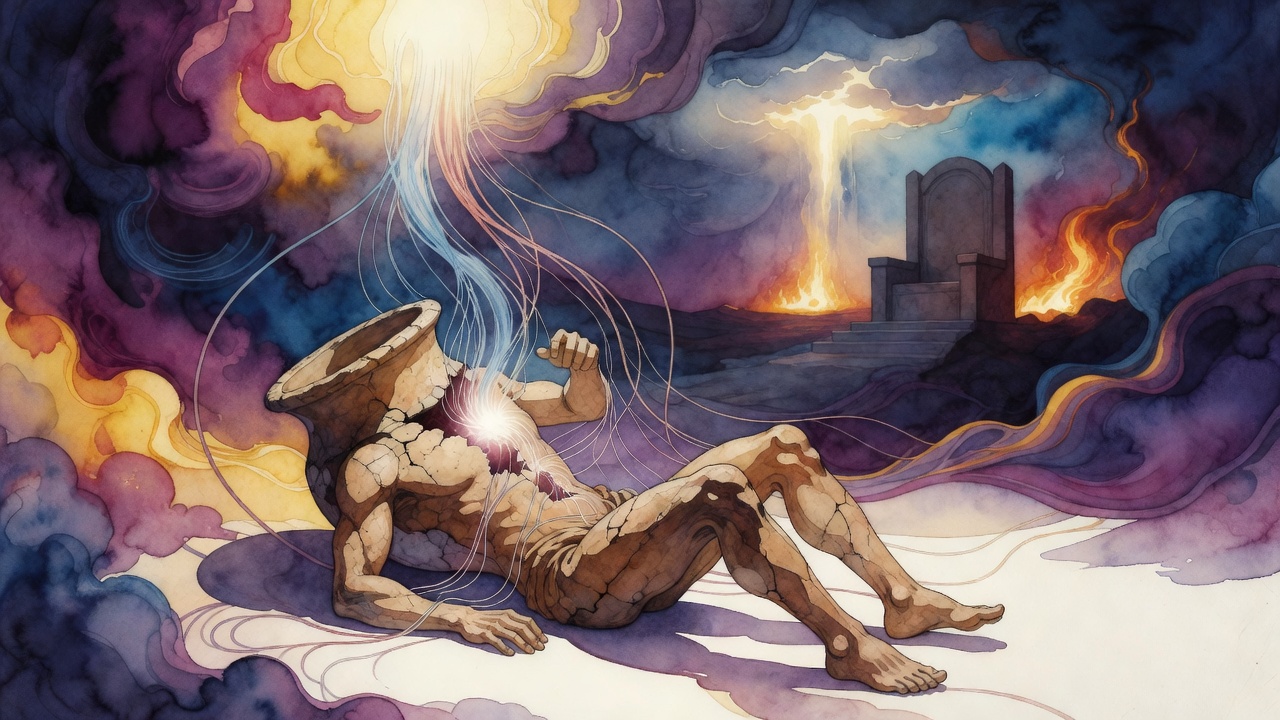
The light would not sit in the new vessels. It withdrew and sent down a thin vapor instead, hevla degarmei, the breath of the bones.

Curated by Arthur · Told by Maggid ·
Table of Contents
  1. Line Against Residue
  2. When Light Will Not Sit
  3. Return by Stages of Clean
  4. Branch of Atzilut

Light tried new vessels, could not seat, and hid above. Forms waited like a body waiting for a soul still in a garden while bone is cleaned.
The Soul Locked in Battle With Its Coarse Vessel Click for full size

Thin vapor crossed the distance: hevla degarmei, breath of the bones. Not full indwelling. Not abandonment.

Line Against Residue

The Line rules Residue rather than smashing it, until defects become vehicles of revealed oneness. Repair, not erasure, is the glory.

When Light Will Not Sit

The awkward middle after Tzimtzum (the divine contraction) is real: light entered, failed to mesh, retreated, yet nourishment continues. Hiddenness is a stage, not divorce.

Return by Stages of Clean

How far the vessel is repaired dictates how fully the soul returns. Cleansing stages after death and beyond only intensify a law already true in ordinary years of habit broken and cruelty refused.

Branch of Atzilut

Below is branch of Atzilut (the world of emanation). Connection completes when evil returns to good. The soul fights with mitzvot (commandments) and patience until vapor becomes full light again.


← All myths
From the tradition

Sources

4 sources

The texts behind this telling. Some cards carry a translation of the source; others are our own retelling of it, and each card says which. Every card links out to the original.

Kalach Pitchei Chokhmah 41:8Kalach Pitchei Chokhmah

Retold in our words. Read the original at the link below.138 Openings of Wisdom, trans. Rabbi Avraham Greenbaum, Azamra Institute (2005) · CC-BY

Jewish mysticism wrestles with this feeling constantly. It asks, how do we reconcile the apparent imperfections of the world with the idea of an all-powerful, all-good God?

One fascinating answer comes from a text called Kalach Pitchei Chokhmah (Wisdom), "41 Openings of Wisdom." It speaks of something called "the Line."

This Line, it tells us, isn't just any old line. It's the root of the soul itself. Its mission? To work through the “Residue.”

The "Residue" – that’s where things get interesting. In Kabbalah, the Reshimu (Residue) refers to the trace or remnant left after the initial act of creation. Imagine a potter creating a vessel. The clay that's left behind, the negative space – that's a bit like the Residue. It represents everything that seems to be separate from God, everything that appears imperfect or even… evil.

But here's the twist: the Line’s job isn't to destroy the Residue. It’s to rule over it, to transform it. To prove that everything that seems to contradict truth – everything hidden or obscured – actually circles back to reveal God's ultimate unity. That what seems like opposition is actually part of a larger, divinely orchestrated plan.

The Kalach Pitchei Chokhmah suggests this transformation will fully manifest when the world achieves complete perfection – when evil itself is transmuted into good. This is the Line’s ultimate function: not to erase the Residue, but to repair it. The Residue, these apparent defects in the world, won’t be something repelling God's perfection. Instead, they become the very vehicle through which His true perfection is revealed. It's through the mending of these broken pieces, through the revelation of His unity within the seeming chaos, that we truly understand His power.

So, the next time you're confronted with something that feels wrong, something that seems to contradict your understanding of the divine, remember the Line. Remember the Residue. Remember that the journey towards perfection isn't about erasing imperfection, but about finding the hidden unity within it. Maybe, just maybe, what looks like a flaw is actually a vital part of the masterpiece.

Full source
Kalach Pitchei Chokhmah 41:18Kalach Pitchei Chokhmah

Retold in our words. Read the original at the link below.138 Openings of Wisdom, trans. Rabbi Avraham Greenbaum, Azamra Institute (2005) · CC-BY

Tzimtzum, contraction. It’s the idea that in order for the universe to exist, God, or Eyn Sof (the Infinite), had to withdraw, to create space for something other than Himself. And according to the ancient text, Kalach Pitchei Chokhmah (Wisdom), it's only when this contraction has done everything it can, when it’s reached its limit, that the light of Eyn Sof, blessed be He, can truly shine through and complete the work.

Here's the twist: the light didn't immediately mesh with the vessels created by this contraction. Imagine it like this: the light entered, but couldn't quite connect, so it retreated, becoming hidden above. What does that mean?

The Kalach Pitchei Chokhmah uses a beautiful analogy to explain it: think of the soul residing in the Garden of Eden while the body undergoes purification here on earth. Even though separated, the soul still sends what it needs to the body, a kind of ethereal sustenance referred to as hevla degarmei – the "vapor of the bones. A connection maintained even across seemingly insurmountable distances.

So, it is with these vessels, these containers meant to hold the Divine light. We'll explore this idea further later on in the Kalach Pitchei Chokhmah, but for now, consider the profound implications.

What does this tell us about our own struggles, our own brokenness? Perhaps it suggests that even when we feel incomplete, when the light seems distant, there's a process at work. Maybe the initial separation, the feeling of being hidden from the source, is a necessary stage. Just as the soul nourishes the body from afar, so too does the Divine light continue to influence and shape us, even when we can't perceive it directly.

And perhaps, ultimately, it’s in that very process of purification, of working through the Tzimtzum of our own lives, that we become vessels capable of truly holding and reflecting that infinite light.

Full source
Kalach Pitchei Chokhmah 42:7Kalach Pitchei Chokhmah

Retold in our words. Read the original at the link below.138 Openings of Wisdom, trans. Rabbi Avraham Greenbaum, Azamra Institute (2005) · CC-BY

One such exploration comes from the Kalach Pitchei Chokhmah, a kabbalistic text that explores the mysteries of existence. It paints a picture of the soul's journey, particularly its relationship with the body, that’s really quite beautiful.

The Kalach Pitchei Chokhmah describes a gradual process, a dance between the soul and the body. It suggests that the extent to which our physical form is "repaired" dictates how readily the soul can reunite with it.

So, what does "repaired" mean in this context? Well, it's all about purification. The text talks about a process the body undergoes after death, beginning with purification from what it calls "uncleanliness" through Chibbut ha-Kever, the "torment of the grave." That sounds intense. It's essentially a spiritual cleansing, a removing of the impurities that cling to us during our earthly lives.

It doesn't stop there! Even after resurrection, there's a further refinement, a removal of even the "slightest residual trace of uncleanliness." This is where it gets really interesting. The Kalach Pitchei Chokhmah emphasizes that this isn't a simple, one-time event. It's a complex process with "many details."

Why all this purification? Because the soul, in its pure essence, needs a vessel worthy of its light. The more purified the body, the more fully the soul can inhabit it. Each stage of purification allows the soul to shine with "added luster." It's like polishing a diamond, each facet revealing more brilliance than the last.: our tradition often emphasizes the importance of tikkun (spiritual repair) olam, repairing the world. Perhaps this idea of purifying the body after death is a microcosm of that same principle. Just as we strive to repair the world around us, we also undergo a process of inner repair, preparing ourselves for a deeper connection with the Divine.

It's a comforting thought, isn't it? That even after death, there's a process of growth, a continued journey towards wholeness and light. And maybe, just maybe, that journey begins with the simple act of striving for purification in our lives now.

Full source
Kalach Pitchei Chokhmah 41:1Kalach Pitchei Chokhmah

Retold in our words. Read the original at the link below.138 Openings of Wisdom, trans. Rabbi Avraham Greenbaum, Azamra Institute (2005) · CC-BY

Jewish mystical thought, particularly in texts like Kalach Pitchei Chokhmah (Wisdom), explores this very idea. It suggests that everything we perceive, everything that exists in our world, is just an offshoot – a branch extending from a much grander, more complete reality called Atzilut (the World of Emanation).

Think of Atzilut – the realm of emanation – as the source. The wellspring. And everything else? Just different ways that source expresses itself. Kalach Pitchei Chokhmah emphasizes that nothing truly new is created outside of Atzilut. Everything is already contained within it, just manifested in a different form. It's like taking water from a river and pouring it into different shaped glasses – the water is the same, but the presentation changes.

So, where does that leave us? Are we simply puppets dancing on strings connected to this higher realm? Not exactly. There’s a crucial connection between the "Line" (a concept representing divine emanation) and what’s called the "Residue" – often understood as the soul and the body.

This is where things get really interesting. According to this teaching, the connection between these two – the divine spark and our earthly vessel – only becomes truly complete after the emergence of evil and its eventual return to good.

Wait, what? Evil is necessary?

It’s a challenging idea, no doubt. But consider this: perhaps it's through confronting and overcoming challenges, through wrestling with the darker aspects of existence, that we truly come to understand and appreciate the good. Maybe it's the contrast between light and shadow that allows us to perceive the light more clearly.

The journey, it seems, isn't just about basking in the divine light. It's about working through the shadows, learning from them, and ultimately, returning to the source transformed. It's in that return, in that integration of darkness into light, that the connection between our soul and the divine becomes whole.

Full source