5 min read

The Soul That Shrank to Enter Cloudy Flesh

A vast soul is told to diminish like the moon before it can wear a body. Closed inside cloudy flesh, it climbs back by deeds alone.

Curated by Arthur · Told by Maggid ·
Table of Contents
  1. The Order to Grow Small
  2. Why Two Creations Instead of One
  3. Closed Inside the Cloud
  4. The Slow Sculptor
  5. Climb Measured in Deeds
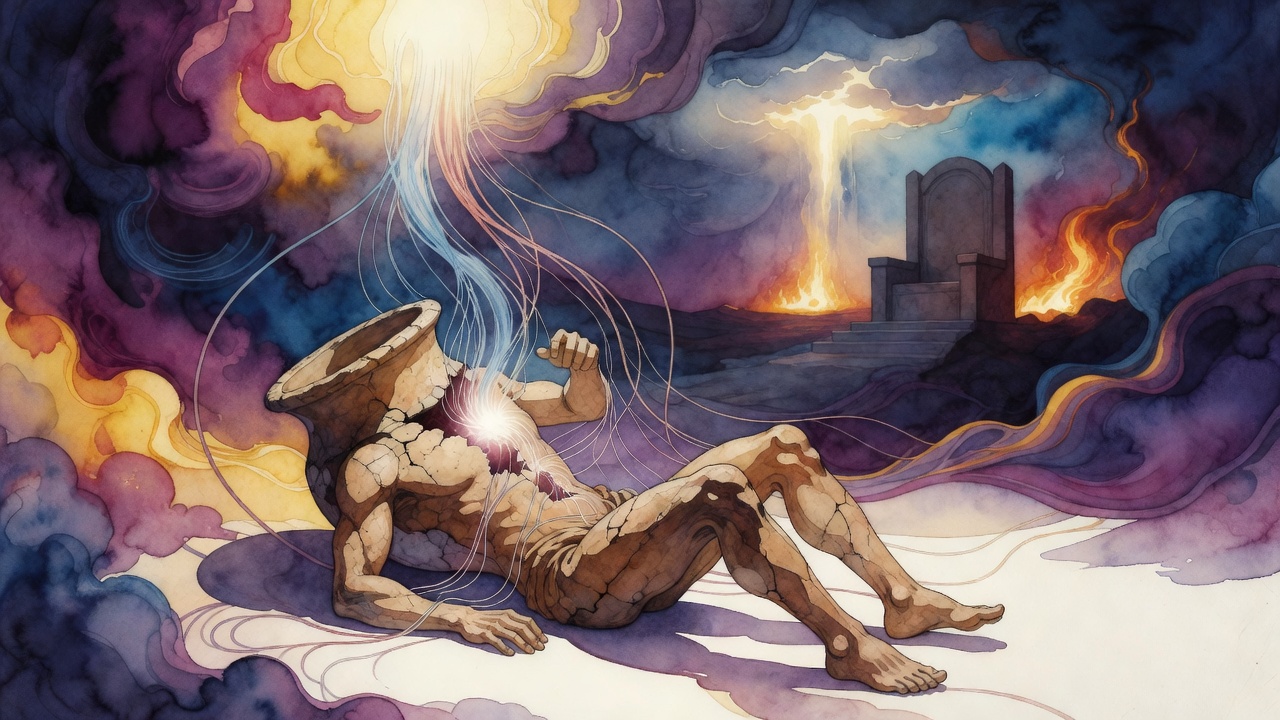
The Soul That Shrank to Enter Cloudy Flesh Click for full size

The Order to Grow Small

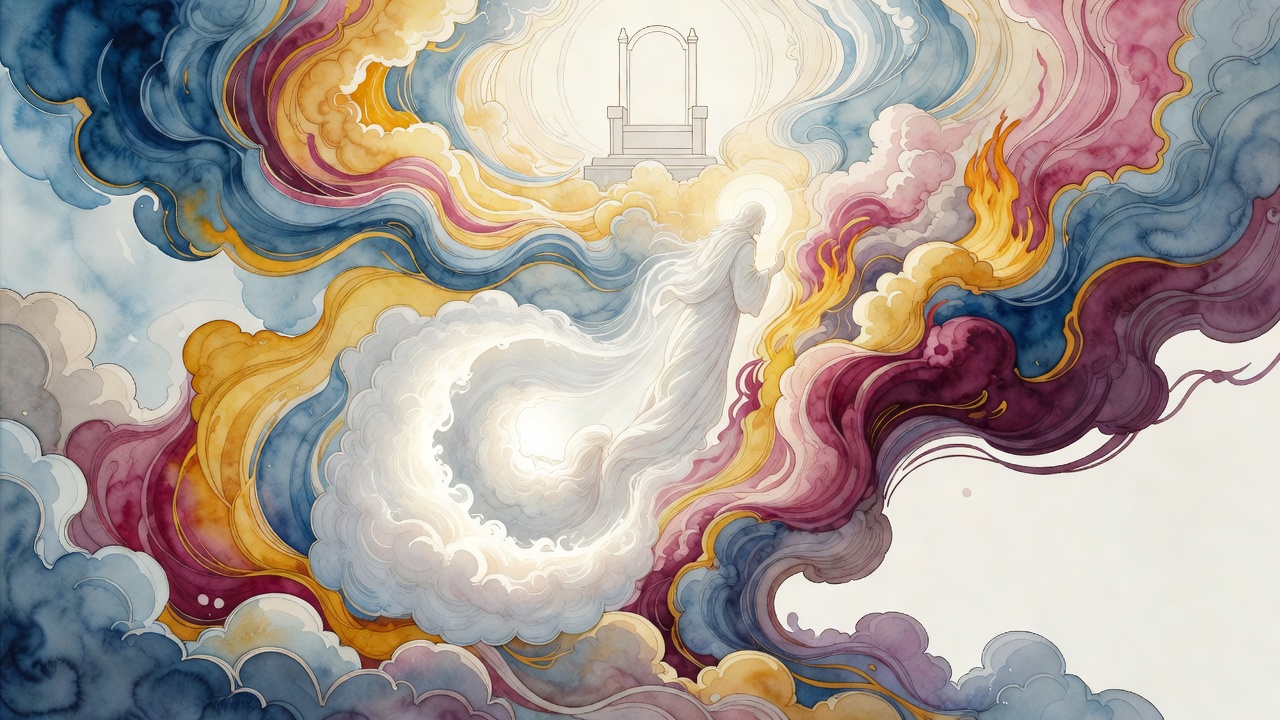
The soul arrives too large for any ribcage. In its first brightness it could flood a city of bodies and still have light left over. The Holy One does not punish it. He measures it. Diminishment falls like a tailor's cut: less radiance, less force, a shape that can survive inside cloudy flesh without burning the garment to ash.

The Talmud's moon is told, Go and diminish yourself. Isaiah promises a later hour when lunar light will equal solar light (Isaiah 30:26). Between those sentences the soul lives its human life: reduced on purpose, promised restoration, locked in a test.

Why Two Creations Instead of One

The Soul asks the hard question aloud. Why not one seamless living thing? Why body and soul as separate makings if God could have fused them from the start? The answer is a doorway, not a slogan. Division is the entrance into every other detail of purpose, struggle, and reward. Without a seam there is no climb. Without a climb there is no earned light.

So the body is shaped from deficiency and the soul from greatness, and they are yoked. The intellect in Da'at Tevunot does not flatter the flesh. It calls the body's root dark. Then it hands the neshama (the higher soul) a slow craft: refine the vessel little by little through good deeds until the body can stand beside the soul without shame.

Closed Inside the Cloud

While the soul is closed and closed within the cloudy body, the yetzer hara (the evil urge inside a person) is not an outside thief. The Zohar says the evil inclination was made to test a person. Aptitude of action decides elevation. Each refusal of the cheap yes, each mitzvah (a commandment) done without an audience, loosens one hinge of the cloud.

The soul remembers home the way a bird remembers a direction without a map. Yearning is not weakness. It is evidence that a part of the Lord above was placed in a rented room and has not forgotten the landlord's house.

The Slow Sculptor

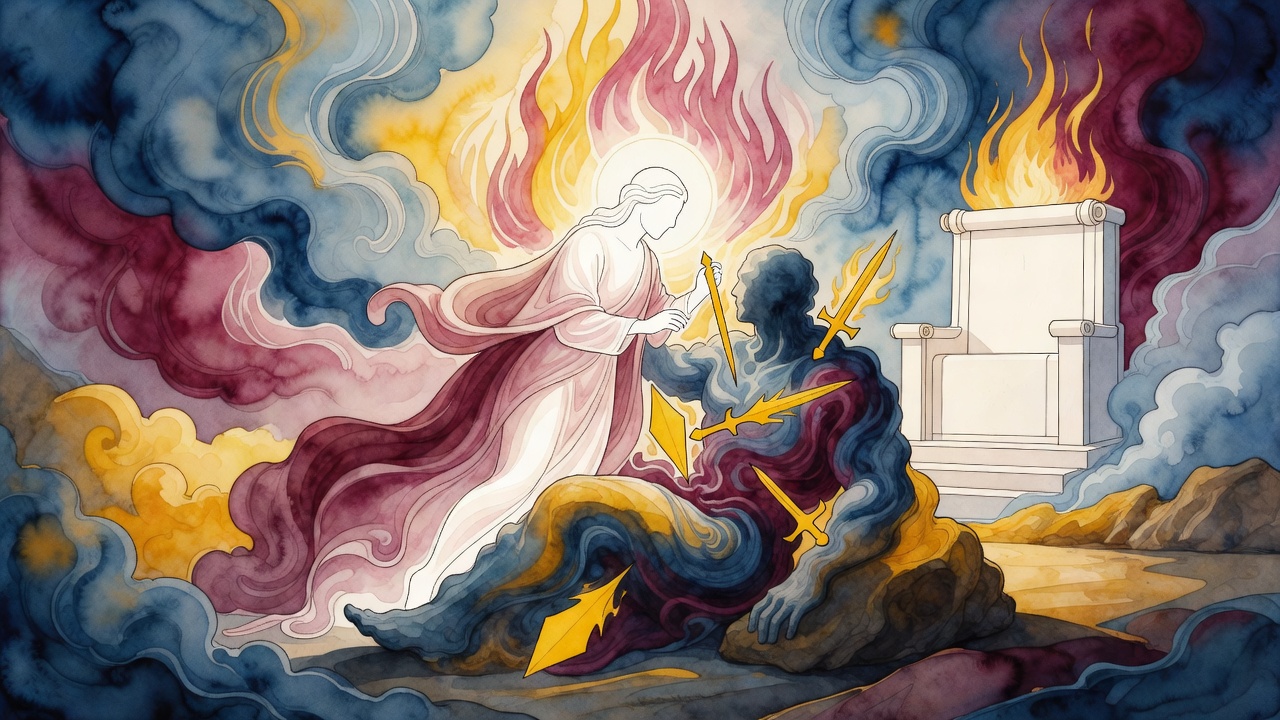
If the soul poured its full strength into the body at once, the body would not become holy. It would break or fake a glory it had not earned. So the neshama diminishes on entry and then grows stronger by the work of refining. Act by act, the sculptor reveals a form the clay did not know it held. Strength returns to the soul as the body learns not to rule.

The goal is not escape from skin. The goal is a body worthy to visit the sanctuary of beauty forever, standing with the soul rather than against it.

Climb Measured in Deeds

No ladder appears in the air. The rungs are ordinary: bread shared, tongue held, Shabbat guarded, truth spoken when a lie would pay. According to the aptitude of those acts, the diminished moon of the soul brightens. Future equality of lights is not a fairy tale. It is the end of a curriculum begun at the first cut of diminishment.

She sits inside the ribs and feels both prison and workshop. The map of the cosmos is written as this one tension: vastness ordered to shrink, darkness ordered to be refined, a return that must be walked rather than wished.

Outside, people praise strength that never bent. Inside, the real strength is the soul that accepted a smaller flame so a human life could exist at all, then spent years feeding that flame with deeds until cloudy flesh began to clear.

Parents see a version of this when a bright child learns to live inside rules that feel smaller than their hunger. The cut is not cruelty. It is the condition of shared air. The soul accepts the cloudy lease because without it there is no human story at all, only uncontained brilliance with nowhere to spend itself.

Mitzvot (commandments) are not decorations on that lease. They are the renovation plan. Charity opens a window. Prayer clears soot. Study braces a beam. The yetzer hara (the evil inclination) tests each improvement the way weather tests a roof. Aptitude of action is the only honest inspection report.

Yearning toward the source can look like restlessness to people who only measure success in flesh. The soul does not apologize for the homesickness. It is proof of origin. Wholeness will not be a bigger cloud. It will be a body so refined that the original light can return without tearing the garment, moon matching sun without war.

Until then, diminishment remains a daily discipline. Grow small enough to love a finite hour. Grow strong enough, act by act, to deserve a larger flame inside the same ribs.

Some nights the cloud feels thicker than the promise. Isaiah's equal lights seem far. The teaching answers with patience: diminishment was the entrance fee; elevation is the rent paid daily; restoration is the deed still being written by choices no one else can score.


← All myths
From the tradition

Sources

4 sources

The texts behind this telling. Some cards carry a translation of the source; others are our own retelling of it, and each card says which. Every card links out to the original.

Da'at Tevunot 72:5Da'at Tevunot

Retold in our words. Read the original at the link below.Sefaria Community Translation · CC-BY

Da'at (Knowledge) Tevunot, a Kabbalistic text, offers a fascinating perspective on the soul's journey into the human body. It suggests that our souls, in their original, unadulterated form, are incredibly vast and powerful. But to inhabit a physical body in this world, something has to give.

Think of it like this: the Holy One, Blessed be He, diminishes the soul's light and strength, carefully tailoring it to the capacity of the body it will inhabit. It’s not about punishment; it’s about fitting the vessel.

This act of diminishment, of contraction, is likened to the moon in the Talmud (Chullin 60b), where it’s told "Go and diminish yourself." A temporary state! Because just as Isaiah (30:26) prophesizes, "And the light of the moon will be like the light of the sun" in the future, so too can our souls regain their full radiance.

How? That’s where our actions come in. We have the power, the goodness is in our hands, to elevate ourselves, step by step, through our choices and deeds.

Now, here's the rub. That diminished state also means that while we're here, our souls are "closing and closed within the cloudy body." What does that mean? It means we're constantly tested. We are constantly being examined with the trials of the yetzer hara (יצר הרע), the "evil inclination." This isn't some external demon, though. As the Zohar (section 1, 106b) wisely tells us, "The evil inclination was not made other than to test man with it." It's part of the process, the crucible in which our souls are refined.

The Da'at Tevunot emphasizes that according to the aptitude of our actions, so does our soul merit elevation. The more we strive, the more we rise, level by level. Each act of kindness, each moment of self-control, each attempt to connect with the Divine – it all matters.

And what awaits us at the end of this journey? At the time of reward, the events of all of the souls activates them, and elevates them according to their actions. This elevation ultimately leads to the resurrection of the dead, when our souls will return and refine their bodies, enjoying an abundance of peace forever.

So, the next time you feel that nagging sense of untapped potential, remember the story of the soul's journey. Remember the moon, temporarily dimmed but destined to shine with the brilliance of the sun. Remember that every choice, every action, is a step towards reclaiming the fullness of your being. It's a journey, not a destination, and the power to elevate ourselves is always within reach.

Full source
Da'at Tevunot 74:1Da'at Tevunot

Retold in our words. Read the original at the link below.Sefaria Community Translation · CC-BY

There’s a fascinating idea explored in Da'at (Knowledge) Tevunot, a work that explores wisdom and understanding. It speaks of the relationship between the intellect, the soul, and the body.

The intellect, in this framework, makes a profound statement: The body, this physical vessel we inhabit, is inherently flawed. Its very creation is rooted in darkness and deficiency. Heavy stuff. But before you start despairing about your mortal coil, there's more to the story.

The soul, neshamah (the higher soul), is the key. This spark of the Divine, according to Da'at Tevunot, originates from a place of immense greatness. But here's the twist: when the soul enters the body, it deliberately diminishes itself. It doesn't overwhelm the body with its pure light all at once. Why? Because doing so would be too much, too soon. It would fundamentally alter the body's very nature.

Instead, the soul takes a gradual approach. Little by little, through good deeds, through acts of kindness and compassion, it works to refine the body. It’s a slow, patient process of transformation. Think of it like a sculptor carefully chipping away at a rough stone, revealing the beautiful form hidden within.

And here's where it gets even more interesting. As the soul engages in these good acts, it elevates itself. Its strength grows with each act of refinement. As the soul's strength increases, so too does its ability to refine the body. It's a beautiful cycle of growth and transformation.

This process continues until the body becomes worthy, appropriate to stand alongside the soul. The ultimate goal? To gaze upon the beauty of haShem (God), to visit His sanctuary, for all eternity.

The idea that our physical existence, with all its imperfections, isn't a barrier to spiritual growth, but rather an opportunity for it. That through conscious effort, through the performance of mitzvot (good deeds), we can elevate ourselves and our bodies to a state of spiritual readiness.

So, the next time you feel that tension between the earthly and the divine within you, remember this: it's not a battle, but a partnership. A slow, patient dance of refinement, leading us ever closer to the Divine presence. What small step can you take today to participate in that dance?

Full source
Da'at Tevunot 69:1Da'at Tevunot

Retold in our words. Read the original at the link below.Sefaria Community Translation · CC-BY

The Soul, in this passage, poses a powerful question: why two creations instead of one? Why didn't God just create us as a unified being, seamlessly alive? After all, as the text points out, God is certainly capable of such a feat. Couldn’t the Almighty have simply made us intrinsically alive, without this division, this tension, between the physical and the spiritual? What purpose does this duality serve?

The Da'at Tevunot suggests that understanding this very division is key. It's a doorway, the text says, "to enter into the other details." Other details of… well, of everything! Of our purpose, our struggles, our potential.

That the secret to unlocking deeper understanding lies not in ignoring this fundamental split within us, but in confronting it directly.

This idea, of the body and soul as distinct entities, is a common thread in Jewish thought. We see it echoed in countless stories and teachings. But Da'at Tevunot pushes us further, asking us to examine the why behind it all. Why not just create a being that is whole, undivided, inherently alive?

Perhaps the answer lies in the very nature of growth and striving. Maybe the tension between the body, with its earthly desires, and the soul, yearning for the divine, is what fuels our journey. Maybe it's the friction that sparks the flame of transformation.

Or maybe, just maybe, the separation is an illusion. Perhaps the ultimate goal isn't to reconcile two separate entities, but to realize that they were always intertwined, two sides of the same coin.

The question posed by Da'at Tevunot remains a powerful one. It invites us to reflect on our own existence, to consider the interplay of body and soul within ourselves, and to ponder the deeper mysteries of creation. And who knows? Maybe, just maybe, in confronting this question, we’ll find that doorway opening before us, leading us to a richer, more profound understanding of ourselves and the world around us.

Full source
Da'at Tevunot 24:4Da'at Tevunot

Retold in our words. Read the original at the link below.Sefaria Community Translation · CC-BY

Our sages certainly did. And they saw that yearning, that restless feeling, as a clue – a whisper from the soul itself. Because, as Da'at (Knowledge) Tevunot, a profound work of Jewish thought, tells us, the soul, that spark within us, is "a part of the Lord above. It’s like anything of heavenly origin, naturally drawn back to the heights, finding no rest until it gets there.

This idea of "cleaving" – in Hebrew, devekut – is central to Jewish mystical thought. It's about so much more than just believing in something. It’s about an intimate connection, a merging, even, with the Divine.

What does that actually mean? What does it look like to "achieve" this cleaving? Well, here's the humbling part: We, in our current state, immersed in our imperfections, simply can't fully grasp it. Try to imagine describing the taste of chocolate to someone who's never tasted anything. It's like that.

However! And this is important: just because we can't fully understand the destination doesn’t mean we can’t chart the course. The very fact that we recognize this longing, this yearning for devekut, reveals our own deficiencies. We know that completeness lies in this cleaving, therefore, we also know that our current state is defined by distance from it.

The music is there, the signal is being transmitted, but something is interfering. Something is obstructing the connection. That obstruction, that "something that lays between us and Him, may his name be blessed," is the deficiency we need to address.

It's those obstacles – our ego, our distractions, our imperfections – that make it impossible to fully cleave to the Divine. But the good news is, these are things we can work on. We can strive to remove these obstructions and, in doing so, move closer to that completeness we mentioned.

And that, my friends, is where the real work begins. Because to understand how to do this, to truly understand how to clear the path to devekut, we need to explore something truly fundamental. And that’s what we’ll explore next time. Are you ready?

Full source