Retold in our words. Read the original at the link below.Townsend 1989 translation of Midrash Tanhuma, S. Buber Recension · CC-BY
And they brought the tabernacle unto Moses (Exod. 39:32). It is written elsewhere in reference to the verse: He withdraweth not His eyes from the righteous; but with kings upon the throne He setteth them forever, and they are exalted (Job 36:7). What does this verse signify? That the Holy One, blessed be He, does not deny the righteous man the realization of his plans. Therefore He withdraweth not His eyes from the righteous. You may know this to be so from Abraham, who begot Isaac, who resembled him closely, as it is said: These are the generations of Isaac, Abraham’s son: Abraham begot Isaac (Gen. 25:19). And Jacob begot Joseph, who resembled him, as is said: These are the generation of Jacob: Joseph (ibid. 37:2). Reuben, Simeon, et al., are not mentioned here but only Joseph. It says also: Because he was the son of his old age (ibid., v. 3). Hence, He draweth not His eyes from the righteous.
Another explanation of He draweth not His eyes from the righteous. At the time that Moses came and told the Israelites: Take ye from among ye an offering unto the Lord (Exod. 35:5), they rejoiced exceedingly and brought their free-will offering with joy and eagerness. Notice that it is written: And they came both men and women (ibid., v. 22); that is to say, in their eagerness they pressed against each other. The men and women came as a huge throng when they brought their gifts, as it is said: All the women that were wise-hearted (ibid., v. 25).
They brought all that was required in two mornings. Hence it is written: For the stuff they had was sufficient for all the work (ibid. 36:7). And He said to Moses: Tell the multitude to bring their gifts. This tells you that the Israelites were extremely eager to participate in the work of the Tabernacle. After two days the wise-hearted men, who desired to bring their gifts, were not permitted to do so, since He had already said: Let neither man nor woman make any more work (ibid., v. 6). The leaders were deeply distressed by not having been privileged to bring anything to the work of the Sanctuary. They said: “Since we did not merit to participate in the offerings for the Tabernacle, let us give the garments for the priesthood.” The Holy One, blessed be He, said: Since My sons were so painstaking and conscientious concerning the Tabernacle, let their praise be inscribed in the Torah with reference to the Tabernacle. Therefore it is written: For the stuff they had was sufficient for the work (ibid., v. 7).
Because the leaders were slow to bring their gifts, a letter is omitted from their names. Thus in Scripture the word for leader lacks one yod. Later, however, they helped in the work of the Tabernacle, joining Bezalel and Oholiab in their labors and the wise men in their work, as is said: And every wise-hearted man that wrought (Exod. 36:8). And the women spun the purple curtains, as is said: And all the women whose hearts stirred them up in wisdom spun the goats’ hair (ibid. 35:26).
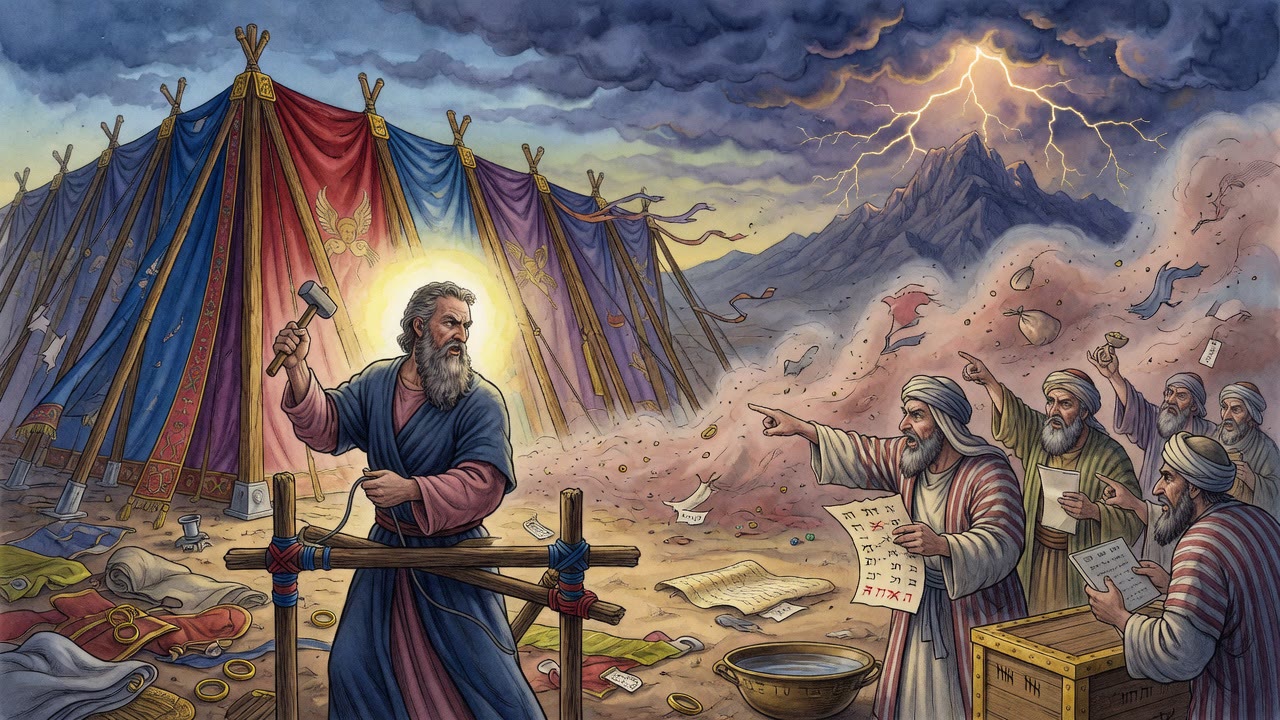
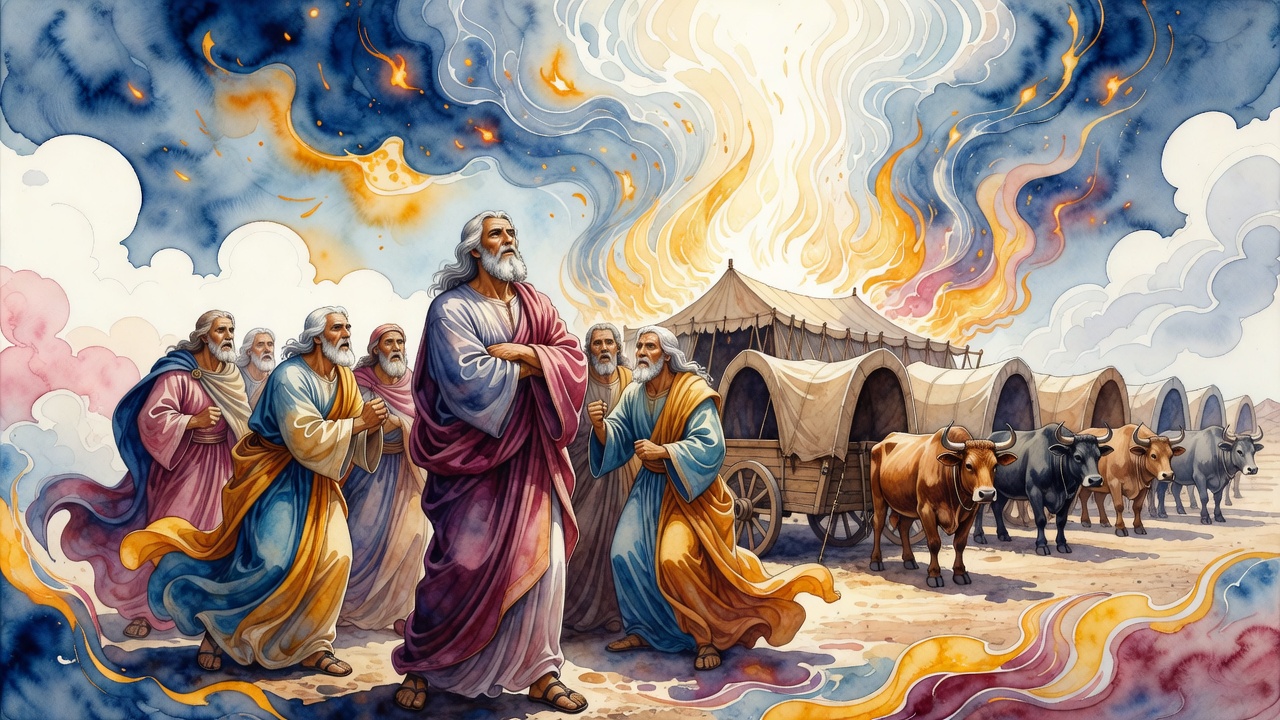
When at last they completed the work of the Tabernacle, they sat waiting for the Shekhinah (the Divine Presence) to descend and hover over it. However, they were distressed because the Shekhinah failed to hover over it. What did they do then? They went to the wise-hearted men and said to them: “Why do you sit by idly? Erect the Tabernacle and the Shekhinah will come to rest among us.” They tried to erect the Tabernacle, but did not know how. They were unable to make it stand. Whenever they thought they had assembled it, it would fall apart. They went to Bezalel and Oholiab and said: “Come, erect the Tabernacle that you have constructed, perhaps you will be worthy to erect it.” They too tried to assemble it but were unable to do so. They began muttering and complaining, saying: “See what the Son of Amram did to us when he took our possessions for this Tabernacle, and made us assume this burden while promising us that the Holy One, blessed be He, would descend from the heavenly sphere and would dwell within the curtain of goats’ hair, as is said: That I may dwell among them (Exod. 25:8).”
Why were they unable to erect it? Because of the fact that Moses was distressed at not having participated in the construction of the Tabernacle. Why did that happen? The offerings were given by the Israelites, and the work was performed by Bezalel, Oholiab, and the wise-hearted. Because Moses was distressed, the Holy One, blessed be He, concealed the way to erect it from them, and that is why they were unable to do so. After they had tried in every way to do so and still were unable to set it up, all the Israelites approached Moses saying: “Moses, our master, everything you told us we have done, and everything you asked us to bring and to give, we have given: Behold, all the work of the Tabernacle (Exod. 39:32). Perhaps we have overlooked something, or perhaps something else should be added to what you told us. See, everything is here,” and they showed it all to him, as it is said: And they brought the Tabernacle unto Moses (ibid., v. 33) and Moses saw all the work (ibid., v. 43).
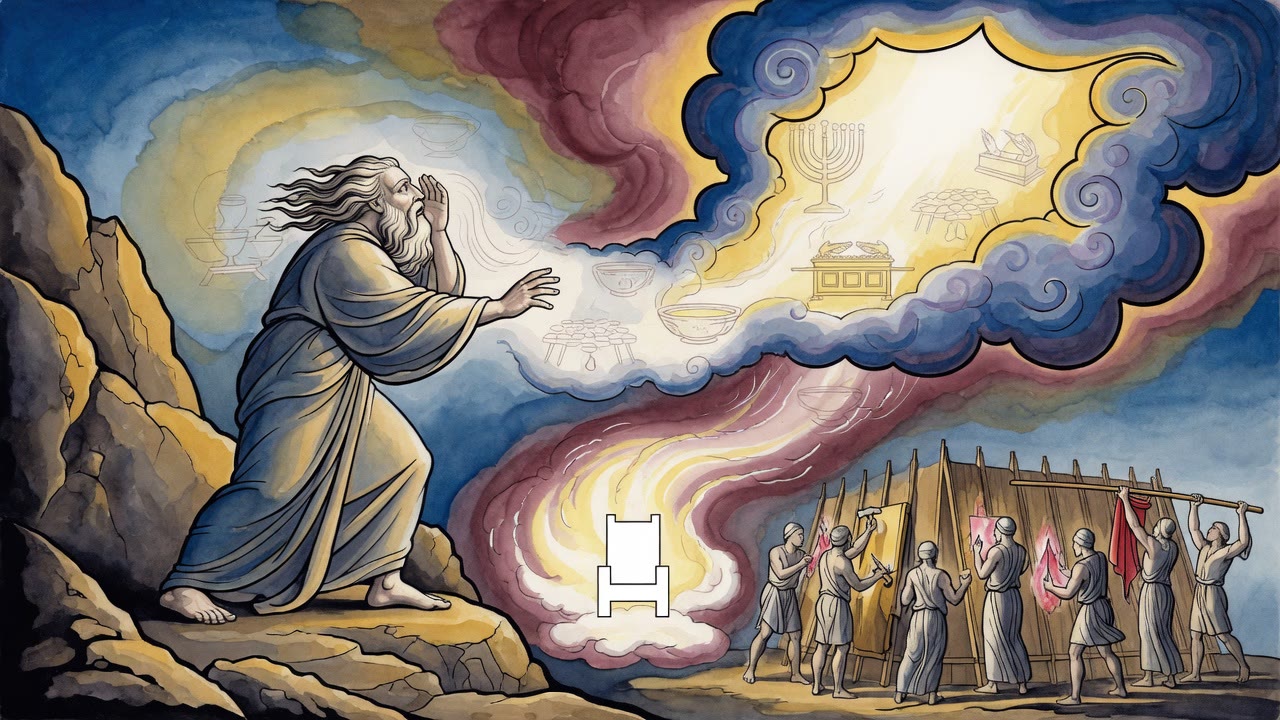
They said to him: “Did you not tell us to do such-and-such?” He replied: “Yes,.” And so they pointed to everything that had been done. They said: “If that is so, why does it not stand? We tried to have Bezalel, Oholiab, and the wise-hearted erect it, but they were unable to do so.” Moses was troubled by all this until the Holy One, blessed be He, told him: Moses, because you were unhappy over the fact that you did not share in the work of the building of the Tabernacle, these wise men are not able to erect it. Now Israel will know that if you do not erect it, it will never be set up. Have I not written previously that it would be done by you, as it is said: And Moses reared up the Tabernacle (Exod. 40:18)? And it says also: And the Lord spoke unto Moses, saying: And the first day of the first month (Nisan) shalt thou rear up the Tabernacle of the Tent of Meeting (ibid., v. 2). Moses replied: Master of the Universe, I do not know how to erect it either. He said to him: Apply yourself to it and it will stand up of itself, for I have written concerning you that you will raise it, as is said: And it came to pass in the first month in the second year on the first day of the month, that the Tabernacle was reared up (ibid., v. 17). Who finally set it up? Moses, as it is said: And Moses reared up the Tabernacle.
R. Hiyya the son of Joseph stated: Throughout the seven days of dedication, Moses took it apart and assembled it twice each day, as is indicated in those verses by the words reared up and it was reared. R. Hanina held that he did so three time each day, since it is said: Reared up, thou shalt rear up, and it was reared. How do we know that they showed him everything? Because it is said: And they brought the Tabernacle unto Moses (Exod. 39:32). Hence, He draweth not His eyes from the righteous (Job 36:7). And Scripture adds: And Moses saw all the work (Exod. 39:43). It does not say “all the work of the Tabernacle” but rather all the work, for the words all the work of the Tabernacle would be equal to the work of creation itself, as is stated above.
He blessed them forthwith, as is said: And Moses blessed them (ibid.). What blessing did he confer upon them? Our sages said: O Lord, God of our fathers, etc. (Deut. 1:11). R. Meir held that he said: “May it be His will that the Shekhinah will rest within the labors of your hands,” and (that) they replied: And let the graciousness of the Lord our God be upon us (Ps. 90:17). Why is it stated so many times: According to all the Lord commanded Moses (Exod. 39:1)? Because the Israelites criticized Moses at the time they strove to erect the Tabernacle but could not do so. They said: “Perhaps the Holy One, blessed be He, told Moses some simple thing to do to erect the Tabernacle, and (thus) Moses alone is responsible for all this difficulty.” Therefore the Holy One, blessed be He, said: Since you have criticized him, I will attach My name to whatever I command him. Thus it is written: According to all the Lord commanded Moses.
The Holy One, blessed be He, declared: If a man criticizes him, he will in fact be criticizing Me, since I told him to do all this: Make Me a Sanctuary (Exod. 25:8).
When did he tell Moses to make the Sanctuary? It was on the Day of Atonement, the tenth day of Tishri. It happened then because he ascended the mountain three times and spent one hundred and twenty days there; that is, from the sixth day of Sivan to the Day of Atonement, the tenth day of Tishri. That is the day of which it is said: And the Lord repented of the evil which he said He would do unto His people (Exod. 32:14) because of the episode of the golden calf. It was the day He said to him: I have pardoned according to thy words (Num. 14:20); it was the day He said: Let them make Me a Sanctuary; it was the day he asked: And pardon our iniquity and our sin, and take us for Thine inheritance (Exod. 34:5); on this day may You grant pardon to future generations; it was the day the Holy One, blessed be He, said to him: For on this day shall atonement be made for you (Lev. 16:30). Hence they constructed the Tabernacle with joy and gladness.
How many months were required to complete the work of the Tabernacle? R. Samuel the son of Nahman held that the work of the Tabernacle was completed in three months, Tishri, Marheshvan, and Kislev, and it remained unassembled through Tevet, Shevat, and Adar. It finally was erected on the first day of Nisan, as it is said: On the first day of the first month shalt thou rear up the Tabernacle of the Tent of Meeting (Exod. 40:2). R. Hanina held: The work on the Tabernacle was completed by the first day of Adar. Why? Because the work that can be accomplished on one day in the summer is equal to two days work in the winter.
If what R. Samuel the son of Nahman said is correct, and the Tabernacle was completed in three months, then why was it not erected immediately? Because the Holy One, blessed be He, wished to combine the festivities of the erection of the Tabernacle with the celebration of the birthday of our patriarch Isaac. Isaac was born on the first day of Nisan. The Holy One, blessed be He, said to Himself: I will combine the celebrations. The scoffers in that generation grumbled and complained, saying: “The work of the Tabernacle has already been completed and it still has not been set up.” They were not aware of the plan and the intention of the Holy One, blessed be He. Because of this King David declared: For thou, Lord, hast made me glad through Thy work; I will exult in the works of Thy hands (Ps. 92:5).
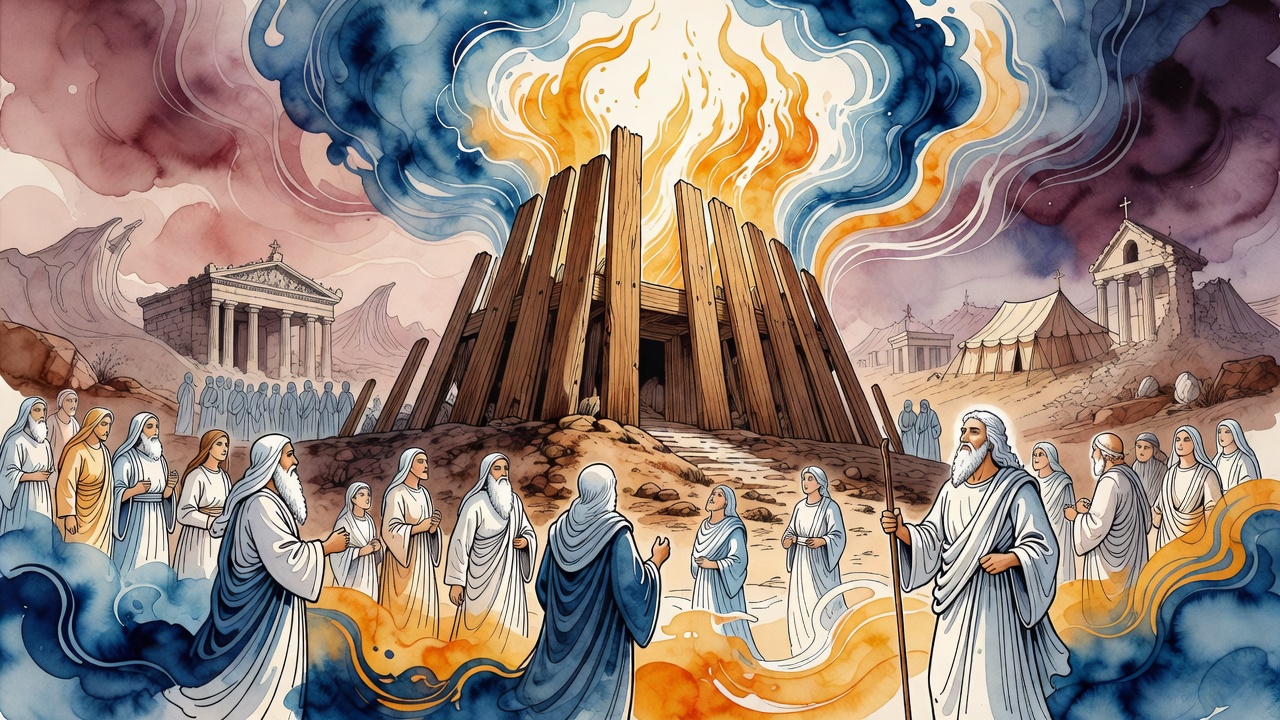
For Thou, Lord, hast made me glad through thy work alludes to the Tent of Meeting. I will exult in the works of Thy hands refers to the building of the Temple, may it be rebuilt speedily in our time. How great are thy works, O Lord: Thy thoughts are very deep (ibid., v. 6) relates to the fact that You decided to combine the celebration of the erection of the Tabernacle with the celebration of the birthday of our patriarch Isaac. That day he received ten crowns, as discussed in Seder Olam. Therefore it says: A brutish man knoweth not, neither doth a food understand this (ibid., v. 7). A brutish man knoweth not alludes to the scoffers and fools of that generation, who did not know the thoughts of the Holy One, blessed be He. Neither doth a fool understand refers to those who do not realize that none of them would be able to rear it, neither Bezalel nor Oholiab nor the wise men who had performed the work. Only Moses would come and do his part, since he was troubled by the fact that he had not participated at all in the work done on the Tabernacle. Therefore Moses reared the Tabernacle, and neither Bezalel nor Oholiab nor the wise could do it. And it is written: And it came to pass on that day that Moses made an end of setting up the Tabernacle (Num. 7:1). When the Tabernacle was set up, the Shekhinah descended into it immediately, as it is said: And Moses was not able to enter into the Tent of Meeting, because the cloud abode thereon, and the glory of the Lord filled the Tabernacle (Exod. 40:35). It is written elsewhere: For the cloud of the Lord was upon the Tabernacle by day (ibid., v. 38) to fulfill what is written: Surely His salvation is nigh them that fear Him; that glory may dwell in our land (Ps. 85:10). The Holy One, blessed be He, said: In this world My Shekhinah will dwell among you and within your sight, as it is said: And the appearance of the glory of the Lord (Exod. 24:1), but in the future the Shekhinah will never depart from you, as it is said: In that day I will dwell therein among the children of Israel and will not forsake My people Israel (I (Kings 6:1)3). Blessed be the Lord forever. Amen. Selah.

 Click for full size