Parshat Vayeshev5 min read

Tamar Strikes Her Belly and Names Kings Inside

Dragged toward the fire as a priest's daughter, Tamar strikes her womb and cries that she carries kings and redeemers, not shame.

Curated by Arthur · Told by Maggid ·
Table of Contents
  1. About Three Months and Not Three Full Ones
  2. The One Dove and the Line That Had to Live
  3. Promises That Do Not Fit a Pyre
  4. Fire Stops When Truth Opens Its Hand

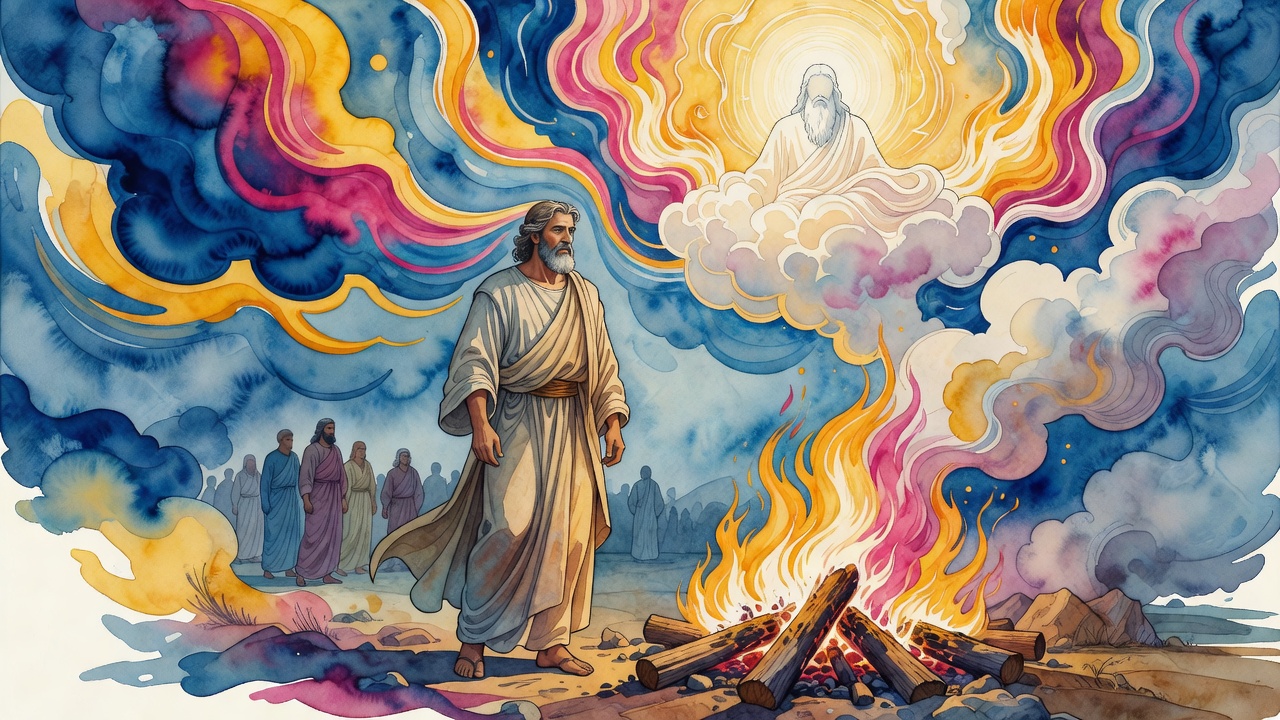
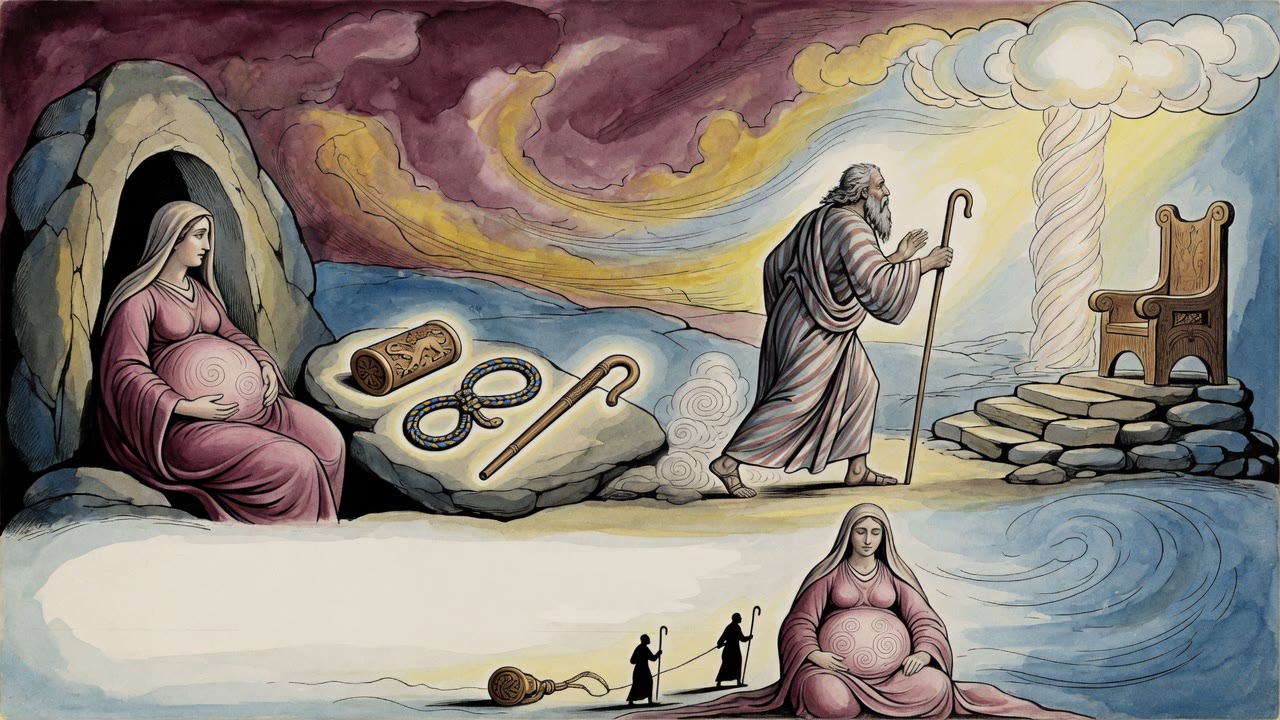
Tamar did not lower her eyes when the men came with rope and wood. She put her palm flat against her belly and struck once, hard enough that the watching women flinched, and she called out so the whole courtyard could hear: "I am pregnant with kings. I am pregnant with redeemers." Dust rose from sandals. Someone laughed the short laugh of people who have already decided a story. The sentence hanging over her was fire. Judah had said, "Bring her forth, and let her be burnt" (Genesis 38:24), and the sages insist the words were not random cruelty. Tamar was the daughter of Shem, of a priestly line, and for a priest's daughter who seemed to have profaned herself the law named flame.

Tamar Strikes Her Belly and Names Kings Inside Click for full size

About Three Months and Not Three Full Ones

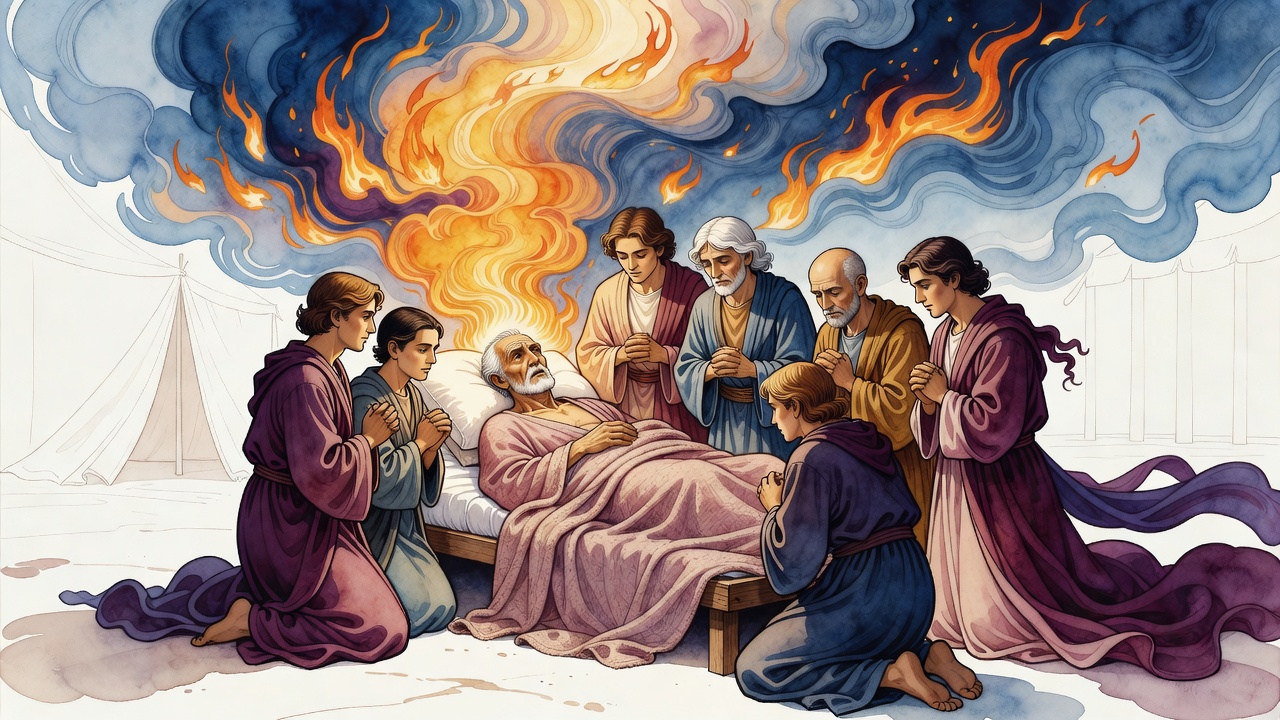
Scripture says it was "about three months" when her body could no longer hide what it held. The Maggidim refuse to count three whole moons. They reckon the greater part of the first month, the whole of the middle, and the greater part of the last, and they teach that the Torah treats a part as a whole when a secret is ripening inside a woman who cannot yet name it safely in public.

So the child was not fully timed when the accusation landed. The secret was still soft. Tamar had the seal, the cord, and the staff pressed against her skin under cloth, and she would not throw them into the street until the last breath before the fire. She waited with a priest's daughter's calm and a mother's rage, counting the hours the way a person counts water in a drought.

In the women's corner someone whispered that three months was enough for shame. Tamar heard and answered only with another strike of palm to belly, as if the body itself were a drum announcing a different calendar.

The One Dove and the Line That Had to Live

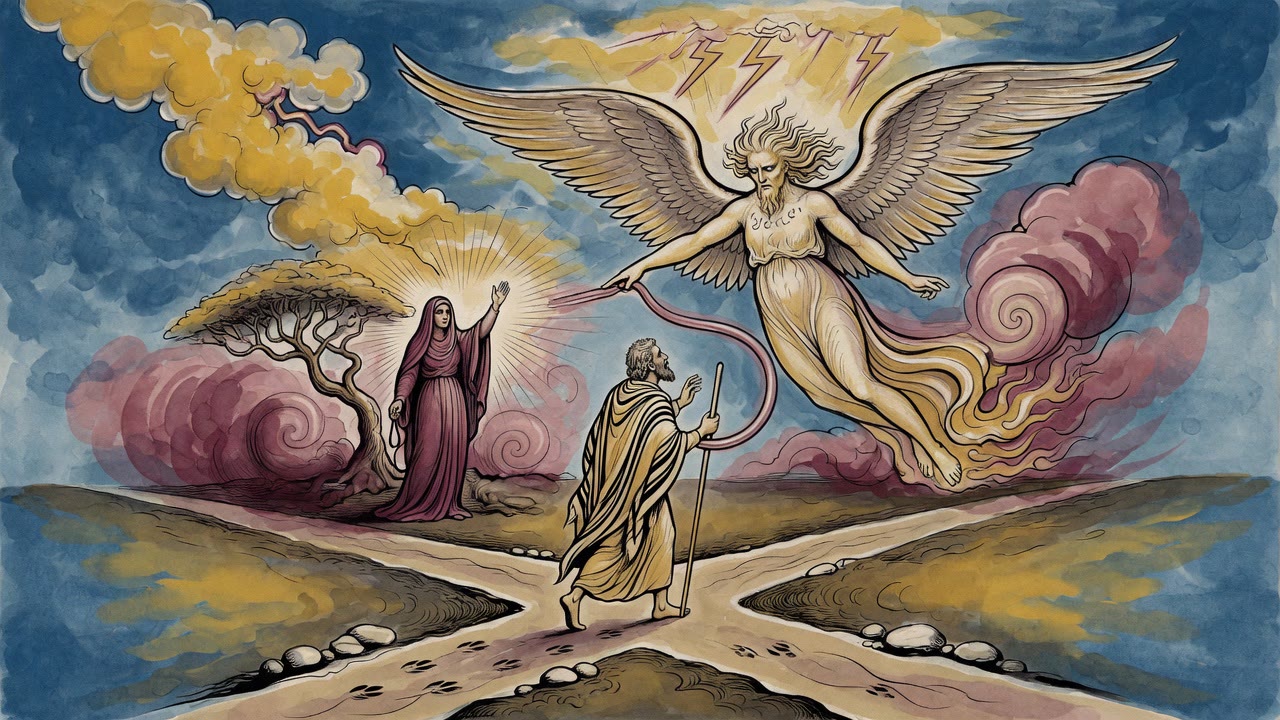
Long before that courtyard, the Song of Songs midrash heard another counting. "One is my faultless dove," the verse says, and the sages point to Abraham, the one who stood alone against idols when the whole street bowed to clay. "One to her mother" is Isaac, only son of Sarah. "Pure to the one who bore her" is Jacob, clear and barur to Rebecca as righteous before the house was finished.

That chain is not poetry for its own sake. It is the line Tamar is trying not to let burn. The girls who will later laud the beloved, the tribes, the praise of queens and concubines, all of it runs through a pregnancy that almost ended in ash. When Tamar strikes her belly, she is defending the dove-line with her body as evidence the court cannot yet read.

Abraham smashed idols. Isaac lay under a knife and lived. Jacob wrestled until dawn. Tamar stood under a verdict of fire and refused to treat her unborn as a footnote. The midrash of the dove and the midrash of the courtyard are one pressure: the line must survive the people who try to tidy it with violence.

Promises That Do Not Fit a Pyre

The kabbalists who map the path of the fathers speak of promises that outrun any single generation's shame. The covenant does not ask whether a woman's story looks clean to the marketplace. It asks whether the seed promised to Abraham still has a vessel willing to risk disgrace for its life. Tamar knew that before the sages wrote diagrams.

Judah's staff still smelled of his hand. His seal still held the cut of his name. She kept those objects the way a person keeps a last key, not as trophies, as proof that the father of the child was not a stranger at the roadside but the very man who had sent her into risk and then called for flame when risk became visible.

Night before the judgment she did not sleep well. The child turned. She pressed both hands to the movement and whispered the only argument she trusted: kings, redeemers, not shame.

Fire Stops When Truth Opens Its Hand

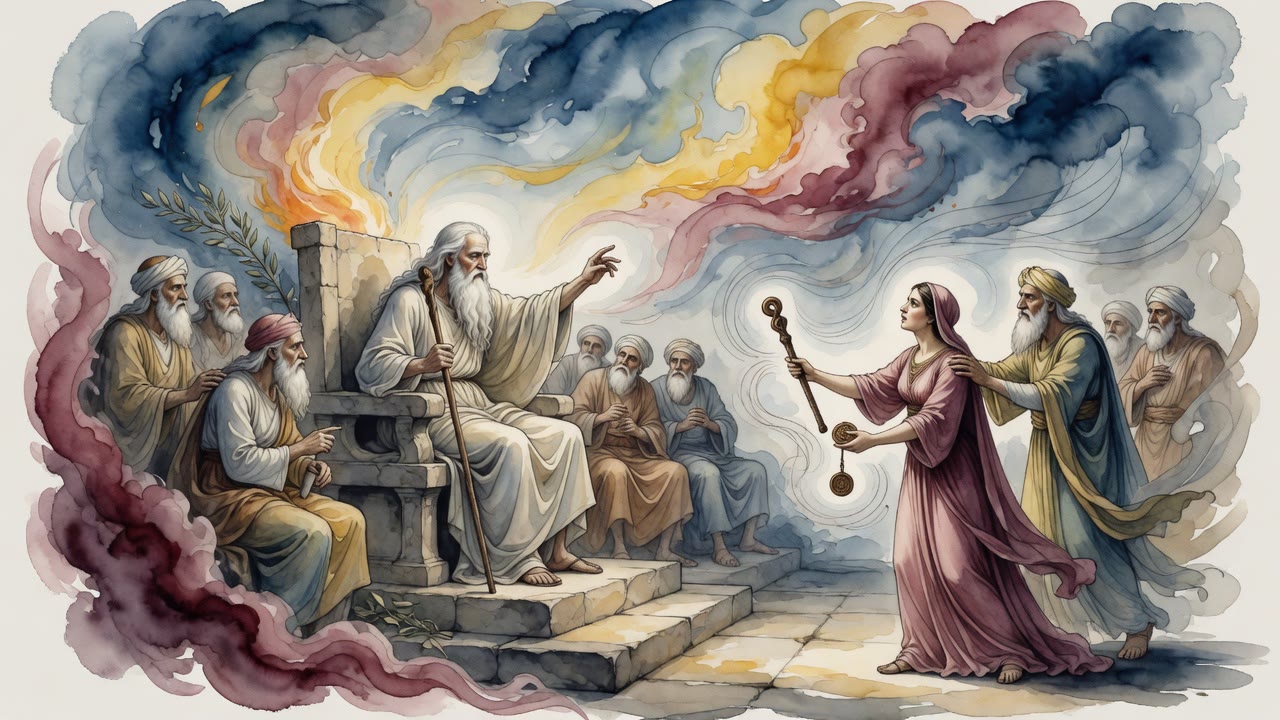
When the moment came, she did not shout Judah's name first. She sent the tokens into the court and let the objects speak. The seal, the cord, the staff crossed the dust like small animals returning home. Judah recognized what he had given and said she was more righteous than he. The wood was not lit. The rope went slack. The redeemers stayed inside her, and the house of David kept its first breath.

The three partial months finished into full time. Perez and Zerah were born into a story that almost chose smoke over kings. Tamar walked away from the place of judgment with soot that never became fire on her clothes, and with a palm that still remembered the strike she had given her own flesh so that no one could call that flesh empty.

Years later, when songs spoke of a single dove and fathers of a promise that bends but does not break, the courtyard still sat under the words. A woman had named what she carried while men stacked wood. The wood never got its meal.


← All myths
From the tradition

Sources

3 sources

The texts behind this telling. Some cards carry a translation of the source; others are our own retelling of it, and each card says which. Every card links out to the original.

Midrash Aggadah, Genesis 38:24Midrash Aggadah

Translation of the source text.Midrash Aggadah (Buber), Public Domain, on Sefaria · CC-BY-SA

"And it came to pass about three months after" (Genesis 38:24), not three complete months, but rather the greater part of the first, the greater part of the last, and the middle one complete.

"Behold, she is with child by harlotry", this teaches that she was patting her belly and saying, "I am pregnant with kings! I am pregnant with redeemers!"

Tamar was the daughter of Shem, as it is said, "And the daughter of any priest, if she profane herself by playing the harlot, she profaneth her father; she shall be burnt with fire" (Leviticus 21:9). And therefore Judah said, "Bring her forth, and let her be burnt."

Full source
Shir HaShirim Rabbah 6:9Shir HaShirim Rabbah

Retold in our words. Read the original at the link below.The Sefaria Midrash Rabbah, 2022 · CC-BY

In Jewish tradition, it's often interpreted as an allegory – a story with a deeper, hidden meaning. And that's where Shir HaShirim Rabbah comes in. This is a collection of rabbinic interpretations of the Song of Songs, and it takes us on quite a journey.

One verse in particular, (Song of Songs 6:9), has captured the imagination of interpreters for centuries: "One is my faultless dove, one to her mother, pure to the one who bore her. Girls see her and laud her; queens and concubines, and praise her." Now, The first reading, this sounds like a lover praising their beloved. But Shir HaShirim Rabbah sees something much grander here. It sees the story of the Jewish people, embodied in our ancestors.

"One is my faultless dove" – who is this "one?" According to the Rabbis, this refers to Abraham. Why? Because, as it says in (Ezekiel 33:24), "Abraham was one." He was the singular individual who dared to challenge the idolatry of his time, the one who forged a new path toward monotheism. He was unique, a pioneer.

Who is "one to her mother?" This is Isaac, Abraham's son. Shir HaShirim Rabbah emphasizes that Isaac was an only child to his mother, Sarah. This highlights his special status, the weight of expectation placed upon him as the inheritor of Abraham's legacy.

Next, we have "pure [bara] to the one who bore her." This speaks to Jacob, the third patriarch. The text draws a clever connection here. "Pure" in Hebrew is bara, and the Rabbis link this to the idea that it was clear [barur] to his mother, Rebecca, that he was entirely righteous. Rebecca knew, deep in her heart, the special destiny that awaited Jacob. It was barur, clear, that he was destined for greatness.

But the allegory doesn't stop there. "Girls see her and laud her." Who are these "girls?" One interpretation sees them as the tribes of Israel. When Joseph's brothers arrived in Egypt, as we read in (Genesis 45:16), the news spread quickly: "The news was heard in Pharaoh's palace, saying, 'Joseph's brothers have come.'" This arrival brought hope and sustenance to the entire family, echoing the idea of praise and admiration. Alternatively, the Rabbis suggest this "girl" is actually Leah, Jacob's wife. They point to (Genesis 30:13), where Leah exclaims, "In my happiness, as women will be happy for me [ishruni]." There's a linguistic connection here between "laud her [vayashruha]" and "will be happy for me [ishruni]," linking Leah's joy and recognition to the verse in Song of Songs.

Finally, "Queens and concubines, and praise her." This refers to Joseph, Jacob's son, who rose to become a powerful figure in Egypt. As Pharaoh said to his servants in (Genesis 41:38), "Can we find someone like this?" The Rabbis emphasize the uniqueness of Joseph, his wisdom and insight. As the verse continues, "After God has disclosed all this to you, [there is no one as insightful and wise as you]" (Genesis 41:39). Joseph was so extraordinary that if you walked from one end of the world to the other, you wouldn't find anyone like him.

So, what does this all mean? Shir HaShirim Rabbah isn't just giving us a history lesson. It's teaching us that the love between God and the Jewish people is reflected in the lives of our ancestors. It's a story of faithfulness, resilience, and the enduring promise of redemption.

Full source
Baal HaSulam's Introduction to Zohar 66:1Baal HaSulam's Introduction to Zohar

Retold in our words. Read the original at the link below.Sefaria-hosted English translation · CC-BY

You're not alone. Jewish tradition, especially Kabbalah, is deeply interested in the idea of inner and outer, of the pnim (internal) and chitzon (external) – and it applies this concept far beyond just individual people.

The great Kabbalist, Baal HaSulam, in his "Introduction to the Zohar," breaks it down for us in a fascinating way. He says that everything, absolutely everything, has an internal and an external dimension.

Think about the world at large. Who's considered "internal"? According to Baal HaSulam, it's Israel, the descendants of Abraham, Isaac, and Jacob. The "external" world? The other nations. Now, before you bristle, it's crucial to understand that this isn’t about superiority. It's about a relationship to something deeper, something more central to the unfolding of spiritual reality.

It doesn't stop there! Even within Israel, there's an internal and external. The "internal" ones are those dedicated servants of God, those who truly strive for connection. The "external"? Those who, well, don't. The same logic applies to other nations too, with righteous gentiles forming their "internal" aspect, as opposed to "the vulgar and damaging people."

See how the layers keep going?

Now, let's get really personal. What about each of us individually? Even within a single Jew, there’s this constant interplay. There are those who are internal, in that they are worthy of understanding the internal soul of the Torah and its secrets, and those who are external, who are only involved in the practical aspects of Torah. According to Baal HaSulam, the "Israel" part of you, the deepest, most essential part, is the secret of the "point in his heart." It is in this part of ourselves that we are the most connected to the Divine.

The "external" part? That's like the other nations within you. It's the body itself, the ego, the impulses that can pull us away from our spiritual center. And what of that "external" part? Is it doomed to be forever separate?

Not at all! Baal HaSulam offers a beautiful image: even that "other nations" aspect can be like a convert to Judaism, a ger tzedek. Think of it! Since it’s linked to the internal aspect, to that spark of the Divine within us, it can become like a righteous convert, willingly attaching itself to the people of Israel, to the internal, to the sacred.

It's a powerful metaphor for the potential for integration within ourselves. That even the parts of us that feel foreign, or even opposed to our spiritual aspirations, can be brought into harmony.

It means recognizing that the battle between internal and external isn't just "out there" in the world. It's happening within each of us, all the time. It means striving to strengthen that "point in the heart," to nurture the "Israel" within, and to bring even our most "external" aspects into alignment with our deepest values. The Zohar, as interpreted by Baal HaSulam, invites us to a constant process of refinement, of bringing the outer into harmony with the inner, and ultimately, of revealing the Divine spark that resides within us all.

Full source