6 min read

Tamar Sent Judah the Seal, Cord, and Staff

Tamar waits at the opening of eyes, Judah walks toward judgment, and three small pledges save a woman and her unborn twins.

Curated by Arthur · Told by Maggid ·
Table of Contents
  1. Pride Entered Before the Road
  2. Tamar Sat at the Opening of Eyes
  3. The Angel Blocked Judah's Escape
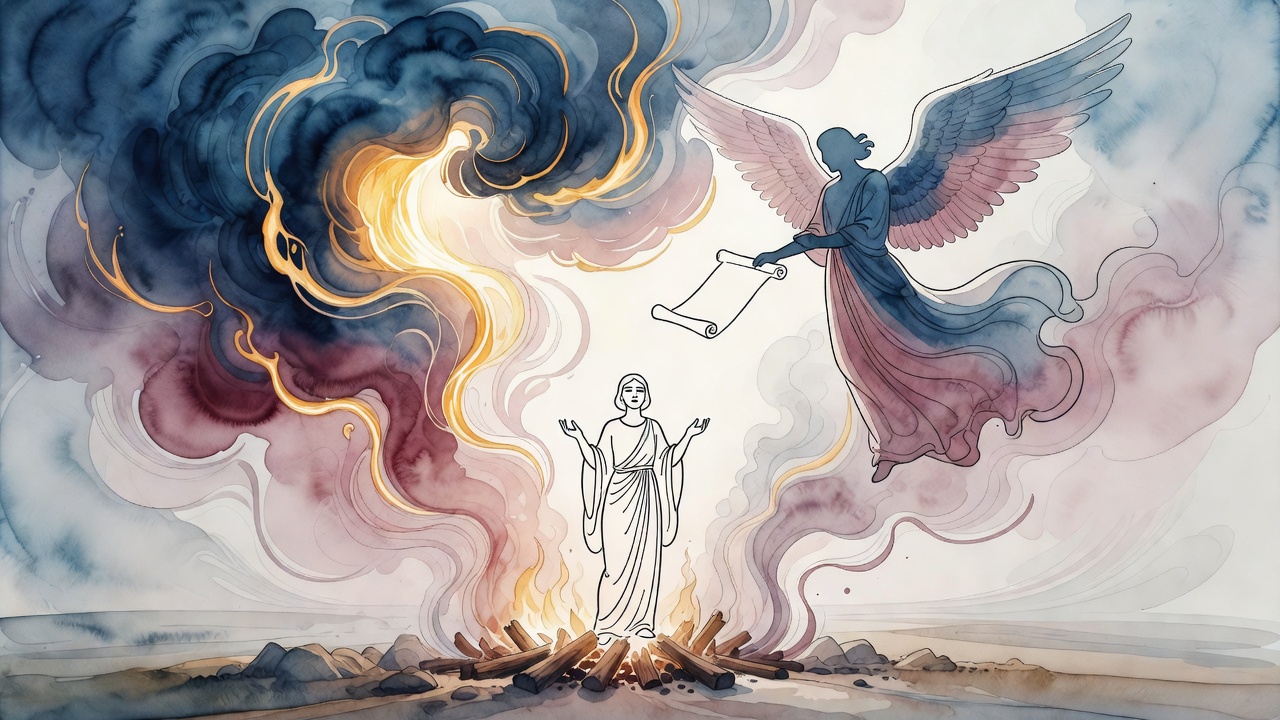
  4. The Fire Waited for Her
  5. Judah Spoke Before Flesh and Blood
  6. Fire and Pit Paid Him Back

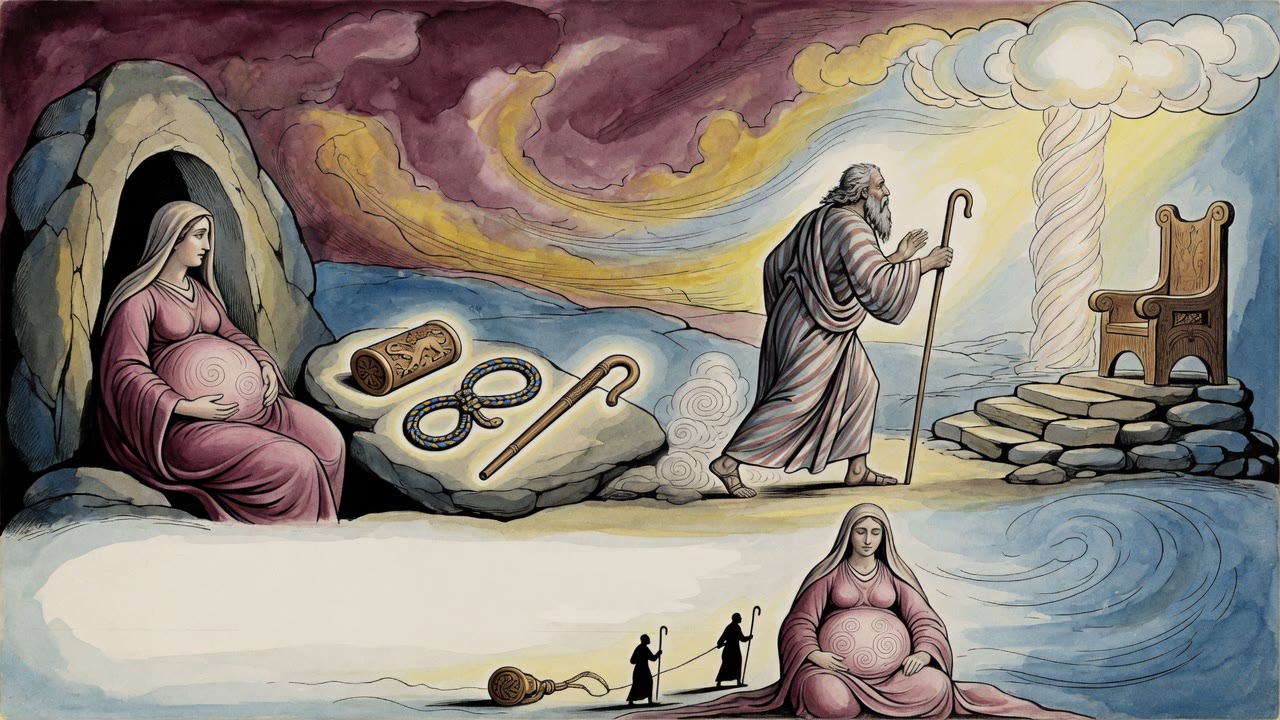
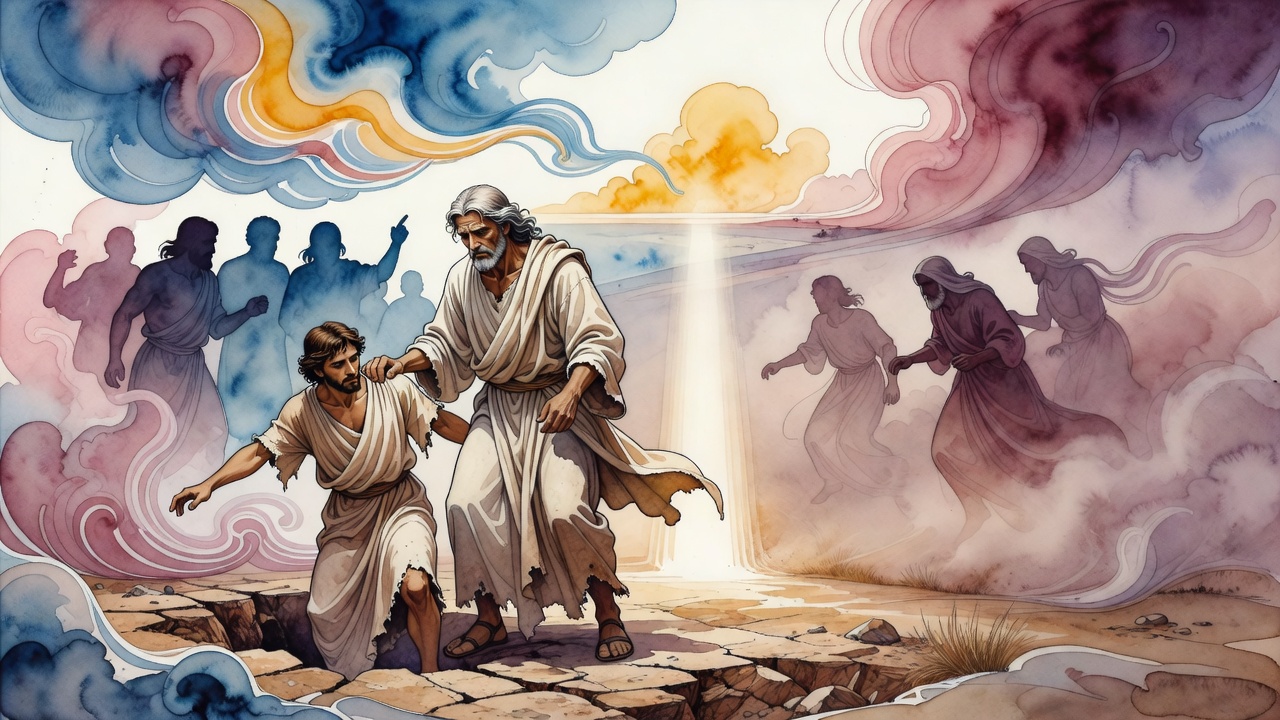
Tamar was already being led toward the fire when light came into her eyes. Somewhere near her, lost among the dust and panic, lay the pledge that could save her life.

Pride Entered Before the Road

Judah knew how to speak with strength. That was part of the danger. He had boasted that desire had never mastered him in war. He had looked at Reuben's disgrace and judged him from a higher place. Then the higher place gave way beneath his own feet.

His first fall came through Bath-shua. He had meant to consult Jacob before marrying her, but her father was a king, and the house glittered with wealth. During the meal she poured wine. The wine turned his eyes aside. Passion darkened his heart. He took what he wanted and later found no joy in the sons born from that choice.

Two of those sons reached Tamar and died. Er died first. Onan followed after refusing to raise offspring for his dead brother. One son remained, Shelah, and Judah sent Tamar back to her father's house with a promise that sounded like law and behaved like delay. Wait until Shelah grows up. Wear widowhood. Stay available. Stay silent.

Tamar Sat at the Opening of Eyes

The place was called Petach Enaim, the opening of eyes, but the sages searched for such a town and found none. So the name became an action. Tamar sat where eyes open.

She lifted her eyes toward the One upon whom all eyes depend and prayed not to leave that place empty-handed. She was not hunting pleasure. She was hunting the future Judah had locked away from her. The line of the house was closing, and she had been made to carry the blame for men whose sins were not hers.

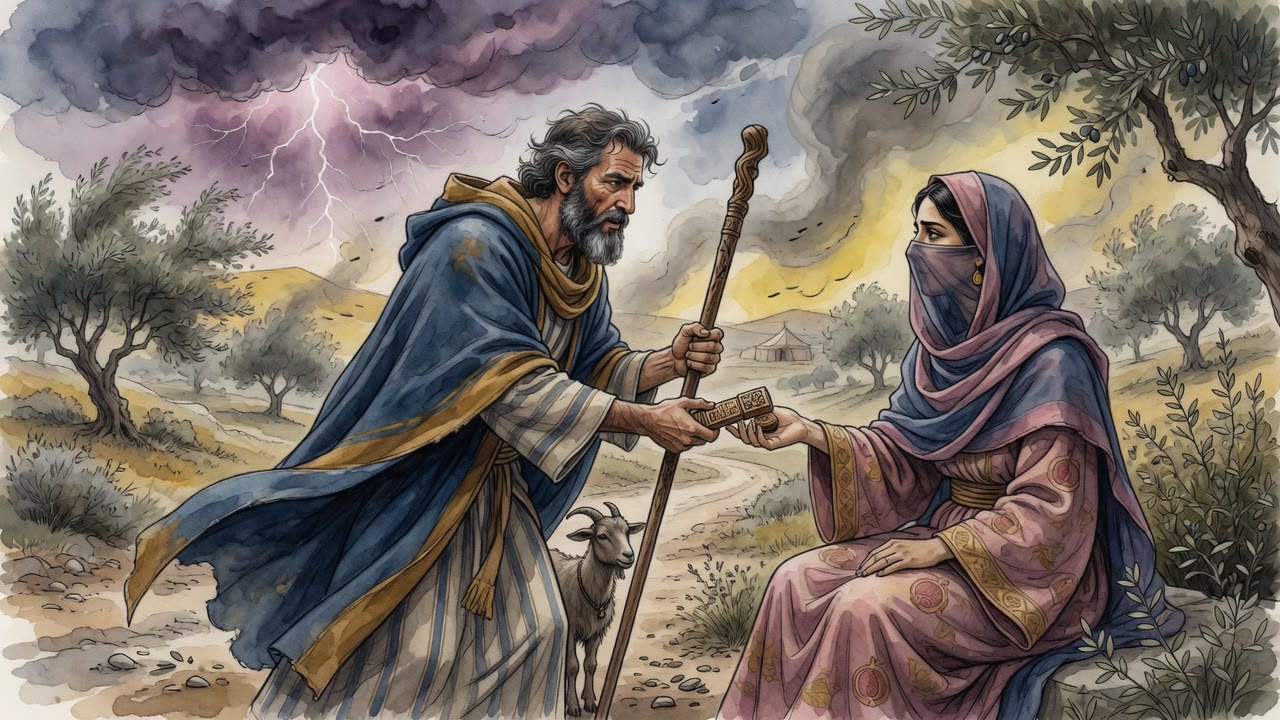
She covered her face with a veil. When Judah came along the road, he did not recognize her. She told him she was pure. She told him she was unmarried. He looked at the covered face and reasoned that a woman who hides herself cannot be a public harlot. A harlot uncovers her face to be seen.

He prepared to pass by.

The Angel Blocked Judah's Escape

Heaven would not let him leave. The Holy One summoned the angel appointed over desire, and the angel stood before Judah in the road.

Where are you going, Judah? From where will kings arise? From where will redeemers arise?

The question struck the road before the man did. Judah thought he was passing a veiled woman. Heaven saw David waiting in the distance. Heaven saw a line of kings pressed into a moment that could be missed if one man kept walking.

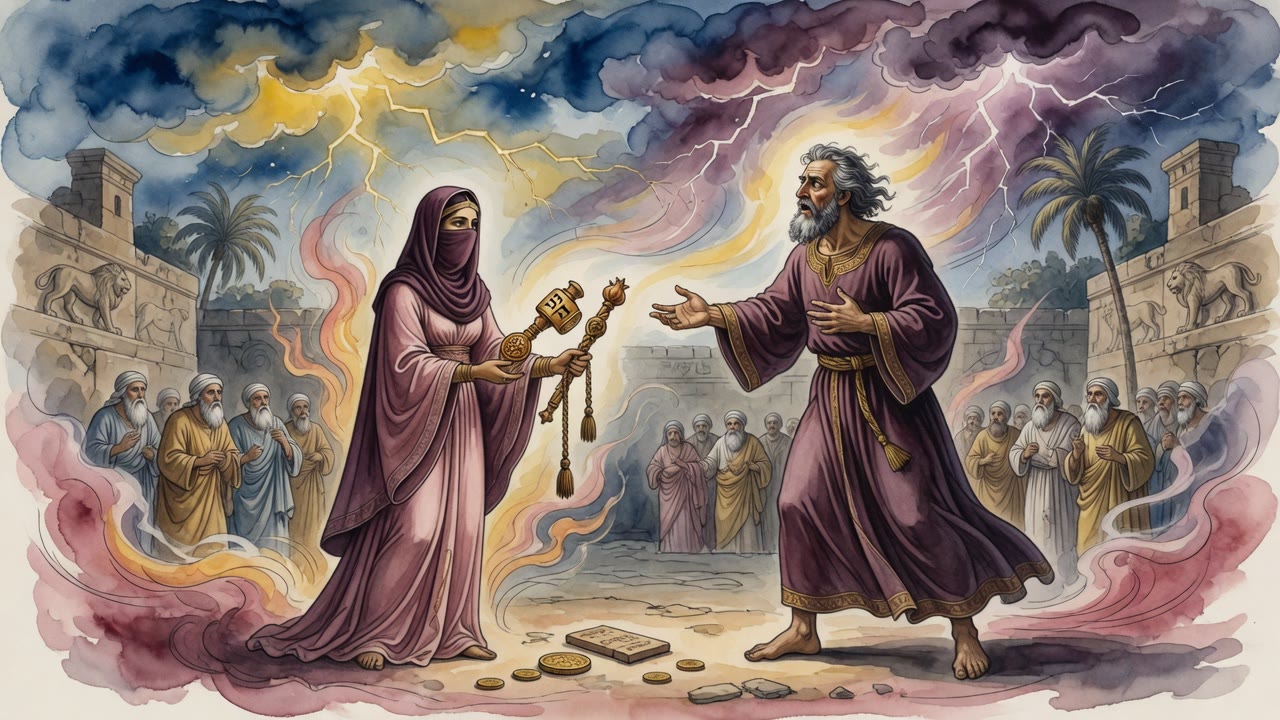
Judah turned back. Tamar asked for a pledge: his seal, his cord, and his staff. Not ornaments. Identity. Authority. The marks by which a man is known. He gave them, and the future entered her body.

The Fire Waited for Her

Months later her pregnancy became visible. The verdict came hard and public. Bring her out and let her be burned.

The man who had withheld Shelah now judged the woman who had forced the truth into daylight. Tamar did not shout his name into the street. She sent the pledge. Seal. Cord. Staff. The objects moved ahead of her like witnesses.

But first she had to find them. The pledge had been lost, and the fire was near. Then God lit her eyes. The dust gave back what it had swallowed. Tamar sent the objects to Judah with words that returned an old wound to his hands: recognize, please, whose these are.

Years earlier Judah and his brothers had sent Joseph's bloodied coat to Jacob with that same demand. Recognize, please. The words had broken a father then. Now they broke the son who had spoken them.

Judah Spoke Before Flesh and Blood

A voice from heaven pressed him: speak now, and she will not burn.

Judah could have kept the air closed in his throat. The fire would have taken Tamar. The twins inside her would have died with her. His seal, cord, and staff might have become rumor, then ash, then nothing.

He spoke.

From me was the matter. She is more righteous than I.

The confession did not make him clean. It made him true. Before flesh and blood, with his own authority lying in another person's hands, Judah acknowledged what he had done and what he had withheld. Tamar lived. The children lived. The fire lost its claim.

Fire and Pit Paid Him Back

Heaven counted the lives. Tamar and the twins were saved from the fire. Joseph, once saved from the pit when Judah argued against killing him, stood beside them in the accounting. Four lives. Fire and pit.

Generations later, four descendants from Judah's line stood in danger and came out whole. Hananiah, Mishael, and Azariah were drawn unburned from the fiery furnace. Daniel came up alive from the lions' pit. Measure answered measure. The confession in the road of Genesis kept burning forward until fire itself had to release Judah's children.

Even Reuben heard the echo. When Judah confessed openly, Reuben found courage to own his own sin before his father. Long afterward Moses blessed them both, Reuben with life, Judah with strength. A man who once sent a bloodied coat and said recognize, please, finally recognized himself.


← All myths
From the tradition

Sources

6 sources

The texts this telling draws on, in full. Open a card to read inline, or expand it for a wider, quieter read.

Legends of the Jews 2:34Legends of the Jews

It's a moment of vulnerability that resonates across millennia. Judah, a man known for his strength and leadership, admits to a profound moral failing. He warns us, his descendants, "Do not walk after the desire of your hearts, and vaunt not the valiant deeds of your youth. This, too, is evil in the eyes of the Lord."

Why such strong words?

Judah reveals that his downfall began with pride. He boasted that the allure of beautiful women had never tempted him during wartime. He even criticized his brother Reuben for his transgression with Bilhah (Genesis 35:22). But as readers often see, pride comes before a fall.

"While I boasted... the spirit of passion and unchastity gained possession of me," he confesses. This led him to marry Bath-shua, and, as the text delicately puts it, "trespassed with Tamar, though she was the affianced of my son." (Genesis 38).

The story of Judah and Tamar is complex and layered, full of cultural nuances that might seem strange to modern ears. What's key here is the underlying struggle with temptation and the consequences of succumbing to it.

Judah recounts how he initially intended to consult his father, Jacob, before marrying Bath-shua. But Bath-shua's father, a king, presented him with overwhelming wealth and adorned his daughter with irresistible beauty. Then, during a meal, he had her pour the wine. "The wine turned my eyes awry, and passion darkened my heart," Judah laments. Blinded by desire, he ignored both God's commands and his father's wishes.

Did he get away with it? Not quite.

"The Lord gave me a recompense according to the counsel of my heart, for I had no joy in the sons she bore me." His choices had consequences, a painful reminder that our actions have repercussions, not just for ourselves, but for those around us as well.

Judah's story is a powerful lesson in humility, reminding us that even the strongest among us are susceptible to temptation and that boasting about our virtues can be a dangerous trap. It encourages us to be vigilant, to seek guidance, and to remember that true strength lies not in resisting temptation perfectly, but in acknowledging our failures and striving to learn from them.

Full source
Midrash Tanchuma Buber, Vayeshev 17:7Midrash Tanchuma Buber, Vayeshev

Another interpretation. Rabbi Judah the Levite son of Rabbi Shallum said: When she was going out, the Holy One, blessed be He, lit up her eyes, and she found them after she had lost them; for there is no "finding" except out of the category of what was lost, as it is written, "Or has found what was lost" (Leviticus 5:22). Immediately she sent to Judah, "to the man to whom these belong" (Genesis 38:25). She said to him, "Judah, recognize, I pray, your Creator." Immediately, "And Judah recognized" (Genesis 38:26).

At that hour a heavenly voice (bat kol) went forth and said to him: Say, "She is pregnant by me," so that she not be burned. And afterward he acknowledged: "From me was the matter." The Holy One, blessed be He, said to him: Judah, you have saved three souls for Me from the fire, and one from the pit. By your life, I too will save for you just as you have saved for Me. Who are they? Hananiah, Mishael, and Azariah from the fiery furnace, and Daniel from the lions' pit. What is written concerning them? "And among them, from the children of Judah, were Daniel, Hananiah, Mishael, and Azariah" (Daniel 1:6). "From the children of Hezekiah" is not written here, but "from the children of Judah." On account of what? On account of his having saved Tamar and her children, and Joseph from the pit.

When Reuben heard that Judah had acknowledged, immediately he too arose and said: I also have profaned my father's couch. Eliphaz said to Job, "I will show you, hearken to me; and this I have seen, and I will declare it, that which wise men have told" (Job 15:17-18), these are Reuben and Judah. Therefore, "to them alone was the land given" (Job 15:19). When? "And no stranger passed among them" (ibid.), when Moses came to bless them, what did he say? "Let Reuben live and not die," and "And this is for Judah" (Deuteronomy 33:6-7).

Full source
Bereshit Rabbah 85:11Bereshit Rabbah

The story of Judah and Tamar, found in Genesis 38, is a powerful exploration of just that. And the Rabbis, in their infinite wisdom, examine the layers of this narrative in Bereshit Rabbah, offering us profound insights.

Tamar, Judah's daughter-in-law, finds herself in a precarious position, tricked and seemingly abandoned by Judah. So, she takes matters into her own hands, disguising herself and engaging with Judah, ultimately becoming pregnant. When her pregnancy becomes apparent, she’s accused of infidelity and sentenced to be burned. But Tamar, ever the clever one, sends a message to Judah: "By the man to whom these belong, I am with child. Identify, please, whose signet, and belt, and staff these are" (Genesis 38:25).

That phrase, "She was taken out," (mutzet in Hebrew) sparks some fascinating interpretations. Rabbi Yudan offers a beautiful thought: perhaps Judah's original signet, belt, and staff were actually lost, and God, blessed be He, provided him new ones! He draws a parallel to the verse: "Or found (matza) a lost item.." (Leviticus 5:22), suggesting a divine intervention, a sort of cosmic replacement.

Rav Huna sees the words "She was taken out" as a condemnation for both Judah and Tamar. He points out that the word "she" (hi in Hebrew), spelled heh vav alef, can also be read as "he" (hu). The implication? Both Judah and Tamar should face the same consequences for their actions. A stark reminder that justice should be blind.

But it’s Tamar's message to Judah that really grabs us. "Identify, please (haker na).." She's not just asking him to identify the objects; she's challenging him to acknowledge his own role in the situation. According to Yefe To’ar, a commentary on Bereshit Rabbah, Judah initially tries to deny his involvement. So Tamar ups the ante: "Acknowledge now your Creator; they belong to you and your Creator." Talk about a mic drop! It's as if she's saying, "These items, miraculously recreated, are a sign from above. Recognize your responsibility, not just to me, but to God!"

And here's where the echo comes in. Rabbi Yoḥanan connects this moment to an earlier episode in Judah's life. Remember when Judah and his brothers sold Joseph into slavery? They presented Joseph's coat to their father, Jacob, and said, "Identify, please, whether this be thy son's coat or not" (Genesis 37:32). The Holy One, blessed be He, says to Judah, "You said to your father: 'Identify, please'; as you live, Tamar will say to you: 'Identify, please.'"

Wow. Talk about reaping what you sow. The very words Judah used to deceive his father are now used against him, forcing him to confront his own hypocrisy and past actions. It’s a powerful reminder that our words and deeds have consequences, often in ways we can't anticipate.

This story, unpacked by the Rabbis in Bereshit Rabbah, isn't just about Judah and Tamar. It's about accountability, divine justice, and the cyclical nature of life. It challenges us to examine our own actions and words, to consider how they might reverberate in the future. Are we creating echoes we'll be proud to hear? Or are we setting ourselves up for a confrontation with our past selves? It's a question worth pondering, isn't it?

Full source
Midrash Aggadah, Genesis 38:14Midrash Aggadah

"And she sat at the entrance of Enaim (the opening of the eyes)" (Genesis 38:14). We have searched through the entire Scripture and have not found a place named Petach Enaim; rather, this teaches that she lifted up her eyes to the One upon whom all eyes are dependent, and she said before the Holy One, blessed be He: "May it be Your will that I not go out empty from this entrance."

Another interpretation: this teaches that she opened up arguments before him, and said to him, "I am pure, I am unmarried." Judah saw her and did not take notice of her. He said, "Since she has covered her face, this one is not a harlot; for if she were a harlot, she would not cover her face." He sought to pass by, but the Holy One, blessed be He, summoned for him the angel who is appointed over desire. He said: "Judah, where are you going? From where shall kings arise? From where shall redeemers arise?"

Full source
Yalkut Shimoni on Torah 145:4Yalkut Shimoni on Torah

"And Judah saw her and thought her to be a harlot" (Genesis 38:15). A person must guard himself with his wife's sister and with his relatives, that he not stumble with one of them. From whom do you learn this? From Judah. "And Judah saw her", why? "For she had covered her face" while she was in the house of her father-in-law. Another interpretation: "And Judah saw her", he paid no heed, since she had covered her face; he said: were she a harlot, she would not cover her face.

Rabbi Yochanan said: he sought to pass by, and the Holy One, blessed be He, appointed for him the angel who is appointed over desire. He said to him: Where are you going, Judah? From where do kings arise? From where do redeemers arise? "And he turned aside to her by the way" (Genesis 38:16), against his will, not of his own good pleasure.

"And she said, Your signet and your cord" (Genesis 38:18). The Holy Spirit sparkled within her. "Your signet", this is the kingdom, as you say, "Though Coniah son of Jehoiakim king of Judah were a signet upon My right hand" (Jeremiah 22:24). "And your cord", this is the Sanhedrin, who are marked with a cord, as you say, "And they shall put upon the fringe of each corner a cord of blue" (Numbers 15:38). "And your staff which is in your hand", this is the King Messiah, as you say, "The LORD shall send the staff of your strength out of Zion" (Psalms 110:2). "And he went in to her, and she conceived by him" (Genesis 38:18): mighty ones like him, righteous ones like him.

Full source
Targum Pseudo-Jonathan on Genesis 38:18Targum Pseudo-Jonathan on Genesis

The Targum names them precisely: thy seal, and thy mantle, and thy staff which is in thy hand (Genesis 38:18). Tamar did not ask for silver. She asked for the three objects a man of standing would not give up unless he meant to return.

The Sages of Bereshit Rabbah dwelled on these three items. The seal (chotam) marked Judah's name on documents, his legal self. The mantle (petilin, the cord) fastened his outer robe, his public garment. The staff was his walking rod, his authority on the road. Together they amount to a small portable portrait of a tribal leader. The Targum Pseudo-Jonathan, redacted in the Land of Israel in the early centuries of the common era, lists the three items in exactly the form that would later let the court scene work: unmistakable, identifiable tokens.

What Tamar is doing, in the tradition's reading, is archival. She is collecting evidence. She knows that if she is later accused, she will need more than her word. She will need the objects themselves, held in her hand, to force a powerful man to recognize his own handwriting.

There is a quieter theological note. The Targum says Judah gave them to her. A man's public identity is not taken from him; he hands it over. The seal, the mantle, the staff walk away with a veiled stranger because, for a few hours, he has stopped being the Judah who guards them.

The midrashic lesson is simple and hard. The signs of who we are in the world, our name, our robe, our staff, can be lost in a moment of private indifference. They can also, if we are fortunate, be given back to us as witnesses that call us back to ourselves.

Full source