6 min read

The Fourteen Years Jacob Hid in the House of Eber

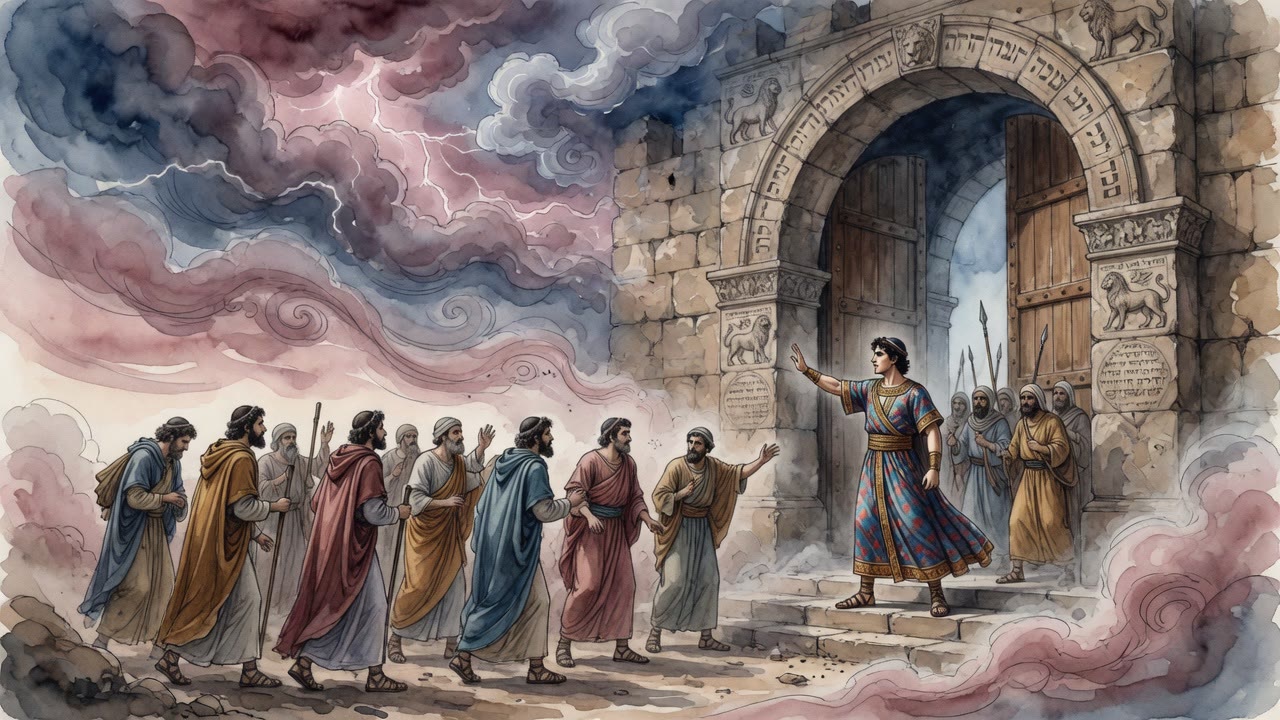
Jacob fled Esau's blade and vanished into the house of Eber for fourteen years, hidden among men who remembered the world before the Flood.

Curated by Arthur · Told by Maggid ·
Table of Contents
  1. The Brother Who Could Not Be Outrun
  2. The Door That Opened on Older Air
  3. Fourteen Years Without a Window
  4. What Esau Did While Jacob Vanished
  5. The Two Roads Out of One Tent

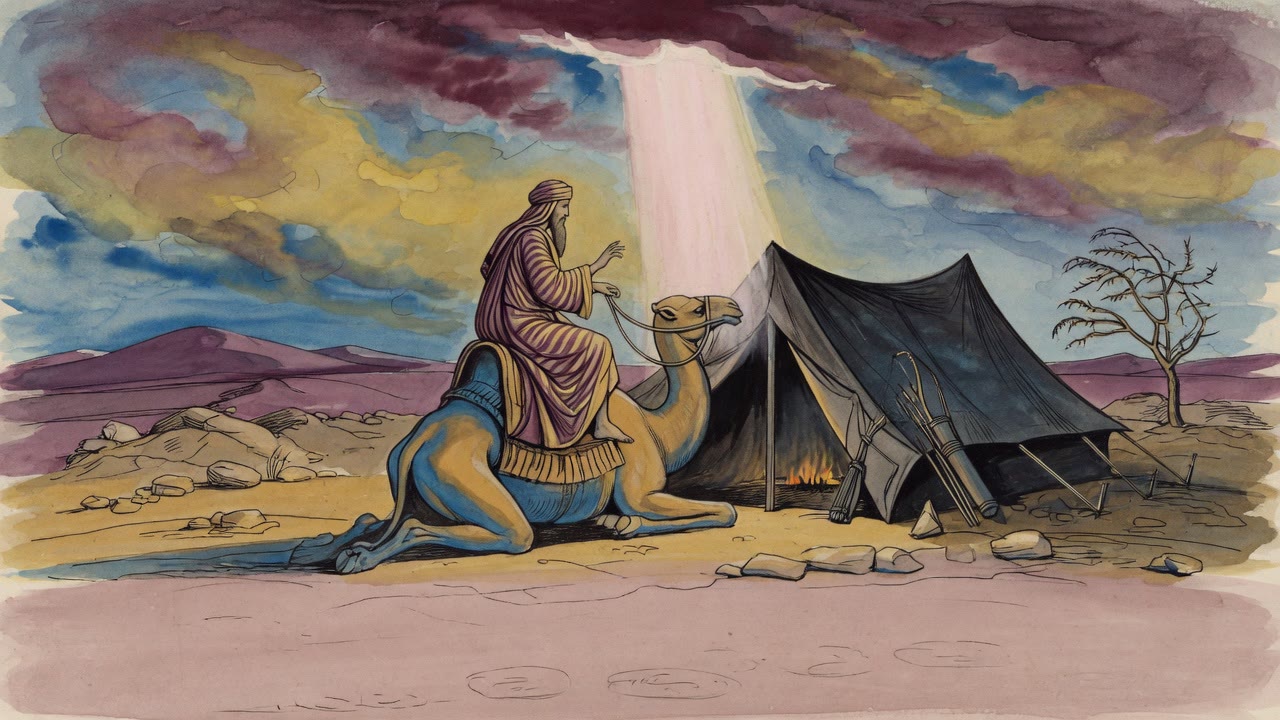
The boy ran with his sandals in his hand so his footfalls would make no sound on the stones outside Beersheba. Behind him, in the dark of the tent, his brother was sharpening a grievance into a vow. Jacob did not look back. He had stolen something that could not be returned, and the man he had stolen it from was a hunter who knew how to wait, how to track, how to close the distance on a thing that thought it had gotten away.
The Brother Who Could Not Be Outrun

Esau had loved the blessing the way he loved the open field, fiercely and without reflection, and now it was gone, pressed into the palm of the smooth-skinned younger one who stayed near the tents. The hatred came up in Esau hot and complete (Genesis 27:41). He told himself he would let the old man die in peace first. Then he would settle it.

Jacob heard the size of that promise before he heard the words. His mother heard it too. She did not tell him to be brave. She told him to disappear. Go, she said, and not toward anyone who would expect to find him. A fugitive who runs to the obvious door is a fugitive already caught.

So he did not go straight to Haran. The road to his uncle's house was the road a furious brother would watch. Jacob turned aside from it, into a country of memory rather than kin, and knocked at a door that had stood for longer than anyone alive could properly account for.

The Door That Opened on Older Air

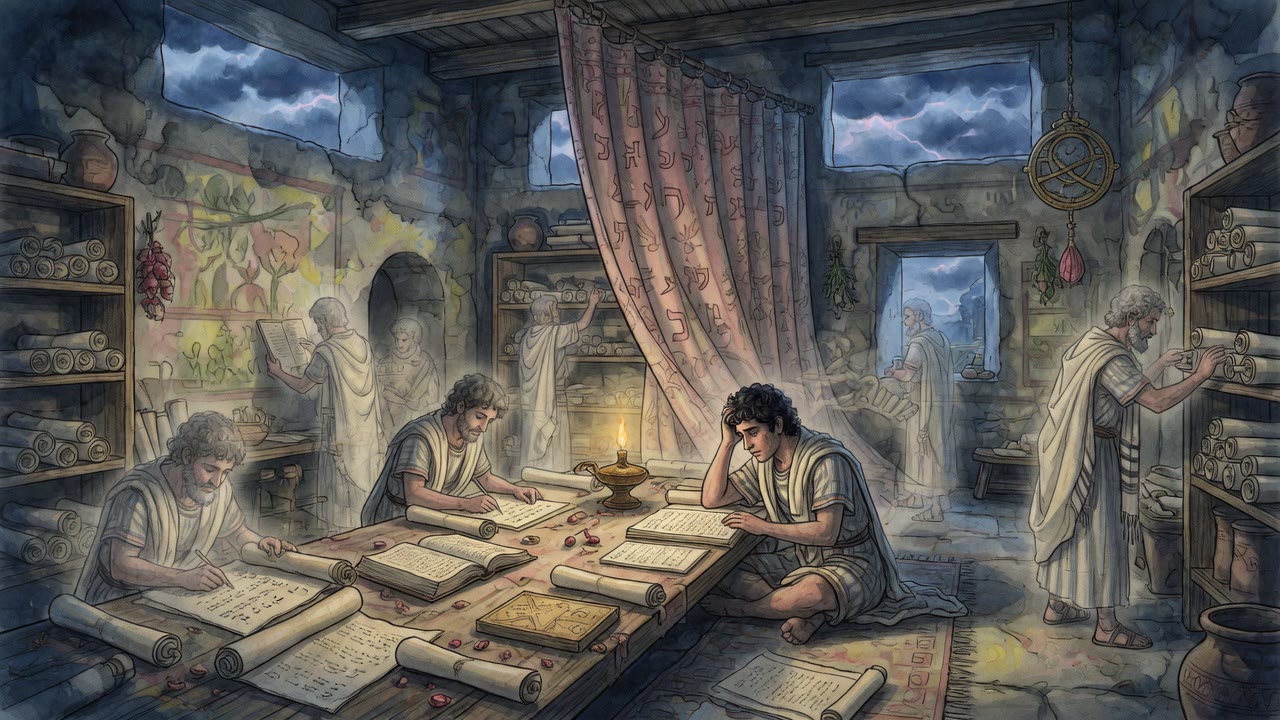
The house of Eber smelled of lamp oil and old cloth and the particular stillness of a place where men sat very still for a very long time. Eber was descended from Shem, and Shem was the son of Noah, and that meant the air inside those walls carried something the open road did not. Here lived the keepers of a chain that reached back past the patriarchs, past the scattering of tongues, back to a man who had stood on a wooden floor while the whole world went under and then watched it come up dripping and new.

Jacob came to that door with nothing. His father's house was closed to him. His birthright was a thing he had taken rather than been given, and his blessing had cost him every roof he owned. He had a name that meant heel-grabber and a brother counting down the days. He set all of it down at the threshold and asked to be let in to learn.

They let him in. And then the road outside went quiet, and the years began to pass without anyone in Canaan knowing where he was.

Fourteen Years Without a Window

Count them. He was sixty when he slipped out of Beersheba. He was seventy-seven when he finally stood at his uncle's well in Haran and rolled the stone away for a shepherd girl. Between those two numbers sits a silence that the running and the arriving never explain. Fourteen years. He spent them here, hidden, bent over study from the time the lamp was lit until the time it guttered out.

There were no errands. There was no flock to count, no field to walk, no brother's footstep to listen for in the night. There was only the slow turning of words, the same words again and again until they wore grooves into him. A man does not hide for fourteen years to wait out a temper. A temper cools in a season. He stayed because the hiding had become something else. The fugitive had become a student, and the student was being rebuilt from the inside while no one watched.

The trickster who left his father's tent in a borrowed coat, smelling of someone else's field, was being unmade in that house and slowly put back together as a man who could stand at a stranger's door and say his own name without flinching.

What Esau Did While Jacob Vanished

Esau, for his part, had no school to disappear into. He had his rage, and he turned it not only on the brother who fled but on the parents who had let it happen. He felt betrayed from every side at once, the blessing gone, the trickster gone, and his mother and father standing there having watched it all.

So he made a change he could control. He took his household and went down to the land of Seir, away from the house where the wound had been opened. There he took another wife, Basemath, daughter of Elon the Hittite, and he gave her a new name, Adah. He believed that the day he renamed her was the day the blessing slipped finally and forever out of his hands, and he was trying, one name at a time, to rewrite a story that had already been written without his consent.

He stayed in Seir only about half a year before he came back to Canaan and set his wives in his father's house at Hebron. Esau circled. Esau renamed. Esau could not sit still long enough to be changed by stillness.

The Two Roads Out of One Tent

Two brothers ran from the same night. One ran to a place of memory and let it work on him in the dark for fourteen years. The other ran to a place he could rule and tried to bend it to his grievance. When Jacob at last walked out of Eber's door and turned toward Haran, he was no longer the man who had fled. He went to meet a future wife, a scheming uncle, and a wrestling match at a river crossing that would leave him limping and renamed by a hand that was not his own.

The smooth-skinned boy who took his brother's blessing by trickery had been hidden away and remade in silence, and only the keepers of the oldest house knew the shape of the work that had been done.


← All myths
From the tradition

Sources

5 sources

The texts this telling draws on, in full. Open a card to read inline, or expand it for a wider, quieter read.

Legends of the Jews 6:79Legends of the Jews

The Torah tells us that Esau harbored a deep-seated hatred for Jacob because of that stolen blessing. He felt utterly cheated. And Jacob, well, he was understandably terrified of his brother's wrath. So, what did he do? He fled. According to Legends of the Jews, Jacob sought refuge in the house of Eber, the son of Shem, where he remained hidden for fourteen long years.

What about Esau? The text says he was "vexed" – not just at Jacob, but at his own parents as well. He felt betrayed on all fronts. So, he decided to make a change. He took his wife and moved to the land of Seir. There, he married a second wife, Basemath, the daughter of Elon the Hittite, renaming her Adah. Why the name change? Well, it’s said he believed that this marked the moment the blessing truly slipped from his grasp. It's like he was trying to rewrite his own destiny, one name at a time.

He stayed in Seir for about six months, but then Esau returned to Canaan, placing his wives in his father's house in Hebron. This didn't exactly bring peace to the family. The wives of Esau, They weren’t exactly poster children for pious living. They worshipped their fathers' gods – those "gods of wood and stone" – and were, "more wicked than their fathers." They sacrificed and burned incense to the Baalim (a plural form of the name Ba'al, referring to various local deities), and Isaac and Rebekah were just plain fed up. You can almost feel the tension simmering in their household, can't you?

Meanwhile, back at Eber's house, fourteen years had passed. Jacob, now presumably a changed man, yearned to see his parents again. He decided to return home. Here's where things get interesting. Legends of the Jews tells us that Esau had, for a time, forgotten what Jacob had done. But the moment he saw his brother returning, the old resentment flared up. All the pain, all the anger, rushed back. He was "greatly incensed against him, and he sought to slay him."

What a cliffhanger. What happens next? Does Esau act on his rage? Does Jacob's newfound piety protect him? These are questions that keep us turning the pages of this ancient saga, exploring the complexities of family, faith, and the enduring power of a blessing – or a curse.

Full source
Legends of the Jews 6:77Legends of the Jews

Take Isaac's blessings to his sons, Esau and Jacob. The first reading, they seem like simple pronouncements of fortune, but scratching beneath the surface reveals a complex theology about merit, divine will, and the nature of blessing itself.

In Legends of the Jews, as retold by Rabbi Louis Ginzberg, Isaac's blessing to Esau wasn't just a pat on the head. It was a roadmap, a geographic and socio-economic destiny. "Behold, of the fat of the earth shall be thy dwelling," Isaac declared, referring to Greater Greece, in Italy. He continued, "and of the dew of heaven from above," a nod to Bet-Gubrin. And then, the tough part: "and by thy sword shalt thou live, and thou shalt serve thy brother," but with a promise of eventual liberation: "when he casts off the yoke of the Lord, then shalt thou shake his yoke from off thy neck, and thou wilt be his master."

So, what does it all mean?

The key here is that Isaac's blessing for Esau was, according to this tradition, unconditional. No strings attached. Whether Esau was a righteous person or a sinner, the blessings were his. He would enjoy the good things of this world, period.

But Jacob's blessing? That was a different story. It was all about merit. Jacob's prosperity, his success, his very blessing, depended on his pious deeds. Through them, and only through them, would he have a legitimate claim to earthly prosperity.

Now, why would Isaac do that? Why the disparity?

Isaac, it seems, was playing the long game. He reasoned that Jacob, being a righteous man, would persevere even in the face of suffering. He wouldn't lose faith, even if things got tough. But Esau? Esau was a different story. Isaac thought, "If that reprobate Esau should do a good deed, or pray to God and not be heard, he would say, 'As I pray to the idols for naught, so it is in vain to pray to God.'"

In other words, Isaac feared that conditional blessings for Esau would backfire. If Esau felt that his efforts went unrewarded, he would abandon faith altogether. So, Isaac bestowed an unconditional blessing upon Esau, ensuring that he would at least experience some good in his life, regardless of his spiritual state.

It's a fascinating insight, isn't it? It suggests a complex understanding of human nature, divine justice, and the delicate balance between reward and faith. It also makes us wonder: what kind of blessing do we strive for? The unconditional kind, freely given? Or the conditional kind, earned through our actions? And perhaps more importantly, what do we do with the blessings we receive, however they arrive? Are we like Jacob, striving to live up to the responsibility of our blessings? Or are we like Esau, accepting them without considering their source or purpose? Perhaps the story of Isaac's blessings is less about the blessings themselves, and more about what they reveal about our own hearts.

Full source
Yalkut Shimoni on Torah 119:2Yalkut Shimoni on Torah

and he lay down in that place – R’ Yehudah says ‘here he lay down, but all fourteen years that he was hidden away in the land serving Ever he never laid down.’ R’ Nechemia says ‘here he lay down, but all twenty years that he was in the House of Lavan he never laid down.’ And what would he say? Fifteen songs of ascent which are in the Book of Tehillim. And why the songs of ascent? As it says “…Had it not been for the Lord Who was with us, let Israel declare now,” (Tehillim 124:1) this refers to grandfather Yisrael (Yisrael Saba). R’ Shmuel bar Nachman said ‘he would say the whole Book of Tehillim, and for what reason? As it says “But You are holy; You await the praises of Israel,” (Tehillim 22:4) this refers to grandfather Yisrael (Yisrael Saba).

Yaakov was seventy-seven when he left his house, and the well went before him two day’s travel all the way from Be’er Sheva to Mount Moriah. He reached there at midday and the Holy One encountered him there, as it says “And he arrived at the place…” (Bereshit 28:11) Why is the Holy One known as ‘place’ (makom) Because in every place where the righteous stand, there the Holy One is found, as it says “Wherever I allow My name to be mentioned, I will come to you and bless you.” (Shemot 20:21) The Holy One said to him ‘Yaakov, the bread is in your bag and the well is before you to eat and drink. Lay down in this place.’ He replied ‘Master of the world, right now when the sun is only a fifth down, should I lay down in the place at the wrong time?!’ The sun moved into the west and Yaakov looked and saw the sun and lay down there, as it says “…and he lodged there because the sun had set…” (Bereshit 28:11) Yaakov took twelve stones from the stones of the altar upon which Yitzchak was bound and placed them under his head.

The place (hamakom) came to make known to him that in the future twelve tribes would rise out of him, and they were made into one rock in order to make known to him that they would all in the future be one nation in the land.

Full source
Bereshit Rabbah 68:5Bereshit Rabbah

Our sages wrestled with it too. to a fascinating little corner of Bereshit Rabbah (Genesis Rabbah), a classic collection of rabbinic interpretations of the Book of Genesis. Specifically,

Rabbi Ḥizkiya throws out some interesting calculations. He says Jacob was 63 when he received those blessings from his father, Isaac – the ones that rightfully belonged to Esau. Then, he spends 14 years hidden away in the house of Ever (that's a whole other story for another time!). After that, he works seven long years for Rachel. Add it all up, and Jacob doesn't marry until he's a ripe old 84! Meanwhile, Esau is already 40.

What's the takeaway? Rabbi Ḥizkiya concludes that HaKadosh Baruch Hu, the Holy One, Blessed be He, delays things for the righteous but speeds them up for the wicked. It's a pretty provocative idea, isn't it? It suggests that challenges and delays might actually be a sign of divine favor, a way of preparing the righteous for something even greater.

Then, Rabbi Hoshaya picks up on another intriguing detail from the text. We read, "Jacob heeded his father and his mother" (Genesis 28:7), but then the verse also says, "Jacob departed from Beersheba." Why repeat that?

Rabbi Hoshaya suggests that Jacob wasn't just blindly following orders. He was being thoughtful, even a little cautious. He thought to himself, "When my father wanted to leave the Land of Israel, where did he seek permission? From Beersheba! So, I'll do the same. If God gives me permission, I'll go. If not, I'll stay put." That's why, Rabbi Hoshaya argues, the verse had to specifically mention Jacob leaving Beersheba. It shows he was acting with intention, seeking divine guidance every step of the way.

So, what does it all mean? Maybe it's a reminder that the path of the righteous isn't always a straight line. It might involve delays, detours, and moments of careful consideration. Maybe the delays aren't punishments, but opportunities for growth. And maybe, just maybe, the extra time allows for a deeper connection to something bigger than ourselves, a connection that guides us, even when we think we're just following the map.

Something to chew on, isn't it?

Full source
Seder Olam Rabbah 2Seder Olam Rabbah

Chapter 2

Our father Jacob was sixty-three years old when he received the blessing. In that same period Ishmael died, as it is said: "And Esau saw that Isaac had blessed Jacob"; "and Jacob obeyed his father"; "and Esau saw that the daughters of Canaan were evil"; and "Esau went to Ishmael" (Genesis 28:6-9). The verse did not need to say "the sister of Nebaioth." What does "the sister of Nebaioth" teach? It teaches that Ishmael betrothed her and died, and Nebaioth her brother married her to Esau.

Our father Jacob spent fourteen years in the land of Israel hidden away and serving Eber. Eber died two years after Jacob our father went down to Aram-Naharaim. Jacob left there and came to Aram-Naharaim, and he was standing at the well at seventy-seven years old. He spent twenty years in Laban's house: seven before he married the matriarchs, seven after he married the matriarchs, and six years after the eleven tribes and Dinah were born. It follows that all the tribes except Benjamin were born within seven years, each one after seven months. Jacob left Aram-Naharaim and came to Sukkot, where he spent eighteen months, as it is said, "And Jacob journeyed to Sukkot" (Genesis 33:17). He left Sukkot and came to Bethel, where he spent six months offering sacrifices to the Omnipresent. He left there, and Benjamin was born to him and Rachel died. In that same period Rebecca and Deborah died. Rachel was thirty-six years old when she died, and Leah did not live beyond forty-four years. It follows that Rachel and Leah were each twenty-two years old when they were married, for they were twins.

Jacob came to Isaac his father in the land of Canaan and served him for twenty-two years, and Joseph served him for nine years. "These are the generations of Jacob: Joseph, being seventeen years old" (Genesis 37:2), and in that same period Leah died. Joseph went down to Egypt and spent twelve months in Potiphar's house, as it is said, "And from the time that he had appointed him" (Genesis 39:5), in the house because of the heat and in the field because of the cold. He spent twelve years in prison: "They afflicted his foot with fetters"; "until the time that his word came" (Psalms 105:18-19). In his thirtieth year he left prison, as it is said, "And Joseph was thirty years old when he stood before Pharaoh" (Genesis 41:46). In that same period Isaac died. Then came the seven years of plenty and two years of famine. It follows that Joseph was thirty-nine years old when our ancestors went down to Egypt, and Levi was forty-four. It follows that Joseph was separated from Jacob his father and did not serve him for twenty-two years.

Within those years Judah married the daughter of Shua, as it is said, "And it came to pass at that time that Judah went down" and "Judah saw there" (Genesis 38:1-2). Count one year for Er's conception. Er grew for seven years and married, making eight. One year for Er, one year for Onan who performed levirate marriage, one year for "remain a widow in your father's house" (Genesis 38:11), one year for "many days passed and the daughter of Shua died" (Genesis 38:12), and one year for Perez's conception. Perez grew for seven years and married, making eighteen. One year for Hezron, one year for Hamul, and Hezron and Hamul went down with him to Egypt.

In the same way you say, "And Haran begot Lot" (Genesis 11:27). How much older was Abraham than Sarah? Ten years, as it is said, "Shall a child be born to him who is a hundred years old, and shall Sarah, who is ninety years old, bear?" (Genesis 17:17). How much older was Abraham than Nahor? One year. How much older was Nahor than Haran? One year. Haran grew for six years and married, making eight. One year for Lot and one year for Iscah, who is Sarah. Why was she called Iscah? Because all gazed at her beauty, as it is said, "and they praised her to Pharaoh" (Genesis 12:15). Another interpretation: Iscah because she saw by prophecy, as it is said, "Whatever Sarah says to you, listen to her voice" (Genesis 21:12).

Our father Abraham was ninety-nine years old when he was circumcised, as it is said, "And Abraham was ninety-nine years old when he was circumcised" (Genesis 17:24), and he died at one hundred seventy-five years. Sarah died at one hundred twenty-seven years, as it is said, "And the life of Sarah was" (Genesis 23:1). Isaac died at one hundred eighty years. Jacob died at one hundred forty-seven years, [as it is said], "the days of Jacob, the years of his life" (Genesis 47:28).

Full source