Parshat Ki Tisa6 min read

The Angel of Death Lost Israel at Sinai and Won It Back

At Sinai the angel of death lost his claim on Israel. Forty days later the calf rose and the second half of the verse gave his sword back.

Curated by Arthur · Told by Maggid ·
Table of Contents
  1. The Sword With Nothing Left to Cut
  2. Moses Was Told to Go Down
  3. The Ladder Jacob Would Not Climb
  4. The Verse Turned and the Sword Came Back
  5. The Gentle Words on the Summit

The destroyer came to Sinai expecting work and found the mountain closed against him.
The Angel of Death Lost Israel at Sinai and Won It Back Click for full size

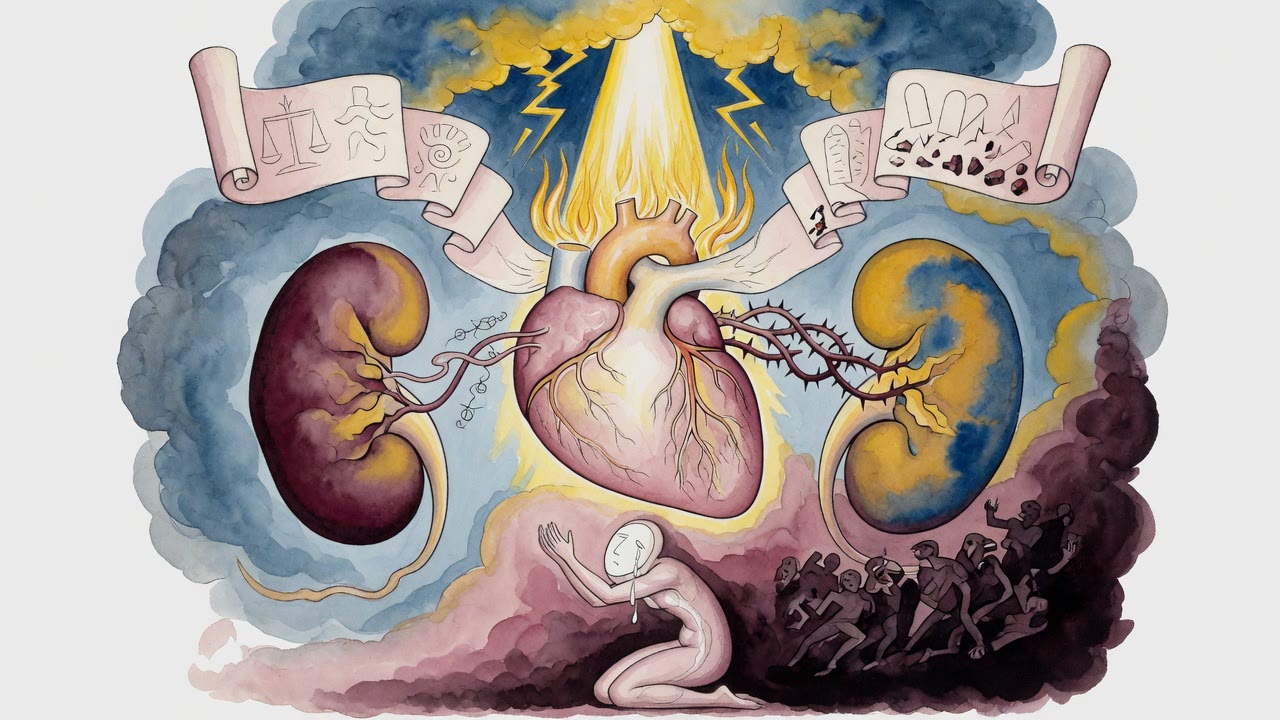
Israel stood in the smoke at the foot of it and accepted the Torah, and while that acceptance was still warm in their mouths God turned from the fire and spoke to the angel of death the way a householder speaks to a collector he has decided to turn away at the gate. Over every nation of the earth, power. Over this one, none. "I had said: You are divine beings, celestial beings, all of you."

The angel had a sword and no names left to put to it.

"Just as I live and endure," God said, "so My children endure." The nations belonged to their ministers and the ministers belonged to the ledger, but this people was the portion of the Lord, Jacob the allotment of His inheritance, and nothing in that allotment was for sale.

The Sword With Nothing Left to Cut

Forty days is a long time to stand at a border holding a weapon nobody will let you use.

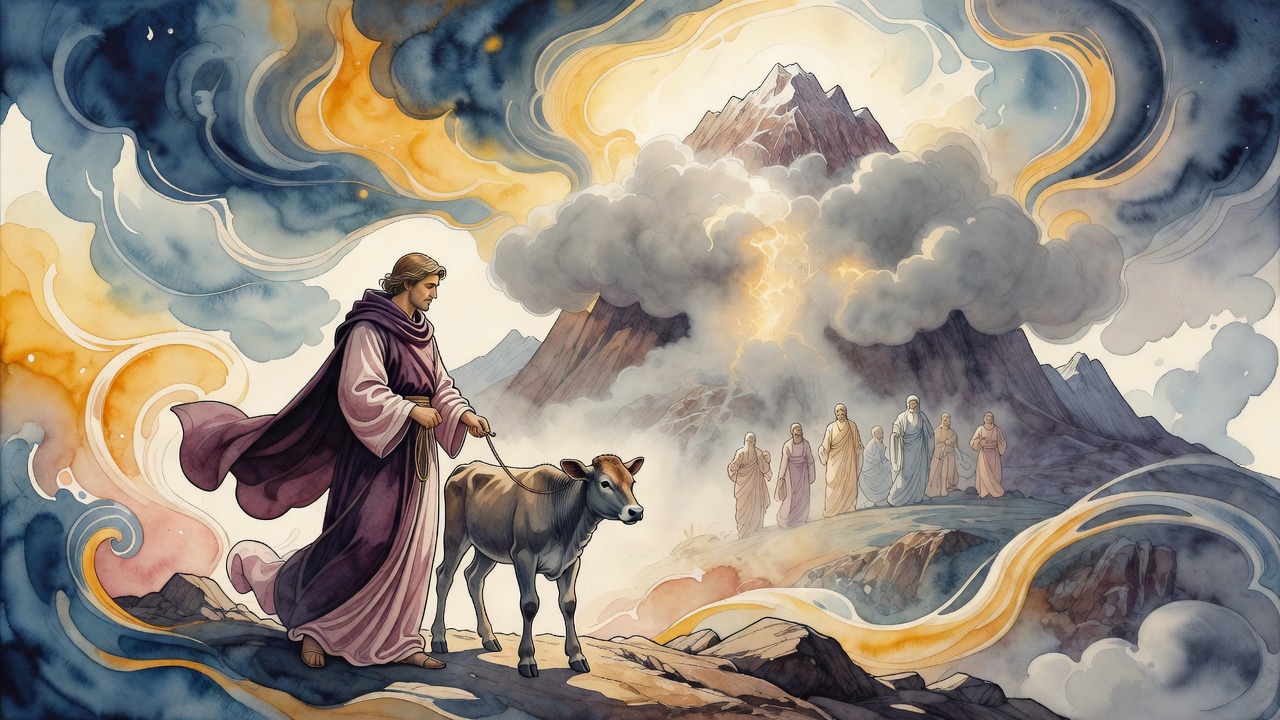
The angel waited where the camp's edge met the wilderness. Inside, the people gathered bread that came down white on the ground each morning, and they did not sicken and they did not fall. They had stopped being mortal, and most of them never noticed. The angel noticed. He counted the tents the way a creditor counts the rooms of a house he was not permitted to enter.

Near the end of the forty the gold began to move.

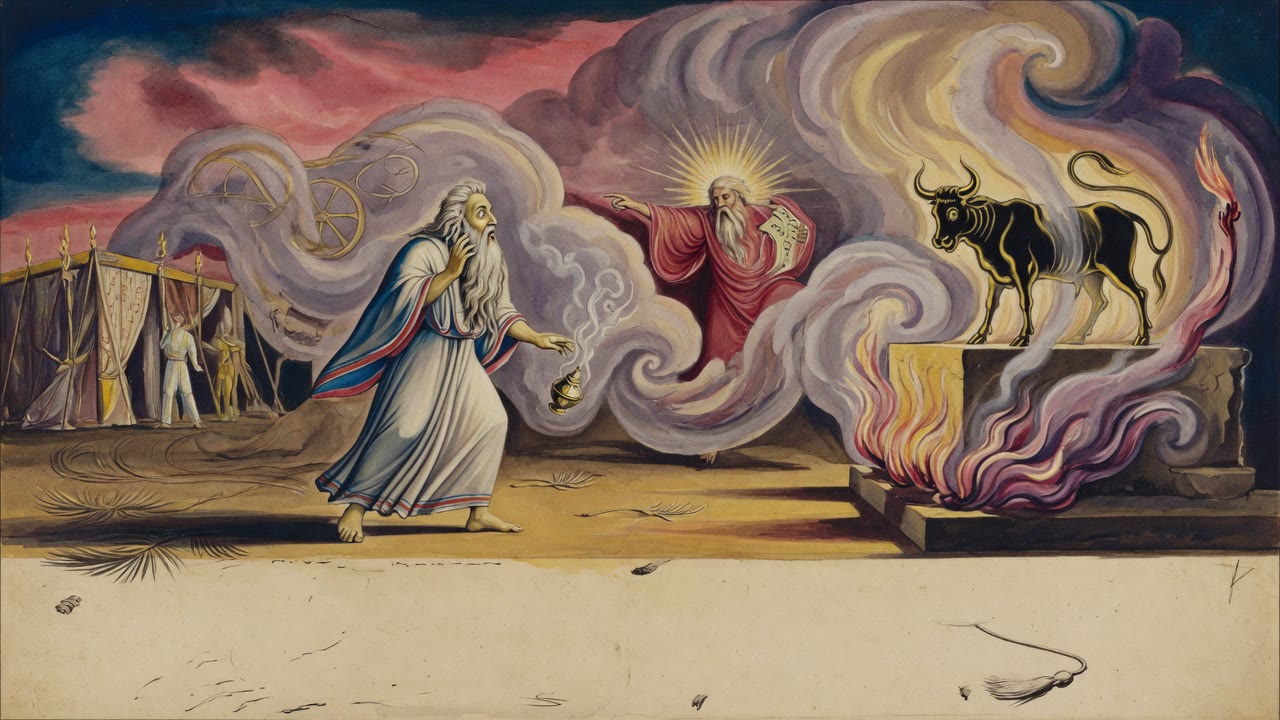
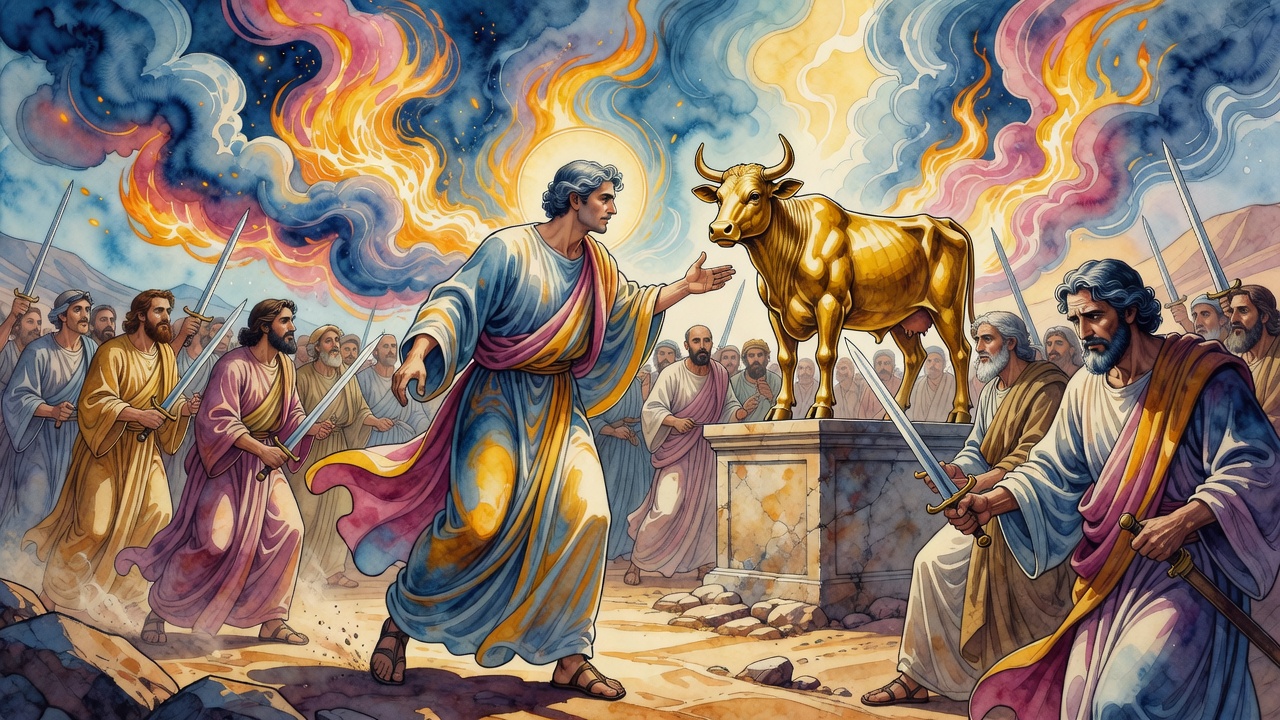
Rings came off ears. Fire took the metal, the metal took a shape, and a shout went up out of the camp that carried past the tents and past the border and up the mountain. "This is your god, Israel!"

The angel did not move. Nothing had been handed to him. But he turned his head toward the sound.

Moses Was Told to Go Down

On the summit Moses was still inside the cloud when the voice changed shape.

"Go, descend."

He stayed where he was. The same voice had spent weeks calling him upward, and now it was pointing at the slope. "Master of the universe," Moses said, "yesterday You told me, Ascend, you and Aaron with you. And You told me, Ascend to the Lord. Now You tell me to go down?"

The answer arrived without cushioning.

"Your people have acted corruptly. Because they sinned, you and they are in descent."

The Ladder Jacob Would Not Climb

To make the arithmetic plain, God took him back to a stone pillow on the open road out of Beersheba, where his ancestor had slept with the whole sky on his face.

Jacob had dreamed a ladder set on the earth with its head in heaven, and on it the guardian of every kingdom was going up and coming down. One climbed a certain height and started back. Another followed him and did the same. Empires, rung by rung, with an angel apiece and a limit apiece.

"Come up," God said to him.

Jacob watched the ministers descending and kept his feet on the ground. If he climbed, he would come down like the rest of them.

"Fear not. Just as I do not descend from My greatness, so neither you nor your descendants will descend from theirs." Then came the clause fastened to the promise: when they perform My will.

The rungs were not the whole of the dream. The angels went up and down bo (בו), in him, and the him was Jacob and everyone who came out of him. When they are righteous, they rise, and whoever climbs on their behalf rises with them. When they fall, the man on the mountain falls too.

Moses' ascent had never been his own property. It was theirs, lent to him. They had spent it on gold.

The Verse Turned and the Sword Came Back

At the border the angel felt the change before anyone announced it.

The sentence that had lifted him off Israel carried a second half, and the second half had been waiting since the mountain like a debt with a later date. "But as men you will die, and as one of the sarim (שרים), the ministers, you will fall."

The nations lived under ministers. God did not feed those nations from His own hand. He fed them through an angel, and whatever an angel governs, the angel of death may harvest. Israel had requested that arrangement out loud when they pointed at a calf and called it a god. Now they had it.

"Behold, I am sending an angel." Forty days earlier the promise would have sounded like an escort for the road. Now it sounded like distance measured out: someone standing between them and the voice, until they earned the voice back.

The angel of death crossed the line he had not been permitted to cross since the mountain shook.

The Gentle Words on the Summit

Then the voice above the cloud did something the decree did not require of it.

It softened. Not the verb of command and not the verb of decree, but amira (אמירה), the word used for gentle speech. "The Lord said to Moses: I have seen this people." It was the tone of a man who has been wronged, who cannot bear the silence any longer, and who finally turns to the one who wronged him and says, "Tell me what I did to offend you."

Moses caught it. A man who has argued with this voice out of a burning bush knows the difference between a door slammed and a door left off the latch.

He implored. He kept imploring while the calf still smoked below him and the camp danced around it and the sentence hung over every tent, and the voice let him.

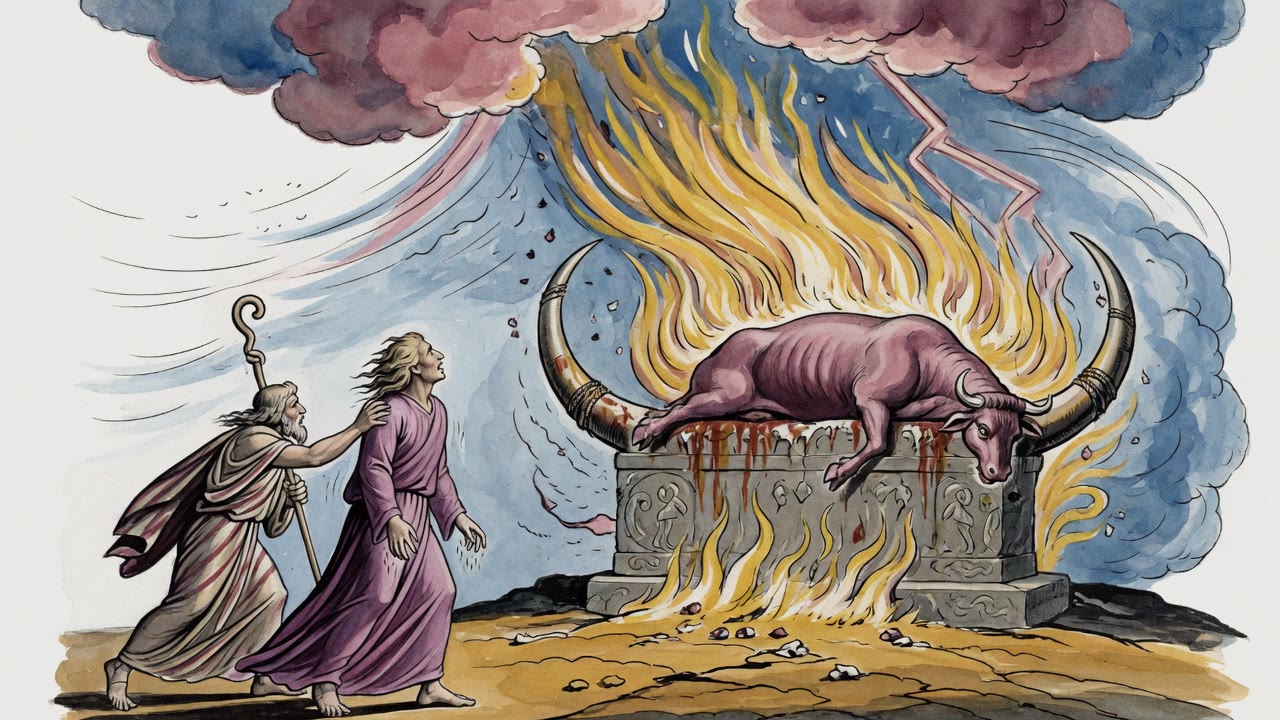
Then he came down into a people who could die again. At the edge of the tents the angel of death stood among them for the first time, unhurried, holding what had been given back, while the smoke of the calf climbed past him toward a ladder nobody was on.


← All myths
From the tradition

Sources

2 sources

The texts behind this telling. Some cards carry a translation of the source; others are our own retelling of it, and each card says which. Every card links out to the original.

Shemot Rabbah 32:7Shemot Rabbah

Retold in our words. Read the original at the link below.The Sefaria Midrash Rabbah, 2022 · CC-BY

It quickly jumps to a seemingly unrelated verse from Psalms: "I had said: You are divine beings, celestial beings, all of you" (Psalms 82:6). What's the connection?

Shemot Rabbah explains that when the Israelites stood at Mount Sinai and received the Torah, God made a profound declaration to the angel of death. Because Israel had accepted the Torah, the angel of death would have power over all other nations, but not over Israel. "Just as I live and endure," God says, "so My children endure." This echoes the idea found in (Deuteronomy 32:9), "For His people is the portion of the Lord, Jacob the allotment of His inheritance."

Of course, the story doesn't end there, does it?

Remember the Golden Calf?

The Shemot Rabbah argues that the Israelites' sin, their declaration, "This is your god, Israel!" (Exodus 32:8) changed everything. It corrupted their actions, leading to the decree from (Psalms 82:7): "Indeed, as men you will die [and as one of the sarim you will fall]." Sarim here can be understood as "ministers" or "officials," but more specifically, as "guardian angels."

The text draws a comparison: just as idolaters are under the auspices of guardian angels – God does not provide for them directly, but rather through angels – so too, they are susceptible to the angel of death. After the sin of the Golden Calf, the Israelites became like those nations, susceptible to the same angelic intermediaries. "Behold, I am sending an angel," the verse in Exodus now implies a different relationship, one of delegated authority rather than direct divine protection.

The passage then shifts to the story of Jacob's dream in (Genesis 28:12), "He dreamed, and behold, a ladder set on the earth." God showed Jacob the guardian angels of each kingdom, ascending and descending. This visual representation highlights the rise and fall of nations, each seemingly tied to its angelic representative.

God even invites Jacob to ascend, but Jacob hesitates. He fears that he, too, will descend like the others. God reassures him: "Fear not, just as I do not descend from My greatness, so too, neither you nor your descendants will descend from their greatness" (Genesis 28:13). But, the crucial condition is added: this promise holds "when they perform My will."

The connection is now clear. The Shemot Rabbah argues that when the Israelites abandoned God and followed idolatry, they forfeited their direct connection to the Divine. Just as other nations rely on guardian angels, so too would they. "Behold, I am sending an angel" now becomes a statement of consequence, a shift in the relationship between God and Israel.

So, what are we left with? This passage in Shemot Rabbah offers a powerful interpretation of the role of angels, not just as benevolent protectors, but as symbols of a nation's relationship with the Divine. It suggests that our actions, our choices, determine the level of direct connection we have with God. And when we stray, when we build golden calves, we may find ourselves relying on intermediaries, on "guardian angels," rather than experiencing the fullness of divine presence.

Full source
Shemot Rabbah 42:2Shemot Rabbah

Retold in our words. Read the original at the link below.The Sefaria Midrash Rabbah, 2022 · CC-BY

The familiar story is this: Moses ascends Mount Sinai to receive the Torah, and the Israelites, impatient and fearful, build a golden idol. But what happens behind the scenes, in the heavenly realms? What was God's strategy?

Well, the Shemot Rabbah, a classic collection of rabbinic interpretations on the Book of Exodus, sheds some fascinating light. It suggests that God wasn't just angry; He was also opening a path for Moses to advocate for his people. God says to Moses, “Go, descend,” (Exodus 32:7) after previously telling him to ascend! It seems contradictory. The Shemot Rabbah sees this as more than just a command. Rabbi Yoḥanan points out that immediately following "Go descend", God softens his tone: “The Lord said [vayomer] to Moses: I have seen this people” (Exodus 32:9). The text emphasizes that "saying [amira] is nothing other than gentle words." This isn't a harsh decree; it's an invitation to dialogue. It's like someone holding a grudge, but wanting to reconcile, asking, "Tell me what I did to offend you."

When Moses hears these "gentle words," he seizes the opportunity to plead for mercy, as the verse states: “Moses implored…” (Exodus 32:11).

Why the initial descent? Moses himself questions it! "Master of the universe," he says, "yesterday You said to me: 'Ascend, you and Aaron with you' (Exodus 19:24), and likewise, 'to Moses He said, ascend to the Lord' (Exodus 24:1), and now You say: 'Go descend'?"

God's response is profound. He explains that Moses’ ascent was tied to the righteousness of the Israelites. As their ancestor Jacob dreamt, “Behold, angels of God were ascending and descending on it [bo]" (Genesis 28:12). The Shemot Rabbah interprets "bo" (in him) not just as the ladder, but as Jacob and his descendants. When they are righteous, they. And their emissaries, like Moses, ascend. When they falter, they descend.

So, when God says, “Go descend,” it's because “your people…have acted corruptly.” (Exodus 32:7). And here's the kicker: God adds, "Because they sinned, you and they are in descent." Ouch. It's a shared fate.

What does this all mean? It suggests a deep interconnectedness between leaders and their communities. Moses' fate is intertwined with the Israelites. Their actions affect his standing, and vice versa. But it also highlights the power of intercession, of using even a moment of apparent condemnation as an opportunity for compassion and advocacy. Moses, hearing a hint of gentleness, steps into his role as defender of his people.

The story challenges us to consider how we respond when faced with difficult situations. Do we see only judgment, or do we look for openings for mercy and reconciliation? And how do our actions impact those around us, especially those in positions of leadership? Are we lifting them up, or are we dragging them down? Perhaps, like Moses, we can find a way to ascend, even when the command is to descend.

Full source