4 min read

The Cherubim Embraced as the Temple Fell

Invaders dragged the Temple's golden cherubim into public view, but their embrace carried more grief than the mockers could understand.

Curated by Arthur · Told by Maggid ·
Table of Contents
  1. Gold Children Guarded the Voice
  2. The Wings Filled the Hidden Room
  3. The Faces Turned With Israel
  4. The Invaders Dragged Out the Embrace
  5. Gold Could Be Mocked, Grief Could Not

The curtain came down, and the enemies of Israel found the secret no priest was allowed to display.

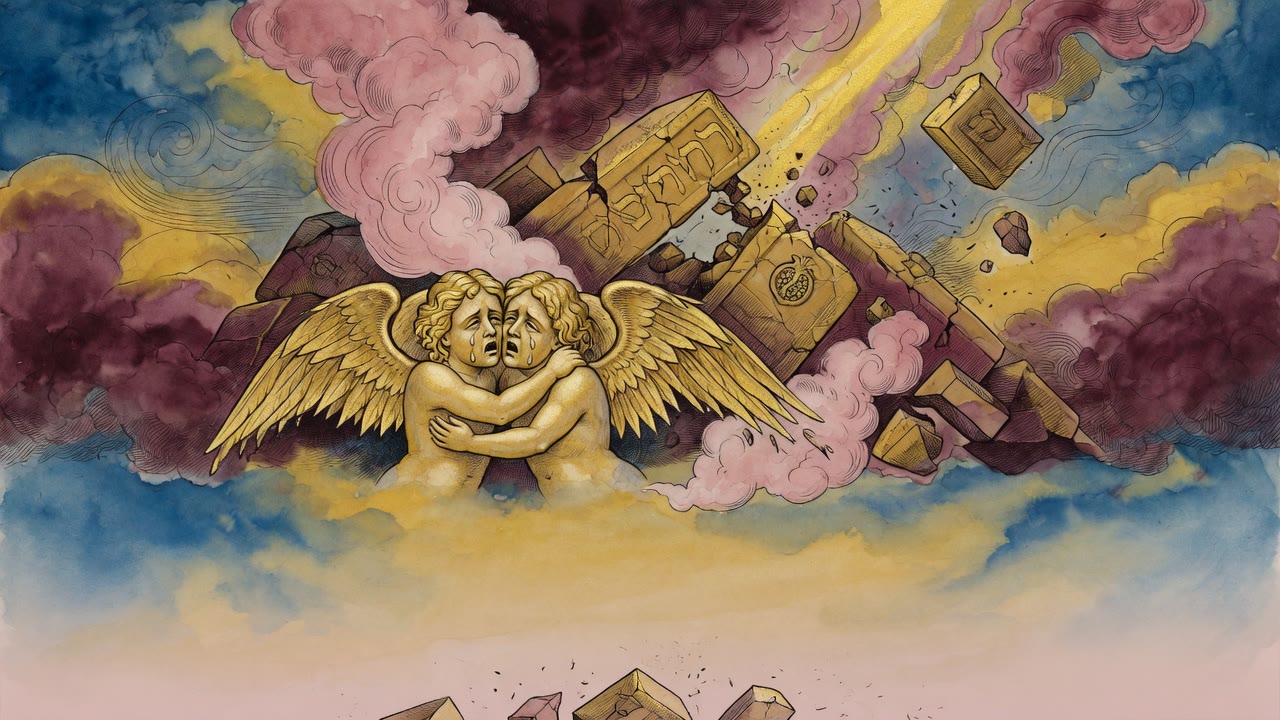
Inside the deepest chamber, above the Ark of the Covenant, two golden cherubim stood close. Their wings filled the hidden room. Their faces, childlike and bright, turned toward one another. The invaders had come for treasure, victory, and proof that Jerusalem's sanctuary had been abandoned. Instead, they found an embrace.
Gold Children Guarded the Voice

The cherubim were not ornaments. They stood over the cover of the Ark, in the place where God spoke to Moses. No statue in that chamber received worship. No priest walked in to admire gold. The room was mostly darkness, silence, and danger, entered only under the tightest holiness.

The sages gave the cherubim faces like children. One face was small beside the grown faces of the heavenly beings seen by prophets. The childishness mattered. At the center of the sanctuary, where the divine voice pressed itself into the world, the guardians did not glare like warriors. They looked young, almost tender, with wings lifted over the place of speech.

Those wings were measured with care. A handbreadth too low or too high could become law, because nothing in that room was accidental. The gold bodies held tablets, letters, voice, covenant, and danger in one silent posture.

The Wings Filled the Hidden Room

When the Ark entered the Temple, the room itself seemed to answer. The staves pushed forward until they pressed against the curtain. Their shape showed through the fabric like breasts beneath cloth, a strange sign of hidden nourishment at the back of the veil.

The cherubim's wings rose until they reached the ceiling. The Holy of Holies was not a storage room for sacred furniture. It was alive with pressure. Wood stretched. Gold lifted. Fabric bulged. A room built to conceal became a room where concealment itself strained outward.

Every object near the Ark carried a double force. It hid and revealed. It guarded and gave. It warned human feet away and made a place for speech to cross the border from heaven into Israel's camp.

The Faces Turned With Israel

The faces of the cherubim did not stay fixed. When Israel did the will of God, they faced each other. Gold looked into gold. The house breathed closeness. The covenant had a visible pulse, though almost no living person could see it.

When Israel turned away, the faces turned away too. The cherubim looked toward the walls, and the hidden chamber carried the posture of estrangement. No public announcement was needed. The relationship had moved, and the gold moved with it.

That made the final invasion harder to bear. The city had fallen. The sanctuary had been breached. The people had not been innocent. By the ordinary measure, the cherubim should have faced the walls. Instead, when the enemies broke in, the figures were joined.

The Invaders Dragged Out the Embrace

The soldiers saw bodies where they expected holiness to be abstract. They saw intimacy where they expected shame to be useful. They dragged the cherubim into public view and turned the hidden sign into a weapon.

"Look at what Judah worships," they jeered. Gold figures. Joined bodies. A private posture stolen from the innermost room and paraded through the streets by men who could see metal but not covenant.

The mockery cut twice. The invaders thought they had exposed corruption. They had exposed grief. The embrace was not a festival. It was the last closeness before exile, the terrible nearness that can appear when separation has already begun.

Gold Could Be Mocked, Grief Could Not

The cherubim held two truths in one posture. When Israel was faithful, their faces met in peace. When Israel failed, their faces turned away. At the hour the Temple fell, they embraced in the place where Israel expected only distance. The contradiction remained.

A broken bond can look cold from the outside. It can also look like clinging. The Temple burned around an image of closeness no enemy understood, and no mockery could make it simple. The gold left the hidden room, but the grief stayed where the voice had once spoken from between the waiting wings.


← All myths
From the tradition

Sources

4 sources

The texts this telling draws on, in full. Open a card to read inline, or expand it for a wider, quieter read.

Legends of the Jews 3:13Legends of the Jews

It was there, shrouded in mystery, that the Ark of the Covenant resided. And upon that Ark? The Cherubim.

These weren't your chubby Renaissance cherubs. The Talmud describes them as having the faces of boys (Yoma 54a-b). And according to Ginzberg's retelling in Legends of the Jews, there were two of them, mirroring so much that's essential in Jewish thought: the two tablets of the Law, and even the two sacred names of God, Adonai and Elohim, representing His benevolence and His power.

There’s more! The measurements of the Cherubim themselves held symbolic weight. Each face was one span, and each wing extended ten spans, totaling twenty-two spans – a number that corresponds directly to the twenty-two letters of the Hebrew alphabet! What does it all mean? It’s a reminder that God's word, the Torah, is intimately connected to His presence and to these angelic figures.

The space "from between the two Cherubim" (Numbers 7:89) was where God communed with Moses. But why there? The Talmud teaches that the Shekhinah – the Divine Presence – never fully descended to earth, just as no mortal ever fully ascended to heaven. Even Moses and Elijah, figures of immense spiritual stature, remained a slight distance from heaven. As we find in (Psalm 115:16), "The heaven, even the heavens, are the Lord's: but the earth hath He given to the children of men." So, God chose the Cherubim, positioned ten spans above the earth, as the place where the Shekhinah rested to speak with Moses.

Imagine this: the heads of the Cherubim were slightly turned back, like a student bidding farewell to their master. But here's where it gets truly wondrous. As a sign of God's delight in the people of Israel, a miracle occurred. When Israel was devoted to God, the faces of the Cherubim would turn and "look one to another" (Bava Batra 99a). Even more than that, they would embrace, like a loving couple!

During the pilgrimage festivals – Pesach (Passover), Shavuot, and Sukkot – the priests would lift the curtain from the Holy of Holies. Why? To show the pilgrims just how much God loved them, a love made visible in the embrace of the two Cherubim (Yoma 54b).

Isn't that a powerful image? A tangible representation of divine love, displayed for all to see. It makes you wonder: what "curtains" are there in our own lives that, when lifted, could reveal the depth of God's love for us? And how can we, like the devoted Israelites of old, create the conditions for that divine embrace to manifest in our world?

Full source
Bava Batra 99aTalmud Bavli, Bava

Ravnai said in the name of Shmuel: The cherubim stood by a miracle, as it is said: "And five cubits was the wing of the one cherub, and five cubits the wing of the second cherub, ten cubits from the tips of its wings to the tips of its wings" (1 Kings 6:24). Where were their bodies standing? Rather, learn from this: they stood by a miracle.

How did they stand? Rabbi Yochanan and Rabbi Elazar: one said their faces were each toward the other, and one said their faces were toward the House. But according to the one who said their faces were each toward the other, is it not written "and their faces were toward the House" (2 Chronicles 3:13)? It is not difficult: here, at the time when Israel does the will of the Omnipresent; there, at the time when Israel does not do the will of the Omnipresent.

And according to the one who said "and their faces were toward the House," is it not written "and their faces were each toward the other" (Exodus 25:20)? They turned their faces to the side, as it was taught: Onkelos the convert said: The cherubim were "of figured work" (2 Chronicles 3:10), and they turned their faces sideways like a student taking leave of his teacher.

Full source
Yalkut Shimoni on Torah 368:4Yalkut Shimoni on Torah

"And the cherubim shall spread out their wings" (Exodus 25:20). Rabbi Aha bar Yaakov said: no cherub is less than a handbreadth. What is a "cherub"? Rabbi Abbahu said: like a child, for in Babylon they call an infant "ravya." Rav Pappa said to Abaye: if so, regarding what is written, "the face of the one was the face of the cherub and the face of the second was the face of a man" (Ezekiel 10:14), then the face of the cherub is the same as the face of a man? He said to him: a large face and a small face. It was taught: just as we find in the everlasting House [the Temple], the cherubim stood at a third of the height of the House, as it is written, "and the House that King Solomon built for the LORD was sixty cubits long, twenty wide, and thirty cubits high" (1 Kings 6:2), and it is written, "the height of the one cherub was ten cubits" (1 Kings 6:26). So too in the Tabernacle the cherubim stood at a third of the height of the Tabernacle. How high was the Tabernacle? Ten, as it is written, "ten cubits the length of the board" (Exodus 26:16). How many handbreadths is that? Sixty. Subtract the ten of the ark and the cover, and twenty remain; and it is written, "and the cherubim shall be spreading their wings upward," above ten. But perhaps their wings were level with their heads? "Upward" is written. And say that they were raised much higher? Does it say "upward, upward"? And from this we learn that a sukkah which is not ten handbreadths high is invalid. This works well for Rabbi Meir, who says all cubits are of the middle size; but for Rabbi Judah, who says the cubits of the vessels are by the cubit of five handbreadths, the measures, the partitions, and the dividers are a law given to Moses at Sinai.

Full source
Legends of the Jews 3:16Legends of the Jews

It wasn’t just about golden walls and intricate carvings; according to tradition, miracles pulsed within its very structure.

When the Cherubim, those powerful angelic beings, were brought into the Temple, a double miracle occurred. The two staves attached to the Ark of the Covenant – the Ark that held the very tablets of the Ten Commandments – they extended, reaching out until they touched the parokhet, the curtain separating the Holy of Holies from the rest of the Temple. And what’s more, two protuberances, like a woman’s breasts, became visible at the back of the curtain. What could this possibly signify? Our Sages pondered such things for generations!

That's not all. The wings of the Cherubim themselves grew, reaching all the way to the ceiling of the Kodesh Hakodashim, the Holy of Holies. these powerful, symbolic figures, their presence amplified to fill the most sacred space. It paints a picture of overwhelming divine presence, doesn't it?

Let’s talk tables. in the Tabernacle, the portable sanctuary that accompanied the Israelites through the desert, Moses made only one table. But Solomon, in his grand Temple, had ten. Why the change?

The reason, some say, is tied directly to the sustenance of the people. In the desert, sustained by manna, that miraculous food from heaven, one table sufficed. But once the Israelites settled in the Promised Land, the need for food increased, demanding a greater abundance. Therefore, Solomon created ten tables to meet that need.

But hold on – the original table of Moses didn't lose its significance. Oh no. It held a place of honor, situated right in the center. It was upon this table, and only this table, that the shewbread – the specially prepared bread offered to God – was placed.

And the placement of the other ten tables wasn't random either. Solomon arranged them strategically: five to the south, and five to the north. Why? Here's where it gets interesting.

According to tradition, the south is associated with blessing and abundance. "From the south come 'the dews of blessing and the rains of plenty,'" as we find in various sources. But the north? The north is considered the source of evil. So, Solomon, in his wisdom, declared: "The tables on the south side shall cause the rains of plenty and the dews of blessing to come upon the earth, while the tables on the north side shall keep off all evil from Israel."

It’s a fascinating insight into how our ancestors perceived the world – a world where even the placement of tables could influence the flow of divine blessing and protection. It makes you wonder, doesn't it? What seemingly small choices are we making that might have larger, unseen consequences? And how can we orient ourselves towards the "south," towards those sources of blessing and abundance, in our own lives?

Full source