6 min read

The Craftsman Who Cannot Paint Inside Water and the God Who Can

Hannah sang that no fashioner equals God, so a painter tried to draw a living face inside water, in the dark, and all at once, and failed.

Curated by Arthur · Told by Maggid ·
Table of Contents
  1. Hannah's Voice Filled the Sanctuary at Shiloh
  2. The Painter Set His Figure Upon the Water
  3. In the Dark Water No Lamp Could Reach
  4. One Drop of White and One Drop of Red
  5. The Form That Turned and Praised Its Maker
The Craftsman Who Cannot Paint Inside Water and the God Who Can Click for full size

Hannah's Voice Filled the Sanctuary at Shiloh

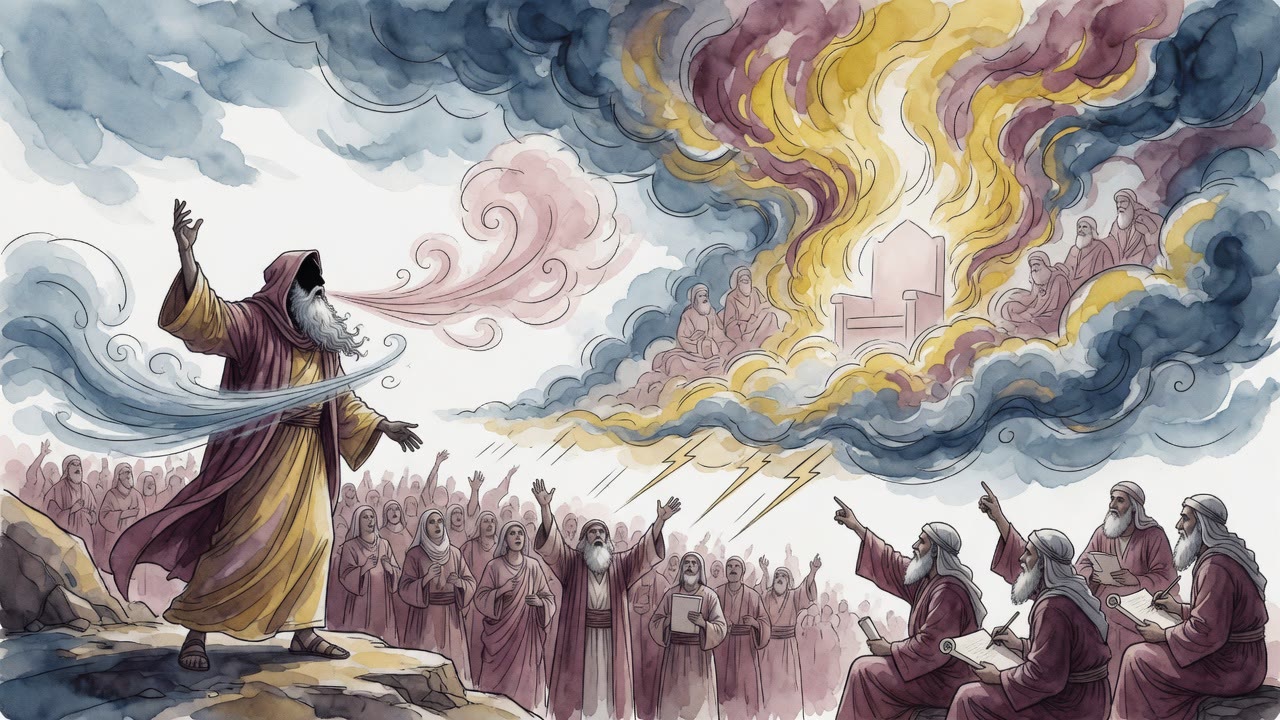
Hannah stood in Shiloh with the child she had begged for now weaned and left at the sanctuary, and she did not weep. She sang. "There is none holy like the Lord," she said, "for there is none besides You, and there is no Rock like our God." The priests heard a woman who had once moved her lips without sound. Now the words came out full and hard, like a hammer on an anvil. She had asked heaven for a body and heaven had made one inside her own, and she had felt it turn.

The sages who carried her song forward heard one more line folded inside it. Read the word for Rock, they said, as the word for Fashioner. There is no fashioner like our God. And having said it, they went looking for a craftsman who could answer the claim.

The Painter Set His Figure Upon the Water

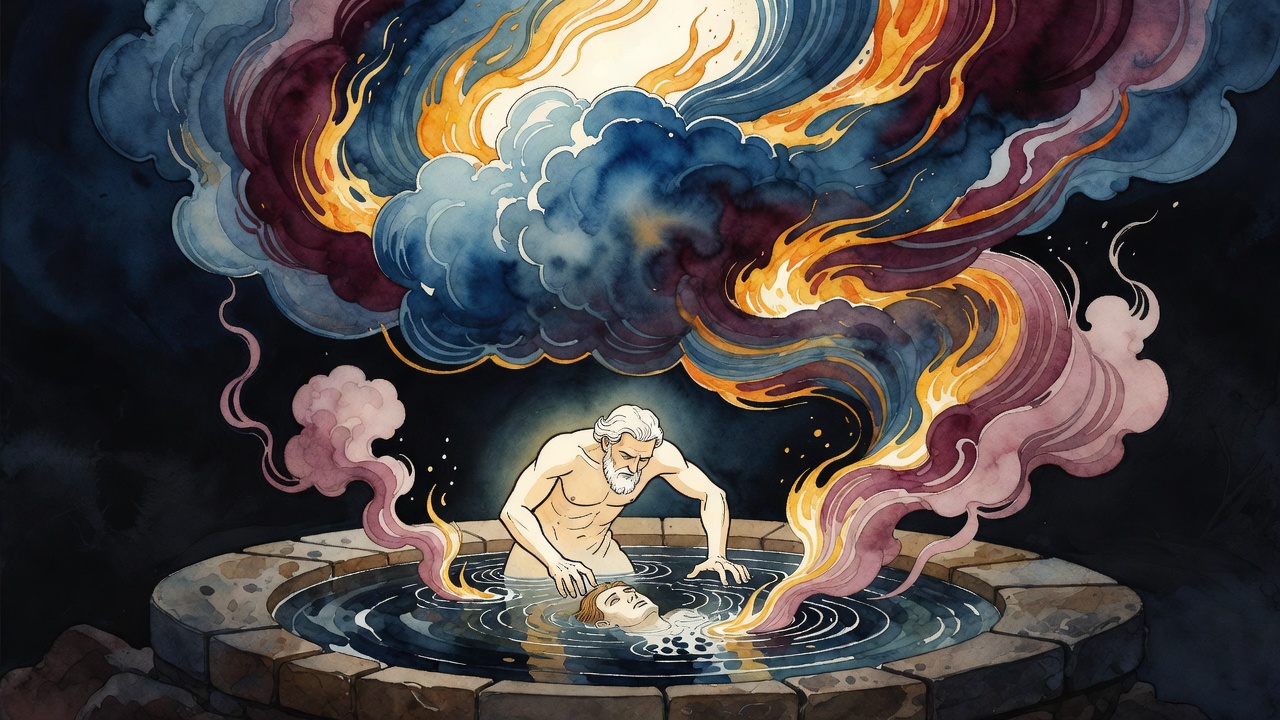
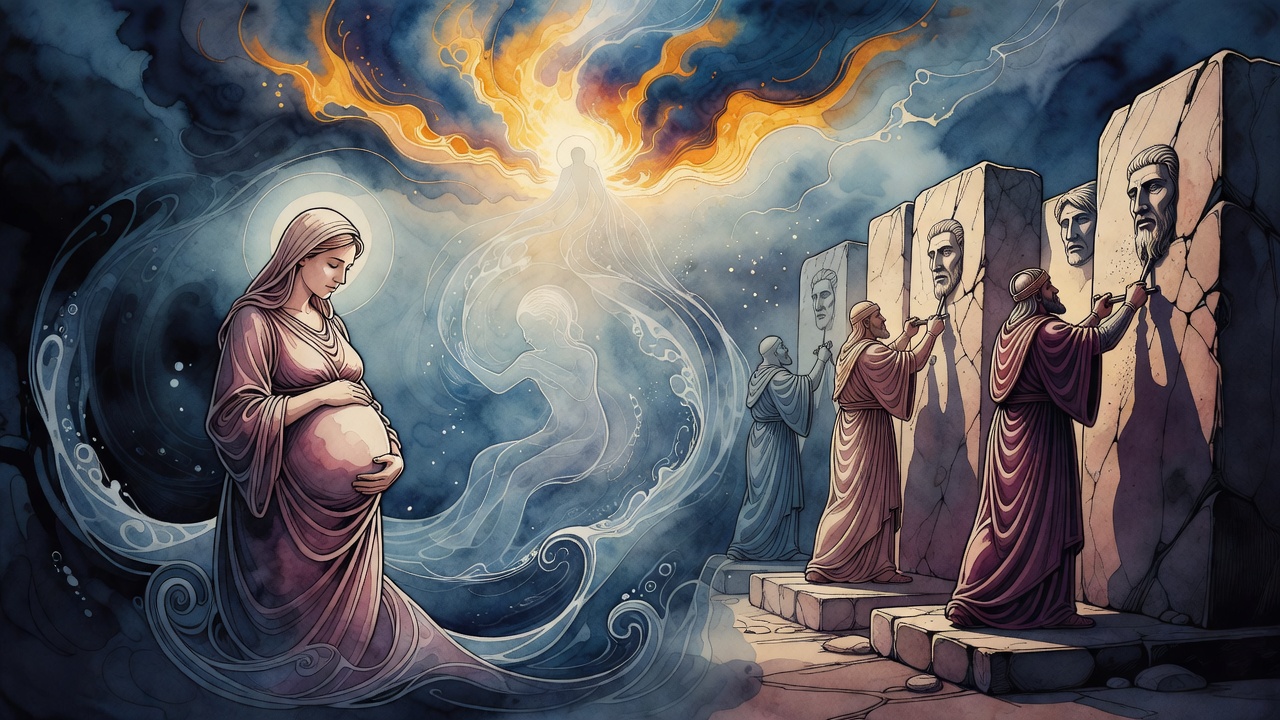
Bring in the best of them, a man who could grind a pigment finer than dust and lay a face on a wall so alive the eyes seemed to follow you across a room. Set him a task. Draw a figure, they said, not on plaster, not on stone, but inside water.

He tried. He touched his brush to the surface of the basin and the line spread and thinned and drowned. He tried again with a heavier hand and the color sank in a brown cloud and was gone. Water takes no image. Water holds nothing still.

But on the first day of the world, when the deep lay dark and unshaped, the voice over it said, "Let the waters swarm." And the water that would not hold a painter's single line filled with fins and scales and a thousand moving forms, each one fashioned inside the very element that had swallowed the painter's brush. A form within water. The craftsman stood at his ruined basin and had no answer.

In the Dark Water No Lamp Could Reach

Then set him a harder task still. Work in the dark.

Every artist he knew needed light. Take away the lamp and the finest hand in the land is a blind man smearing color he cannot see. But the child that Hannah carried had been shaped where no lamp reaches, in the sealed dark of the womb, in water inside a body inside the night. A form within a form, made in secret, and the One who made darkness itself worked there as easily as at noon.

The painter had never made a thing he could not see. Here was a maker who colored an eye by touch in the black, who set the small teeth in their rows, who turned a back and folded the innards in behind it, and folded in with them a soul. Two things, the sages said, that no sorcerer and no painter has ever made: the soul, and the innards a body hides. Both of them, when they are finished, praise the One who made them.

One Drop of White and One Drop of Red

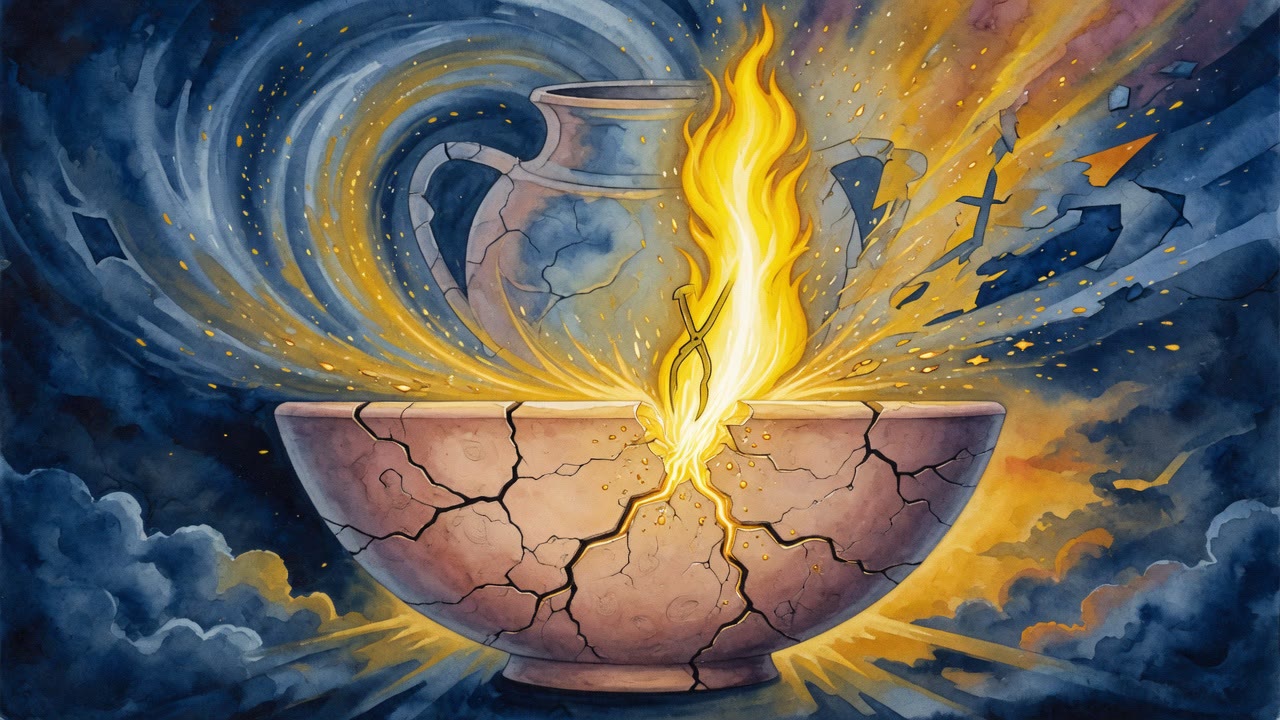
Look at what the painter needed and what the Maker used. The painter mixed a dozen pigments for a single face, black for the pupil, white around it, red for the gum, white again for the teeth, a wall of little jars. The Maker took one drop of white and one drop of red, and from those the whole child came, the black center of the eye and the white ring around it, the white tooth and the red gum, every color drawn out of two.

And the painter built his face the only way a man can, piece after piece, the head first, then an ear, then a limb, hour upon hour until it was done. The Maker did not begin at the head and work down. The child came whole, all of it in a single act, eye and spine and hidden organ and breath, formed together inside the dark.

The Form That Turned and Praised Its Maker

There was one thing more, and it was the thing that ended the contest.

The painter's figure stayed on the wall. It did not walk. It did not see the man who made it. It could not hear him call its name, and when he died it hung there dumb and outlasted him and said nothing. His work would never once thank him.

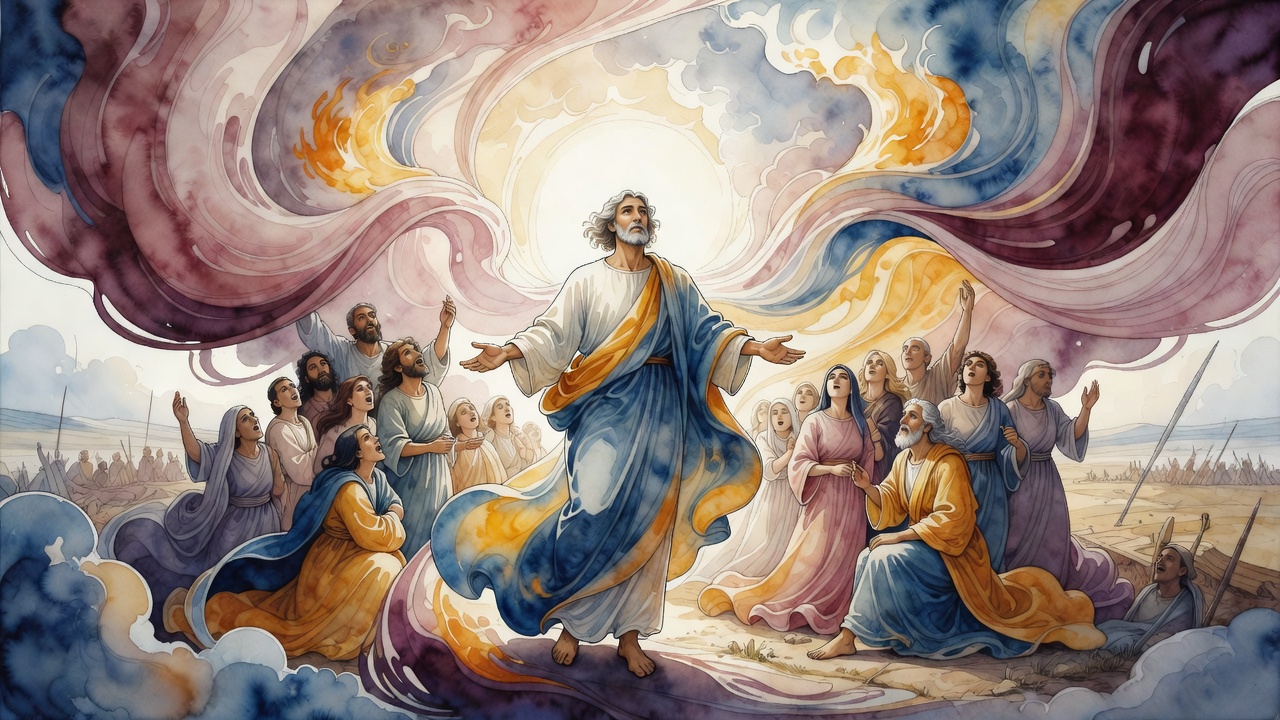
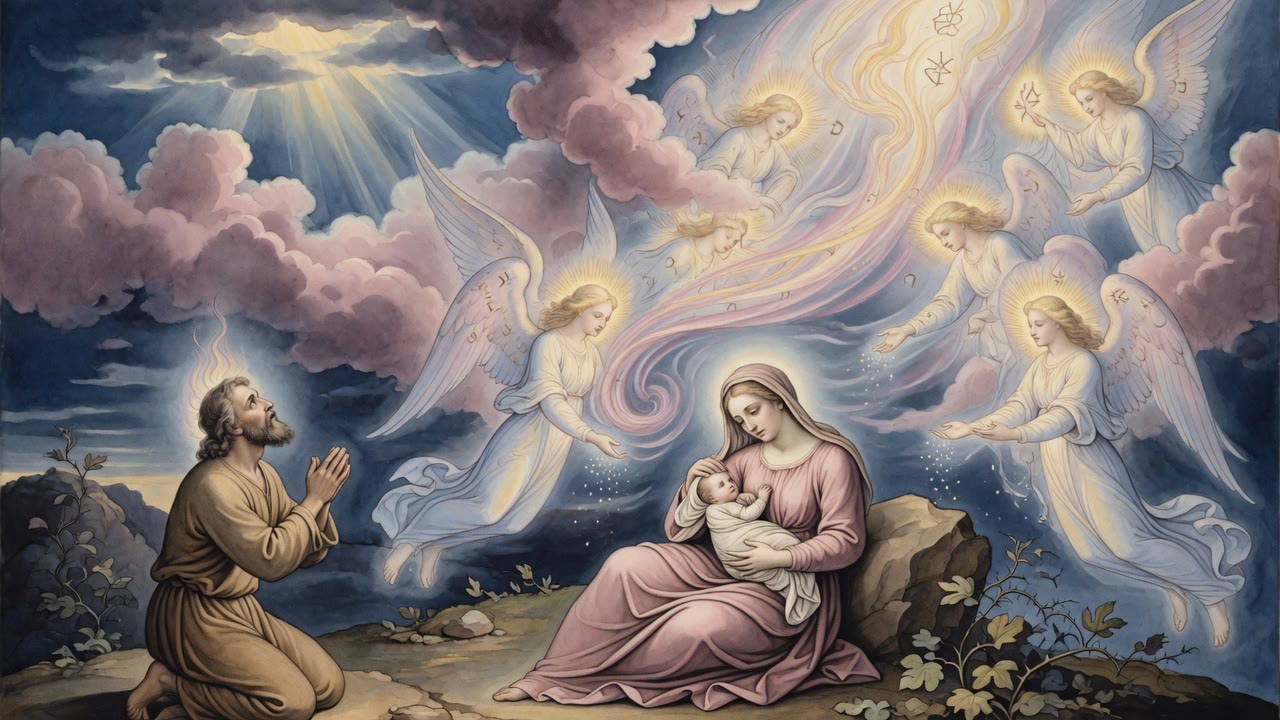
The child in Hannah's arms had walked out of that dark water into the light. It saw. It heard. It would go from one end of the world to the other on its own feet. And one day, grown, it would open its mouth and bless the One who had colored its eyes in the black. "Bless the Lord, O my soul, and all that is within me, His holy name." The Holy One had made a form that turned and praised its Maker. No painter had ever done that, or ever would.

So Hannah had it right in Shiloh, and the sages let her word stand. There is none besides Him. There is no fashioner like our God.


← All myths
From the tradition

Sources

2 sources

The texts behind this telling. Some cards carry a translation of the source; others are our own retelling of it, and each card says which. Every card links out to the original.

Midrash Shmuel 5:6Midrash Shmuel

Translation of the source text.Midrash Shmuel, Krakow 1893, Public Domain, on Sefaria · CC-BY-SA

"And there is no Rock like our God" (I Samuel 2:2). Flesh and blood cannot fashion a form within a form, but the Holy One, blessed be He, fashioned man within his mother's womb. Flesh and blood cannot fashion a form within water, but the Holy One, blessed be He, fashioned a form within water, as it is said, "And God said: Let the waters swarm" (Genesis 1:20). Flesh and blood requires several pigments, but the Holy One, blessed be He, fashioned man from a single pigment: this orb of the eye is black, and its surround is white, and the teeth are white, and their surround is red. Flesh and blood fashions a form, and its form outlasts him, but the Holy One, blessed be He, outlasts His form, "There is none holy like the Lord, for there is none besides You" (I Samuel 2:2), read it "for none outlasts You." Flesh and blood fashions a form and puts plaster into his pigments, but the Holy One, blessed be He, is not so; rather, "and You are familiar with all my ways" (Psalms 139:3). Flesh and blood fashions a form, and it does not move from its place, but the Holy One, blessed be He, fashioned man, and he walks from one end of the world to the other. Flesh and blood fashions a form, and it neither sees nor hears, but the Holy One, blessed be He, fashioned man, and he sees and he hears. Flesh and blood fashions a form, and he cannot make it in darkness, but the Holy One, blessed be He, fashions a form in darkness, "When I was made in secret" (Psalms 139:15). Flesh and blood fashions a form, and he cannot make for it a back, but the Holy One, blessed be He, fashions a form and makes for it a back, "You have formed me behind and before" (Psalms 139:5). Flesh and blood fashions a form, and he cannot make for it innards, but the Holy One, blessed be He, fashions a form and makes for it innards, "and all my innards, His holy name" (Psalms 103:1). Shmuel bar Abba in the name of Rabbi Yochanan: two things no sorcerer can make, nor can any painter make them, and both of them praise the Holy One, blessed be He, and these are they: the soul and the innards. This is what David said, "Bless the Lord, O my soul, and all my innards, His holy name" (Psalms 103:1). Flesh and blood fashions a form, and its form does not praise him, but the Holy One, blessed be He, His form praises Him, "Let every soul praise the Lord" (Psalms 150:6). Rabbi Krispa in the name of Rabbi Yochanan: flesh and blood, when he comes to fashion a form, begins from its head, or from its ears, or from one of all its limbs, until he completes it; but the Holy One, blessed be He, fashions all of man at once, as it is said, "For He is the Fashioner of all" (Jeremiah 10:16). Thus, "and there is no Rock like our God", and there is no Fashioner like our God.

Full source
Midrash Tehillim 18:26Midrash Tehillim

Retold in our words. Read the original at the link below.Rabbi Mike Feuer, Jerusalem Anthology · CC-BY

The Midrash Tehillim, a collection of rabbinic teachings on the Book of Psalms, invites us to do just that. It uses a powerful comparison to highlight God’s unique creative power, drawing a line between human artistry and the Divine.

It begins with the words of Hannah, from the Book of Samuel: "For there is no God but the Lord." (1 Samuel 2:2). It emphasizes God's holiness and uniqueness. “There is none holy like the Lord, and there is none besides You; there is no Rock like our God" (1 Samuel 2:2). This sets the stage for exploring just how unparalleled God’s power really is.

The Midrash (rabbinic interpretive commentary) boldly states: "There is no artist like our God." But what does that mean, exactly?

Well, imagine a painter. A human artist needs materials. They can’t paint with water alone. But the Midrash reminds us that the Lord is the master of the waters themselves! Remember (Genesis 1:20), "Let the waters swarm"? God commanded the waters to teem with life. The water isn’t a limitation for God; it’s His raw material.

And what about darkness? A painter needs light to see, to create. But the Lord, as we read in (Isaiah 45:7), "…creates darkness.” Darkness isn’t an obstacle for God; it's something He actively brings into being.

Think about how a human artist works. They blend colors – red, black, white, green – to create different forms.

Human artistry is also a gradual process. Bit by bit, an artist shapes their creation. But the Lord? The Midrash emphasizes the immediacy of Divine creation. “For He who made everything is the Lord” (Jeremiah 10:16). Everything, all at once.

Flesh and blood praises its own form, but the Lord's form praises Him. This is because flesh and blood cannot instill spirit, soul, entrails, and offspring, but the Holy One, blessed be He, forms shape and instills in it spirit, soul, entrails, and offspring, as it says, "Bless the Lord, O my soul" (Psalm 104:1).

The contrast is clear: Human art is limited, dependent. Divine art is boundless, originating.

So, what’s the takeaway here? Perhaps it’s an invitation to shift our perspective. To look beyond the surface, beyond the familiar, and recognize the awesome, unfathomable power that brought everything into being. To appreciate not just the what of creation, but the who. And, as the Midrash concludes, to affirm with conviction: "There is no Rock besides our God."

A reminder to see the world – and ourselves – as masterpieces, crafted by the ultimate Artist. A masterpiece that is constantly praising its creator.

Full source