Parshat Bereshit6 min read

The Earth's Complaint and the Dew That Answered It

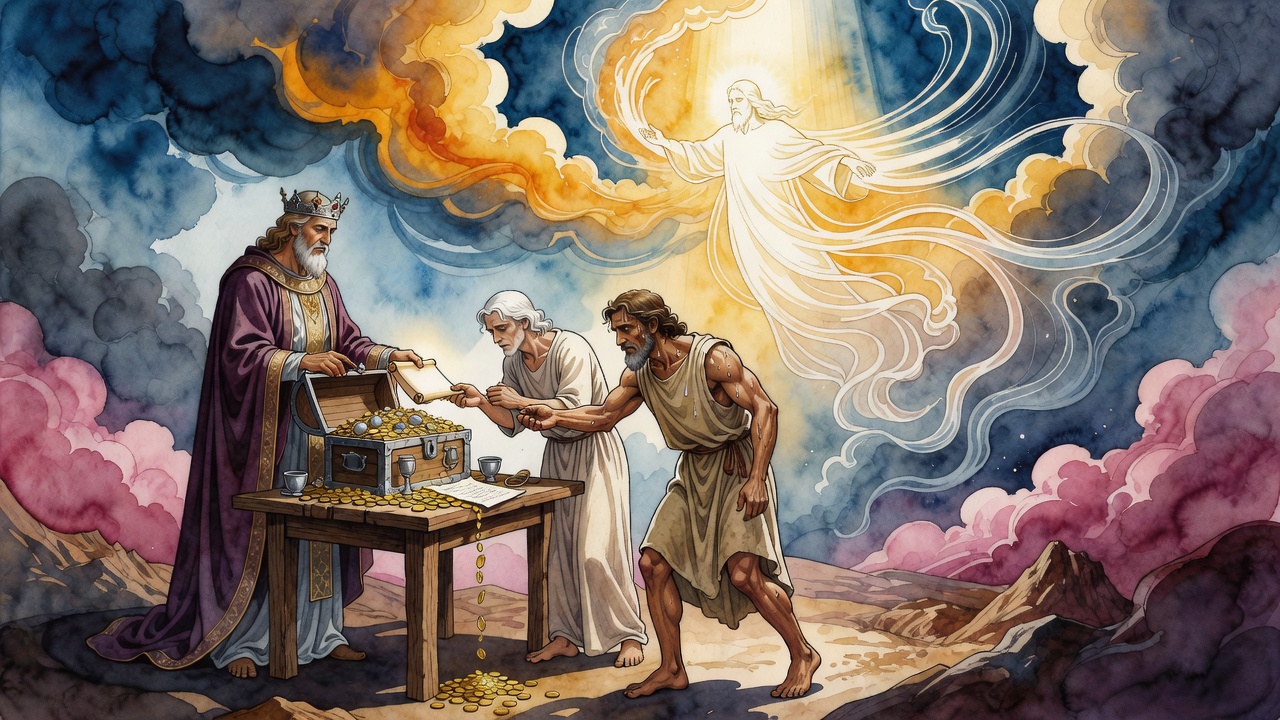
A king buys two servants at one price on one contract, feeds the first from his treasury, and sends the second out to sweat for bread.

Curated by Arthur · Told by Maggid ·
Table of Contents
  1. Two Servants Bought at One Price
  2. The Maidservant Put Outside the Gate
  3. Tenants Settled in the Empty Air
  4. The Nurse Who Watches the Sleeping Child
  5. The Glance That Took In Both Floors
  6. The Dew That Falls on an Open Door
The Earth's Complaint and the Dew That Answered It Click for full size

Two Servants Bought at One Price

The king came down to the market himself. He paid one price for two servants, wrote them into one contract with one stroke of the reed, and walked them home through the same gate.

The first he sat at a table inside the house and fed out of the treasury. The second he sent to the field.

By dusk that one had dirt in his teeth and a blister opening across his palm. He came back to the door and would not step through it. "We were bought the same way," he said. "One price, one contract, one morning. He eats what the king eats. I eat what I dig. Name the difference and I will accept it."

Nobody named the difference.

The servant at that door was the earth, in the second sentence of the world, unformed and void, tohu vavohu (תהו ובהו). (Genesis 1:2) Heaven had been made the same day out of the same speech, and heaven was already eating, fed on the radiance of the One who made it. Down here the ground had to be cut open with a plow before it gave anything up.

The Maidservant Put Outside the Gate

There were two maidservants as well, bought the same morning at the same price. One the king kept in the palace. The other he walked to the gate and set outside it.

She did not weep. She stood in the road in the condition the old word names, toha uvoha, astonished, staring at a door that had closed while she faced it.

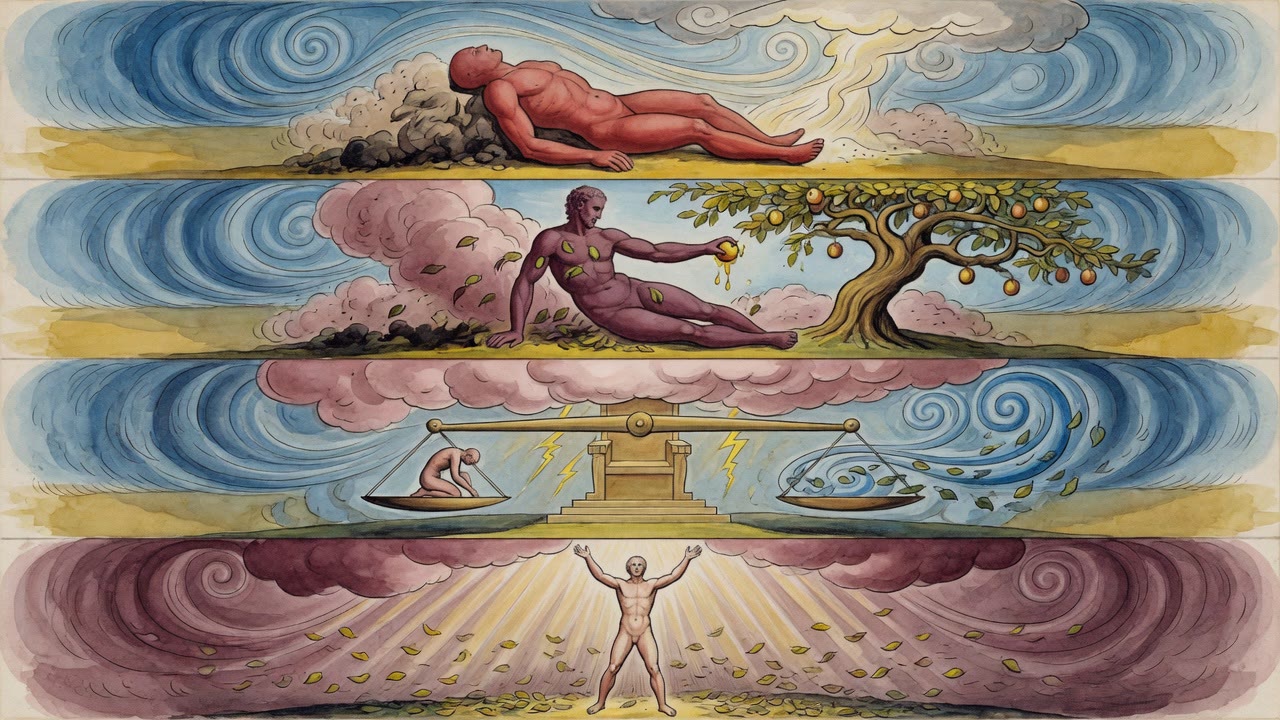
Inside that house nobody is ever buried. The ones who serve up there do not sicken and do not go down into anything. The earth had the arithmetic before there was a creature alive on her to count. Everything she carried she would also have to swallow. The servant at the table kept his table forever. She would get a harvest and a grave, then another harvest and another grave, until the last one.

Tenants Settled in the Empty Air

The building went up anyway.

Any king builds a palace with an upper story and a lower story and puts occupants in both. Nobody rents out the space between the floors. Nothing up there holds weight.

The Holy One filled it. On the fifth day the birds came out of nothing into the middle of nothing and stayed up, holding themselves on the empty stretch above the earth's face. (Genesis 1:20)

Under them the water swarmed and the great sea serpents came up, written into the account with a letter missing, as though the word itself were short one partner. Behemoth and Leviathan broke the surface. One sage said neither of them was given a mate at all. Another said Behemoth has a mate and no appetite for her, and pointed at the knotted sinews in the beast's thighs. (Job 40:17)

Then, out of one white drop, a peacock, carrying three hundred and sixty five colors, one for every day the sun takes to come back around. All that extravagance was aimed downward, at the floor of the house, at the field where the second servant was working.

The Nurse Who Watches the Sleeping Child

The earth knew another way of keeping watch in the dark.

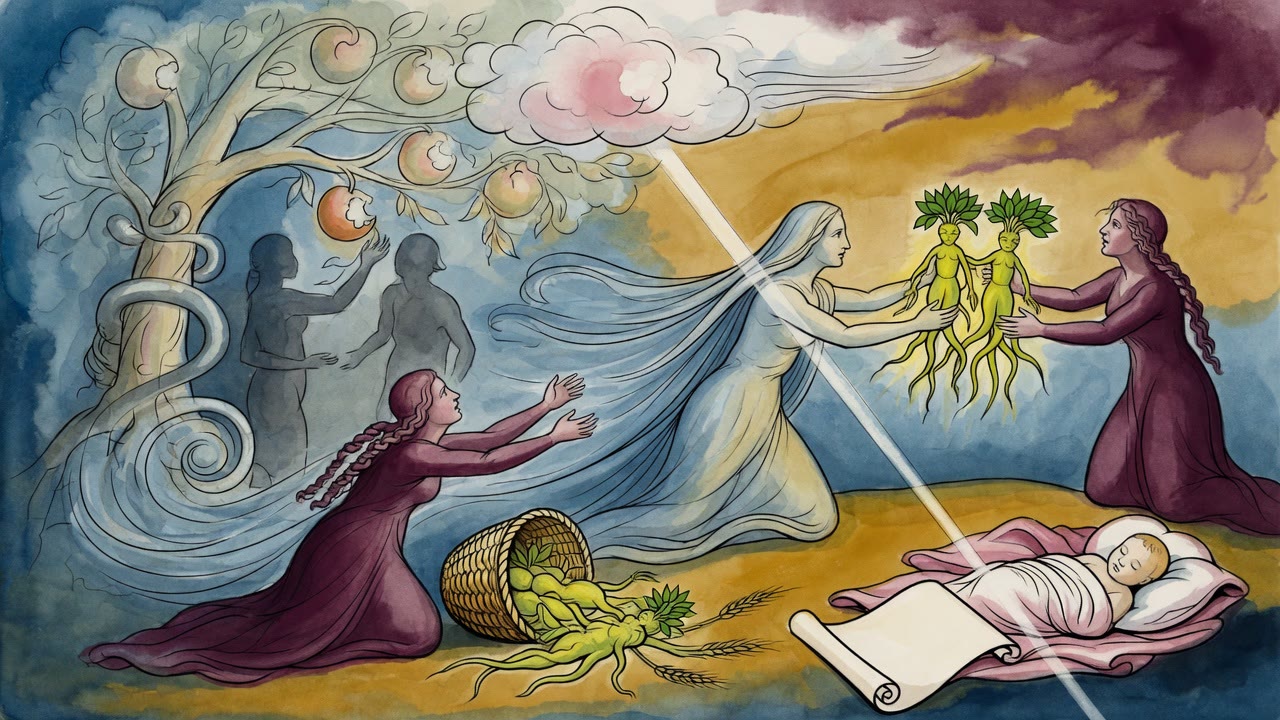
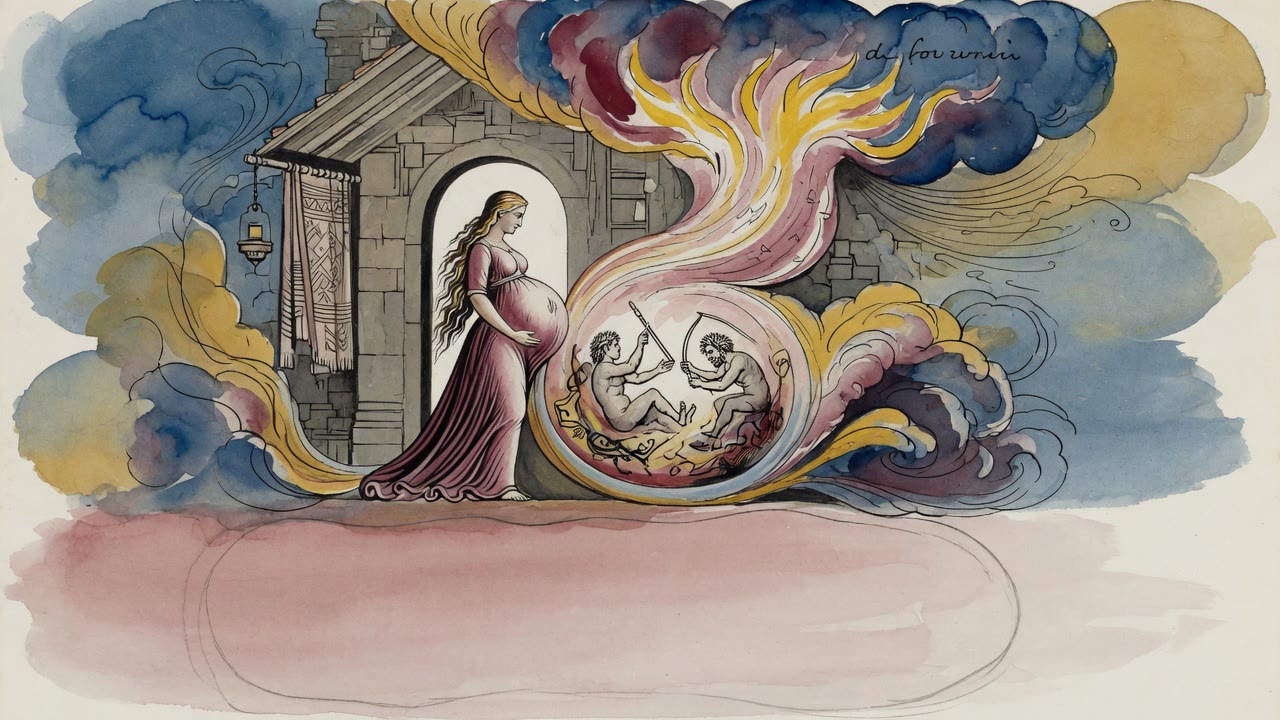
A nurse sits beside the king's son while he sleeps. The room is warm, the child is fed and wrapped, nothing is wrong, and she cannot take her eyes off the door. She knows how the accounting goes. When the boy grows up and does the unforgivable thing, nobody will send for the boy. They will send for her.

The earth was already sitting that watch. Nothing had walked on her yet. She had the shape of it in advance, the man she would be told to grow, the fruit he would take and eat, and the sentence that would not stop at him. "Cursed is the ground because of you." (Genesis 3:17) She would be cursed for a mouth that did not exist yet, for a child who was not yet awake.

The Glance That Took In Both Floors

On the sixth day the King came out to look at what He had built.

A human king cannot do that. He climbs to the upper story and inspects it, comes down and inspects the lower, and by the time he reaches the cellar he is remembering the roof instead of seeing it.

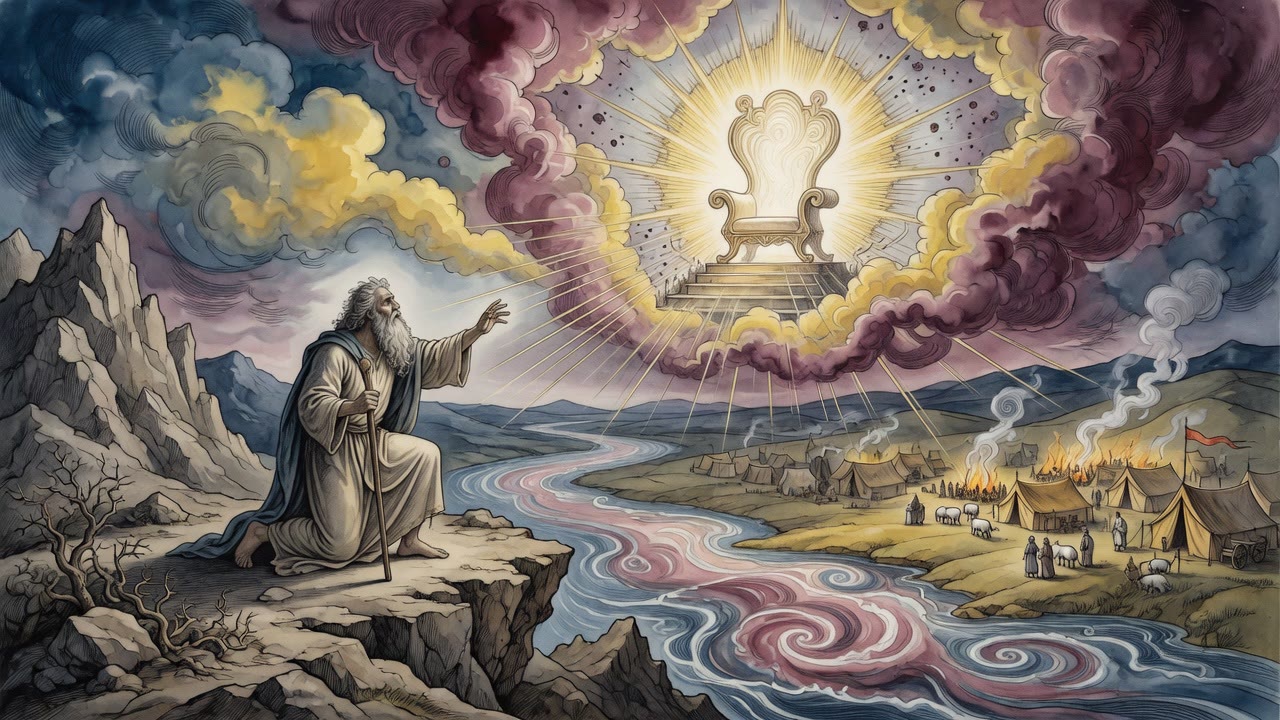
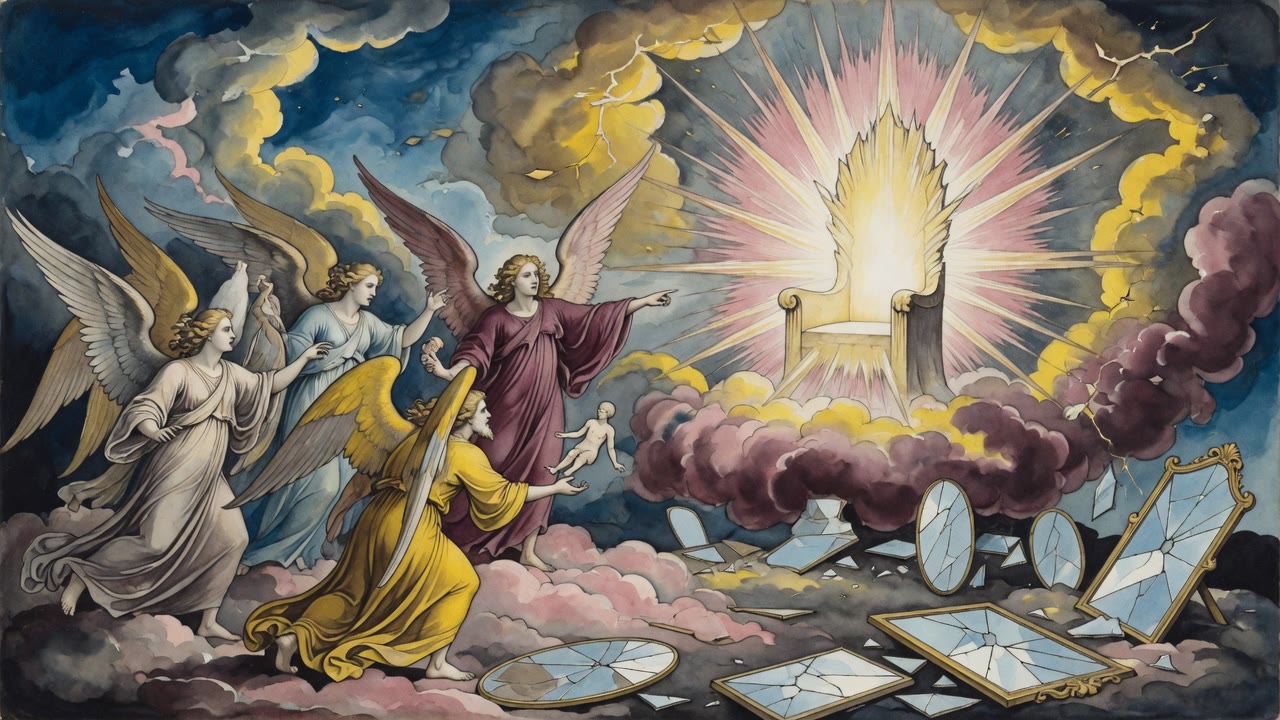
The Holy One took the whole house in a single look. Heaven and earth, the servant at the table and the servant in the field, and He called it very good. The words came a second time with one letter added at the front, and reached past this world into the world that has not arrived, so both stood inside the same glance.

Nothing had been obscured from Him since He stretched out His arm and made them both. Not the blister. Not the sentence at the door, which He had known before there was a servant or a tongue to say it with. "Even when there is no speech on my tongue, behold, Lord, You know it all." (Psalm 139:4)

The earth had thrown her complaint out into the dark. It had been heard before she was made.

The Dew That Falls on an Open Door

The answer came at night, and it came as water instead of a verdict.

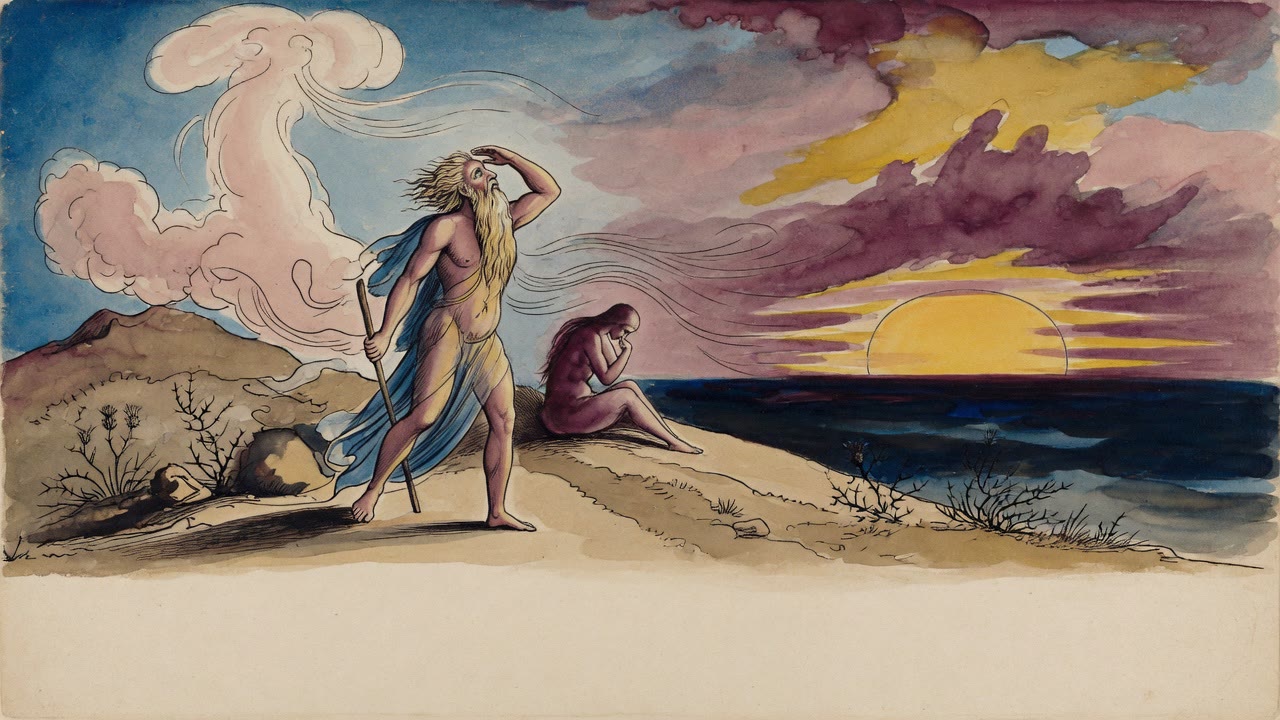
Far down the line there was a man whose doors were never shut. Job let in anyone who walked up the road, lean years and fat, and while his neighbors scraped thin harvests off their fields his own came in heavy. "My root will be open to water, and dew will lie on my branch." (Job 29:19) A house begins at its door the way a tree begins at its root. His root ran wet because his door stood open.

Jacob reached the same water another way. He stayed bent over Torah the way a root stays in a stream, and the blessing he took at his father's bedside opened with the dew of heaven.

Dew, tal, is not the treasury. It is not a set table for a servant who never broke ground. It comes down in the dark, a little at a time, onto soil that has been cut open, and in the morning it lies on the branch of whoever left the door open all night.

The servant in the field never got the difference explained to him. He got the field, and the water on it, and the door.


← All myths
From the tradition

Sources

4 sources

The texts behind this telling. Some cards carry a translation of the source; others are our own retelling of it, and each card says which. Every card links out to the original.

Bereshit Rabbah 2:2Bereshit Rabbah

Retold in our words. Read the original at the link below.The Sefaria Midrash Rabbah, 2022 · CC-BY

Our sages grappled with these questions ages ago, and in Bereshit Rabbah, a collection of rabbinic interpretations of Genesis, they offer some pretty striking analogies.

A king. He buys two slaves, same price, same contract. But he decrees that one gets pampered, fed from the royal treasury, while the other has to sweat and toil just to eat. The second slave is understandably confused. "We were bought the same way! Why the difference?"

Rabbi Abahu uses this image to explain the earth's initial state, described as tohu vavohu – "emptiness and disorder" (Genesis 1:2). He suggests that the earth was bewildered. The celestial beings, created at the same time, are sustained by the Divine Presence, while terrestrial beings, well, we have to work for our supper. It's a cosmic inequality, and the earth, in its nascent form, is already questioning it.

Then, Rabbi Yehuda bar Simon offers another analogy, this time with two maidservants. Again, same purchase, same price. But one gets to stay in the palace, basking in royal favor, while the other is banished. The banished maidservant is, naturally, in a state of toha uvoha – bewildered and astonished.

Rabbi Yehuda bar Simon suggests this mirrors the earth's lament: the celestial beings get to live forever, while terrestrial beings are subject to death. A pretty raw deal, if you This inherent mortality, this disparity in destiny, is what the phrase "tohu vavohu" represents. It's a kind of cosmic unfairness.

But Rabbi Tanhuma brings in a different perspective, a bit more somber. He compares the earth's state of toha uvoha to a wet nurse watching over a king's sleeping baby. She's anxious, knowing that she'll be blamed for any misbehavior of the child. As Rabbi Tanhuma puts it, when the child misbehaves, the nurse is blamed.

Similarly, the earth, even before humanity fully comes into being, foresees its fate. It knows it will be punished because of humanity, as it says, "Cursed is the ground because of you" (Genesis 3:17). The earth anticipates the consequences of our actions, the burden it will bear. The Midrash (rabbinic interpretive commentary) is telling us that even in the beginning, the earth held a certain anxiety about its relationship to humankind.

These interpretations in Bereshit Rabbah aren't just about explaining a phrase. They're about exploring fundamental questions of fairness, destiny, and responsibility. The rabbis use vivid stories to make the abstract concrete, helping us understand the earth's initial state of "emptiness and disorder" not just as a physical condition, but as an emotional and existential one.

So, the next time you look around at the world and wonder why things are the way they are – the inequalities, the burdens, the inherent limitations – remember the king and his slaves, the maidservants, and the anxious wet nurse. They remind us that these questions are ancient, and that wrestling with them is part of what it means to be human.

Full source
Bereshit Rabbah 7:4Bereshit Rabbah

Retold in our words. Read the original at the link below.The Sefaria Midrash Rabbah, 2022 · CC-BY

Bereshit Rabbah, that magnificent collection of rabbinic interpretations of Genesis, puts it this way: "And let birds fly" (Genesis 1:20). It points out that earthly kings build palaces with upper and lower levels for occupants. But do they settle occupants in the airspace? No! Only the Holy One, blessed be He, settles occupants even there.

This is such a potent image. God's creativity isn’t limited by our human concepts of property or dominion. The sky itself is populated, teeming with life.

Then we move on to (Genesis 1:21): "God created the great serpents and every living creature that crawls, with which the water swarmed by their species, and every winged bird in its kind, and God saw that it was good." What does it mean that God created the great serpents, the hataninim?

Rabbi Pinḥas, quoting Rabbi Aḥa, offers a fascinating idea: the word taninim is written without the usual yod, the letter that often signifies the plural. This, they suggest, hints at Behemoth and Leviathan, those mythical beasts of immense power, who, in this interpretation, have no mates. Though Rabbi Shimon ben Lakish challenges that, saying Behemoth does have a mate, but no desire, citing the verse "The sinews of its testicles are knotted" (Job 40:17). A rather... graphic image, to be sure!

And from there, the discussion takes an unexpected turn, moving from mythical monsters to... peacocks. Rav Huna, citing Rav Matna, shares a remarkable tidbit: the peacock, in all its iridescent glory, originates from a single, white drop – sperm – yet displays 365 colors, one for each day of the solar year. It's a beautiful, if somewhat startling, illustration of the potential contained within the smallest of beginnings.

But here's where it gets even more interesting. Rabbi Yirmeya Kahana poses a question to Rabbi Shimon ben Lakish about crossbreeding sea animals. Is it permitted, according to halakha (Jewish law)? Remember, (Leviticus 19:19) forbids crossbreeding animals. Ben Lakish replies that it isn't, citing "by their species" from the verse.

But Kahana pushes back, pointing out that "by their species" is written regarding fish too, but how can you crossbreed fish? This sparks a fascinating debate about the application of kilayim, the prohibition against mixing different kinds, to the aquatic world.

Rabbi Yona offers a solution: what if you tie two different species of fish, a mairon and an asparon, together with reed-grass and force them to move together? That, he argues, would be a violation of the prohibition of diverse kinds, since we know the diverse kinds involving driving animals may not be used to plow, haul, or pull together. So, “And every living creature that crawls, with which the water swarmed by their species” indicates the prohibitions involving diverse species apply to sea life as well. And then, the text concludes by circling back to its starting point, connecting "every winged bird" to the peacock.

What are we left with after all this? It seems to me that this passage, seemingly about the creation of birds and sea creatures, is actually a meditation on the boundaries of creation, the limits of our understanding, and the constant, playful intellectual wrestling that is so central to Jewish tradition.

Full source
Bereshit Rabbah 9:3Bereshit Rabbah

Retold in our words. Read the original at the link below.The Sefaria Midrash Rabbah, 2022 · CC-BY

In Bereshit Rabbah, a classic collection of rabbinic interpretations on the Book of Genesis, the rabbis confront this very idea. They explore what it means when the Torah tells us, "God saw everything that He had made, and, behold, it was very good" (Genesis 1:31).

Rabbi Yoḥanan offers a striking analogy. He says that when a human king builds a palace, he has to look at the upper floors separately from the lower ones. He can't take it all in at once. But the Holy One, blessed be He, sees everything – the highest heavens and the lowest earth – all in a single, comprehensive view.

Wow.

But Rabbi Shimon ben Lakish takes it even further. He suggests that when the Torah says, "Behold, it was very good," it’s actually referring to olam ha-zeh (this present world), this world, the one we inhabit right now. But then, with the addition of the word "and," when it says, "And, behold, it was very good," it's hinting at olam ha-ba, the World to Come. So, according to Rabbi Shimon ben Lakish, God isn’t just seeing everything in space; He’s seeing everything in time, too! He's holding this world and the next in His gaze, simultaneously.

Mind. Blown. Again.

Building on this, Rabbi Shimon ben Lakish, quoting Rabbi Elazar ben Azarya, brings in a verse from Jeremiah (32:17): "Alas! My Lord God, behold, You made the heavens and the earth with Your great power and with Your outstretched arm; there is nothing that is obscured from You." The implication? Once God created everything, nothing has ever been hidden from Him since. Every single thing that has happened, is happening, and will happen, is already known.

Rabbi Ḥagai, citing Rabbi Yitzḥak, brings in a verse from I Chronicles (28:9): "And you, Solomon my son, know the God of your father and serve Him wholeheartedly and with a willing mind, for the Lord seeks all hearts, and understands all inclinations of thoughts. If you seek Him, He will be accessible to you, but if you forsake Him, He will abandon you forever." The powerful point here is that God knows our thoughts even before we fully form them.

Rabbi Yudan, again in the name of Rabbi Yitzḥak, reinforces this: even before a creature is created, God knows its thoughts. It’s as if our very potential is already an open book to the Divine. Rabbi Yudan himself then adds, quoting (Psalm 139:4): "Even when there is no speech on my tongue, behold, Lord, You know it all." Even before we utter a word, God knows what we're going to say.

So, what does all of this mean for us? It’s a pretty heavy thought. If God sees everything, knows everything, even before it happens, then what about free will? What about our choices? Are we just puppets in some grand cosmic play?

Maybe, instead of focusing on the potentially overwhelming implications, we can take comfort in the idea that we are seen. Truly seen. Not just our actions, but our intentions, our hopes, our fears. And maybe, just maybe, that kind of profound knowing is a foundation for a deeper, more meaningful relationship with the Divine.

Full source
Bereshit Rabbah 66:1Bereshit Rabbah

Retold in our words. Read the original at the link below.The Sefaria Midrash Rabbah, 2022 · CC-BY

Bereshit Rabbah turns to The Dew of Heaven and Its Layers of Blessing.

The rabbis, masters of close reading and insightful connections, find a clue in the Book of Job. Remember Job, the famously righteous sufferer? He says, "My root will be open to water, and dew will lie on my branch" (Job 29:19). Now, The first reading, this seems like a straightforward description of prosperity. But the rabbis see something deeper.

Job, in his own words, is saying that because his doors were always open – his home a haven for all – everyone else might have had meager harvests, but he reaped abundance. The phrase "My root will be open to water" isn’t just about literal irrigation. Radal, a commentator, explains that the "root" here is interpreted as the door, since a house "begins" from the door, just as a tree begins from its roots. It speaks to Job’s boundless generosity. Water, after all, is freely available, and so was Job's hospitality.

Where does the dew come in?

This is where Jacob enters the picture. Jacob, the trickster turned patriarch, also received a blessing connected to dew. The rabbis suggest a connection: Because Jacob dedicated himself to Torah, which, like water, is a source of life and nourishment, he was blessed with dew from the heavens. Torah study, engaging with sacred texts, is like opening yourself to a constant flow of wisdom and understanding. It's a wellspring that never runs dry. And just as Job’s open-door policy brought him abundance, Jacob's commitment to Torah study brought him the blessing of dew.

So, what is dew, in this context? It's not just moisture in the air. It's a symbol of divine blessing, a reward for generosity and dedication to spiritual growth. It’s a subtle, gentle gift, nourishing and life-giving. It suggests a blessing that comes not from grand gestures or obvious displays, but from consistent, quiet acts of kindness and devotion.

The blessing of dew, then, is a wish for a life sustained by both earthly and spiritual nourishment. A life where open-heartedness and dedication to wisdom bring a gentle, persistent flow of divine grace.

Doesn’t that make you think differently about simple blessings?

Full source