The Feast Where Simon Maccabeus Was Betrayed
Ptolemy had married Simon's daughter and held the plain of Jericho. He invited his father-in-law to dinner and put armed men in the inner room.
Table of Contents
 Click for full size
The Empty Camp at Night
Gorgias came looking for Judas in the dark. He brought a strong force and good intelligence: the Jewish fighters were camped at Emmaus, fewer in number, worse equipped, and vulnerable to a night raid that would scatter them before they could form a line. He left his own camp and marched into the hills to find them.
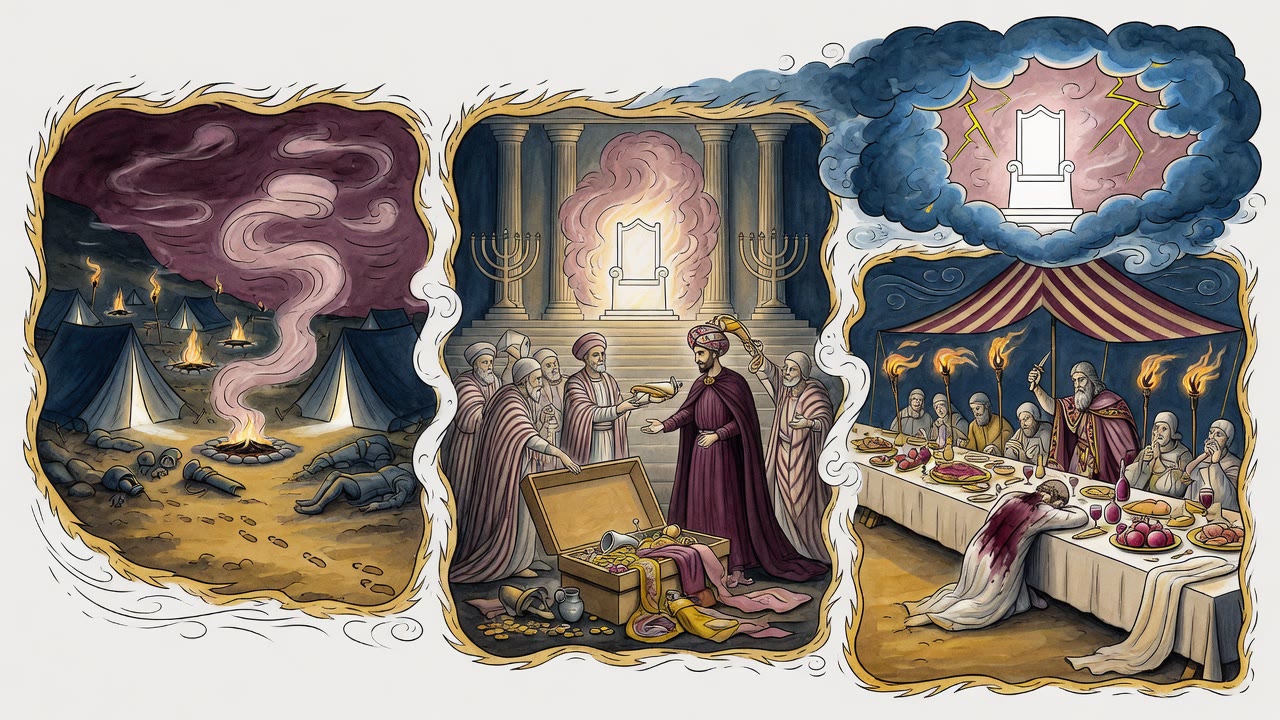
He found an empty camp. The tents were there, the fires perhaps still warm, but the men were gone. Judas had moved first. While Gorgias climbed into the Judean hills searching for the Jewish army, Judas was already marching on Emmaus from a different direction.
At dawn Judas stood before a force considerably larger than his own. He had perhaps three thousand fighters, some without armor, some without adequate weapons. What they had was nerve and the specific kind of courage that comes from knowing the alternative is extinction. Judas told them that it was better to die fighting than to watch the destruction of their people and their sanctuary. The numbers did not change. The courage remained.
They charged. The mercenary infantry broke and ran toward the plain. The cavalry fled to Philistia. When Gorgias came down from the hills and saw his own camp in flames and the army dispersed, he also fled. Judas had won by refusing to be where the enemy expected him to be.
Simon Remembered Across Generations
The revolt moved through brothers. Mattathias began it. Judas carried the battle forward with the kind of ferocity that makes legends. Jonathan survived where Judas could not and held the political and priestly authority together through years of negotiation, alliance, and sudden violence. When Jonathan was taken and killed by Tryphon, the trap closing on a man who had trusted a promise he should not have trusted, the leadership passed to Simon.
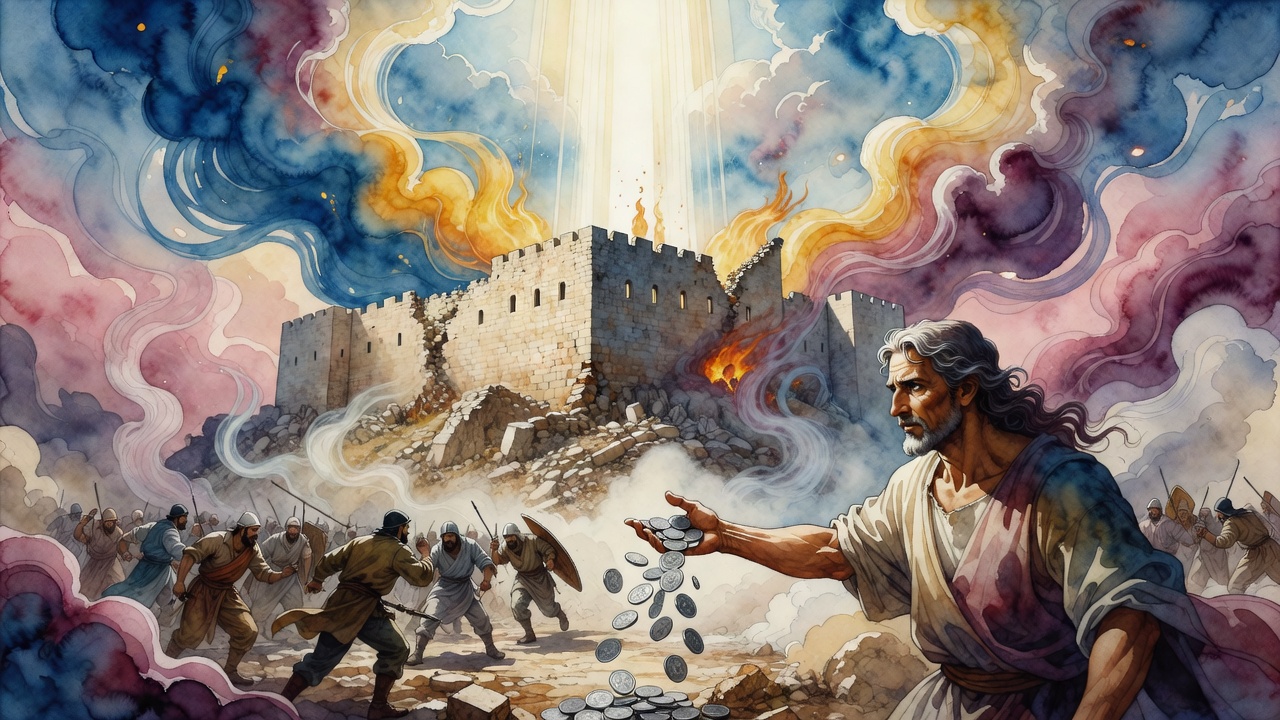
Simon was the last of Mattathias's sons still standing. He rose not by conquest alone but by something rarer among military leaders: he spent his own money. When the struggle was at its most uncertain, when the country needed walls, when Jerusalem needed fortifications, when fighters needed pay, Simon drew on his own resources. He did not wait for a patron. He did not negotiate foreign subsidies with the strings that foreign subsidies always carry. He paid.
The people recognized the difference. When the Hasmonean dynasty was formally confirmed, the text of the decree the people issued was exact about what Simon had done: he had sustained the war with his own silver and gold. The memory was kept deliberately, because it established the nature of Simon's authority. He had not seized the priesthood or the leadership. He had earned them by spending himself on the community's survival.
The Peace That Came With Simon
Under Simon, the land had peace. The statement in 1 Maccabees is simple and has the quality of something that had been impossible for so long that the people barely knew how to receive it. Every man sat under his vine and under his fig tree, and no one made them afraid. Old men sat in the squares talking. Young men wore glorious armor. Simon gave food to cities and equipped them with weapons and made his name famous to the ends of the earth.
This was the vision Micah had spoken, every person under their vine and their fig tree, as a picture of what shalom would look like when it finally arrived in a place that had known nothing but trouble. 1 Maccabees deploys that image deliberately. Simon was not only a military and political leader. He was, for a generation, the answer to a prophetic promise.
The peace was real and the peace was fragile. It existed because Simon held it together, and Simon was mortal.
Knives at the Feast
Ptolemy son of Abubus had married Simon's daughter. He held the command of the plain of Jericho. He was ambitious and he was patient, and he waited until the right moment arrived.
The moment arrived at a feast. Simon visited the cities of the district with his sons Mattathias and Judas. At Jericho, Ptolemy invited them into his stronghold and gave them a banquet. He had men hidden in the inner room, waiting. When Simon and his sons had drunk enough that caution was further away than usual, Ptolemy's men rose and killed Simon and Mattathias and Judas at the table.
The betrayal had been rehearsed. Ptolemy had already sent messengers to Antiochus VII offering to hand over the country and requesting troops. He sent men to seize the cities of Judea. He sent a letter to the commander John, Simon's remaining son, inviting him to his death as well.
John received warning before the letter arrived. He survived. The revolt continued. But the last of Mattathias's sons died at a feast, killed by a son-in-law who had calculated that the moment of peace was also the moment of maximum danger. A man secure at his own table, eating and drinking with his sons, has let his guard down in the one place he believed the danger was over.
← All myths