5 min read

The Flood Generation Asked God to Leave Them Alone

A mist came up and watered the whole earth by itself, so they asked heaven for one drop of rain and nothing else. Noah later said he was no better.

Curated by Arthur · Told by Maggid ·
Table of Contents
  1. All They Wanted Was One Drop
  2. The Eyes Roved and the Fountains Answered
  3. The Snare Was in the Mouth
  4. Noah Counted Himself With Them
  5. Come Into the House
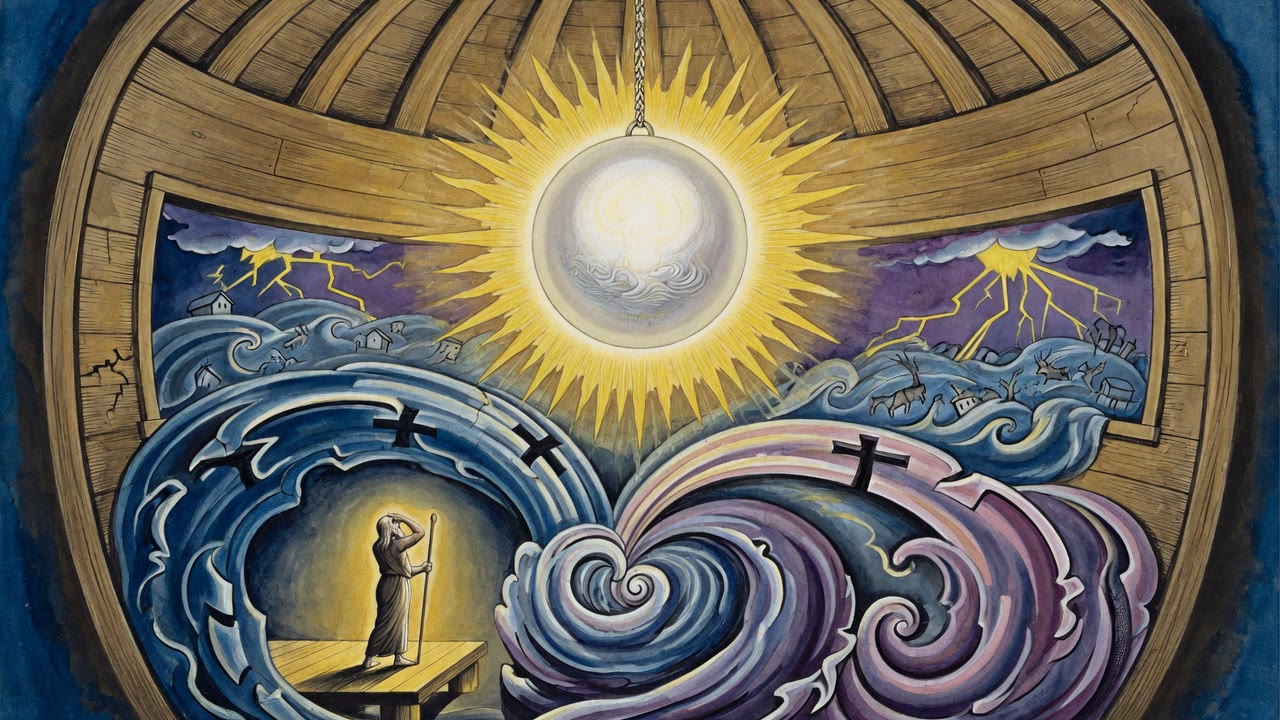
The Flood Generation Asked God to Leave Them Alone Click for full size

All They Wanted Was One Drop

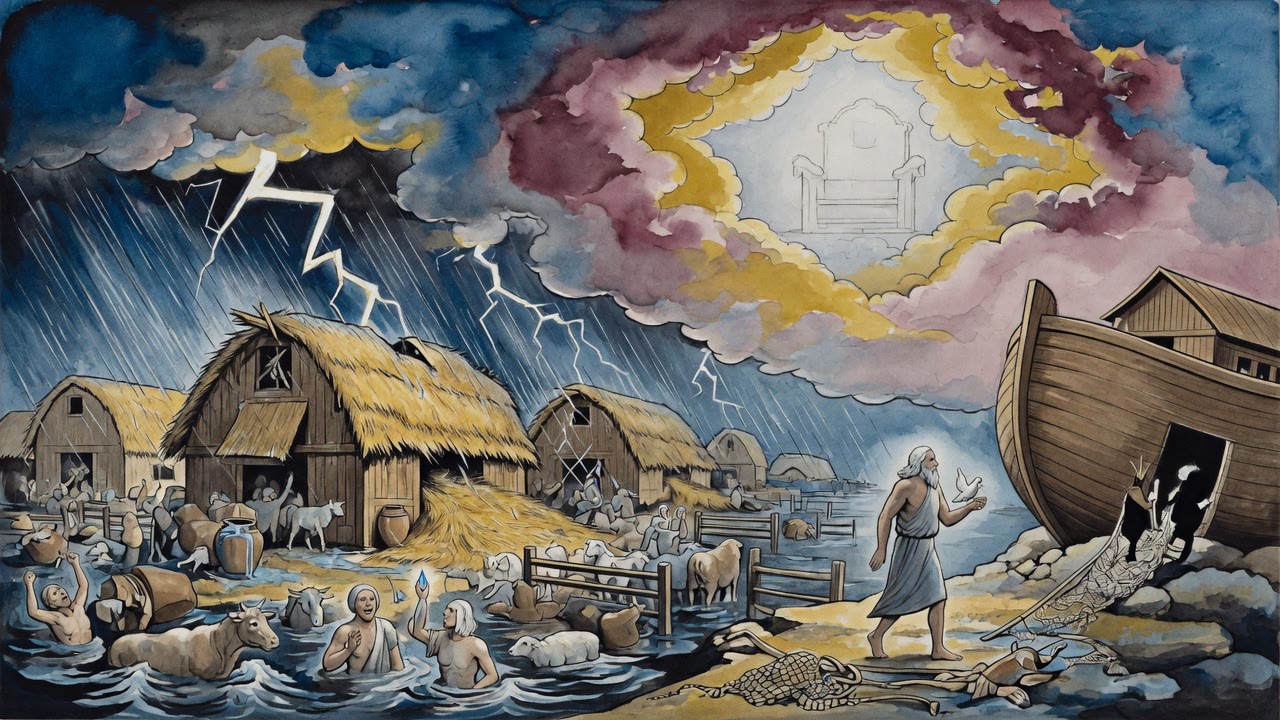
Nothing in that generation was going wrong. The bulls covered the herd and never failed. The cows carried to term and never dropped a calf early. There was a timbrel in the house and a harp next to it, and people spent their days in wealth and went down to the grave in a moment without ever living through a bad year.

That was the problem, and they said it out loud.

"Depart from us." Leave us alone. Not a curse, a dismissal, the way a man tells a hired hand he is not needed after all. One drop of rain is all we want out of You, they said, and we will manage the rest. A mist comes up off the ground and waters the whole face of the earth by itself. Why keep heaven on the payroll for that?

God answered them with the one thing they had left Him.

"You boast to Me about the good I gave you? With it I am going to collect."

The rain was on the earth forty days and forty nights.

The Eyes Roved and the Fountains Answered

Rabbi Yossi ben Dermaskit measured it tighter than that. Their eyes ran up and down, he said, taking whatever they landed on, helping themselves with a look before they ever put a hand out. Eyes, eineihem. So the fountains were opened on them, maynot, above and below, and the sound of the sentence came back matched to the sound of the sin.

On that day all the springs of the great deep were broken open and the windows of heaven were opened.

Looking with no limit met water with no limit. They had asked for a drop and the whole reservoir arrived at once.

The Snare Was in the Mouth

Rabbi Yudan, in the name of Rabbi Aivu, found the mechanism sitting in Proverbs. In the transgression of the lips there is an evil snare, and the righteous one comes out of trouble.

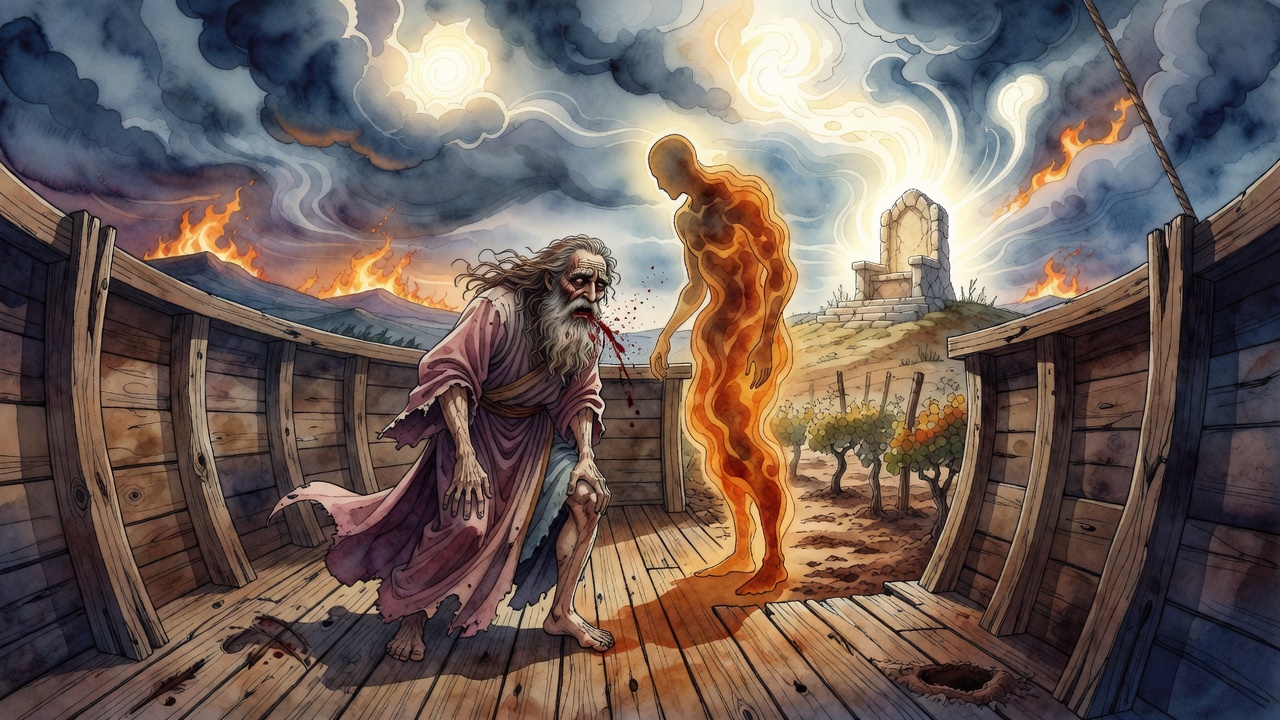
The talking did it. Not only what they had done. What they said while they were doing it. A snare is the one trap a man walks into on his own legs, and every sentence they aimed at heaven drew the loop in another notch.

And the righteous one comes out of trouble. That is Noah, and the proof is the three words spoken to him at the far end of it. Go out of the ark.

Noah Counted Himself With Them

A psalm asks God to destroy those who speak falsehood, and says the Lord abhors a man of bloodshed and deceit. Turn it toward the generation of the Flood and it fits without alteration. Them and their false speech. Rabbi Pinhas said: them and their conduct. The murderer who got up at daybreak to kill the poor and the needy and turned thief after dark. An earth filled to its edges with violence because of them.

Then the psalm turns and the speaker says two words about himself. And I.

And I, in Your great mercy, come into Your house. Just as they did, so did I. What is the difference between me and them?

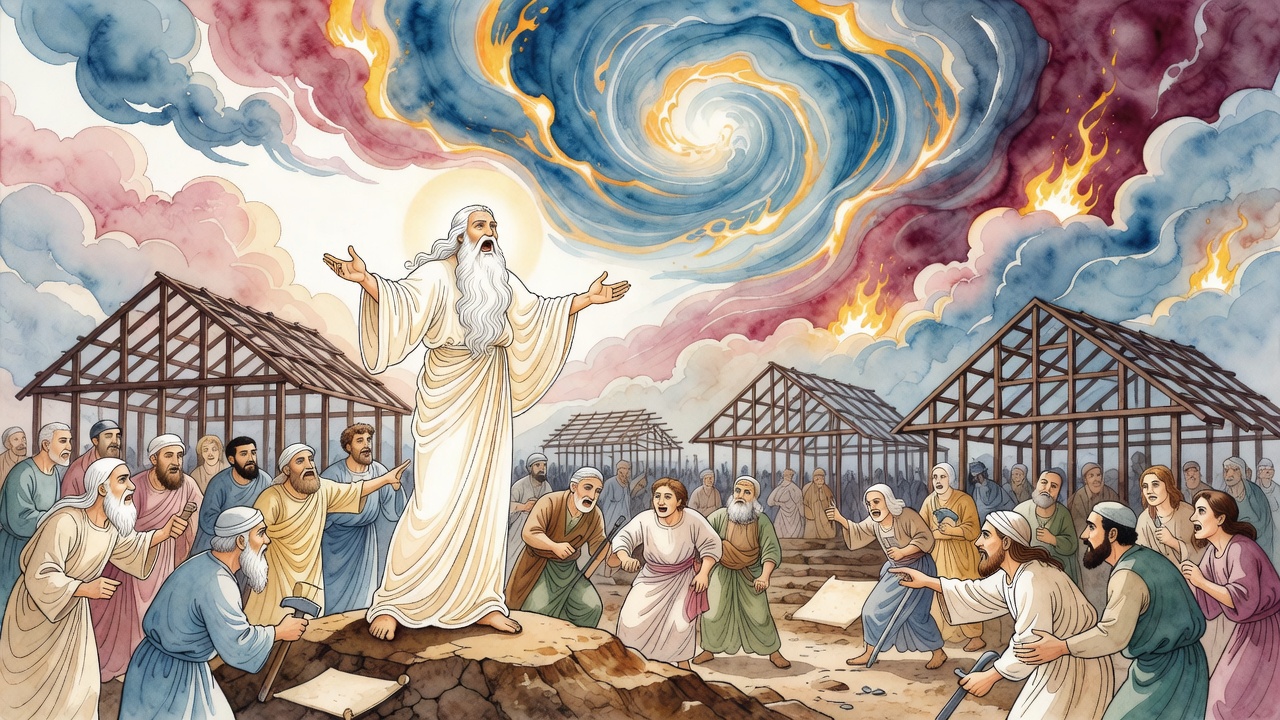
The one saying that is Noah. He watched a world go under for what it said and what it did, and then he set himself down in the same sentence with it, because he had lived his whole life inside that world and had never once stood up and said stop.

He answered his own question and the answer was not his record. What is the difference between me and them? You dealt kindly with me. You said: come, you and your whole household, into the ark.

Come Into the House

Come, you and your entire household, into the ark, for I have seen you righteous before Me in this generation.

Into the ark, which the psalm calls Your house. Not the house Noah cut out of gopher wood and sealed with pitch while the neighbors came out to watch him work. God's house, and the door was opened because God opened it.

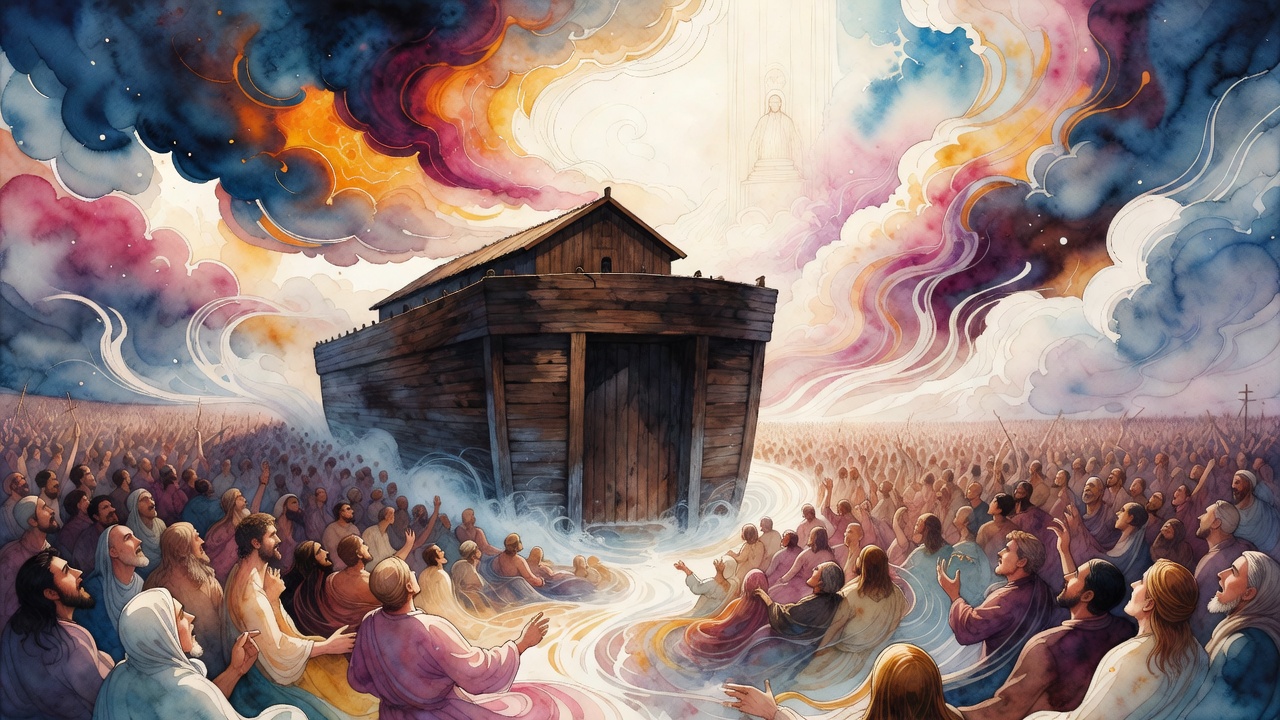
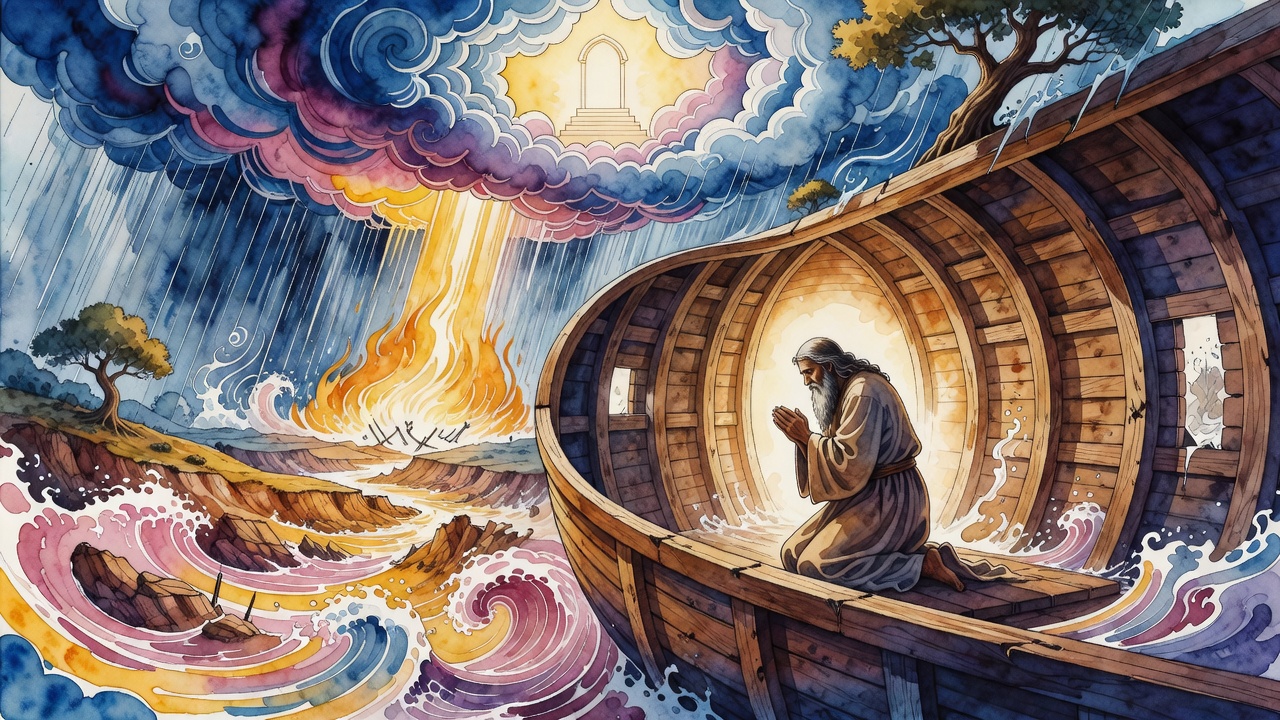
Outside, the men who had wanted one drop stood in water that would not stop arriving, and their own sentences closed around their ankles.

Inside, a flawed man walked up a plank with his sons and his wife and their wives and every animal that had come when it was called, into a house that was not his, and the door shut behind him.


← All myths
From the tradition

Sources

3 sources

The texts behind this telling. Some cards carry a translation of the source; others are our own retelling of it, and each card says which. Every card links out to the original.

Sifrei Devarim 43:8Sifrei Devarim

Retold in our words. Read the original at the link below.Sifrei by Rabbi Shraga Silverstein · CC-BY

The Sifrei Devarim offers a fascinating, and perhaps unsettling, perspective. It wasn't just about being "bad." It was about something far more insidious: complacency born of abundance.

The Sifrei Devarim tells us that the generation of the Flood rebelled precisely because they were too comfortable. Picture this: (Job 21:10-13) describes their lives of ease: "Their bull genders and does not fail; their cow calves, and does not abort… They take the timbrel and harp, and rejoice at the sound of the organ. They spend their days in wealth, and in a moment go down to the grave." A life of endless pleasure and prosperity.

Here’s the catch. This very satiety, this feeling of having everything, led to arrogance. They became self-sufficient, or so they thought. "And they say unto G-d: 'Depart from us,'" they declared. "All we need from Him is one drop of rain." We can manage ourselves, they seemed to boast, echoing the verse in (Genesis 2:6): "And a mist went up from the earth and watered the whole face of the ground." They didn't feel they needed divine intervention. They believed they had it all figured out.

That’s when G-d responds. It's a powerful lesson about humility and the dangers of taking blessings for granted. The Sifrei Devarim continues, "You vaunt yourselves over the good that I have bestowed upon you? With it I shall exact punishment of you!" The very thing they trusted – the abundance of water – became the instrument of their destruction: "And the rain was on the earth forty days and forty nights" (Genesis 7:12).

There's even a more visceral interpretation offered by R. Yossi b. Dermaskith. He suggests that their eyes, their eineihem in Hebrew, roved up and down, consumed by lust and excess. In response, G-d opened up the upper and lower fountains, the maynoth (which sounds similar to eineihem), to destroy them. As (Genesis 7:13) tells us, "On this day were broken up all the fountains of the great deep, and the windows of heaven were opened." It’s almost a measure-for-measure kind of justice. The very source of life, twisted by their unchecked desires, became the agent of their demise.

So what does this all mean for us? It's a stark reminder that blessings can become curses if we lose sight of gratitude and humility. It's not just about avoiding "sin," but about cultivating a sense of appreciation for the gifts we have, and recognizing our dependence on something greater than ourselves. Perhaps the story of the Flood isn’t just about a catastrophic event in the distant past. Maybe it’s a constant invitation to examine our own hearts, to ensure that our blessings lead us to humility, not hubris. What do you think?

Full source
Bereshit Rabbah 34:3Bereshit Rabbah

Retold in our words. Read the original at the link below.The Sefaria Midrash Rabbah, 2022 · CC-BY

There's a powerful lesson hidden in the story of Noah and the Flood.

Rabbi Yudan, quoting Rabbi Aivu, kicks us off with a verse from Proverbs: "In the transgression of the lips there is an evil snare, but the righteous one emerges from trouble" (Proverbs 12:13). It's a verse that sounds simple, but it packs a serious punch.

The Bereshit Rabbah, a classic collection of Rabbinic interpretations on the Book of Genesis, uses this verse to explain why the generation of the Flood met such a catastrophic end. What did they do wrong? It wasn't just their actions, but the "transgression of their lips." They rebelled against God with blasphemous statements. The Tanḥuma Noaḥ 14 emphasizes this point. Their words created a snare, trapping them in their own destruction. It wasn't just that they were wicked. Their very speech, their open defiance, sealed their fate. Words, after all, are powerful.

The verse doesn’t end there. "But the righteous one emerges from trouble." Who is the righteous one in this context? Noah, of course!

When everyone else was succumbing to the flood, Noah found salvation. Why? Because he was righteous, and his righteousness, in the eyes of the Rabbis, allowed him to escape the "trouble." He was told, “Go out of the ark.” He survived the deluge, emerging into a new world.

The contrast is stark. The generation of the Flood, undone by their own rebellious words. Noah, saved by his righteousness. They can build or destroy, bless or curse.

So, what's the takeaway? Be mindful of your words. Use them to build, to bless, and to seek righteousness. You never know what kind of flood your words might unleash, or what kind of ark they might help you build.

Full source
Bereshit Rabbah 32:1Bereshit Rabbah

Retold in our words. Read the original at the link below.The Sefaria Midrash Rabbah, 2022 · CC-BY

The verse that kicks it all off is God's instruction to Noah: "Come, you and your entire household, into the ark, as I have seen you to be righteous before Me in this generation" (Genesis 7:1). Simple enough. But the rabbis, never ones to shy away from a deeper dive, see layers upon layers in these words.

The passage immediately connects this verse to a verse in Psalms: "Destroy those who speak falsehood; the Lord abhors a man of bloodshed and deceit" (Psalms 5:7). The connection might not be immediately obvious to us, but the rabbis saw a parallel. This verse in Psalms, they suggest, speaks of those who are wicked, specifically Do'eg and Ahitofel, figures known for their deceit and violence in the time of King David.

Rabbi Pinḥas takes it a step further, suggesting that it's not just their words ("doverei") that are abhorrent, but their very conduct ("midaberoteihen"). Ahitofel, as we learn from II (Samuel 16:21), advised David's son Absalom to sleep with his father's concubines – a deeply symbolic act of rebellion and usurpation. He also plotted to kill David, saying, "I will come upon him while he is weary and dispirited. and I will smite the king alone" (II Samuel 17:2). Do'eg, on the other hand, sowed discord and incited violence against the priests of Nob (I Samuel 22).

In Naḥman son of Rabbi Shmuel bar Naḥmani, Do'eg even tried to invalidate David's marriage to Mikhal, arguing that David was a traitor and therefore considered legally dead, thus freeing Mikhal to marry another (I (Samuel 25:4)4). Think about the implications! Manipulating the law to justify immoral actions.

The text emphasizes the gravity of their actions by stating that the Lord "abhors" them – to such an extent that they will "neither come to life nor will they be judged" at the resurrection. That's a pretty severe condemnation!

But then comes a twist. David, the Psalmist, continues, "And I, [in Your great mercy, come to Your House]" (Psalms 5:8). The rabbis interpret this as David acknowledging his own past transgressions. After all, David himself was involved in questionable acts involving sexual immorality and bloodshed (II Samuel 11). So what's the difference between David and these other wicked figures?

The answer, is that God "dealt kindly" with David because he repented for his sins. As the prophet Nathan tells him, "The Lord has also expunged your sin.." (II (Samuel 12:1)3). Repentance, in this view, offers a path to redemption.

But the interpretation doesn’t stop there. The passage circles back to the original question: what about Noah? Another interpretation suggests that the "those who speak falsehood" in (Psalms 5:7) refers to the generation of the Flood. They, too, were guilty of bloodshed and injustice, as (Genesis 6:13) tells us: "the earth was filled with injustice because of them."

And here's where it gets really interesting. The text suggests that Noah, in a way, was complicit in their sins. He didn't protest their actions strongly enough. So, how is he different? Why did God choose to save him?

The answer, again, lies in God's grace. God "dealt kindly" with Noah and said to him, "Come, you and your entire household, into the ark." The ark, in this interpretation, is seen as "Your [God's] house," a place of refuge and salvation.

It seems to me that this passage from Bereshit Rabbah is wrestling with fundamental questions of justice, mercy, and human responsibility. It also suggests that silence in the face of injustice can be a form of complicity. And ultimately, it offers a glimmer of hope: even in the face of overwhelming wickedness, there is always the possibility of salvation.

Full source