Parshat Noach5 min read

Noah Prayed to Leave the Ark Like a Prison

Twelve months without sleep, a lion's bite, and a prayer from the ark as prison. Noah left coughing blood, then partnered with Satan to plant a vineyard.

Curated by Arthur · Told by Maggid ·
Table of Contents
  1. What the Bite Cost Him
  2. Bring My Soul Out of Prison
  3. The Stranger at the Field
  4. Blood Under the Vines

Noah was late once with the lion's food, and the lion took the difference out of his body.
Noah Prayed to Leave the Ark Like a Prison Click for full size

He had it coming only in the sense that everything on board had a feeding time and none of those times were his. Some animals ate at the second hour of the night and others at the third, so nobody in that family slept for twelve months. They carried tree branches in for the elephants. They carried glass beads for the ostriches. R. Levi said flatly that neither Noah nor his sons could sleep the whole year, and the lion is the proof of it: one delay, one bite, and a man walked out of the ark crippled.

What the Bite Cost Him

Only Noah was left, Scripture says, and the word for only can also be read as a word for affliction, so his body was no longer whole. A whole body is what the altar requires, so the hands that had kept every living thing alive for a year could not bring an offering when the year was over. His son Shem went up and did it in his place, and his father watched from wherever a man watches that from.

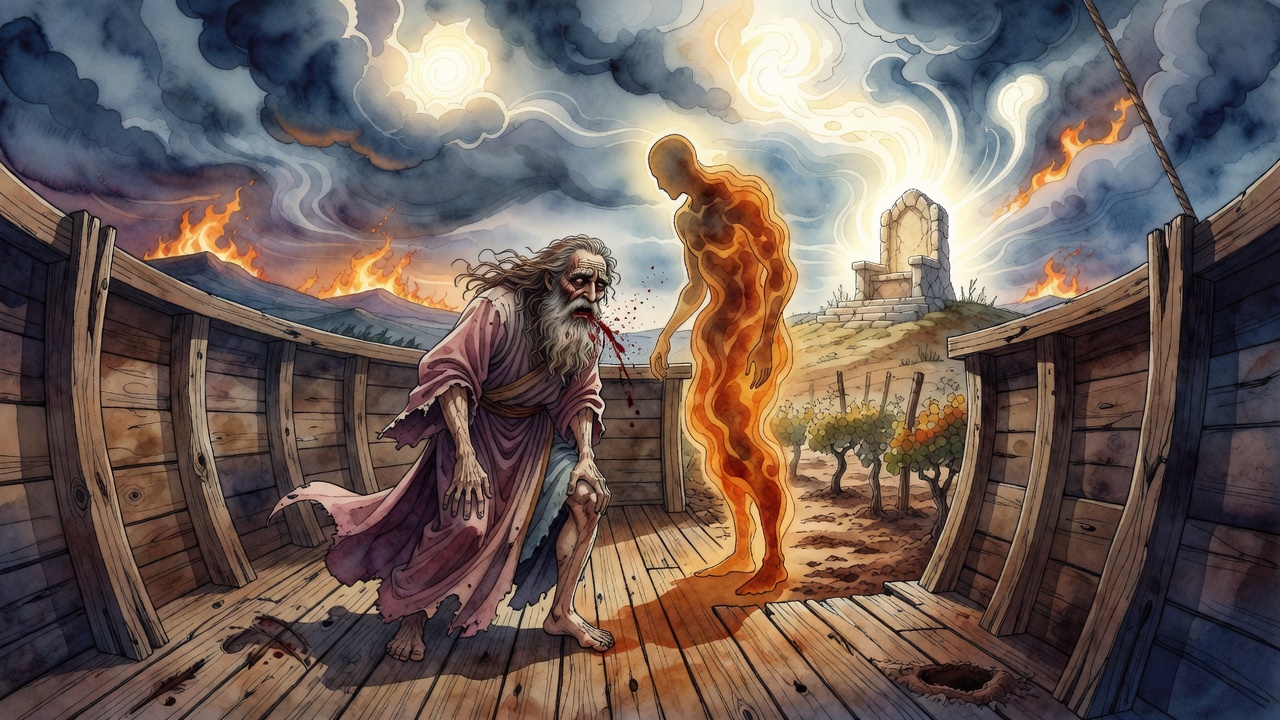
Then there was the cough. R. Huna said he came out of the wet timber with a cold in him and spat blood for it. The righteous shall be made whole in the earth, the proverb says, which is a promise about later and not about that morning.

Bring My Soul Out of Prison

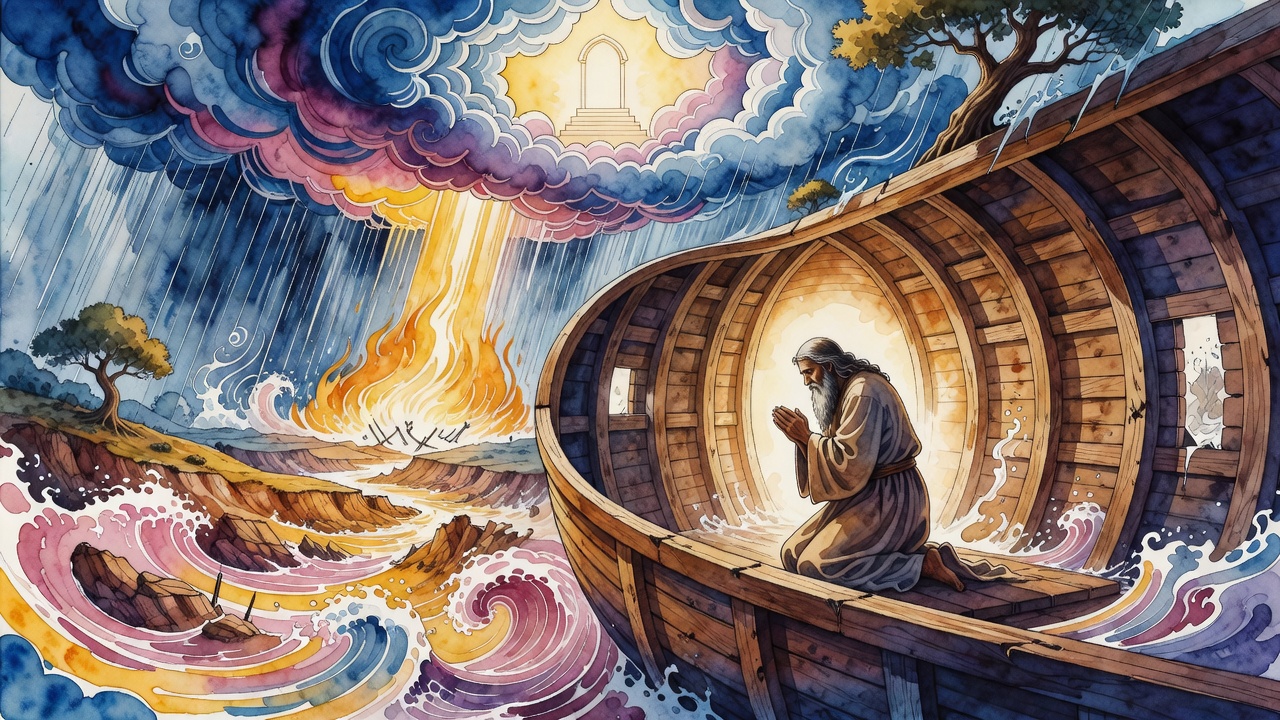
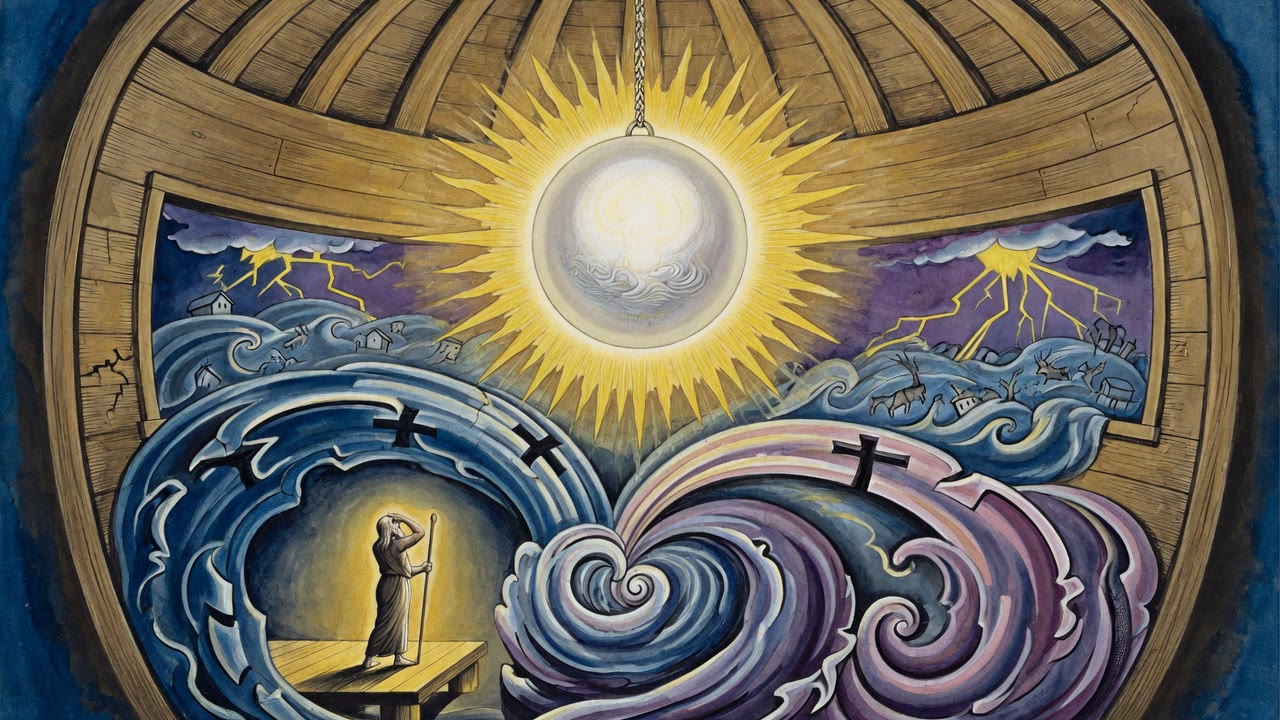
He prayed the same line the whole time he was in there. Bring my soul out of prison, that I may give thanks to Your name (Psalms 142:8). It is a prisoner's psalm and he used it as a prisoner, and the Holy One answered him with a date rather than a rescue: you are not to leave this ark until twelve months have gone by.

The lock had another turn in it besides the door. Nobody on that ark was permitted to increase and multiply, because while the Holy One is busy destroying the world men do not sit inside a box repopulating it. Joseph would work the same way later, fathering his two sons in the years before the famine and none during it. So the verse brings Noah and his sons in through the door in one group and their wives in another (Genesis 7:7), and it is only at the end, when the ground is dry, that the order comes as pairs: go forth, you and your wife and your sons and your sons' wives (Genesis 8:16).

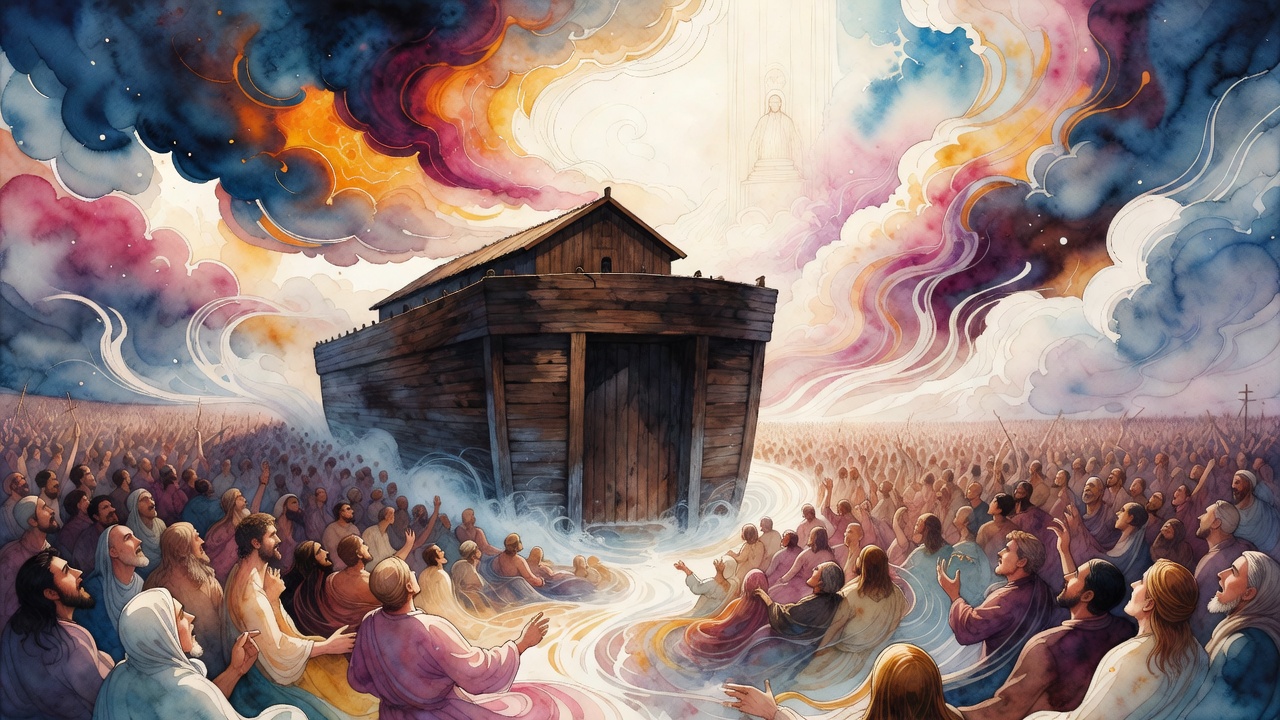
He stood at the open door with the whole earth in front of him, empty and rinsed and belonging to nobody, and the first thing he did was ask a question. "Master of the universe, are You going to turn around and bring another flood?" He was told no, and it was sworn to, and that oath has held.

The Stranger at the Field

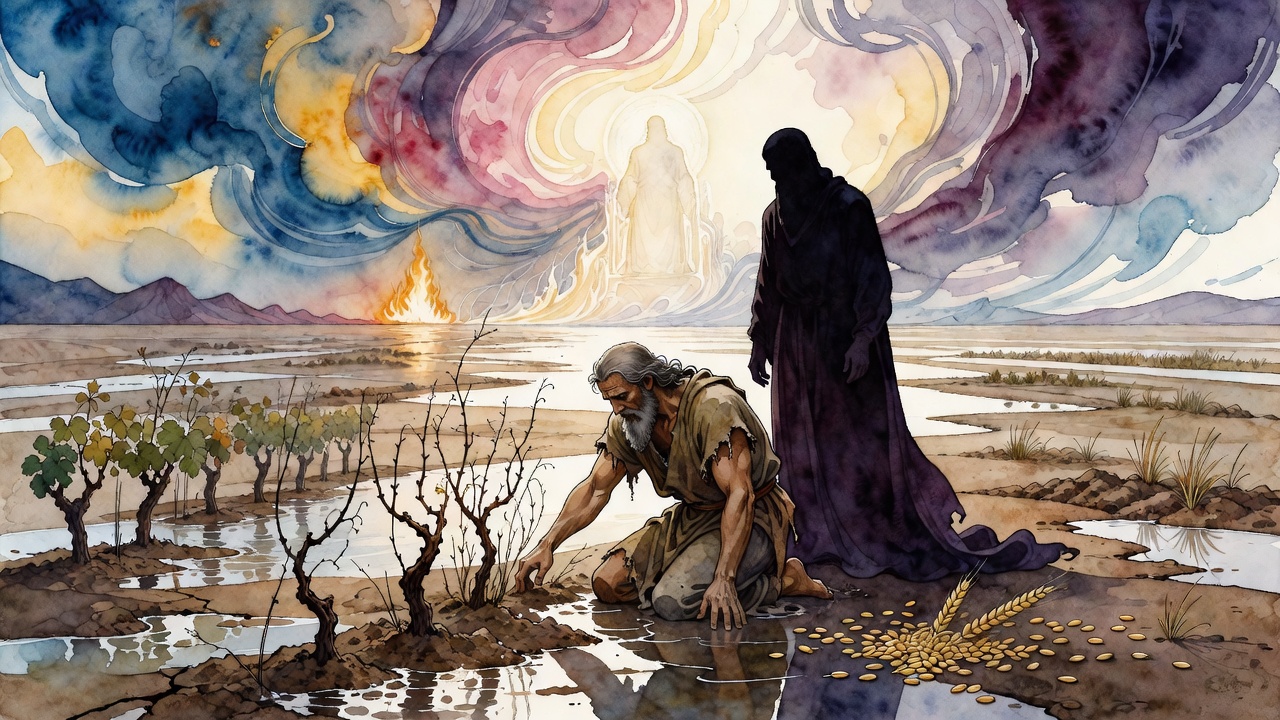
Then Noah began to till the ground, and the man who had been called righteous and perfect got a new description out of it. Man of the earth. He planted a vineyard, and while he was working somebody came up to the edge of the field and asked him what he was planting.

"A vineyard."

"What is it?"

"The fruit is sweet, wet or dried," Noah said, "and out of it comes wine that makes the heart of a man glad."

"Come, let us be partners in this vineyard," Satan said.

Noah had spent twelve months getting up at the second hour of the night for animals that would have eaten him, and one of them had. He had come out of that wooden box limping, coughing blood, watching his own son do his work at the altar. Here was somebody at the edge of a field offering to take half the labor off him, and he said, "Certainly."

Blood Under the Vines

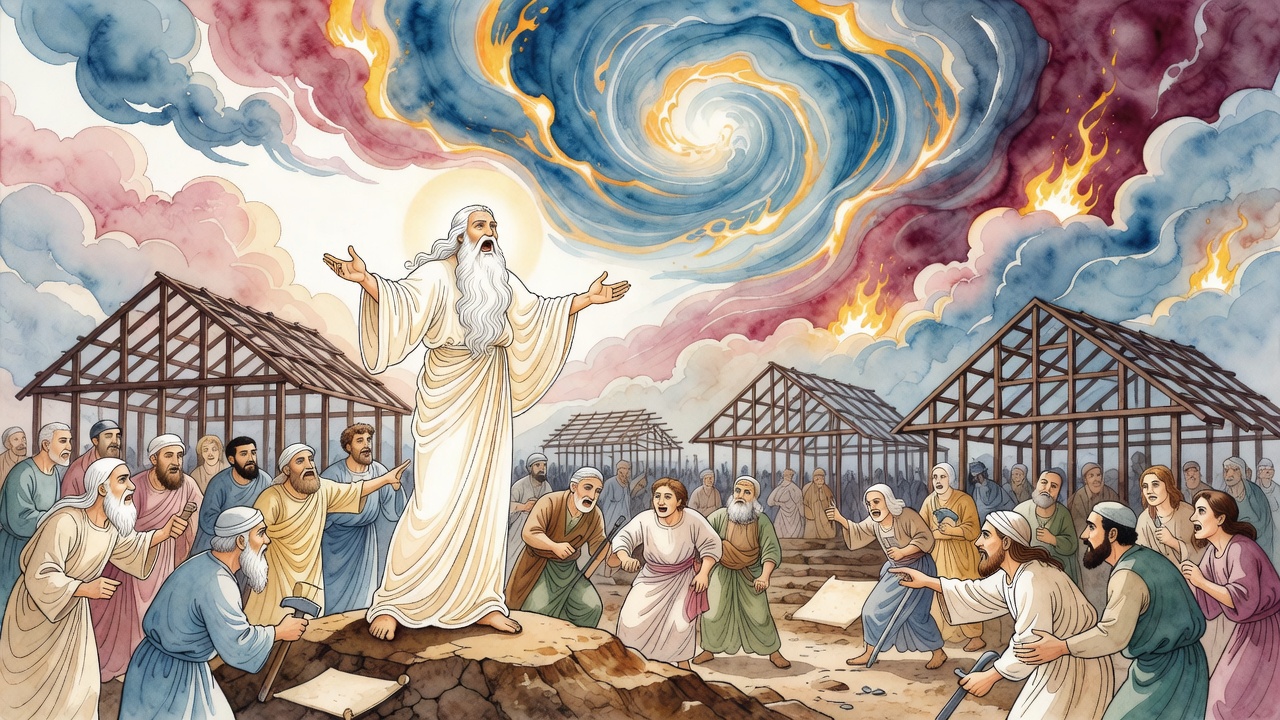
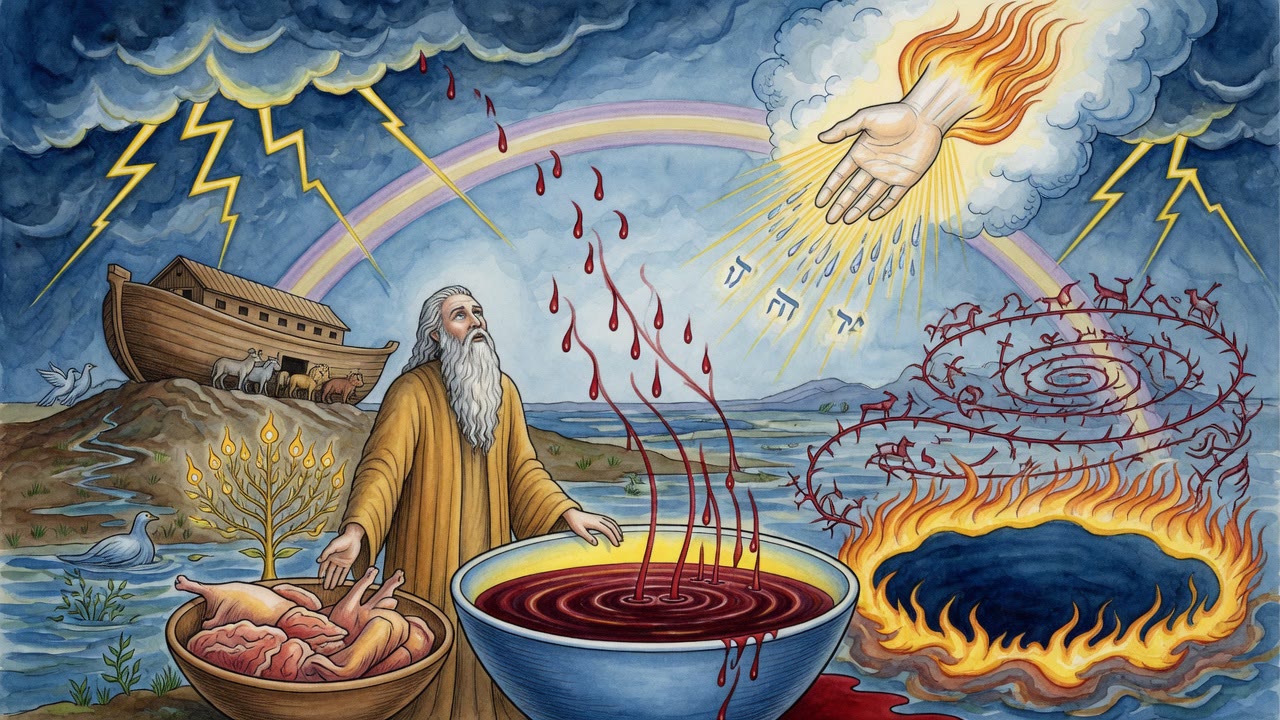
His partner went and got a lamb and slaughtered it under the vines. Then a lion, in the same place. Then a pig, then an ape, and the blood of all four soaked down into the dirt and watered the roots, which is one way of writing out a contract in advance. Before the wine a man is dumb as a sheep before its shearers. After a little he is a lion and tells the room there is nobody in the world to match him. After more he is a pig in the wet. At the end he is an ape, dancing and laughing and talking nonsense with no idea what he is doing.

The sages held that it all happened on the one day, because the vine went into the ground and bore that same afternoon. He harvested it and pressed it and drank it, and by evening he was uncovered inside his own tent.

Shem, who had been going up to the altar in his father's place ever since the lion, took a garment and walked into the tent backward.


← All myths
From the tradition

Sources

3 sources

The texts behind this telling. Some cards carry a translation of the source; others are our own retelling of it, and each card says which. Every card links out to the original.

Midrash Tanchuma, Noach 9Midrash Tanchuma

Retold in our words. Read the original at the link below.Townsend 1989 translation of Midrash Tanhuma, S. Buber Recension · CC-BY

Go forth from the ark (Gen. 8:16). Scripture says elsewhere in allusion to this verse: Bring my soul out of prison, that I may give thanks to Thy name; the righteous shall crown themselves because of me; for Thou wilt deal bountifully with me (Ps. 142:8). Bring my soul out of prison refers to Noah, who was imprisoned in the ark. R. Levi said: Neither Noah nor his sons were able to sleep during the entire twelve months (in the ark) because they were obliged to feed the animals, the beasts, and the birds. R. Akiba stated that they even brought into the ark tree branches for the elephants and glass beads for the ostriches. Some of the animals had to be fed at the second hour in the night and others at the third hour of the night.

Further proof that they did not sleep is presented to us by R. Yohanan. He tells us in the name of R. Eliezer the son of R. Yosé the Galilean that because Noah once delayed feeding a lion, the lion bit him so severely that he left the ark crippled, as it is said: And only Noah was left (Gen. 7:23). The word ah (“only,” also “to be afflicted”) indicates that his body was no longer whole. He became, thereby, unfit to bring sacrifices to the altar, and his son Shem had to do it in his stead. Concerning him it is said: Behold, the righteous shall be made whole in the earth (Prov. 11:31).

R. Huna said in the name of R. Yosé: He left the ark coughing and spitting blood because of a cold he had contracted, and it is for this reason that Scripture states: Bring out of prison my soul … the righteous shall crown themselves because of Me (Ps. 142:8), that is, through me the Holy One blessed be He took a crown. They shall reason: Though Noah was righteous, he was not wholly righteous. The Holy One, blessed be He, nevertheless performed miracles in his behalf, as it is said: He delivereth him that is innocent (Job 22:30). In this verse i-naki (“innocent”) should be interpreted as velo naki, that is, he was not wholly righteous. How many more miracles would He have performed in his behalf if he had been wholly righteous!

Full source
Midrash Tanchuma, Noach 11Midrash Tanchuma

Retold in our words. Read the original at the link below.Townsend 1989 translation of Midrash Tanhuma, S. Buber Recension · CC-BY

Another explanation of go forth from the ark. David said: Bring my soul out of prison (Ps. 142:8). Noah, while in the ark, prayed continually: Bring my soul out of prison, and it is said elsewhere: For this let everyone that is godly pray unto Thee in a time when Thou mayest be found; surely, when the great waters overflow, they will not reach unto him (ibid. 32:6).

The Holy One, blessed be He, said to him: Noah, I have decreed that you are not to depart from this ark until twelve months have elapsed. And thus Isaiah declared: Thus said the Lord: In an acceptable time have I answered thee; and in a day of salvation have I helped thee … saying to the prisoners: “Go forth”; to them that are in darkness, “Show yourselves” (Isa. 49:8–9).

To say to the prisoners go forth implies that they were enjoined from sexual intercourse. Why was that? When the world is overwhelmed by suffering and destruction, men are forbidden to (fulfill the command to) increase and multiply (Gen. 6:28) Surely, while the Holy One, blessed be He, is engaged in destroying the world, men should not strive to populate it. Joseph behaved accordingly. He indulged in intercourse with his wife only prior to the years of hardship, as it is said: And unto Joseph were born two sons (Gen. 41:50). When were they born? In the years preceding the famine.

That is why Job declared: They are lonely in want and famine (Job 30:3). That is, when want and famine come into the world, be lonely; abstain from sexual intercourse. Noah acted accordingly. When he entered the ark, it is said: And Noah and his sons came, and after that is written: His wife and his sons’ wives (Gen. 7:7). However, when he was about to depart from the ark, the Holy One, blessed be he, told him: Go forth from the ark, you and your wife and your sons and your sons’ wives (Gen. 8:16). Thus we learn that Noah and his sons were forbidden to indulge in sexual intercourse while in the ark.

Scripture states in reference to Noah, that thou mayest say to the prisoners “Go forth,” and to them that are in darkness, “Show yourselves” (Isa. 49:9). Say to the prisoners; that is, say to those who are forbidden to have sexual intercourse, Go forth from the ark. To them that are in darkness, show yourselves. Show yourselves refers to the beasts, the animals, and the birds. Thereupon, He told them: And you, be ye fruitful and multiply; swarm in the earth, and multiply therein (Gen. 9:7).

Forthwith, Noah said: Master of the universe, will you retract the promise you made, and bring another flood? He replied: I promise that I shall not bring another flood. As it is said: And the Lord smelled the sweet savor, and the Lord said in his heart: “I will not again curse the ground,” etc. (Gen. 8:21); and it says elsewhere: For this is as the waters of Noah unto me; for as I have sworn that the waters of Noah shall no more go forth over the earth, so have I sworn that I would not be wroth with thee (Isa. 54:9).

You find that from that time until Solomon erected the Temple, it rained continuously for forty days each year as a reminder of the waters of the flood that lasted forty days. After Solomon completed the Temple, he pleaded for mercy in behalf of them (Israel), and the continuous rains ceased, as it says: And in the eleventh year, in the month of Bul (I (Kings 6:3)8). What is the meaning of the words In the month of Bul? It refers to the month when the cattle are given mixed fodder which was stored inside the house (because of the rains).

Another comment upon In the month of Bul. It was named Bul because He selected it as the month for the forty days of the flood (mabul).

We find that the Holy One, blessed be He, said to Noah: Neither shall there anymore be a flood (Gen. 8:11). Isaiah later explained that this was an oath, as it is said: For as I have sworn that the waters of Noah shall no more go over the earth (Isa. 54:9), and that this promise will be fulfilled everlastingly. How much more so, then, will He keep the three oaths that He explicitly swore to Israel. The first oath was: So have I sworn that I would not be wroth with thee nor rebuke thee (ibid.); the second was: The Lord God has sworn by His holiness (Amos 4:2); and the third was: The Lord God has sworn by His right hand, and by the arm of His strength: Surely I will no more give thy corn to be food for thine enemies (Isa. 62:8).

The Lord has sworn by His right hand and by the arm of His strength (Isa. 62:8). By his right hand refers to the Torah, as it is said: His right hand was a fiery law unto them (Deut. 33:2). And by the strength of His arms alludes to the tefillin (phylacteries), as it is said: The Lord will give strength unto His people (Ps. 29:11). Surely I will no more give thy corn to be food for thine enemies … in the courts of My sanctuary (Isa. 68:8–9) refers to Jerusalem. What oath did He proclaim in reference to Jerusalem? He vowed that He Himself would build it, as it is said: The Lord doth build up Jerusalem; He gathered together the dispersed of Israel (Ps. 147:2).

R. Samuel the son of Nahmani stated: There is an aggadic tradition which states that Jerusalem will not be rebuilt until the dispersed of Israel are gathered together. However, if one should tell you: The exiles are already gathered together and Jerusalem still hath not been rebuilt, believe him not, for it is written: The Lord doth build up Jerusalem, and after that Scripture says: He gathered together the dispersed of Israel (ibid. 147:2).

Israel said to the Holy One, blessed be He: Master of the universe, has not Jerusalem already been rebuilt and destroyed? And He replied: It was destroyed and you were exiled from it, because of your sins, but in the future I will rebuild it and it will never be destroyed again, as it is said: When the Lord hath built up Zion … He hath appeared in His glory (Ps. 102:17).

Full source
Midrash Tanchuma, Noach 13Midrash Tanchuma

Retold in our words. Read the original at the link below.Townsend 1989 translation of Midrash Tanhuma, S. Buber Recension · CC-BY

And Noah, the husbandman, began and planted a vineyard (Gen. 9:20). Noah degraded himself when he began to till the soil. R. Judah the son of R. Shalum said: At first Noah was called a righteous and perfect man, but now he is described as a man of the earth. And he planted a vineyard; that is, after he planted the vineyard he was called a husbandman.

Three men toiled upon the earth and degraded themselves thereby. They were: Cain, Noah, and Uzziah. It is written of Cain: He was a tiller of the ground (ibid. 4:2), and that is followed by the verse: You shall be a fugitive and a wanderer in the earth (ibid., v. 12). Noah, as it is written: And Noah, the husbandman, began, and planted a vineyard (Gen. 9:20). And soon thereafter he disgraced himself: He drank of the wine (ibid., v. 21). Our sages held that on the very day he planted the vineyard, it bore its fruit, he harvested it, pressed it, drank the wine, became intoxicated, and exposed his private parts.

Our teachers of blessed memory stated: While Noah was planting the vineyard, Satan appeared before him and asked: “What are you planting?” He answered: “A vineyard.” “What is it?” inquired Satan. “Its fruits are sweet, whether moist or dry,” he answered, “and from them one produces a wine that causes the heart of man to rejoice, as it is written: And wine doth make glad the heart of man (Ps. 104:15).” Satan suggested: “Come, let us be partners in this vineyard.” And Noah replied: “Certainly.”

What did Satan do? First, he obtained a lamb and slaughtered it beneath the vineyard. Then, he took a lion and slaughtered it there, and after that he obtained a pig and an ape and slaughtered them in the same place. Their blood seeped into the earth, watering the vineyard. He did this to demonstrate to Noah that before drinking wine man is as innocent as a sheep: Like a sheep that before her shearers is dumb (Isa. 53:7). But after he drinks a moderate amount of wine he believes himself to be as strong as a lion, boasting that no one in all the world is his equal. When he drinks more than he should, he behaves like a pig, wallowing about in urine and performing other base acts. After he becomes completely intoxicated, he behaves like an ape, dancing about, laughing hysterically, prattling foolishly, and is completely unaware of what he is doing. All this happened to the righteous Noah. If the righteous Noah, whom the Holy One, blessed be He, praised, could behave in such a fashion, how much more so could any other man!

Thereupon Noah cursed his seed, saying: Cursed be Canaan (Gen. 9:25). Because Ham had glanced at his naked father, his eyes became red. Because he related (what he had seen) to others with his mouth, his lips became twisted. Because he turned his face away (ignored his father’s condition), the hair of his head and beard was singed. And because he neglected to cover his naked father, he went about naked, with his prepuce extended. This happened to him because the Holy One, blessed be He, exacts retribution measure for measure. Nevertheless, the Holy One, blessed be He, relented and had mercy upon him, for His tender mercies are over all His works (Ps. 145:9). The Holy One, blessed be He, said: Inasmuch as he caused himself to be sold into slavery, let him go free because of the eye that sees and the mouth that speaks. Hence, the law states: A slave must be freed because of the loss of a tooth or an eye, as it is written: And if a man smite the eye of his bondman, or the eye of his bondwoman, and destroy it, he shall let him go free for his eye’s sake. And if he smite out his bondman’s tooth, or his bondwoman’s tooth, he shall let him go free for his tooth’s sake (Exod. 21:26–27). May we not logically conclude a fortiori: If a servant, purchased with money, must be released from bondage if his master blinds him or knocks out his tooth, should not the seed blessed of the Lord (Isa. 65:23), the planting of the Lord that He might be glorified (Ps. 61:3), be freed after their deaths from their sins? Hence, free among the dead (Ps. 88:6), indicating that they should go free (from sin) with all their two hundred and forty-eight limbs.

The Holy One, blessed be He, said: In this world sin increases because of the evil inclination, but in the hereafter I will take away the stony heart out of your flesh (Ezek. 36:26). Hence, it is written: It shall be no more the confidence of the House of Israel, bringing iniquity to remembrance, when they turn after them (ibid. 29:16), and it is written elsewhere: In those days, and in that time, saith the Lord, the iniquity of Israel shall be sought for, and there shall be none, and the sins of Judah, and they shall not be found (Jer. 50:20).

Scripture states in reference to Uzziah: He loved husbandry (II Chron. 26:10). He was a king who devoted himself to husbandry while ignoring the Torah. One day he visited the House of Study and inquired of those present: “What are you engaged in doing?” They responded with the verse: The common man that draweth nigh shall be put to death (Num. 1:51). Thereupon, he replied: “The Holy One, blessed be He, is King, and I am king, and it is fitting indeed for a terrestrial king to serve a Celestial King by burning incense before Him.” He went into the Temple of the Lord to burn incense upon the altar of incense. And Azariah the priest went in after him, and with him fourscore priests of the Lord (II Chron. 26:16–17). The young priests who entered with him said to him: It pertaineth not unto thee, Uzziah, to burn incense unto the Lord, but to the priests, the sons of Aaron, that are consecrated it pertaineth to burn incense; go out of the sanctuary, for thou has trespassed (ibid., v. 18). Therefore God was angry with him. Immediately, Uzziah was wroth; and he had a censer in his hand to burn incense; and while he was wroth with the priests, the leprosy broke out in his forehead (ibid., v. 19). At that moment the Temple was rent asunder, and its pieces were hurled a distance of twelve by twelve miles. And they thrust him out quickly from thence; yea, himself made haste also to go out, because the Lord had smitten him (ibid., v. 20). Why did this all happen to him? Because he neglected the Torah and devoted himself to husbandry.

Full source