Three Men Walked Into Nebuchadnezzar's Furnace Expecting to Die
A congregation told God there was nobody righteous left alive to lean on. God answered by naming three men who went into a fire in Babylon.
Table of Contents
 Click for full size
The Congregation Said There Was Nobody Left
They came into the synagogue after everything was over and said it plainly. "Redeem us."
"There are righteous men among you," God said. "There are men in this room who fear me."
"There were," they said. "In the days of Moses there were. In the days of Aaron and Saul and David and Solomon there were. They have been taken from us, and they were taken because of what we did. The righteous die and nobody lays it to heart. Every man lies to his neighbor now and flatters him with his mouth. We have no one left to lean on. We walk in the dark and we do not know where we are going."
They knew what had been in the room before. Moses came down off the mountain carrying the light he had been standing in, and the people were afraid to come near his face. Joshua was given a share of that same splendor at the Jordan, and the nation feared him the way it had feared Moses. A share of it. Not all of it. Even at the best of times what they held was a portion.
"Trust the name," God said. "I am the one holding you up."
They wanted an example. He gave them three.
A King Asked Which God Could Take Them Out of His Hand
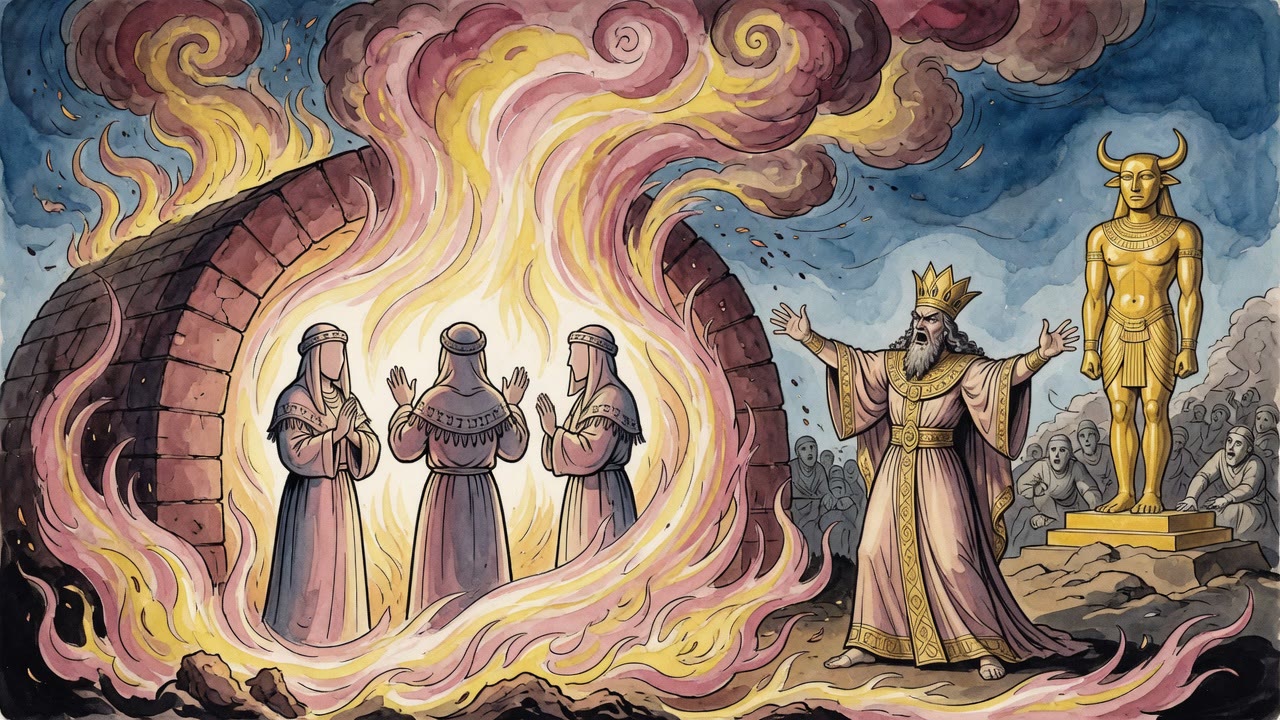
The image on the plain of Dura was gold from its feet to its head, and the rule was simple. When the horn sounded, everyone in the empire went down on his face. Officials, governors, treasurers, judges, all of them flat in the dust together.
Certain Chaldeans brought Nebuchadnezzar a report. Three Judeans were standing upright in a field of bowed backs.
He had them brought in, and he was generous about it. He would have the horn and the pipe and the harp play once more, and they could go down with everyone else, and the matter would end there. If they stayed on their feet, the furnace was already stoked, heated seven times past its working heat.
Then he asked the question. "And who is the god that will deliver you out of my hands?"
He was not sneering. He had taken cities and carried their gods out of their own temples on carts, and none of those gods had put a hand out to stop him. He had checked. He was asking from evidence.
They Answered Without Asking for a Guarantee
Hananiah, Mishael and Azariah answered him in one voice, and the first half of the answer was what anyone would expect. Their God was able to deliver them out of the furnace and out of the king's hand.
Then came the rest of it. "And if not, let it be known to you, king, that we will not serve your gods, and we will not worship the golden image you have set up."
They were not walking into the fire in order to come out of it. They were walking into the fire in order to burn.
Love is as strong as death, Solomon wrote, and the sentence is not flattery. Death does not haggle. Death does not accept a payment and go away. Love holds on with exactly that grip, and three men in Babylon had just told a king that they had already conceded the worst thing he could do to them.
He had nothing left to threaten them with. He had the furnace, and they had already agreed to it.
The King Blessed the God He Had Challenged
He had the fire built up hotter, which cost him. The flame came out of the mouth of the furnace and killed the men who carried the three to the edge. Then the three went in bound, in their coats and their hats and their trousers, and did not come apart.
An angel came into the fire with them.
Nebuchadnezzar got up off his throne. The man who had asked which god could take them out of his hand stood in front of his own court and blessed the God of Shadrach, Meshach and Abednego, who had sent his angel and delivered his servants because they trusted him, and who had set aside a king's command, and who had taken three bodies handed over to be burned rather than bowed.
The Dark Is Not the Same as an Empty Room
There was another one after them. Daniel went down into a pit of lions on a similar charge, and the king who signed the order could not sleep and came at first light and shouted down into the hole, asking whether the God he served continually had been enough to save him. The stone came off. Daniel came up.
David heard the whole account and drew the only conclusion available to him. If everyone who trusts is brought out, then he would trust too, and let the outcome be what it would be.
The congregation had come in asking for a righteous man to lean on, and no righteous man was produced. They were handed four names instead, and every one of them belonged to somebody who had walked toward the fire or the pit with nothing in his hands.
← All myths