5 min read

Yosef Bought the Fish That Hid a Sabbath Pearl

A neighbor sold everything and hid a pearl in his hat. The wind took it to the sea. Yosef bought one fish for Shabbat and opened a fortune in its belly.

Curated by Arthur · Told by Maggid ·
Table of Contents
  1. The Fish on Erev Shabbat
  2. See That I Have Given You the Day
  3. Why Fire Is Named Alone
  4. Wealth That Crossed the Water

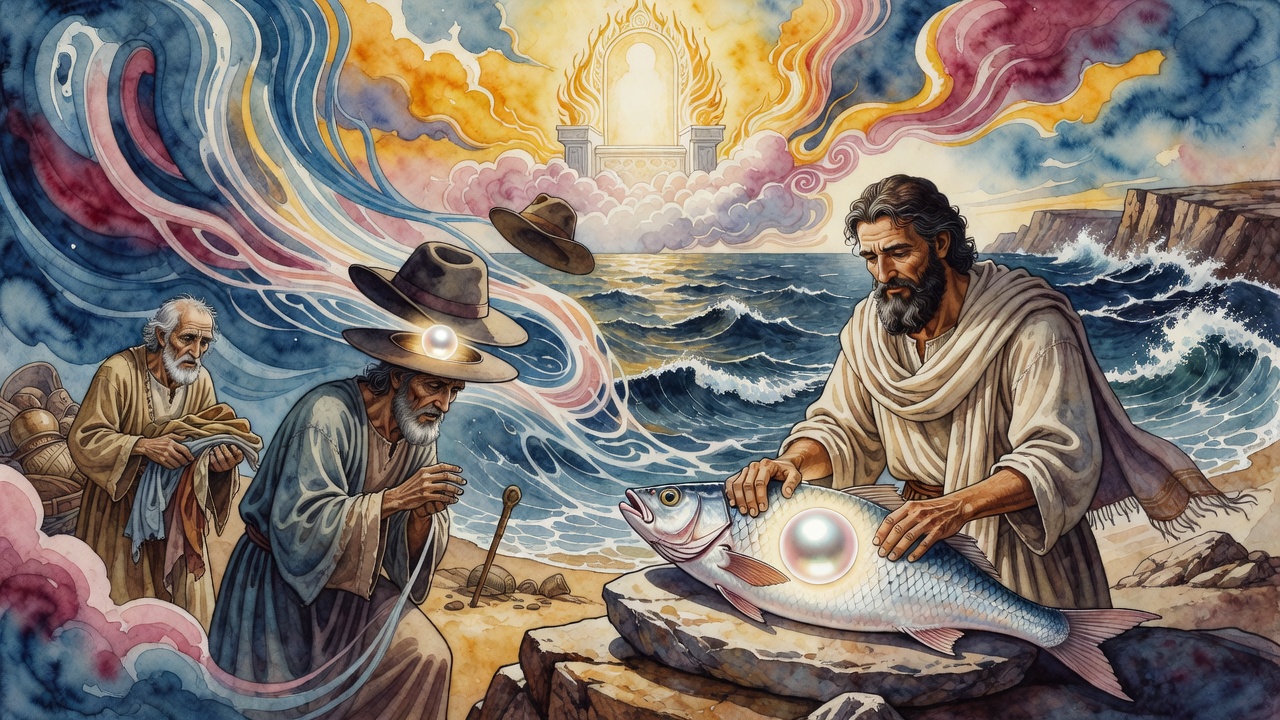
The astrologers told a wealthy gentile that all his fortune would one day sit with his Jewish neighbor. He did not wait for fate like a patient man. He sold fields and houses, bought a pearl worth a province, and sewed it into his hat where no thief would think to look. Then the wind took the hat to the sea while he shouted at the sky.
Yosef Bought the Fish That Hid a Sabbath Pearl Click for full size

The pearl went under. The man cursed the stars that had warned him and the water that had obeyed them.

The Fish on Erev Shabbat

Yosef, who honored the Sabbath, walked the market as the day bent toward rest. Shadows lengthened across the stalls. Fishmongers held up a large fish no one else would buy, its eye already dull, its price still high. Yosef paid what they asked without haggling the day into violation. He always spent freely for the seventh day, as if the table were a small altar that refused empty hands.

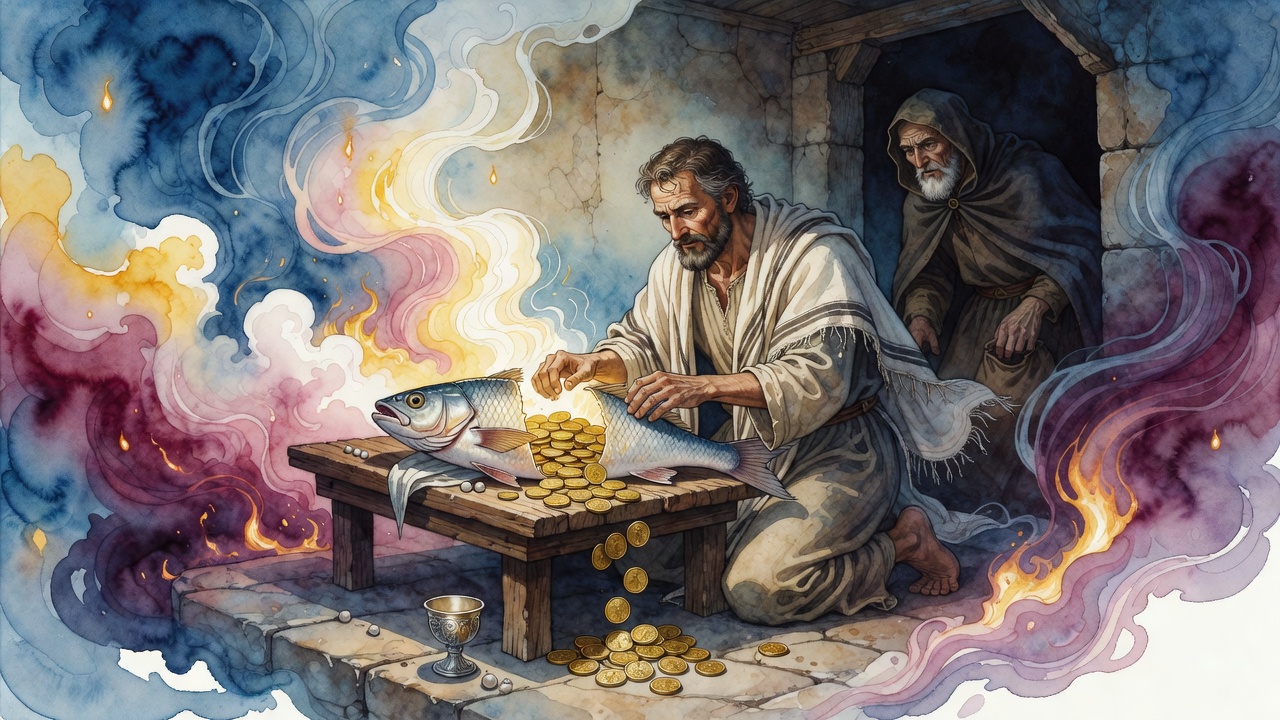
At home the knife opened the belly. Light answered from inside, a hard cool gleam against the dark of the cavity. The pearl the sea had swallowed now lay in a Jew's hand because he would not come empty to Shabbat. His wife covered her mouth. The children leaned in. The house that had prepared for rest suddenly held a future of quiet Fridays paid in advance.

The gentile's wealth had taken the long road through wind and water and a fish's gut and ended on a table set with oil and bread and the smell of cooking done in time.

See That I Have Given You the Day

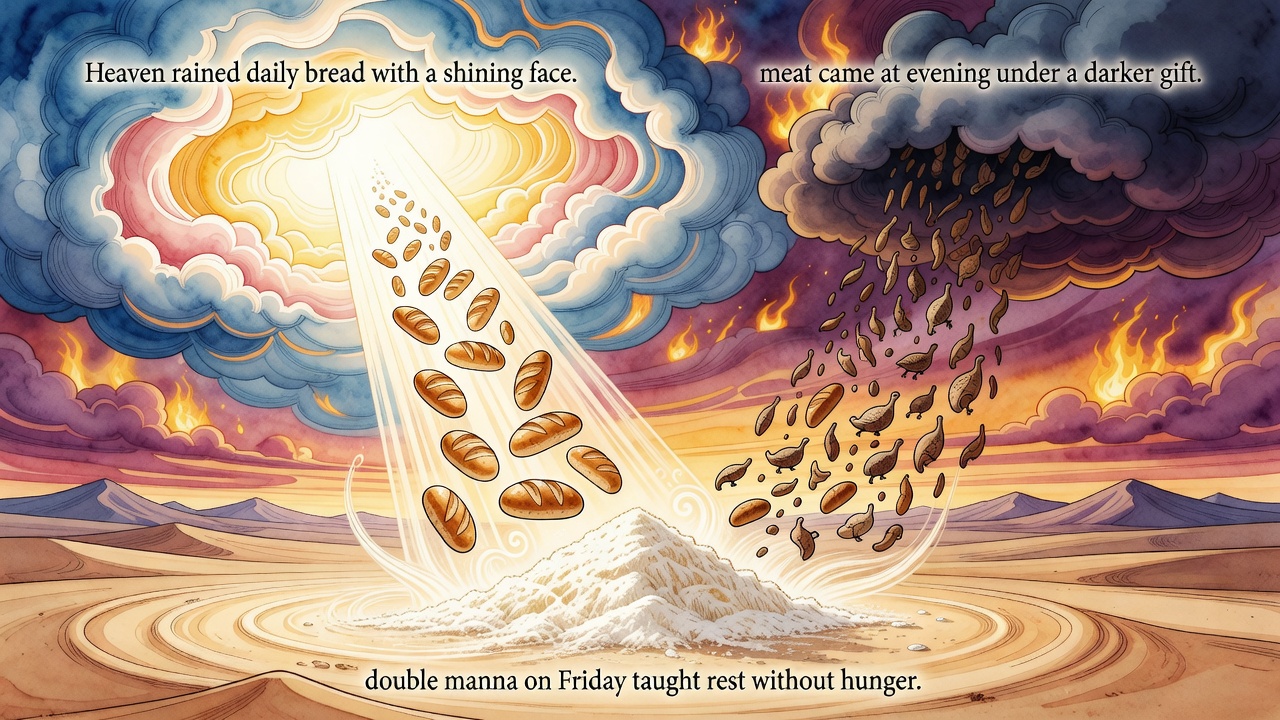
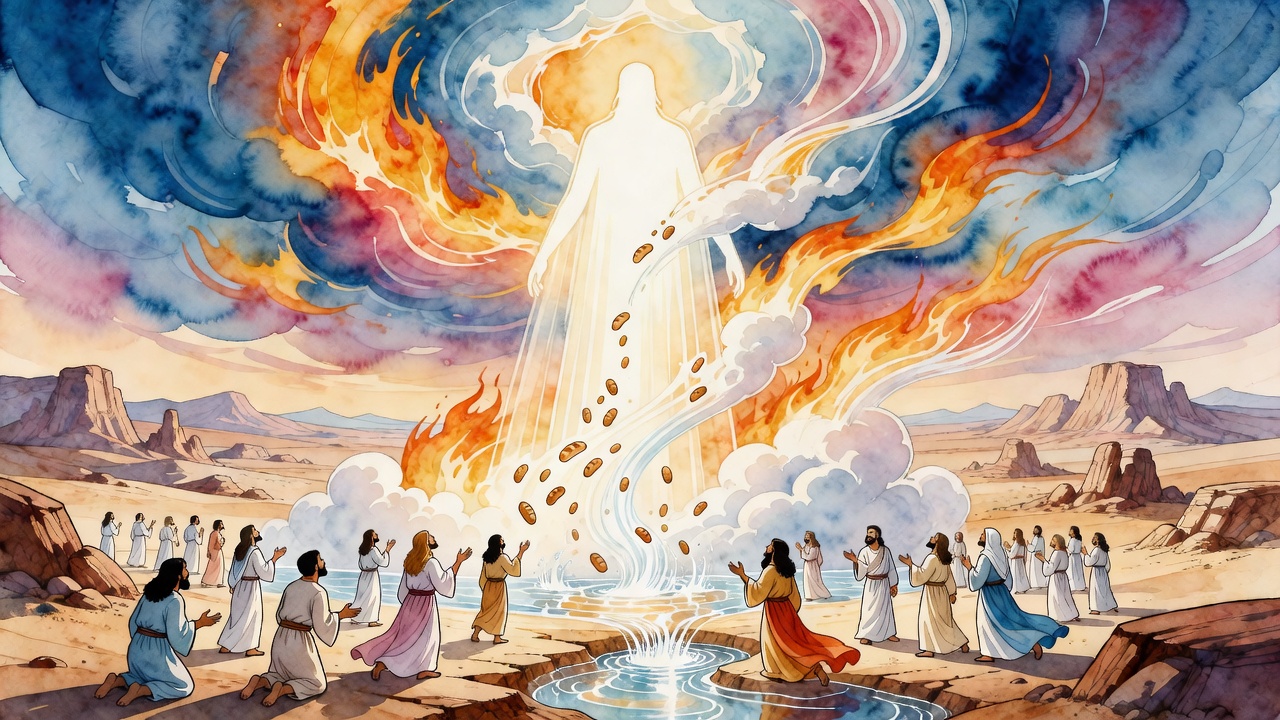
Long before Yosef's fish, manna taught the same stubborn calendar in the wilderness. For six days bread fell on the ground like frost. On the sixth day, a double portion. On the seventh, the ground stayed bare and the people learned that gathering would not save them if they refused the gift of stop. "See that the Lord has given you the Shabbat" (Exodus 16:29). Heaven did not only command rest. It fed rest in advance so no one could claim hunger forced them to break it.

Yosef lived as if that double portion still fell somewhere above the market roofs. He spent for the day before the day arrived. The pearl was only the loudest receipt heaven ever tucked into a purchase. Smaller receipts had been his all along: the early shopping, the lamps ready, the work laid down while light still remained.

A people that once learned rest from sky-bread now learned it again from a fish that refused to stay ordinary.

Why Fire Is Named Alone

Rabbi Yonathan asked why the Torah singles out, "You shall not light a fire" on the Sabbath, when all labor is already forbidden under the general ban. If the thirty-nine categories already close the week, why name the flame? The chain of reasoning runs through the assembly of Israel for the Tabernacle work, through "And Moses assembled" (Exodus 35:1), and through the labors that build and the labors that destroy. Fire is named so no one treats kindling as a soft exception, a private glow in a cold room that does not count because it feels small.

Shabbat is not a mood. It is a fence with a gate that closes on flame as surely as on plow and hammer and the merchant's scale. Yosef's honor was not sentiment poured over wine. It was refusal to treat the day as flexible when money or fear or a late errand pressed against the edge of sunset.

A man who will not light a forbidden fire is ready to buy a fish while there is still time, even when the price stings.

Wealth That Crossed the Water

The neighbor who had trusted stars more than mercy watched a poorer man's table gleam week after week. The pearl paid debts and bought years of quiet Fridays. Yosef did not gloat in the market or hold the gem up to the sun for an audience. He lit the lamps before sunset and let the house fill with the smell of fish cooked in time, the way the desert once filled with the smell of manna cakes.

Providence, in this telling, has a sense of humor sharp enough to use a hat, a wind, and a belly of a fish. It also has a rule older than any astrologer. The day God gave must be met with open hands, not with last-minute bargains against the clock or clever schemes to outrun a warning written in the sky.

When the stars promised transfer of wealth, they forgot to say it would arrive as Sabbath honor, not as theft, and that the sea would be the messenger while a man simply prepared for rest.


← All myths
From the tradition

Sources

3 sources

The texts behind this telling. Some cards carry a translation of the source; others are our own retelling of it, and each card says which. Every card links out to the original.

Yalkut Shimoni on Torah 16:23Yalkut Shimoni on Torah

Translation of the source text.Torat Emet (Yalkut Shimoni) · CC-BY-NC

There was a man called Yosef-who-honors-the-Sabbath. A certain gentile in his neighborhood had very abundant property. The astrologers told him, "All your property Yosef-who-honors-the-Sabbath will consume." He went and sold all his property and bought a pearl with the proceeds and set it in his turban. As he was crossing on a ferry, the wind blew off his turban and cast it into the sea, and a fish swallowed it. The fish was caught and brought up toward evening on the eve of the Sabbath. They said, "Who will buy it now?" They were told, "Go take it to Yosef-who-honors-the-Sabbath, who is accustomed to buy." They brought it to him; he bought it, cut it open, and found the pearl inside, which he sold for thirteen vessels of golden dinars. A certain elder met him and said, "Whoever lends to the Sabbath, the Sabbath repays him."

Rabbi Yishmael son of Rabbi Yosi asked Rabbi: "The people of Babylonia, by what merit do they grow rich?" He said to him, "By the merit of Torah." "And the people of the Land of Israel?" "By the merit of tithes." "And those outside the Land?" "By the merit of Sabbaths and festivals."

Rabbi Chiya bar Abba said: One time a man invited me in Laodicea and brought before us a table borne on sixteen poles, and on it was all that was created in the six days of creation, and a child sat in its midst and proclaimed, "The earth is the LORD's and the fullness thereof" (Psalms 24:1). And why all this? So that the householder's mind should not grow haughty over it. I said to him, "My son, how did you merit all this honor?" He said to me, "I was a butcher, and every fine animal I saw during the week I set aside for the Sabbath." And I said to him, "Blessed is the Omnipresent who granted you this."

Rabbi Tanchuma said: It happened in Rome on the eve of the great fast that there was a certain tailor who went to buy himself a fish, and he and the governor's servant were left bidding over it. This one raised the price and that one raised the price until it reached twelve dinars. The tailor took it. At the governor's table they said, "What is this, that no fish came to your table?" He said, "My lord, what should I conceal from you? There is a certain Jewish tailor who took it for twelve dinars." He sent for him, and he came before him, and he said, "How could you, a Jewish tailor, eat a fish for twelve dinars?" He said to him, "My lord, we have one day on which all the sins we commit the whole year are atoned for us, and when it comes, should we not honor it?" He said, "Since you have brought proof for your words, let him go."

Full source
Shemot Rabbah 25:11Shemot Rabbah

Retold in our words. Read the original at the link below.The Sefaria Midrash Rabbah, 2022 · CC-BY

The Torah tells us in Exodus (16:29), "See that the Lord has given you the Shabbat (the Sabbath); therefore, He gives you on the sixth day bread for two days. Remain each man where he is; no man shall leave his place on the seventh day." But the Midrash (rabbinic interpretive commentary), specifically Shemot Rabbah, digs a little deeper into that verse. It asks a fascinating question: why does it say "see that the Lord has given you the Shabbat," instead of "know"?

It's a good question. "Know" seems more logical. But the Sages suggest that God is telling us something profound.

Imagine, says the Midrash, that idolaters – people who worship other gods – come to the Israelites and ask, "Why do you observe the Shabbat on this particular day?" The answer isn't just something you know intellectually. It's something you can see! "See," God says, "that the manna – the miraculous bread from heaven – does not fall on Shabbat."

In other words, the very absence of the manna on Shabbat is a visible, tangible sign of God's gift to the Jewish people. The manna, which sustained them in the desert, was suspended on the day of rest. It was a weekly reminder of God's providence and a call to cease from labor and find spiritual nourishment.

And then the Midrash takes a sharp, and frankly, uncomfortable turn. It focuses on the phrase "has given you." "To you it is given, and not to idolaters." From this, the Sages derive a rather harsh ruling: If non-Jews observe Shabbat, not only do they not receive a reward, but they are actually liable to be put to death!

Woah.

That’s… intense. The text backs this up by interpreting (Genesis 8:22), "And day and night will not cease [yishbotu]," to mean "They shall not observe a day and night of Shabbat." Likewise, (Exodus 31:17) states, "Between Me and the children of Israel [it is a sign forever]."

The Midrash uses a striking analogy to explain this exclusivity. Anyone who dares to pass between them is committing a grave offense. Shabbat, in this view, is a sacred covenant, a unique and intimate relationship between God and the Jewish people. For an outsider to intrude upon that relationship is… well, let's just say, it's not good.

Now, it's important to understand that these kinds of passages require careful interpretation. We can't just take them at face value. Some scholars suggest this teaching is rooted in a concern about maintaining Jewish identity and preventing assimilation in a world where other cultures might try to adopt Jewish practices without fully understanding their meaning and context. The fear was that a superficial observance of Shabbat could dilute its significance and ultimately undermine the covenant between God and Israel.

The message of Shemot Rabbah here isn't necessarily about condemning non-Jews. It's about emphasizing the unique and profound relationship between God and the Jewish people, a relationship that is visibly manifested in the weekly observance of Shabbat.

So, the next time you light the Shabbat candles, remember that the absence of the manna, the very act of resting, is a powerful reminder of that ancient covenant. And maybe, just maybe, it's a reminder that some things are sacred because they are uniquely ours, a gift given specifically to us, to cherish and to keep holy.

Full source
Mekhilta Tractate Shabbata 2:13Mekhilta DeRabbi Yishmael

Retold in our words. Read the original at the link below.Mechilta, translated by Rabbi Shraga Silverstein · CC-BY

Rabbi Yonathan asked: what is the purpose of specifying "You shall not light a fire" when the Torah already prohibits all labor on the Sabbath? If all thirty-nine categories of labor are forbidden, why single out fire?

Rabbi Yonathan traced a chain of reasoning. From "And Moses assembled" (Exodus 35:1), which introduces the Sabbath laws, one might think a person is liable only if he violates all thirty-nine categories of labor simultaneously. Perhaps transgressing just one or two would not trigger the death penalty.

(Exodus 34:21) narrows this: "From plowing and from harvesting shall you rest." This verse mentions only two labors, which might suggest you are not liable until you transgress at least two categories.

Then comes "You shall not light a fire", a single labor, standing alone. This verse establishes that a person is liable for violating even one category of forbidden labor. Fire is just one of the thirty-nine, and the Torah singles it out to make the point: each labor is independently prohibited. Transgress one, and you are liable.

Rabbi Yonathan's analysis moves from thirty-nine to two to one, progressively narrowing the threshold for liability. The specific mention of fire was the final, decisive step, proving that every individual labor is a separate violation in its own right. You do not need to desecrate the Sabbath comprehensively to be guilty. A single forbidden act is enough.

Full source