Parshat Noach7 min read

The Roped Beast, the Fire-Lizard, and the Bird That Refused

A re'em too vast for the ark, a salamander born of seven years of myrtle fire, and the milcham bird that turned from Eden's fruit and never died.

Curated by Arthur · Told by Maggid ·
Table of Contents
  1. Noah Ties the Mountain to the Hull
  2. Why the Great Beast Lives Apart
  3. The Lizard Born of Seven Years of Fire
  4. The One Bird That Said No
  5. The Guardian at the Edge of the Day

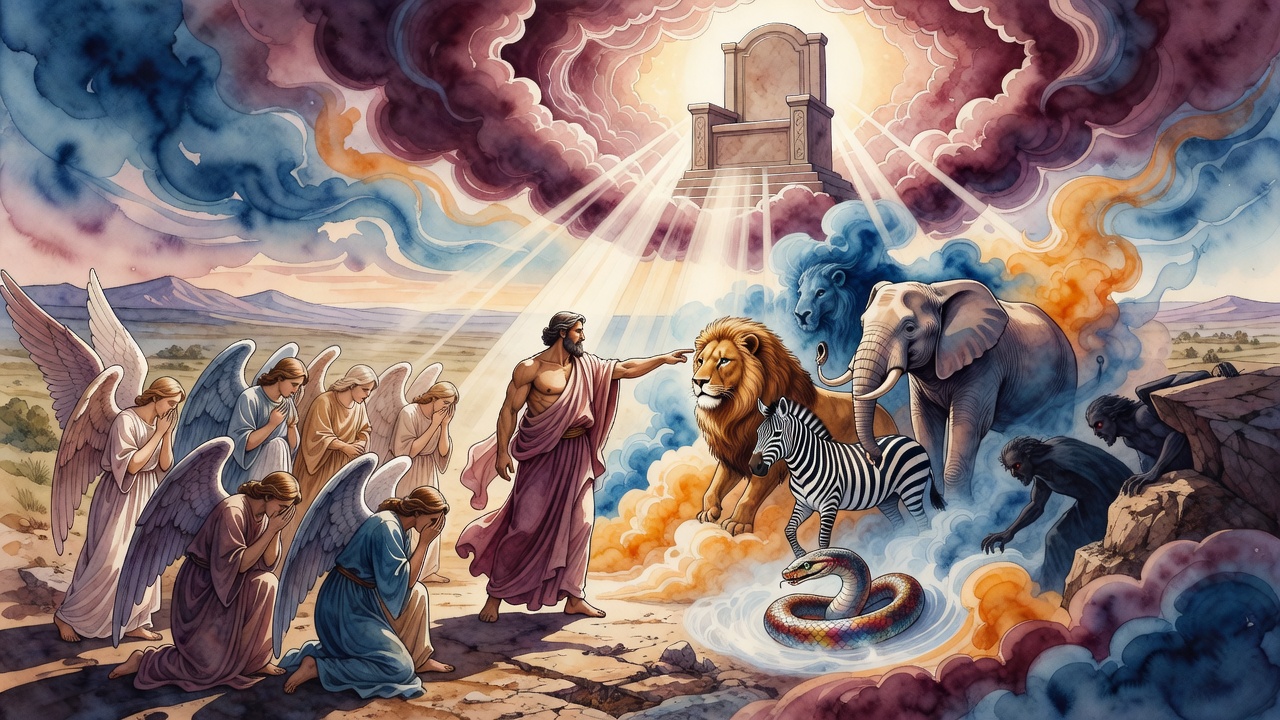
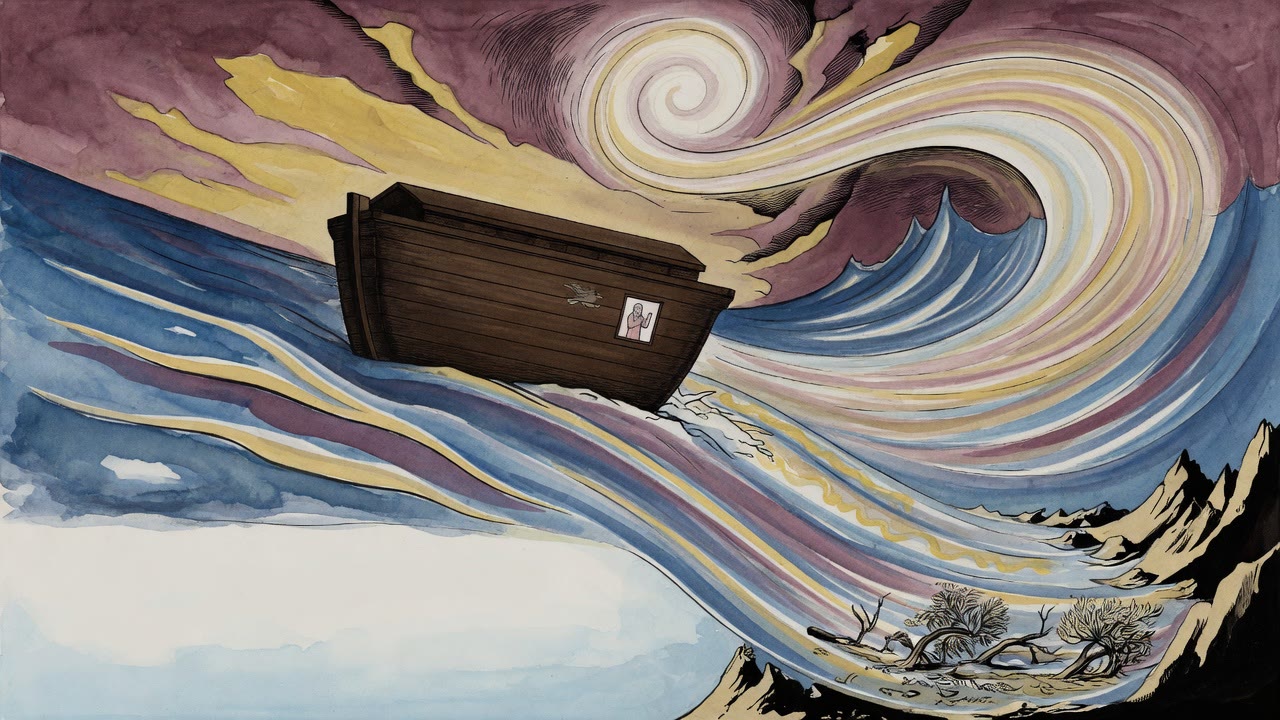
Two and two, the order said, every living thing that breathed, herded up the ramp into the dark of the gopher-wood hull. But one beast stood at the foot of the ramp and would not fit. The re'em was a day old and already the size of Mount Tabor. Its neck ran three parasangs, and the flat place where it rested its head was a parasang and a half across. When it dropped a single ball of dung, the dung dammed the Jordan. No deck could hold it. No door could swallow it. Noah looked up the rising flank of the animal and understood that the largest creature God had made was about to drown.
Noah Ties the Mountain to the Hull

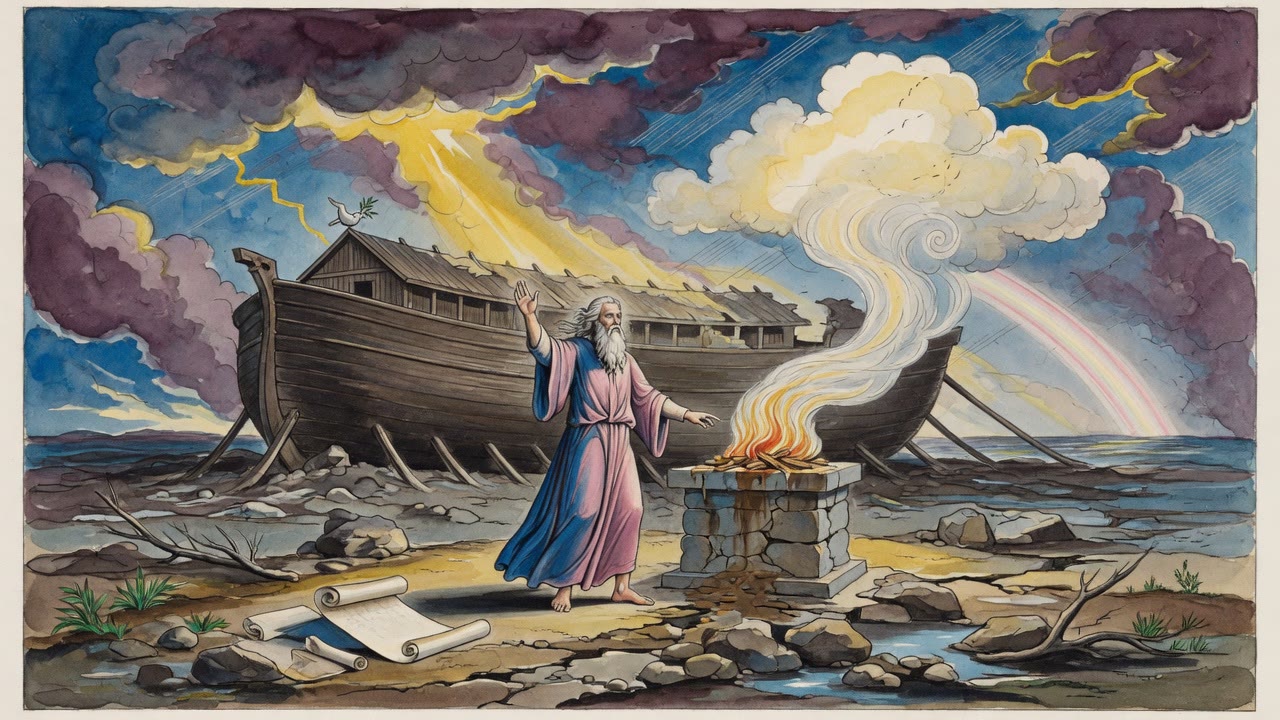
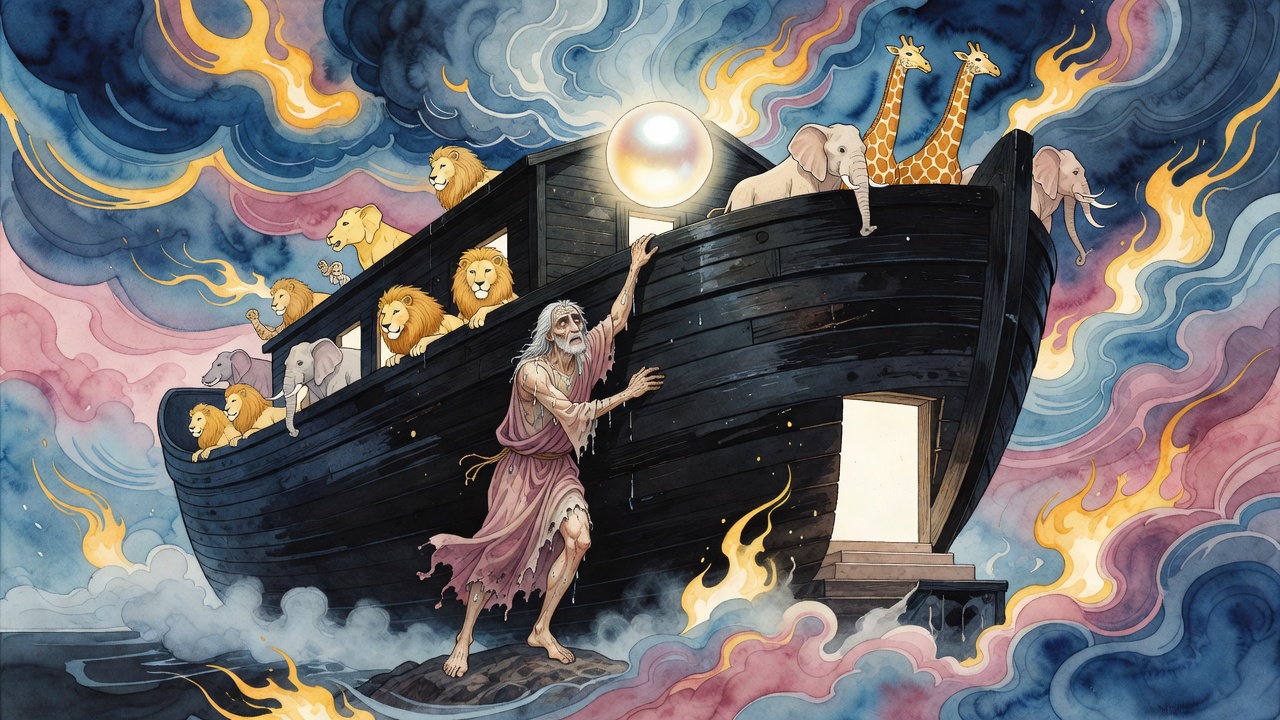
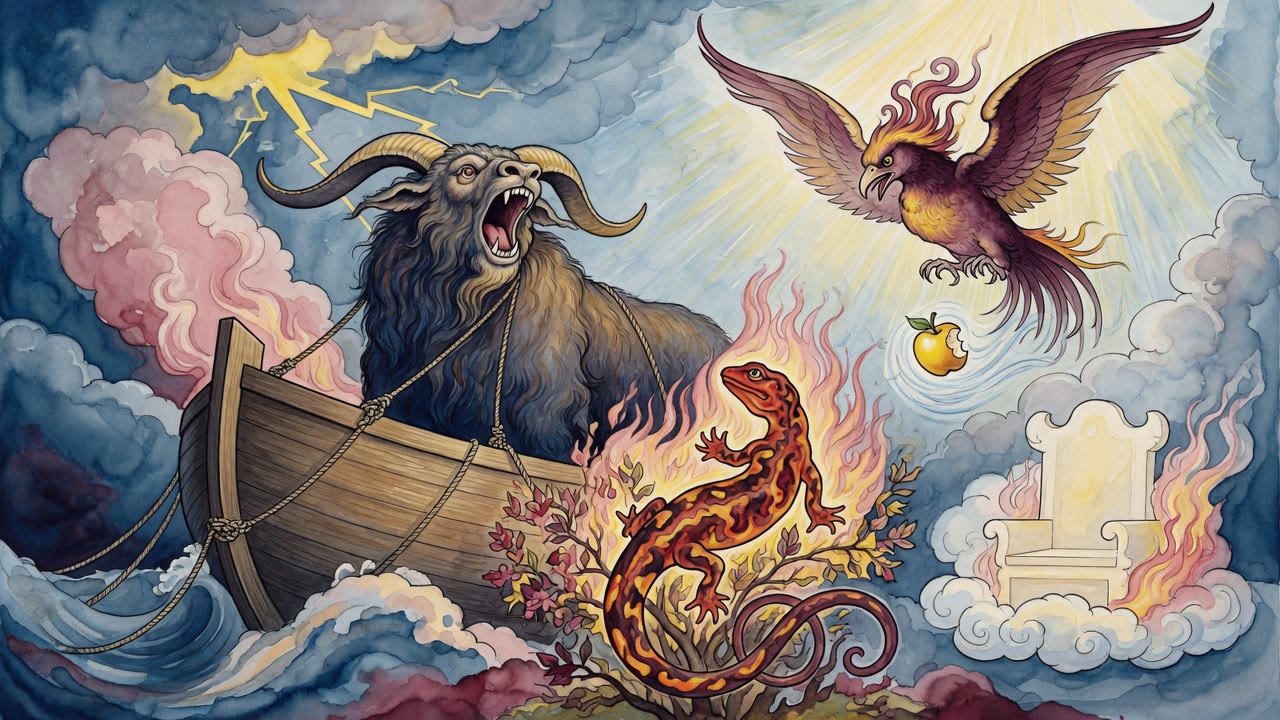
So he roped it. He bound a cord to the horns of the re'em and lashed the other end to the ark, and when the waters came the beast did not climb aboard but swam. It ran in the rising flood beside the hull, dragging at the rope, its horns cutting the surface like two black masts. Some said only the calf was brought, small enough to lead. Others said the great bull itself swam the whole forty days, plowing furrows in the drowned world as long as the road from Tiberias to Susita.

There was a danger in this that the rope alone could not answer. The generation of the flood had corrupted itself with boiling heat, and so the waters that judged them came down scalding, hot as the inside of a body. A beast roped to a wooden box should have been boiled against its planks. But the sides of the ark cooled where the re'em pressed against them, and the creature lived to feel dry ground again.

Why the Great Beast Lives Apart

The re'em never came in pairs the way the other animals did, and the reason was woven into how it lived and died. God had set the male at one end of the earth and the female at the other, east and west, and they met only once in seventy years. The meeting was fatal. The female bit the male, and the wound killed him. She carried the young for twelve years after that, and in the last year she could not move at all. She lay where she fell, starving, rolling side to side, and only her own spittle saved her. It ran from her mouth and watered the ground, and the ground brought forth enough to keep her alive until her belly burst and the twins came out, male and female, their first breath her last. One turned east. One turned west. They would meet in seventy years and die as their mother had died. A single pair was all the world could hold. Three would have broken the earth.

The Lizard Born of Seven Years of Fire

Not every marvel was so large. In the embers of a fire that had been fed myrtle wood and kept burning, without dying, for seven full years, something stirred and was born. The salamander came out of the flame no bigger than a mouse, owing nothing to the water that made the fish or the boggy earth that made the birds. Fire made it, and fire could not touch it. Its blood was the prize. Smear a man's skin with the blood of the salamander and the man became proof against burning, untouchable by any flame. The web it spun was a charm against fire all by itself.

The people of the flood generation knew the legend, and it made them bold. They had heard the threat of a burning deluge and laughed at it. Let the heavens rain fire, they said. We will paint ourselves in salamander blood and stand untouched. They smeared themselves and waited. The water that came was scalding, and it was still water, and the blood of a fire-lizard does nothing against a flood. They drowned in their war paint.

The One Bird That Said No

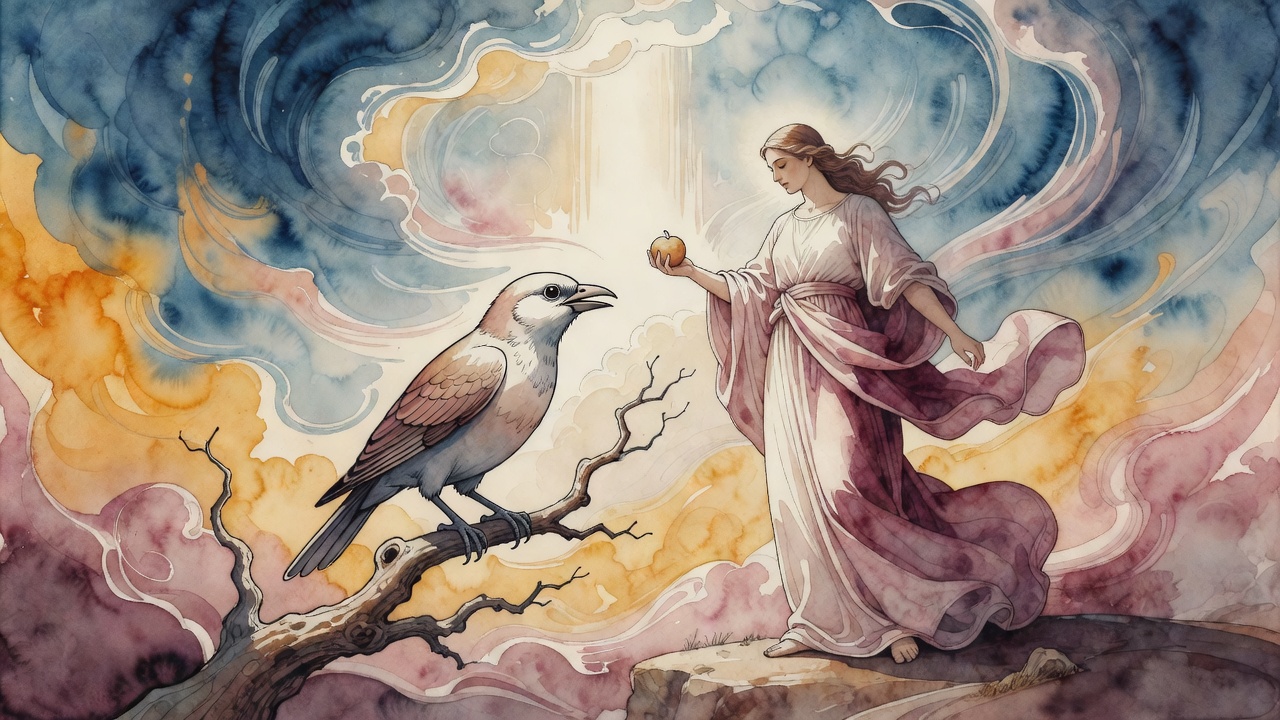
The strangest survivor of all had been spared death long before the flood, in the garden, by refusing a single bite. When Eve took the fruit she did not stop with Adam. She carried it to every beast and bird and creeping thing, and all of them ate, and all of them became subject to death. One bird turned its head away. Milcham looked at the fruit in her hand and would not touch it. "Woe to you," the bird told her. "You have brought death on yourself, on your husband, and on every creature. I alone will not eat." For that refusal it was given a life with no end.

Some called the bird Hol, citing the old promise that the righteous man would multiply his days like the Hol. It lives a thousand years. Then fire comes out of its own nest and burns it down to a thing the size of an egg, and from that egg it grows its limbs and lives. Others told it more gently. The body simply withers, the feathers fall away, an egg remains, and God sends two angels to make it new. Either way it never truly dies. It only begins again.

The Guardian at the Edge of the Day

This deathless bird had work to do at the rim of the world. It was named the guardian of the terrestrial sphere, and it stood between the earth and the fire of the sun. Each dawn it spread its wings and caught the burning rays before they could fall full-strength on the ground, and without that screen of feathers the earth would have scorched to ash. Across its right wing, in letters tall enough to run four thousand stadia, ran a single boast: "Neither the earth produces me, nor the heavens, but only the wings of fire." Enoch, lifted up in his vision, saw whole flocks of them, purple as a rainbow, with the feet and tails of lions and the heads of crocodiles, twelve-winged like angels, flying at the chariot of the sun. At first light they sang, and every bird in the world sang with them.

So the hidden bestiary held together by opposites. A beast too heavy for the world, roped behind the boat that saved everything else. A lizard pulled from flame, whose blood the drowned had trusted in vain. And a bird that paid one refusal in Eden with an endless cycle of burning and waking, standing watch at the door of every morning so the rest of creation would not catch fire.


← All myths
From the tradition

Sources

5 sources

The texts this telling draws on, in full. Open a card to read inline, or expand it for a wider, quieter read.

Legends of the Jews 1:56Legends of the Jews

The familiar version gives us about Leviathan, the mighty sea serpent, Ziz, the colossal bird, and Behemot, the giant land beast, but they aren’t alone in the bestiary of Jewish legend.

There are others, marvelous ones, like the re’em (רְאֵם). According to the legends, if there were more than two re’em, well, let's just say things might get a little… unstable for the rest of us.

The fascinating thing about the re’em is how rarely they… well, re’em! Can you imagine? The Zohar tells us that God deliberately placed the male and female re’em at opposite ends of the earth – one in the east, the other in the west.

It gets even wilder. The act of mating itself is… fatal. The female re’em bites the male, and he dies from the wound. Harsh. But life finds a way, as they say.

She becomes pregnant, and then carries those babies for a minimum of twelve years. Twelve years! Just picture that.

The year before she gives birth, she becomes completely immobile. Imagine being stuck, unable to move, and starving. But even here, there's a touch of the miraculous. Her own saliva, flowing copiously, irrigates the land around her, causing it to bring forth enough food to sustain her. As we find in Midrash Rabbah, nature itself bends to ensure her survival!

For a whole year, she can only roll from side to side, until finally, her belly bursts, and the twins – a male and a female – are born. Their appearance marks the death of the mother re’em. She makes room for the new generation, which is destined to suffer the same fate as the one that came before. Immediately after birth, one goes eastward, the other westward, only to meet again after seventy years, propagate, and perish. It's a cycle of life and death on a truly epic scale.

According to Ginzberg's retelling in Legends of the Jews, a traveler once claimed to have seen a day-old re’em. He described it as being four parasangs tall (a parasang is an ancient Persian unit of distance, roughly equivalent to 3-4 miles), and its head as being one and a half parasangs long. Its horns? A mere one hundred ells (an ell being an old English unit of measurement, around 45 inches) with an even greater height. These are beings of truly awe-inspiring proportions.

What does this tell us? Is it just a fantastical tale, or is there something deeper at play? Perhaps it's a reminder of the delicate balance of nature, the cycles of life and death, and the sheer, overwhelming power that exists in the world – power that must be carefully managed, or it could overwhelm us all.

Full source
Yalkut Shimoni on Torah 54:2Yalkut Shimoni on Torah

"And of every living thing, of all flesh" (Genesis 6:19). Even the spirits entered the ark, as it is said, "and of every living thing" - those who were created with souls but for whom no bodies were created.

Rabbi Judah says: the reem [a giant wild ox] did not enter the ark, but its young entered. Rabbi Nehemiah says: neither it nor its young, but rather Noah tied it to the ark, and it plowed furrows like the distance from Tiberias to Susita. This is what is written, "Can you bind the reem with its rope in the furrow? Will it harrow the valleys after you?" (Job 39:10).

In the days of Rabbi Hiyya bar Abba, one young reem came up into the Land of Israel and left no tree standing without uprooting it. They proclaimed a fast and Rabbi Hiyya prayed, and its mother bellowed from the wilderness, and it went down at her voice.

Full source
Legends of the Jews 1:59Legends of the Jews

It's quite the tale, and it all starts with the Phoenix.

The familiar story centers on Adam and Eve and the fruit from the Tree of Knowledge. But did you know that the animals got in on the action too? According to legend, Eve offered the forbidden fruit to all the animals. But one bird, the Phoenix, refused. And for that act of restraint, it was rewarded with eternal life. Ginzberg, in his Legends of the Jews, tells us that after living a thousand years, the Phoenix doesn't simply die. Instead, its body shrinks, its feathers fall away, until it’s as small as an egg – the seed of the next Phoenix!

The Phoenix isn't just immortal; it's also incredibly important to the world. It’s even called "the guardian of the terrestrial sphere." According to tradition, the Phoenix spreads its wings to catch the sun’s fiery rays. Without it, the earth would be scorched!

Get this: inscribed on its right wing, in letters so huge they stretch for about four thousand stadia (that’s an ancient unit of measurement!), are the words: "Neither the earth produces me, nor the heavens, but only the wings of fire." Where does this magnificent being get its sustenance? Not from earthly food, but from the manna of heaven and the dew of the earth. And even its waste is special – a worm that produces the cinnamon used by kings and princes!

Enoch, who, as the Bible tells us, was translated directly to heaven, saw these Phoenix birds. He described them as wondrous creatures, with the feet and tails of lions and the heads of crocodiles. Their appearance, he said, was a vibrant purple, like a rainbow. And their size? A staggering nine hundred measures! They have twelve wings like angels, and they attend the chariot of the sun, bringing heat and dew as God commands. In the morning, as the sun begins its journey, the Phoenixes and the chalkidri (another mythical bird) sing a song, and every bird flaps its wings, rejoicing and praising the Giver of light. It’s a beautiful image, isn't it? A cosmic chorus greeting each new day.

But birds aren't the only creatures with legendary properties. Among reptiles, we find the salamander and the shamir. The salamander, according to tradition, originates from a fire of myrtle wood that's been kept burning steadily for seven years through magic. It's no bigger than a mouse, but it’s incredibly powerful. Smear yourself with its blood, and you're invulnerable. And the web woven by it? A talisman against fire! Talk about a useful creature. We're told that the people who lived at the time of the great flood were arrogant enough to think they could protect themselves from a fiery deluge with salamander blood.

It makes you wonder, doesn't it? About the power of belief, the stories we tell ourselves, and the creatures that capture our imagination. Are these literal truths? Perhaps not. But as we find in Midrash Rabbah and other ancient texts, they offer us a glimpse into the hopes, fears, and dreams of generations past. And maybe, just maybe, a little bit of magic too.

Full source
Chronicles of Jerahmeel XXIIChronicles of Jerahmeel (Gaster, 1899)

Before Adam named the animals, God brought them before the angels and challenged them to do it first. They could not. Adam named every creature instantly. God turned to the angels and said, "Were you not asking, 'What is man, that You should remember him?' Now his wisdom is greater than yours!" According to the Chronicles of Jerahmeel, a 12th-century Hebrew chronicle translated by Moses Gaster in 1899, this was the moment the angels began to envy humanity.

Samael, the angel of death, descended to find a creature cunning enough to corrupt Adam. He chose the serpent. The serpent approached Eve and challenged her about the forbidden tree. When Eve said they would die if they touched it, the serpent laughed. "God is jealous," he said. "If you eat, your eyes will be opened, and you will know how to create the world just as He does." The serpent stood on his feet, shook the tree, and fruit fell to the ground. The tree itself cried out: "Wicked one, do not touch me!"

When Eve saw the serpent touch the tree and survive, she ate the fruit. Instantly she saw the angel of death with a drawn sword. Her reasoning was brutal: if she alone would die, God would give Adam another wife. Better they die together. She gave Adam the fruit. He ate, saw the same drawn sword, and was stricken with grief.

Eve did not stop with Adam. She fed the forbidden fruit to every creature on earth, beasts, animals, and birds. All ate. All became subject to death. All except one. A bird called Milham refused. "Woe unto you," the bird told Eve. "You have brought death upon yourself, your husband, and all creatures. I alone will not eat." God rewarded the bird with eternal life. Every thousand years, the Milham shrinks to the size of a chick, loses its feathers, and returns to its egg. And God sends two angels to restore it anew.

Full source
Midrash Shmuel 12:2Midrash Shmuel

["And why do you harden your hearts, etc." (1 Samuel 6:6), this is what is written:] "Strike a scoffer and the simple will become prudent, etc." (Proverbs 19:25). "Strike a scoffer", this is the serpent; "and the simple will become prudent", this is Eve. All of them listened to Eve and ate from that tree, as it is written, "and she gave also to her husband with her, and he ate" (Genesis 3:6). And the word "also" includes the eating by the cattle, and by the wild beast, and by the birds, except for one bird, whose name is Hol, as it is written, "And I said, I shall die with my nest, and I shall multiply my days like the Hol" (Job 29:18); "ka-Hol" it is written. The house of Rabbi Yannai and Rabbi Yehudah bar Rabbi Simon [differ]. The house of Rabbi Yannai say: a thousand years it lives; after a thousand [years], fire comes forth from its nest and consumes it, and there remains of it the size of an egg, and it returns and grows limbs and lives again. [And Rabbi Yehudah bar Rabbi Simon says: a thousand years it lives, and at the end of a thousand years its body is consumed and its wings molt away, and there remains of it the size of an egg, and it returns and grows limbs and lives again.]

Another interpretation: "Strike a scoffer", this is Amalek; "and the simple will become prudent", this is Yitro. Rabbi Yehudah bar Simon said: Yitro was enrolled in the army of Amalek, and when [Amalek] fell, he came and converted, as it is written, "And Yitro, the priest of Midian, heard" (Exodus 18:1). Another interpretation: "Strike a scoffer", these are the Philistines; "and the simple will become prudent", these are the prefects. Another interpretation: "Strike a scoffer", these are the Philistines; "and the simple will become prudent", these are the lords [seranim]. "And why do you harden your hearts, etc."

Full source