Parshat Bereshit6 min read

The Three Craftsmen and the World That Agreed to Be Made

Creation was a workshop. God breathed a single letter, raised heaven, earth, and water as craftsmen, and asked each creature if it wished to be made.

Curated by Arthur · Told by Maggid ·
Table of Contents
  1. The Letter That Cost No Breath
  2. Three Craftsmen Rose Out of the Water
  3. God Asked Each Creature If It Wished to Exist
  4. The One Creature No Craftsman Could Make Alone

There was a stretch of nothing that was not empty. It was water. No shore, no floor, only water above and water below and water where the middle should have been. Into that endless wet, God leaned close and breathed.
The Three Craftsmen and the World That Agreed to Be Made Click for full size

The Letter That Cost No Breath

He did not shout. He did not strain. He breathed one soft letter, the letter He, the single sound a mouth makes without gripping the tongue, without teeth or lips or labor. Every other letter clutches at something on its way out. This one only opens and goes. And in that open breath, the way a room fills when a door swings wide, the heavens were already made.

Other builders sweat. They haul and cut and curse the stone. God built the first world the way a tired man sighs. The letter asked nothing of the body that made it, so nothing in that first making came by toil.

He kept a second letter back. A small one, Yod, folded away like a key cut for a door He had not opened yet. With the two of them together He was the Rock of worlds, and the world to come could wait behind the Yod. This one came first, and it came on a breath.

Three Craftsmen Rose Out of the Water

Then God did a strange thing for a maker who needed no help. He hired a crew.

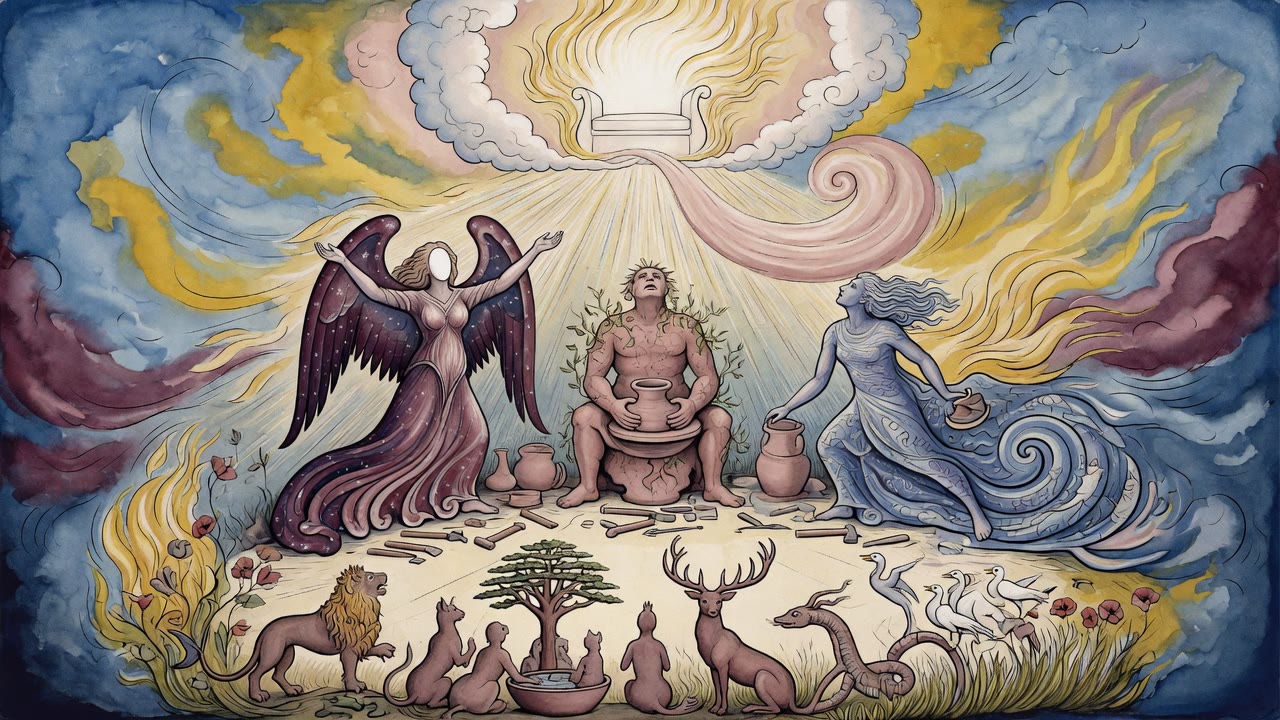
Out of the one water He raised three, and stood them up as workers with tasks in their hands: Heaven, Earth, and Water itself, no longer only substances but craftsmen. He turned to Water first. "Gather," He said. "Pull back into one place, and let the dry land show its face." The waters drew together like a crowd stepping aside, and Earth stood up out of them, streaming.

To Earth He said, "Bring out the living things." Earth strained and opened, and grasses climbed her, and cattle and creeping things walked off her slopes still warm from the ground that bore them. To Water He said again, "Now you. Swarm." The sea thickened with fish, and birds tore loose from the surface and took the air. Heaven He stretched between the waters above and below, a taut floor holding the old flood off the world, and hung it with a greater lamp and a lesser and a spray of smaller fires.

Not one craftsman had to be told its work twice. God had made nothing blind. Every creature walked out of the workshop already carrying the knowledge of what it was for.

God Asked Each Creature If It Wished to Exist

And before any of it hardened into fact, God asked.

He bent toward each thing while it was still only possible and asked plainly. "Do you want to be made?" Each one waited, and each one answered, and each said yes on its own terms, naming the single service it would give back for the gift of being.

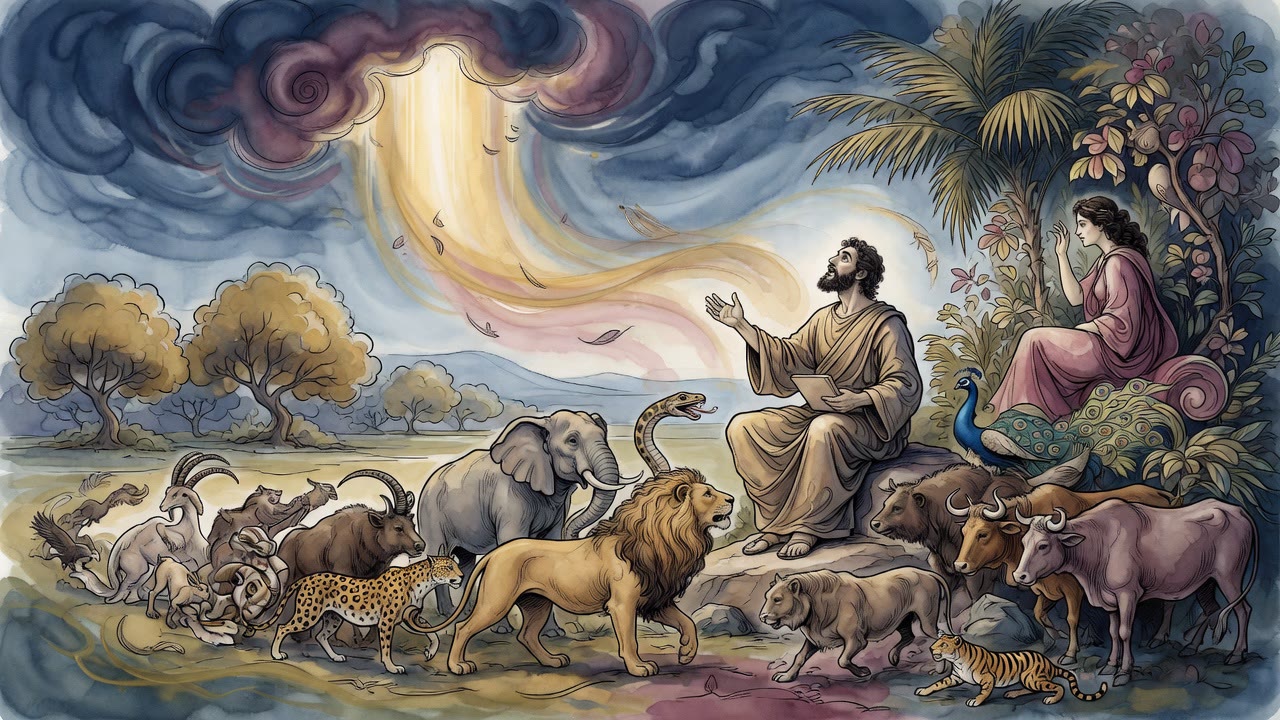
The sea said yes, and set a condition. One day, it said, when a people fled a king across my bed, I will split myself and open a dry road and let them cross. The heavens said yes and swore to hold still, so that on the morning a man climbed a burning mountain to take a Law from God's mouth, the sky would go silent, no wind, no thunder, and not one word would fall and be lost. The sun answered, and the moon beside it, and both agreed to stop, so that when a soldier needed the light to last over a valley until the fighting was done, they would freeze above the hills and refuse to set.

Smaller creatures made smaller vows. The ravens agreed to carry bread in their beaks to a starving prophet. The lions agreed that on one certain night they would lie down beside a man thrown into their pit and keep their mouths shut. The great fish agreed to swallow a runaway whole and, after three days, heave him back onto dry land alive. Every yes was a thread tied at the beginning to an hour far down the line, and the world that left the workshop had agreed to every knot.

The One Creature No Craftsman Could Make Alone

Then God came to the last thing He meant to make, and the whole workshop went still.

He turned to Heaven, to Earth, to Water, and told them straight. "None of you can make this one alone. Not you, not you, not you. And I will not make him the way I made the rest of you. Come together, all three, and I will come down among you, and with our hands in the same work we will make Man."

So the three craftsmen closed in, and God closed in with them. Earth gave the body its clay. Water gave it the wet of blood and the shine of the eye. Heaven gave it the pull that keeps a creature lifting its face upward. And when the shape lay finished and empty, God did the one thing He had let no craftsman touch. He leaned close again, the way He had leaned over the first water, and He breathed. Not a letter this time. A soul. It went in, and the clay sat up, and it knew exactly what it had been made for.

Around it the sea kept its road folded away, and the sky kept its silence ready, and the sun kept its power to stop, and the workshop stood quiet. Everything in it had agreed to be there.


← All myths
From the tradition

Sources

3 sources

The texts behind this telling. Some cards carry a translation of the source; others are our own retelling of it, and each card says which. Every card links out to the original.

PhiloThe Midrash of Philo

Retold in our words. Read the original at the link below.The Works of Philo Judaeus, trans. C. D. Yonge, London, H. G. Bohn, 1854-1890 · Public Domain

The Midrash of Philo turns to The Three Craftsmen.

There's a fascinating myth, found in Midrash (rabbinic interpretive commentary) ha-Ne'elam, a section of the Zohar Hadash (16a-b), that paints a picture of God enlisting some cosmic craftsmen in the act of creation. Forget a solitary divine act, this is a team effort!

The myth begins with everything as water. Just water, stretching out into infinity. Then, God gets to work. According to this tradition, God didn't just speak the world into existence. Instead, He created three master builders: heaven, earth, and water. These weren't just places or substances, but craftsmen, imbued with the power to bring forth creation at God's command.

Think of it like this: God is the architect, but these three are the construction crew. He directs them, giving each a specific task. First, He commands water to produce earth, ordering the waters to gather. And just as we read in (Genesis 1:9), "Let the water below the sky be gathered into one area, that the dry land may appear," dry land emerged.

Next up, earth. God calls on earth to bring forth animals and other living creatures. And obediently, as (Genesis 1:24) tells us, "Let the earth bring forth every kind of living creature." Vegetation and plants followed in the same way, springing forth at God's command, through the agency of earth.

Then came the waters' turn again. God instructed them to teem with fish and birds, fulfilling the verse in (Genesis 1:20), "Let the waters bring forth swarms of living creatures, and birds that fly above the earth across the expanse of the sky."

And what about the heavens? Their task was to separate the upper waters from the lower waters, creating the firmament, just as it's written in (Genesis 1:6), "Let there be a firmament in the midst of the waters, and let it divide the waters from the waters." They were also charged with illuminating the earth, bringing forth the lights in the sky, as (Genesis 1:14) describes.

So, we have a beautifully orchestrated creation unfolding, but with a twist. God is still in charge, but these personified elements are actively participating in the work.

But here’s where the story gets really interesting. When it came time to create man, God changed the rules. He declared, "None of you is able to produce this creature alone. All of you must unite, and I too will join you. Together we shall make man."

So, God joined forces with heaven, earth, and water. Together, they created humanity. And, crucially, God gave humankind a soul.

Now, what does this all mean? Why this emphasis on collaboration?

One interpretation is that this myth subtly shifts the focus from creation solely by God's word to creation by primordial forces. It's almost a step away from pure abstraction, towards a more tangible, almost mythological understanding. As Philo observed in De Somniis 1:76, God didn't just rearrange existing things, but brought entirely new things into being. He was both the artificer and the Creator.

The rabbis often debated whether God had any assistance in creation. We see angels assisting God in other traditions, and here, we see elements personified, almost like lesser deities carrying out divine orders. This, of course, raises some theological questions. Does this diminish God's accomplishment? Does it imply a dependence on pre-existing elements?

Perhaps. But this myth doesn't necessarily detract from God's power. Instead, it highlights God's wisdom in delegating, in empowering these elements to participate in creation. The commentary in Tree of Souls (Schwartz) suggests that this myth, found in Midrash ha-Ne'elam, leans towards the idea that God did have assistance, but He created those assistants specifically for that purpose.

And that final act, the creation of humanity, emphasizes God's unique role. While the elements contribute to our physical being, it is God alone who bestows the soul. In that sense, even with these cosmic helpers, God's creative power remains supreme.

So, the next time you read the creation story, consider this alternative version. A story of teamwork, of delegated power, and ultimately, of a God who invites creation to participate in His grand design.

Full source
Bereshit Rabbah 12:10Bereshit Rabbah

Translation of the source text.Midrash Rabbah -- TE · Public Domain

"When they were created" (Genesis 2:4): Rabbi Abbahu in the name of Rabbi Yochanan said: "When they were created" (be-hibbar'am) means He created them with the letter He [reading be-He bera'am, "with He He created them"]. And just as this letter He, of all the letters, does not hold the tongue while the others grip the tongue, so it was not with toil and not with labor that the Holy One, blessed be He, created His world, but rather "by the word of the LORD" (Psalms 33:6), and the heavens were already made.

And we do not know whether this world was created with He and the world to come with Yod. But from what Rabbi Abbahu said in the name of Rabbi Yochanan, that "when they were created" means He created them with the letter He, it follows that this world was created with He.

"For with Yah the LORD is the Rock of worlds" (Isaiah 26:4): with two letters [Yod and He] the Holy One, blessed be He, created His world.

Full source
PhiloThe Midrash of Philo

Retold in our words. Read the original at the link below.The Works of Philo Judaeus, trans. C. D. Yonge, London, H. G. Bohn, 1854-1890 · Public Domain

He consulted with them. He asked them if they wanted to be made.

The text During those six days, God established the foundations and roots of everything that would exist. But more than that, God created everything with its knowledge. Everything was created with its own understanding, its own purpose.

The text says that God asked each thing if it wished to be created. And when each agreed, it came with conditions, with its own specific way to serve God. It’s almost like a cosmic contract. We find echoes of this idea throughout Jewish literature.

Consider the story of the Exodus. The ocean, the very waters that seemed an insurmountable barrier, agreed to part and allow the Israelites to escape Pharaoh's army. As the text describes, the ocean "agreed to open up to permit the children of Israel to pass through the Red Sea." The Talmud, in Rosh Hashanah (the Jewish New Year) 11a and Hullin 60a, and the Zohar (1:47a) all touch upon this idea of pre-creation agreements.

And it doesn't stop there. The heavens promised to be silent while Moses climbed Mount Sinai to receive the Torah. The sun and moon promised to stand still for Joshua before the walls of Jericho. The ravens promised to feed Elijah, the lions pledged not to devour Daniel, and the whale agreed to cast out Jonah. The No'am Elimelekh (Bo 36b) also speaks to this concept.

Each element, each creature, agreeing to play its part in the grand cosmic drama. God made an agreement with each and every one, and they agreed out of gratitude for the gift of existence.

This idea resonates with other creation myths in Jewish tradition. Some say God created the world from a blueprint, much like an architect. But instead of a literal plan, this text suggests that God visualized, in some way, all that He would create. Philo, the Hellenistic Jewish philosopher, wrote in De Opificio Mundi that "when God decided to create this world. He first formed the invisible world to use as a pattern for the corporeal world."

This "invisible world," these "roots of everything," could be seen as an archetypal realm, a divine vision of all that would be. Other traditions even describe God using the Torah itself as the blueprint for all of Creation.

The implication here is profound. By asking each thing if it wanted to be created, God acknowledged its intrinsic worth, its inherent desire to exist. This explains, perhaps, the powerful impulse to survive that we see in all living beings. Everything wants to continue existing because it chose to exist in the first place!

God's questioning implies a covenant, a brit, between the Creator and Creation. Derekh ha-Shem (2:5:6) explores this covenantal aspect. Creation isn't just a one-way act; it's a mutual agreement, a partnership. As Ginzberg retells in Legends of the Jews, there is mutuality to the process of creation.

So, what does this all mean? It suggests a world far more interconnected, far more conscious, than we might initially perceive. It implies that everything around us, from the smallest grain of sand to the vast expanse of the cosmos, has its own story, its own purpose, and its own agreement with the Divine.

Perhaps, understanding this can deepen our appreciation for the world around us, reminding us that we, too, are part of this grand cosmic agreement. Are we living up to our end of the bargain? That is the question we have to ask ourselves.

Full source