Parshat Bereshit6 min read

The Throne Yah Quarried From Fire Drawn Out of Water

Before the world had a floor, Yah drew fire out of the coldest water and engraved a burning throne, then sealed the six ends with His Name.

Curated by Arthur · Told by Maggid ·
Table of Contents
  1. Before There Was Anything to Stand On
  2. He Cut Thirty-Two Paths Into the Dark
  3. Breath Became Air, Air Became Water
  4. Fire Drawn Out of the Coldest Deep
  5. The Throne Engraved and the Wheels Set Turning
  6. He Sealed the Six Ends With His Name
The Throne Yah Quarried From Fire Drawn Out of Water Click for full size

Before There Was Anything to Stand On

There was no floor to set a throne on. No ground to bolt its feet to, no wall to brace its back. Only ayin, the utter nothing, the void that gives nothing back and holds nothing up.

Into that nothing Yah bent close. Not the long name, the whole unpronounceable four letters, but the short hard breath of it, the name a person gasps when there is no strength left for more. He was already living when nothing else was. El Chai, the living God. El Shaddai. High and holy and dwelling in an eternity that had, as yet, no days to count.

He meant to make Himself a seat. And a seat needs a world to sit in.

He Cut Thirty-Two Paths Into the Dark

Before the first thing existed, Yah drew thirty-two paths of wisdom across the emptiness. Not roads for feet. Shimmering channels, tracks for meaning to run along, etched into a place that had no surface to be etched. Ten of them He set as sefirot, emanations pulled straight out of the nothing, numbers with nothing yet to number. The other twenty-two He kept as letters and held them in His hand like tools.

He worked with three things at once. With sepher, writing, so the world would be a text a person could read. With sephar, number, so it would keep proportion and not fly apart. With sippur, telling, so it would be a story going somewhere and not a heap of facts. Script, count, and tale. He would engrave, weigh, and narrate the thing into standing.

Breath Became Air, Air Became Water

Then the descent began, one thing drawn living out of the last.

First came breath. The breath of the living God moved where there had been no movement, warm and without body. From that breath He drew a second breath and set it as air, and gave it a mother-letter to hold it. Alef took her station, silent, the hush between two sounds, the tongue that decides and does not shout.

From the air He drew water. It came humming. Mem came with it, the mother of the flood, her sound the low hum of a full river closing over everything, cold and deep and patient. Now there was a deep where a breath before there had been only wind. The water spread and hummed and asked for nothing.

Fire Drawn Out of the Coldest Deep

Here the work turned strange.

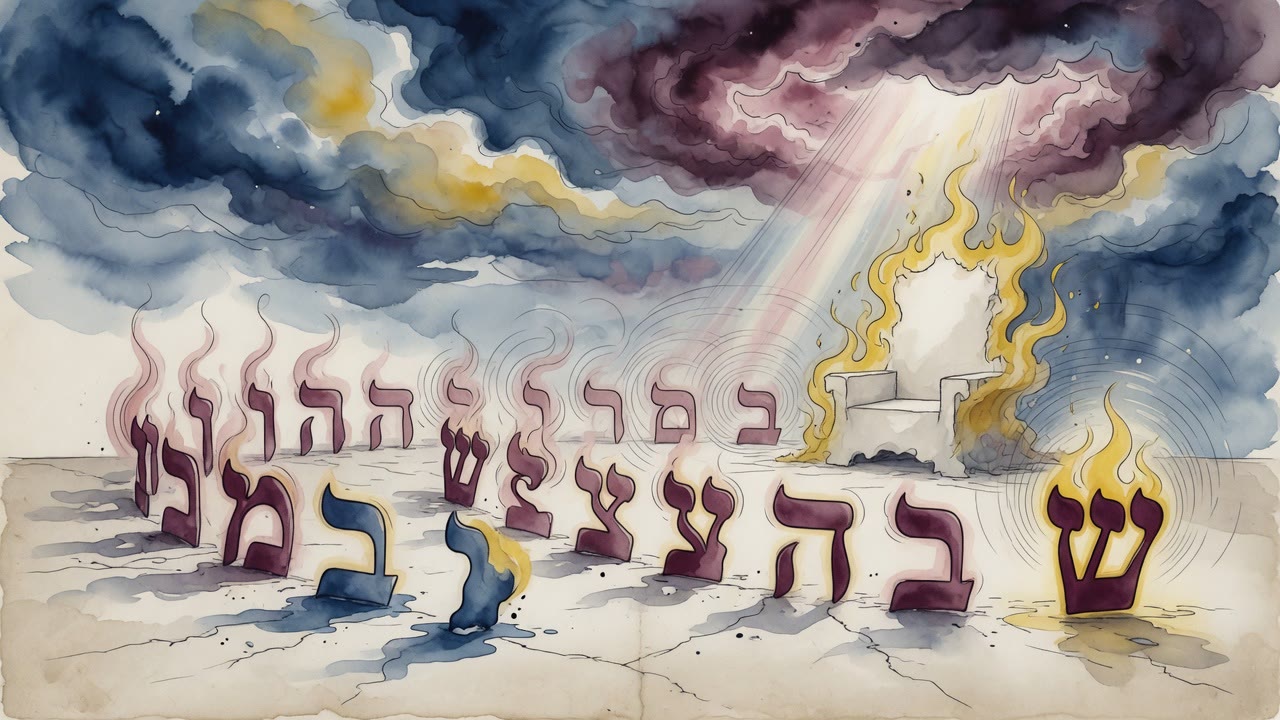
Yah reached into the water, into the coldest element there was, the humming deep that drowns every flame, and out of it He drew fire. Fire from water. The thing that puts out burning gave up burning at His hand. Shin rose hissing where Mem had hummed, the mother of flame, three teeth of fire standing up out of the cold.

The paradox did not trouble Him. That was the whole reason for the quarrying. He would build the hottest seat in all existence out of the coldest stuff there was, so that no one could ever call the fire of the Throne a common spark, born of fire, cheap as any ember. This fire had been water. It remembered being water. It burned because He had turned it, not because it had always burned.

The Throne Engraved and the Wheels Set Turning

With that fire He engraved.

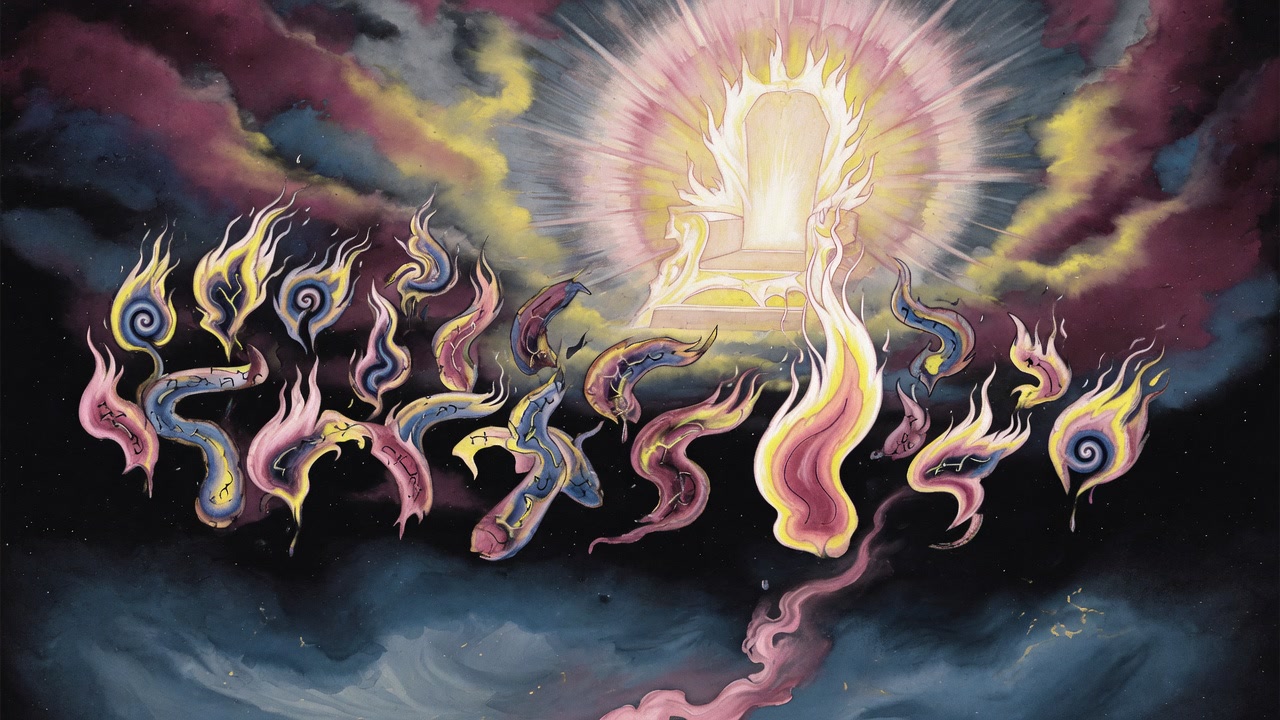
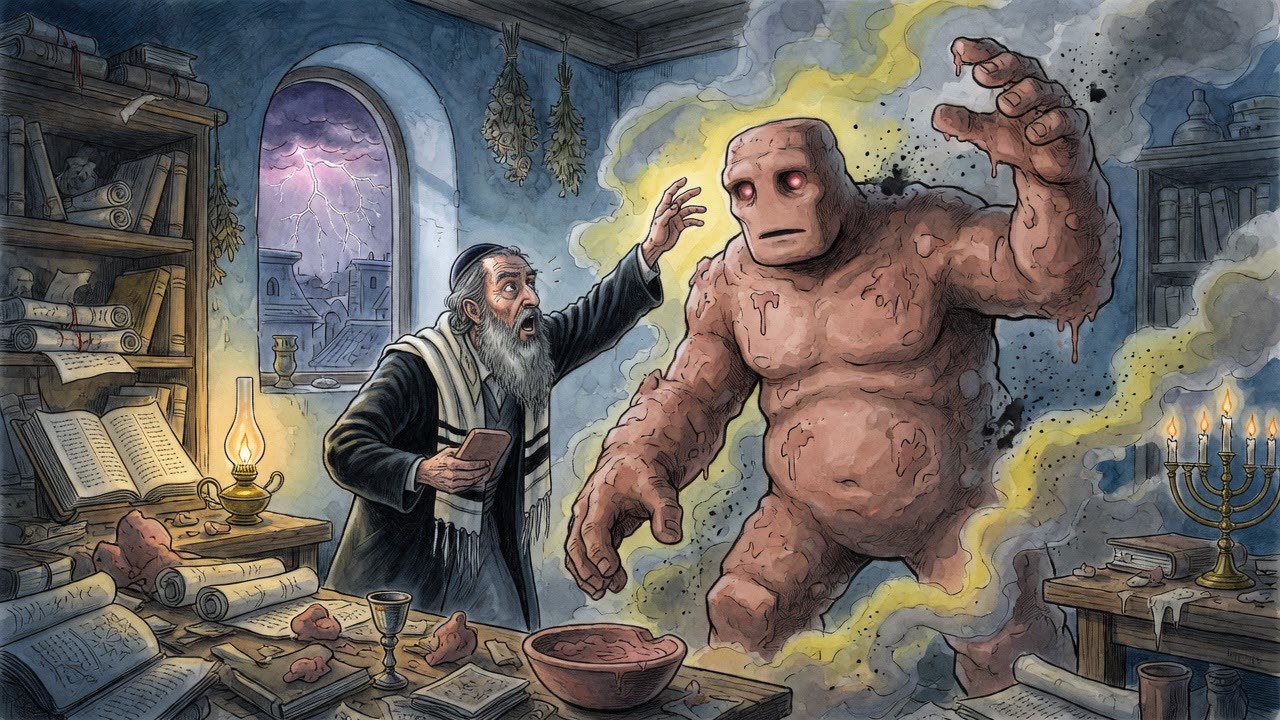
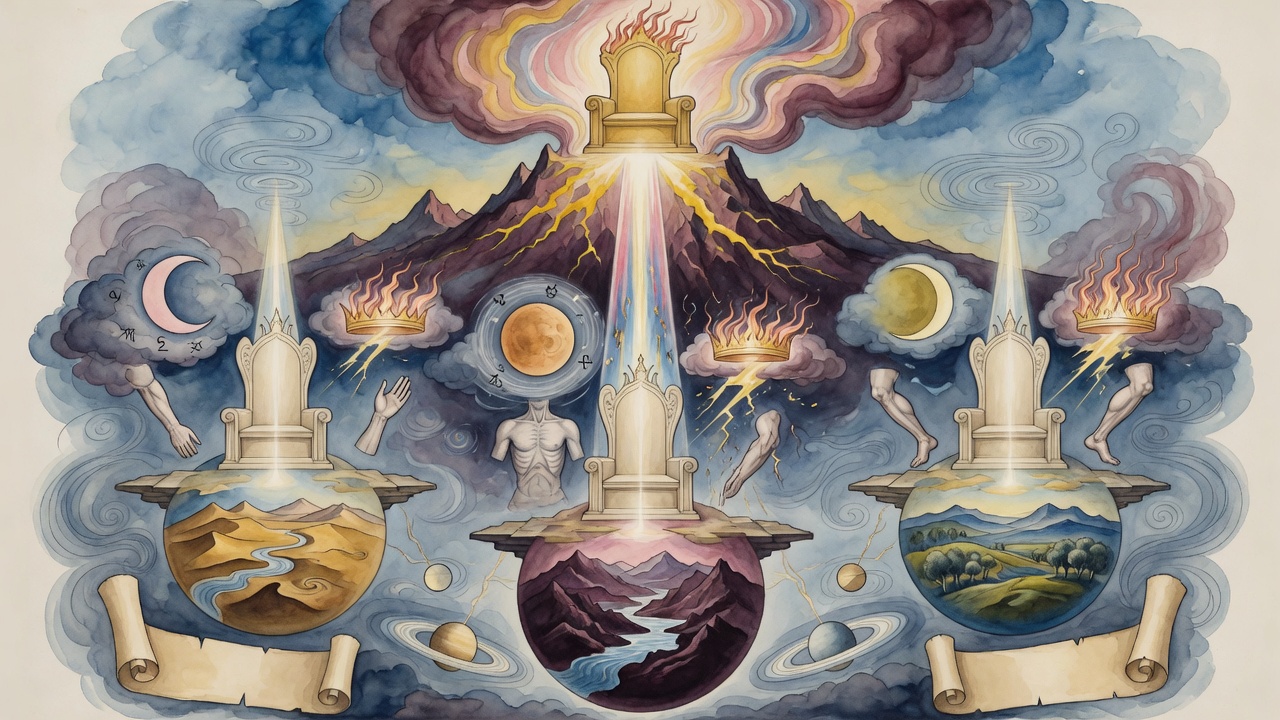
He carved the Throne of Glory from the flame that had been water, cut its high back and its deep seat straight out of the burning. And from the same fire He raised living things to carry it. The Serafim stood up first, the burning ones, fire given wings and voices. Then the Ophanim, wheels within wheels, rims of fire set turning beneath the seat. Then the Chayot, the living creatures, the four holy faces that Ezekiel would one day look up and see wheeling over a river in exile and hardly find words for.

On these three orders He founded His dwelling. His messengers made of wind, His ministers made of flaming fire. The chariot wheeled. The Throne stood on nothing and did not fall, because the thirty-two paths held it, and the letters held the paths, and His hand held the letters.

He Sealed the Six Ends With His Name

A seat at the center of things needs a world with edges, or it drifts.

So Yah took three letters of His own name, Yod and Hey and Vav, and sealed the six directions with them, turning to face each one in turn. He looked up and sealed the height. He looked down and sealed the depth. He faced ahead and sealed the east, turned and sealed the west, sealed the south to His right and the north to His left. Six ends, and the same three letters at each, only their order changed, so that whichever way a thing turned to look it would find the same Name looking back.

Air, water, fire. Alef silent, Mem humming, Shin hissing, and the breath between them holding the balance, a pan of merit on one side and a pan of guilt on the other and the tongue of decree steady in the middle. The world stood sealed on every side, weighed on a scale, written in letters, told as a story already moving. And at the center of it, quarried out of the coldest deep and set alight, the Throne of Glory burned and did not go out.


← All myths
From the tradition

Sources

3 sources

The texts behind this telling. Some cards carry a translation of the source; others are our own retelling of it, and each card says which. Every card links out to the original.

Sefer Yetzirah Gra Version 1:13Sefer Yetzirah Gra Version

Retold in our words. Read the original at the link below.Sefaria-hosted English translation · CC-BY

The Sefer Yetzirah, or "Book of Formation," offers a fascinating blueprint. And in this chapter, drawing from the version attributed to the Gra, the Vilna Gaon, we explore the fiery stuff of creation.

Imagine: fire springing forth from water. A paradox. But according to the Sefer Yetzirah, this is precisely how God engraved and carved the very Throne of Glory. From this celestial fire, came the Serafim, the fiery angels; the Ophanim, the wheels of God’s chariot; and the holy Chayot, the living creatures described in Ezekiel's vision. And from these three, God "founded His dwelling," just as it's written in (Psalms 104:4): "He makes His angels of breaths, His ministers of flaming fire." Think of it: the very fabric of the divine realm woven from fire born of water.

How did this happen? How did the abstract become concrete?

The passage speaks of choosing three letters from the Elementals, the very building blocks of reality. Specifically, the letters Alef (א), Mem (מ), and Shin (ש) – the "three mothers," as they're sometimes called, representing air, water, and fire respectively.

These aren’t just letters; they are potent symbols, pregnant with creative force. The Sefer Yetzirah tells us that God set these letters in His great Name and used them to seal the six extremities: above, below, east, west, south, and north. First, God sealed "above," facing upward, and sealed it with the letters Yud (י), Hey (ה), Vav (ו) – יהו (YHV). Then, He sealed "below," facing downward, with Hey (ה), Yud (י), Vav (ו) – היו (HYV). East was sealed with Vav (ו), Yud (י), Hey (ה) – ויה (VYH), facing straight ahead. West, facing backward, was sealed with Vav (ו), Hey (ה), Yud (י) – והי (VHY). South, facing to the right, got Yud (י), Vav (ו), Hey (ה) – יוה (YVH). And finally, north, facing to the left, was sealed with Hey (ה), Vav (ו), Yud (י) – הוי (HVY).

Notice something? All these combinations use the same three letters, Yud-Hey-Vav (יהו), which, rearranged, form part of the Tetragrammaton, the unpronounceable four-letter name of God.

What does it all mean? Perhaps that creation isn't a single act, but a continuous process of sealing and shaping, of divine energy flowing into every corner of existence. The six directions aren't just points on a compass; they're dimensions of reality, each infused with the very essence of the divine name.

As the Zohar tells us, everything is interconnected, a web of meaning woven from the letters of the Hebrew alphabet. Even the seemingly simple act of assigning letters to directions reveals a deeper truth about the nature of reality itself. The universe, according to the Sefer Yetzirah, is not just a physical space, but a sacred text, waiting to be read.

Full source
Sefer Yetzirah Gra Version 1:1Sefer Yetzirah Gra Version

Retold in our words. Read the original at the link below.Sefaria-hosted English translation · CC-BY

Before the world was a world, something had to be drawn. Sefer Yetzirah, one of the oldest Jewish mystical texts, describes 32 mystical paths of Wisdom, shimmering pathways etched into reality itself. These weren't just drawn; they were engraved by Yah (יָהּ), a powerful, shortened form of God's name.

This wasn't just any deity doing the engraving. The living God, El Chai (אֵל חַי), King of the Universe! And if that wasn't enough, He’s also El Shaddai (אֵל שַׁדַּי), often translated as God Almighty, but also carrying nuances of nurturing and provision. Merciful and Gracious. High and Exalted. Dwelling in Eternity. Whose name is Holy.

He is lofty and holy.

This isn't some abstract philosophical concept; it’s a deeply personal and powerful vision of the Creator.

And how did this Divine Artisan bring the universe into being? The Sefer Yetzirah (the World of Formation), in this version attributed to the Gra (גר״א) – Rabbi Eliyahu Kramer, the Vilna Gaon, an 18th-century luminary – tells us He created His universe with three Sepharim (סְפָרִים). Now, this word is plural, and it's often translated as "books." But it means so much more. It’s a play on words, a triple entendre of creation itself.

First, with Sepher (סֵפֶר), meaning "text" or "writing." The very fabric of reality is woven with divine language, a cosmic code.

Then, with Sephar (סֵפָר), meaning "number." Numbers aren’t just for counting; they’re fundamental principles, the underlying mathematics of the universe. The ratios, the proportions, the elegant equations that govern everything.

And finally, with Sippur (סִפּוּר), meaning "communication" or "story." The universe isn't just a collection of facts and figures; it’s a narrative, a dynamic and unfolding drama. There is intention, and meaning, and relationship.

So, God didn’t just snap His fingers and poof, universe! Instead, He meticulously crafted it with divine language, mathematical precision, and a grand, ongoing story. And what will we write with our own lives?

Full source
Sefer Yetzirah Gra Version 2:1Sefer Yetzirah Gra Version

Retold in our words. Read the original at the link below.Sefaria-hosted English translation · CC-BY

This isn't just any book. It's said to describe how God created the world using the Hebrew alphabet and numbers. Heavy stuff.

There are different versions of the Sefer Yetzirah (the World of Formation). This version starts with something pretty mind-bending: "These are the Ten Sefirot (the divine emanations) of Nothingness."

Ten Sefirot (סְפִירוֹת)? What are they? They're often described as divine emanations, or attributes, through which God reveals Himself and creates the world. But here, they come from…nothingness. From ayin (אַיִן), the utter void. Creation emerging from absolute non-existence.

The text continues, "The Breath of the Living God/ Breath from Breath/ Water from Breath/ Fire from Water/ Up down east west north south."

The very first breath, the Ruach (spirit) Elohim Chayim (רוּחַ אֱלֹהִים חַיִּים) – the breath of the living God – gives rise to…more breath. Then water emerges from that breath, and fire from the water. It’s a progression, a cascading series of creations. The directions – up, down, east, west, north, south – establish the boundaries of existence, the very framework of space.

But the Sefer Yetzirah doesn't stop there. It goes on to talk about the 22 Foundation Letters, the letters of the Hebrew alphabet. These aren't just symbols; they're considered the building blocks of reality.

These 22 letters are divided into three categories: "Three Mothers, Seven Doubles, and Twelve Elementals."

The "Three Mothers" are Alef (א), Mem (מ), and Shin (ש) – אמש. the verse says, "Their foundation is/ a pan of merit/ a pan of liability/ and the tongue of decree deciding between them."

What does that mean? Well, it's getting pretty deep into Kabbalistic symbolism here. The Alef, Mem, and Shin represent fundamental forces in the universe. Some interpret this to mean air, water, and fire, respectively. They are the basis for everything.

The text elaborates: "[Three Mothers, Alef Mem Shin (אמש)/ Mem hums, Shin hisses/ and Aleph is the Breath of air/ deciding between them.]"

The Mem, like water, has a flowing, humming quality. The Shin, like fire, is sharp and hissing. And the Alef? It's the breath, the air, the spirit that mediates between them, bringing balance and harmony. It is the tongue of decree, the force that decides.

According to some Kabbalistic interpretations, the "pan of merit" and "pan of liability" refer to scales of judgment. Our actions create a balance between good and bad. And that "tongue of decree"? It symbolizes the divine judgment that ultimately shapes our world. The Sefer Yetzirah gives us a glimpse into how these forces interact, constantly shaping our reality.

This is just a tiny peek into the Sefer Yetzirah. It’s a text that has fascinated scholars and mystics for centuries, evidence of the enduring power of language, symbolism, and the quest to understand the very fabric of creation. It invites us to ponder the origins of everything, to see the universe not as a collection of random events, but as a carefully constructed tapestry woven from divine breath, letters, and the eternal dance between opposing forces. Could this ancient text hold clues to understanding the universe and our place within it?

Full source