7 min read

The Traveler Shown the Worlds Stacked Beneath His Feet

A voice opens the solid ground like a lid and carries a traveler down through Tevel, the mountain of the dead, and the lip of Gehinnom.

Curated by Arthur · Told by Maggid ·
Table of Contents
  1. The Bickering Folk of Tevel
  2. The Mountain Where the Dead Wait
  3. The Southern Edge Where Fire Stands Guard
  4. The Storm That Ties the Floors Together
  5. The Wings Sealed With the Name

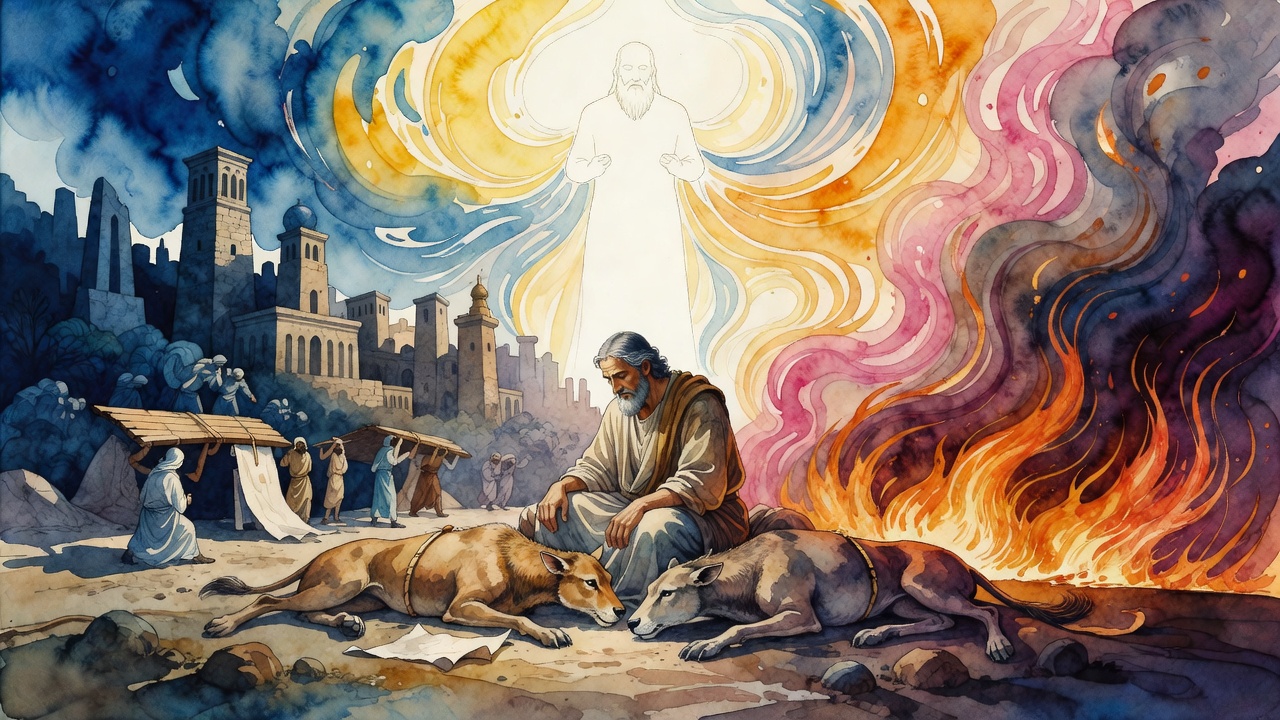
The floor felt solid under his feet, and that was the first lie. A voice told the traveler to kneel and press his palm flat against the ground of the settled world, the floor men call Heled, the only floor most of them ever walk. He pressed. The ground gave like the lid of a box, and something breathed underneath it.
"This is the top room," the voice said. "There are six below it, and the lowest is not the end." Then the floor opened, and he fell.

The Bickering Folk of Tevel

He landed in a country where the sun came up in the west and set in the east. This floor was Tevel. Three hundred sixty-five kinds of creatures moved across it, none shaped like anything born above. A serpent's head sat on a man's shoulders, a man's face rode a long scaled coil, and an ox lifted its head from the grass, spoke to him in clear words, and asked why he was staring.

But the creatures that stopped him cold had two heads on one trunk, four arms, four legs, a single belly. Sitting, they looked like two people sharing a bench. Then they stood, and they were one. He watched a pair try to walk. One head wanted east, the other west, so the body lurched a step forward and a step back and ended where it began. They quarreled all day over a pebble, until their shared stomach forced a truce.

Even the truce was a fight. One head wanted the meal hot, the other cold, so they cooked both, the cold dish first so the hot would not lose its heat. For one meal they were quiet. The instant the last bite went down, one head cried, "You ate more than I did," and the other shouted, "No, you ate more," and the war resumed. The demon king Ashmedai had once dragged a creature like these up to the daylight for King Solomon to puzzle over. The worlds below were crowded, and they were loud.

The Mountain Where the Dead Wait

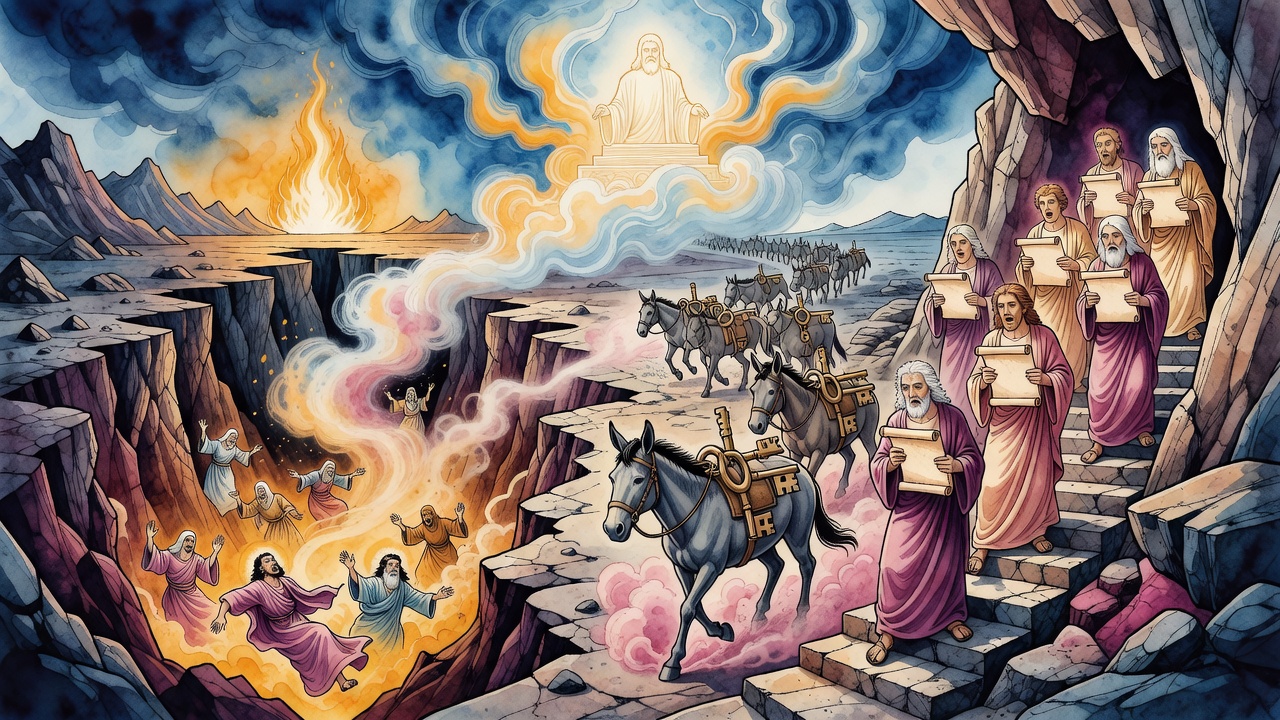
The voice pulled him down past floor after floor until the noise died and a colossal mountain rose out of the dark. It was hollow, its body cut into chambers, and the chambers were full of the dead.

This was Sheol, the gathering place, and it was not one undivided pit. A line ran through the mountain, made of light and of thirst. On one side the upright kept their own hollow with a spring of bright water near them. On the other the wicked crowded in dryness, kept apart, waiting for the Day of Judgment that had not yet come. Nobody here was finished. Everybody here was held.

From the bright side a single voice climbed toward the roof of the world. It was Abel, still bleeding the wound his brother gave him, still crying upward against the seed of Cain and asking that they be wiped from the living earth. The verse about a brother's blood screaming from the ground had never warned the traveler that the screaming did not stop. The dead here were not silent. They appealed, all of them, day and night, and their appeal went up like smoke.

The Southern Edge Where Fire Stands Guard

The voice turned him southward, and the air changed to ash and vapor. Here were the chambers of Teman, packed with fire, and a cave that breathed out tempest and storm and the cold north wind that snows the world quiet. The storehouses ran nearly three thousand years across. At their lip stood an opening, and the opening was Gehinnom.

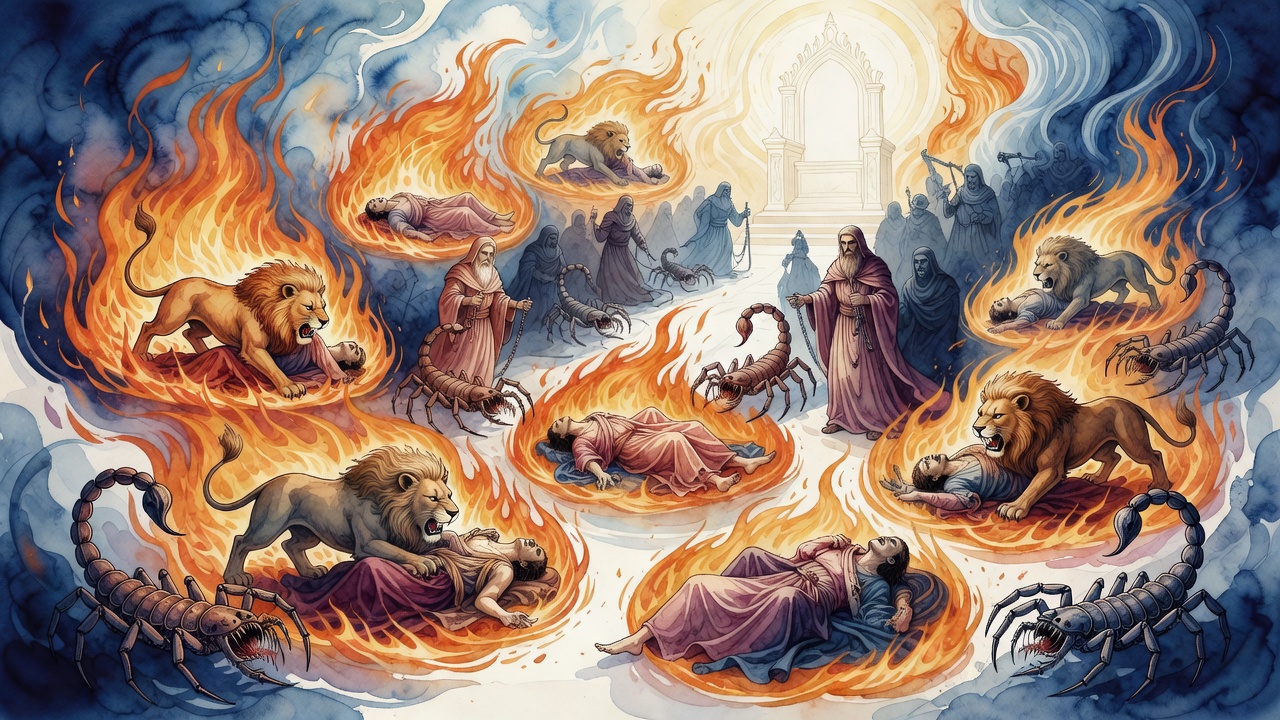
He watched the wicked arrive there in the blink of an eye. When a soul came loose from its body, destroying angels caught it and slung it to the angels of wrath, who slung it from the hollow of a sling straight into the fire, as a man slings a stone. But the opening sat in a cruel place. Standing in it, the wicked could turn and look east, clear across to the glory of the upright, and see what they had lost. They went ashamed and said, "Woe to us, who sinned and never busied ourselves with Torah and its commandments." Then angels armed with thornbushes drove them northward, down to the floor of Gehinnom itself, and the looking only made the burning worse.

The Storm That Ties the Floors Together

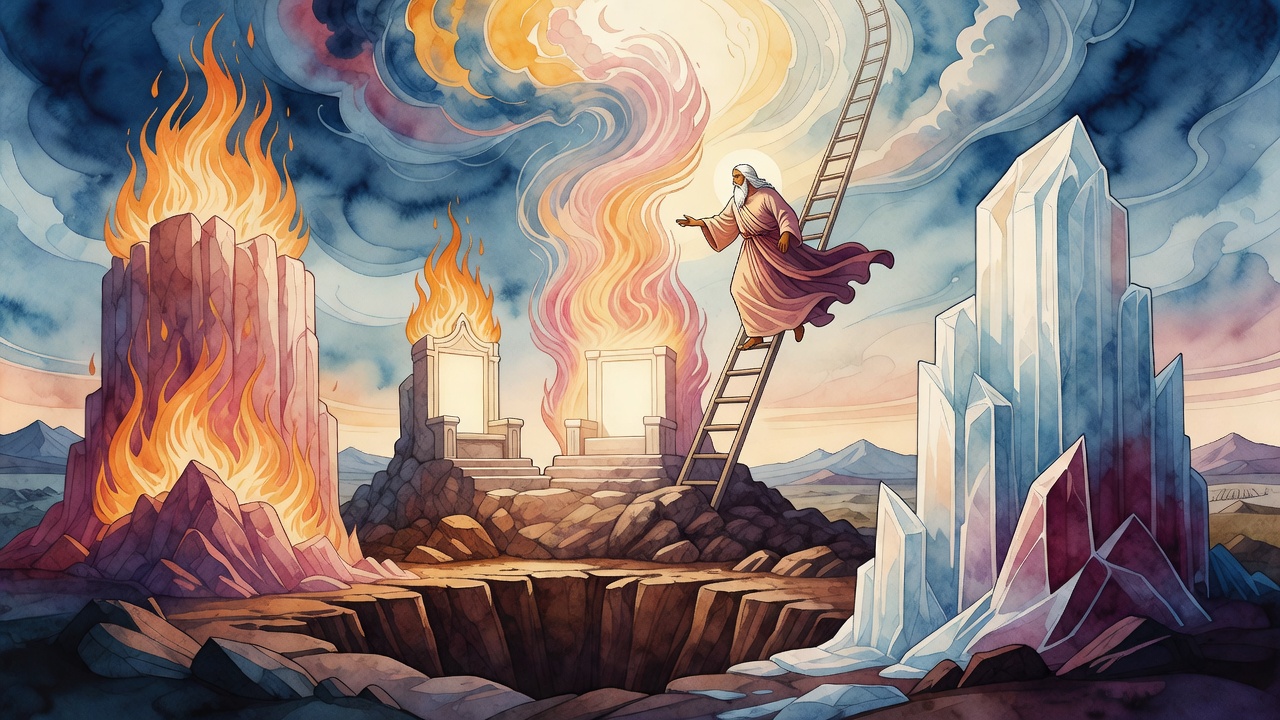
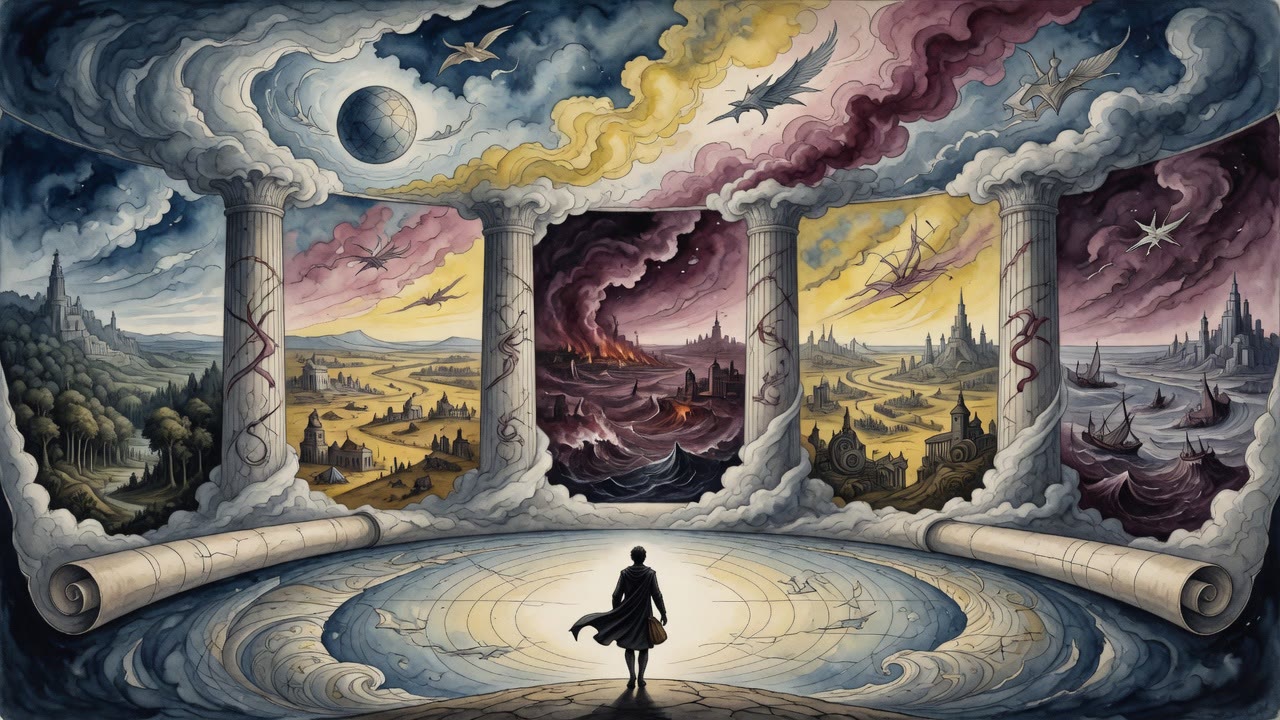
"Now look at what holds it up," the voice said, and the traveler looked down through everything he had crossed. Nothing rested on anything solid. Each floor hung inside a storm tied to the rim of the dome beneath it, and that dome hung inside its own storm, tied to the next. The waters of the world stood on a fire called Chashmal, the Chashmal on mountains of hail, the hail on storehouses of snow, the snow on storehouses of fire and water, all of it on the deep. The lord of the deep had a face like three heads of an ox, and he stood between the upper deep and the lower deep, ordering the one to hold its water back and the other to send its water up, deep calling to deep.

Below the deep lay tohu, a green thread looped around creation, leaking darkness, and below that the sunken stones of bohu bleeding water. Floor hung under floor like one overturned bowl set inside another, never stacked, always nested. The lowest hung from nothing made. It hung on an arm. One arm of the Holy One held up the upper worlds, the other the lower, and beneath everything were the arms of the world.

The Wings Sealed With the Name

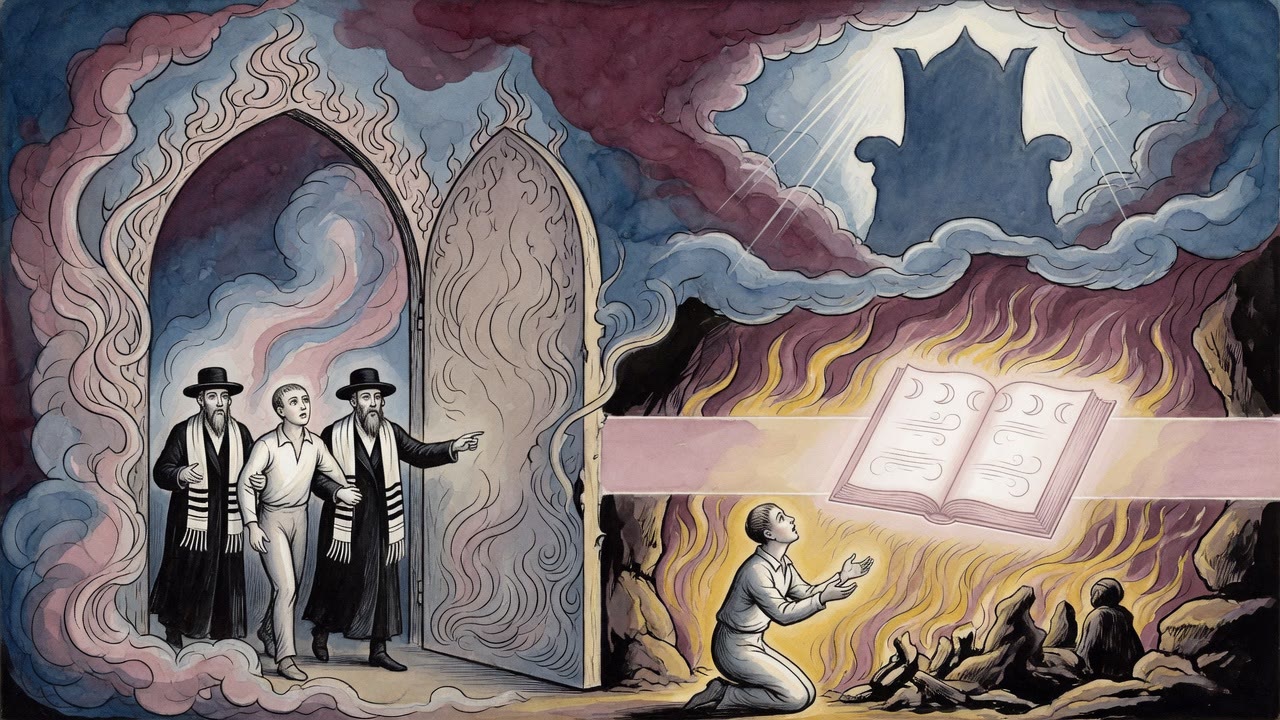
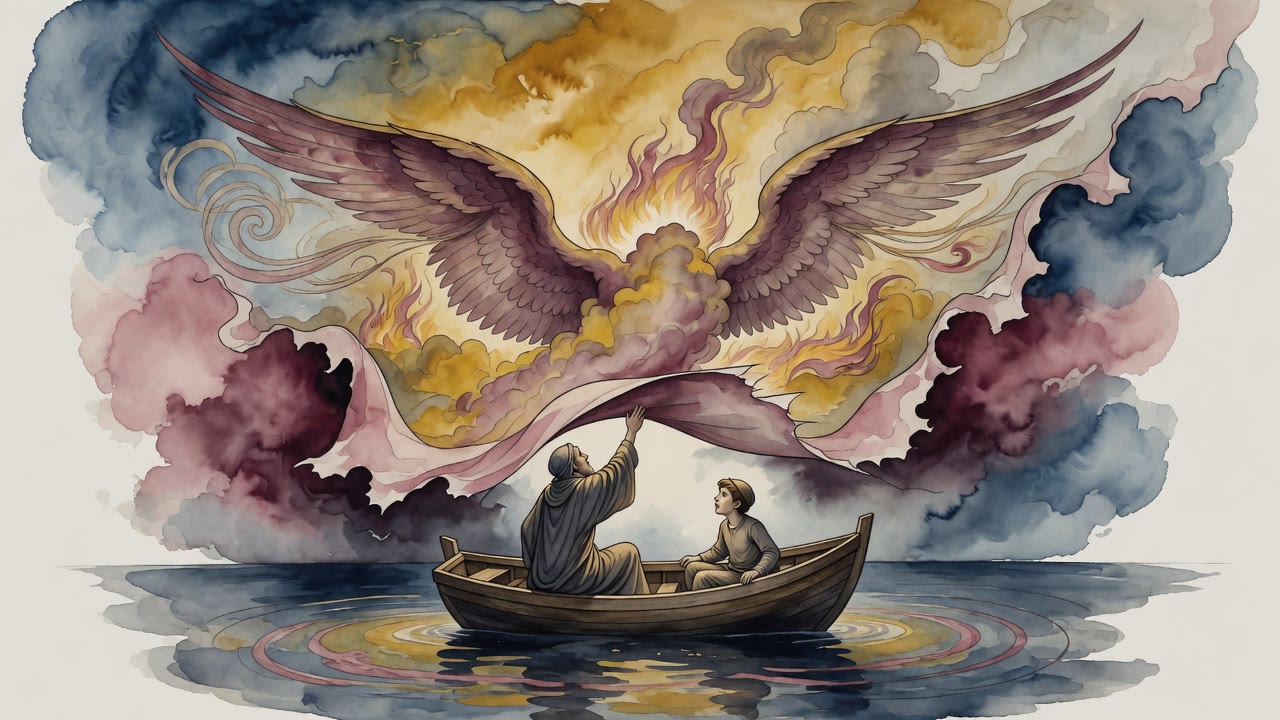
The voice carried him back up through all of it, past the storm and the deep and the mountain and the bickering folk, until his palm pressed again to the floor of Heled. This time, when he lifted his hand, he felt the pull on the other side. The wings of heaven were tied to the wings of the earth, and the wings of the earth tied back to the wings of heaven, and the knot between them was sealed with the Name of God. Above and below were not two places joined by accident. They were one cloth, and a tug on the lowest thread ran all the way up.

He stood on the settled world again. It felt solid. He knew now it was a lid, and that under it the floors went down, loud and burning and waiting, all the way to the arm that would not let go.


← All myths
From the tradition

Sources

4 sources

The texts this telling draws on, in full. Open a card to read inline, or expand it for a wider, quieter read.

Midrash Konen in Beit ha-Midrash 2:36Midrash Konen

We walk on solid ground, sure, but Jewish tradition sometimes whispers of other worlds, hidden realities layered beneath our own. Imagine: not just dirt and rock, but entire ecosystems, civilizations even, thriving in the Earth's shadow. According to some accounts, there are not just one, but six such worlds!

The best-known of these subterranean realms? It's called Tevel.

Tevel isn't just a darker version of our world. Oh no. The sun there rises in the west and sets in the east. Already, things are topsy-turvy! But the real strangeness lies in its inhabitants. The stories tell of 365 different kinds of creatures, none of them like anything we've ever seen. Then there are those with serpentine heads attached to human bodies, or, you guessed it, human heads atop snake-like forms. And don't even get me started on the human-headed oxen who can carry on a conversation!

Hold on, because the weirdness dial is about to get cranked up to eleven. The truly bizarre residents of Tevel are the creatures with two heads, four arms, and four legs.. all attached to a single trunk and stomach. Can you picture it? When they sit down to eat, they look like two separate people. But when they stand and walk, they're undeniably one being.

And are these creatures peaceful, living in harmonious bliss? Not a chance. They bicker constantly, arguing over the smallest things. One head wants to go one way, the other insists on going the opposite direction. As they only have one body, they take a step forward, then a step back, ending up exactly where they started. Stubborn and unyielding, they squabble all day long, until their stomachs rumble and they begrudgingly agree that it's time to eat.

But even mealtime is a battle! One head craves something hot, the other demands something cold. How do they solve this culinary conundrum? By preparing both, of course! They meticulously make the cold dish first, ensuring the hot meal doesn't lose its warmth while they're at it. Finally, they sit down to eat, and for a brief, shining moment, there's peace.

But it never lasts. As soon as the last morsel is swallowed, the accusations begin to fly. "You ate more than I did!" one head cries. "No, you ate more!" the other retorts.

We even hear of an encounter with these two-headed beings in the tales surrounding King Solomon. The demon king Ashmedai, in a display of his power, once pulled a two-headed man from Tevel itself, as we learn in Midrash Konen in Beit ha-Midrash (rabbinic interpretive commentary). This creature then married a human woman and fathered seven sons – six resembling her, and one, predictably, taking after his father. When inheritance time came, the two-headed father demanded two portions, leading to a dispute that was brought before the wise King Solomon.

How did Solomon resolve this bizarre inheritance battle? He cleverly scalded one of the heads. Both heads cried out in pain, proving to Solomon that despite their dual nature, they were indeed a single entity, and therefore entitled to only one share.

This story, as recounted in Seder Rabhah Bereshit, highlights a fascinating concept. Just as there are seven heavens, there are also, according to tradition, seven earths. Our familiar world is just the topmost layer. Beneath us lie these other worlds, each a distinct realm with its own unique characteristics and inhabitants, like the bickering two-headed creatures of Tevel.

What does it all mean? Perhaps these stories of Tevel and its strange inhabitants are simply fantastical tales meant to entertain. Or maybe, they’re a reminder that the world is far more complex and mysterious than we can ever fully comprehend. Maybe they are metaphors for the internal battles we all face, the conflicting desires and impulses that pull us in different directions. Or perhaps, just perhaps, they are glimpses into a reality that exists just beyond our perception, waiting to be discovered. What do you think?

Full source
1 Enoch 22:1-141 Enoch

One early picture, found in the ancient text 1 Enoch (specifically, chapters 22:1-14), dating way back to the second century BCE to the first century CE, paints a fascinating scene.

A colossal, towering mountain. This isn't just any mountain; it's a gathering place, a cosmic waiting room, if you will, for the spirits of the departed. The destination? Sheol. Now, Sheol, in this context, is often translated as "the underworld," or "the grave" but it’s more than just a final resting place. It’s an assembly point.

Within Sheol, a separation occurs. The spirits of the righteous are distinguished from those of the sinners. Each group occupies its own space, awaiting the ultimate Day of Judgment.

The story doesn't end there. Even in this in-between state, the spirits aren't silent. Their voices rise, ascending from Sheol to the heavens, pleading for mercy. Think of it as a constant, celestial appeal.

And among those voices, one stands out: the spirit of Abel, murdered by his own brother, Cain. According to this ancient understanding, Abel's spirit continues to cry out, making his case against the "seed of Cain" until they are utterly wiped from the earth.

Where does this idea come from? Well, it echoes the powerful words in (Genesis 4:10): "Your brother's blood cries out to me from the ground!" It’s a visceral image, isn’t it? The idea that such a terrible deed – fratricide, no less! – can never truly be forgotten, that its consequences ripple through eternity.

Later Jewish thought shifted a bit. The concept of Gehenna, a sort of Jewish hell, began to overshadow Sheol. Gehenna became the place where souls were punished and purified. But the core idea remains: actions have consequences, even in the afterlife.

And what about this "seed of Cain"? The idea here is that the conflict between good and evil isn’t just about individuals; it's about lineages, about the legacy passed down through generations. It’s the ongoing struggle between the descendants of Cain (traditionally seen as the enemies of the Jewish people) and the descendants of Abel (or, more accurately, the descendants of Seth, since Abel didn't have any descendants of his own that we know of).

So, what does this all mean? It's a potent reminder that our actions have profound and lasting effects. The echoes of our choices reverberate through time, influencing not only our own destinies but also the destinies of those who come after us. It challenges us to consider the legacy we're creating, and whether our actions will contribute to a world where justice prevails, or one where the cries of the wronged continue to rise from the depths of Sheol.

Full source
Otzar Midrashim, Midrash Konen ('He Established') 2:8Midrash Konen

South, settlement: the southern direction contains the chambers of Teman. They are storehouses of fire and a cave of vapor, tempest, and storm, as it is written, "From the chambers comes the tempest" (Job 37:9), and it is written, "He went in the storms of Teman" (Habakkuk 3:10). "From mezarim comes cold" refers to the northern wind, which cools the world with snow.

The measure of the storehouses, chambers, and cave is two thousand nine hundred sixty-five years. There is the opening of Gehinnom. The wicked enter there, then turn and see from the eastern direction. They look at the glory of the righteous, become ashamed and distressed, and say, "Woe to those who sinned and did not occupy themselves with Torah and commandments."

Destroying angels lead them with thorn-bushes until they reach the depth of Gehinnom, which is in the northern direction. There are one hundred four years between the opening of Gehinnom and the settlement in the south. When the soul flies from the body, destroying angels receive it and sling it in the blink of an eye to angels of wrath, and the angels of wrath sling it into Gehinnom, as it says, "He shall sling out the soul of your enemies as from the hollow of a sling" (1 Samuel 25:29), and they afflict it in Gehinnom.

It comes out that the expanse of the world contains sea, wilderness, settlement, Gan Eden, and Gehinnom. All four of its borders are a journey of seven times one thousand thousands, plus four hundred seventy-five thousands and five hundred four years.

The sphere of the sun travels from morning to evening five hundred years, and it enters the inhabited world only fifteen hours in the year. The moon travels less than it by eleven hours, and it enters the inhabited world only six hours. The length of the world is five hundred years, its width is five hundred years, and its thickness is five hundred years, and it is round.

The Great Sea, called Ocean, surrounds it. The Great Sea stands on Leviathan's fins, and Leviathan dwells in the lower waters. Compared with them, it is only like a small fish inside the sea. The lower waters stand at the edge of the waters of Ocean, and compared with them they are only like a small spring at the edge of the sea. So are the lower waters compared with the waters of Ocean.

The waters of Ocean stand at the edge of the waters of creation, and the waters of Ocean are like a small spring at the edge of the sea compared with them. The waters of creation stand at the edge of the weeping waters, and compared with them they are like a small spring at the edge of the sea. The weeping waters hang and stand over the lower earth. The lower earth is spread over the waters, as it says, "Who spreads the earth over the waters" (Psalms 136:6).

The waters stand on Chashmal. Chashmal stands on mountains of hail, mountains of hail on storehouses of snow, storehouses of snow on storehouses of water and fire, and storehouses of water and fire on the deep. What is the prince of the deep like? Like three heads of an ox. He stands between the upper deep and the lower deep and says to the upper deep, "Diminish your waters," and to the lower deep, "Bring forth your waters," as it says, "Deep calls to deep" (Psalms 42:8).

The deep stands on tohu. Tohu is like a green line surrounding the whole world like a thread, mediating between the ends of the heavens and the ends of the heavens. From there darkness goes out. Tohu stands on bohu, which are sunken stones immersed in the deep, and from them waters go out, as it says, "He shall stretch over it the line of tohu and the stones of bohu" (Isaiah 34:11).

Bohu stands on sea, sea on sweet waters, sweet waters on mountains, mountains on wind, wind on the wings of storm, and storm hangs and is tied to the edge of the lower earth. The lower earth is in storm, and storm hangs and is tied to the dome of Adamah. Adamah hangs in storm, and storm hangs and is tied to the dome of Haravah. Haravah hangs in storm, and storm hangs and is tied to the dome of Yabbashah. Yabbashah hangs in storm, and storm hangs and is tied to the dome of Arqa. Arqa hangs in storm, and storm hangs and is tied to the dome of Tevel. Tevel hangs in storm, and storm hangs and is tied to the dome of Heled. They are not one on top of another, but like one dome inside another dome.

The domes of the seven firmaments are held by their hooks like the dome of a bowl turned over on a table. Heled is the settlement of the world. Heled hangs in storm and is tied to the dome of Vilon. Vilon hangs in storm and is tied to the dome of Rakia, and Rakia and its hooks are held in the hooks of Tevel. Rakia hangs in storm and is tied to the dome of Shehakim, and the hooks of Shehakim are held in the hooks of Arqa. Shehakim hangs in storm and is tied to the dome of Zevul, and the hooks of Zevul are held in the hooks of Yabbashah.

Zevul hangs and is tied in storm to the dome of Maon, and the hooks of Maon are held in the hooks of Haravah. Haravah hangs in storm and is tied to the dome of Makhon, and the hooks of Makhon are held in the hooks of Adamah. Makhon hangs in storm and is tied to Aravot, and the hooks of Aravot are held in the hooks of the lower earth. Aravot hangs on the arm of the Holy One, blessed be He, as it says, "and beneath are the arms of the world" (Deuteronomy 33:27). Samuel said: Why are these two arms? One on His right supports the upper realms, and one on His left supports the lower realms. Therefore it says, "and beneath are the arms of the world."

After the lower earth comes the Throne of Glory, surrounded by fire and water. After thunderings, fire and water surround quaking and trembling. After quaking and trembling, lightning and thunder surround. After lightning and thunder, sparks and shakings surround. After sparks and shakings comes the likeness of the living creatures. After the likeness of the living creatures, running and returning. After running and returning, words of tumult. After words of tumult, the sound of thin silence. After the sound of thin silence, they say, "Holy, holy, holy." After they say "Holy, holy, holy," they say, "Blessed is the glory of the Lord from His place" (Ezekiel 3:12). After they say, "Blessed is the glory of the Lord from His place," they say, "Blessed is the glory of the Lord forever and ever."

Full source
Midrash Konen in Beit ha-Midrash 2:25Midrash Konen

There's this beautiful image tucked away in the Midrash Konen (found in Beit ha-Midrash (rabbinic interpretive commentary) 2:25), this idea that "the wings of heaven are tied to the wings of the land, and the wings of the land are tied to the wings of heaven, and sealed with God's name."

Isn't that evocative?

What could it possibly mean?

Essentially, it's a poetic way of expressing one of the core principles of Kabbalah: "As above, so below; as below, so above." It's a mirror. A reflection. What happens in the heavenly realms, the Olam Ha'atzilut, the world of emanation, has repercussions down here in our everyday reality, the Olam Ha'asiyah (the World of Action). And conversely, our actions, our prayers, our intentions ripple upwards, influencing the spiritual spheres.

Think of it like this: imagine a story. The threads running horizontally represent the earthly realm, and the vertical threads represent the heavenly. They are interwoven, inextricable. Pull on one thread, and you affect the entire design.

It's a powerful idea, isn't it? The implication is that we are not passive observers in the universe. We are active participants. Our choices matter. Our spiritual work matters.

And the image of "wings," specifically, is also telling. Wings imply movement, ascent, and connection. They speak of the ability to transcend limitations, to bridge the gap between the physical and the spiritual. It suggests that the land itself, the earth, has the potential to take flight, to reach towards the divine. And conversely, that the heavens themselves are anchored, connected, to the very ground we stand on.

And sealed with God's name? That's the ultimate guarantee. It suggests that this connection, this mirroring, is not accidental, but divinely ordained. It’s embedded in the very fabric of creation.

So, next time you look up at the sky, remember the wings. Remember the connection. Remember that what you do here, now, has implications far beyond what you can see. Maybe, just maybe, you're flapping your own wings, influencing the heavens above.

Full source