The Seven Burning Houses Inside Gehinnom
Seven fiery chambers where lions eat the dead and begin again, traitor-kings warden the nations, and scorpions with countless mouths lash the prostrate.
Table of Contents
 Click for full size
The First House Eats Its Dead and Begins Again
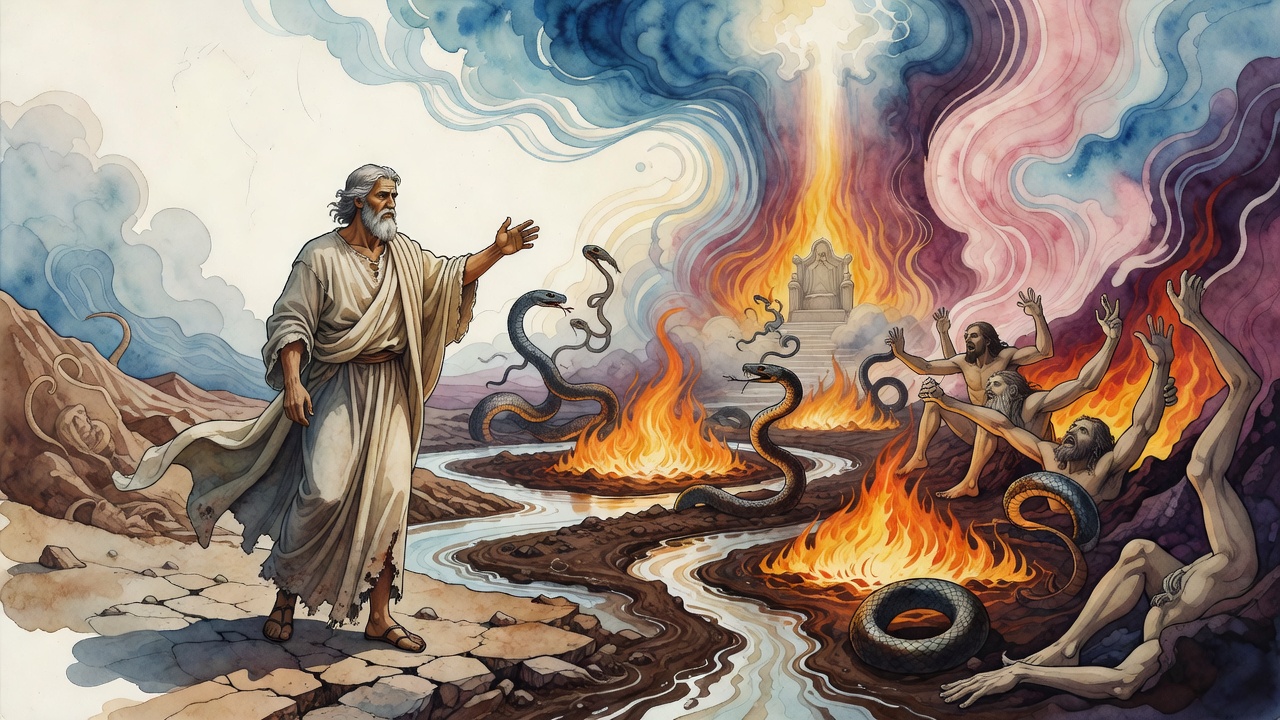
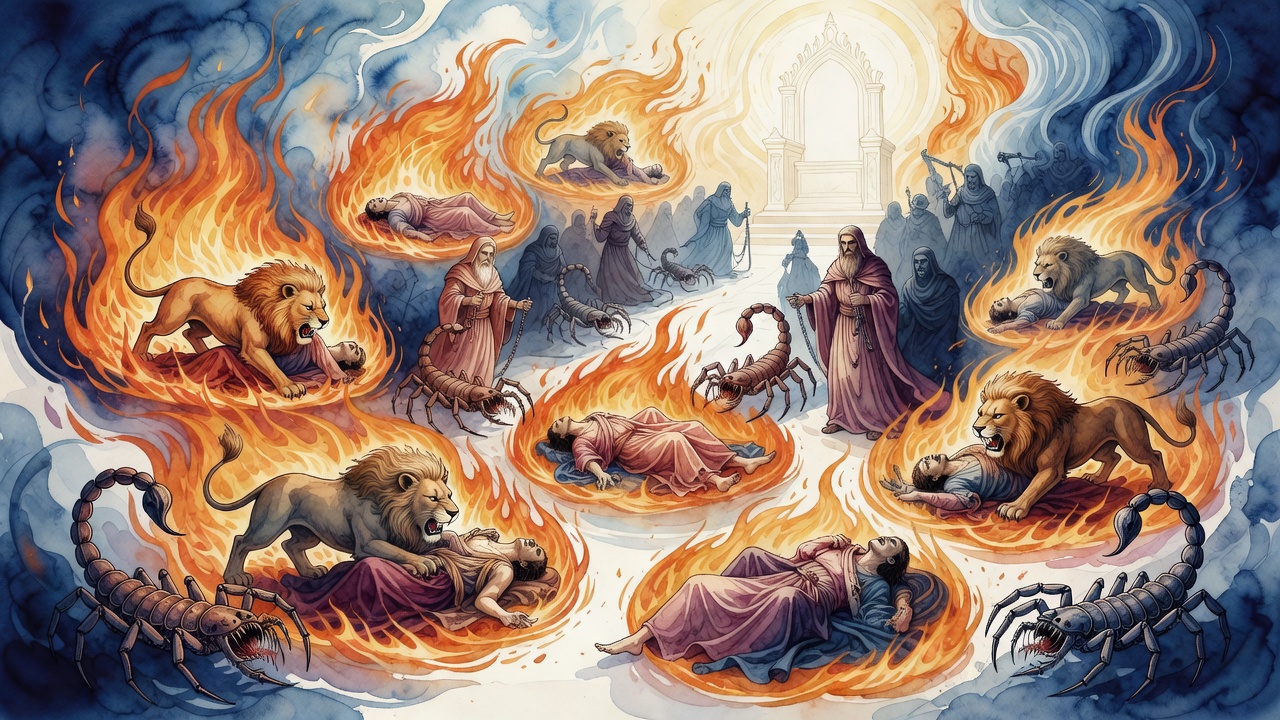
The first house has no floor. It opens into pit beneath pit, and at the lip of every pit a lion stands, and the lions are made of fire. A man falls. Before he strikes the bottom the lions are already upon him, and the fire that is their bodies takes him the way flame takes dry straw, fast, complete, leaving nothing. Then the nothing gathers itself. Flesh returns to the bone, the bone to its socket, the man to the man he was, and he stands at the lip of the pit once more, whole and aware, and he falls again, and the lions eat him again. This is the first house. It has no other business.
Beyond it the rooms open in sequence, and in each of them ten thousand myriads from the nations of the world are stretched out for judgment twice a day. Over each crowd an angel stands with a rod of fire, and each angel has a name, and the names are not gentle. Kushiel in the second house. Shaftiel in the third. Matniel in the fourth. The rod comes down on the prostrate ranks, lifts, comes down. The angels do not tire. The rod does not cool.
The Wardens Who Were Once Kings of Israel
What turns the chambers strange is who stands over the foreign multitudes. They are not strangers. In the second house, set above the nations like a foreman, is Absalom, who once rode out of Israel to take his father's throne. When Kushiel raises the rod against the crowd, a voice comes down from above and says, "Leave him." Leave Absalom out of the blow. The voice gives the reason without softening it. He is spared for the merit of his father David, and for the oath his fathers swore at Sinai when they answered with one mouth, "We will do and we will hear."
So it goes through the houses, each governed by a famous traitor pulled back from his own punishment to preside over someone else's. Korah in the third house, who opened the earth under his own feet, exempted by the merit of Levi. Jeroboam son of Nebat in the fourth, who split the kingdom, exempted by the merit of Ephraim. Ahab in the fifth. Micah in the sixth, the man who carried his idol through the wilderness. Each of them rescued from the rod of fire by a single line: his fathers said at Sinai, "We will do and we will hear." The oath outlasts the crime. It reaches down into the seventh house, where the angel Rogziel stands, and there it stops. With the nations in the last chamber stands Elisha ben Abuyah, the sage who looked into the orchard and lost his faith, called Acher, the Other. For him no voice comes down. He is judged with the crowd he was set over.
Twelve Months Measured Out in Itch and Snow
Hezekiah the king counted the full sentence and named it. Twelve months. Six in the heat and six in the cold, and the two halves do different work. At the start the Holy One brings upon the wicked an itching that crawls under the skin and will not be reached, and the burning is so total that the damned cry out and name it. "This is the Gehinnom (the realm of judgment after death) of the Holy One," they say. They mean the fire.
Then He takes them out of the heat and drives them naked into the snow. The cold closes over them, and they cry out again and name this too. "This is the cold of the Holy One." In the heat their cry is one sound, a short animal "Wah." In the snow it lengthens and breaks into "Woe." David sang of being lifted out of that pit of tumult, out of the miry clay, out of the place where the mouths go from Wah to Woe. And where does the sentence finally end them? Rabbi Yehudah said, in the snow. The snow is where they meet their Zalmon. The same snow that the wicked die in, the household of Israel does not fear, because Israel is clothed in scarlet, in circumcision and tzitzit (ritual fringes) and tefillin (boxes of scripture bound on arm and head) and the open hand that gives and gives again.
The Scorpions With Seventy Thousand Mouths
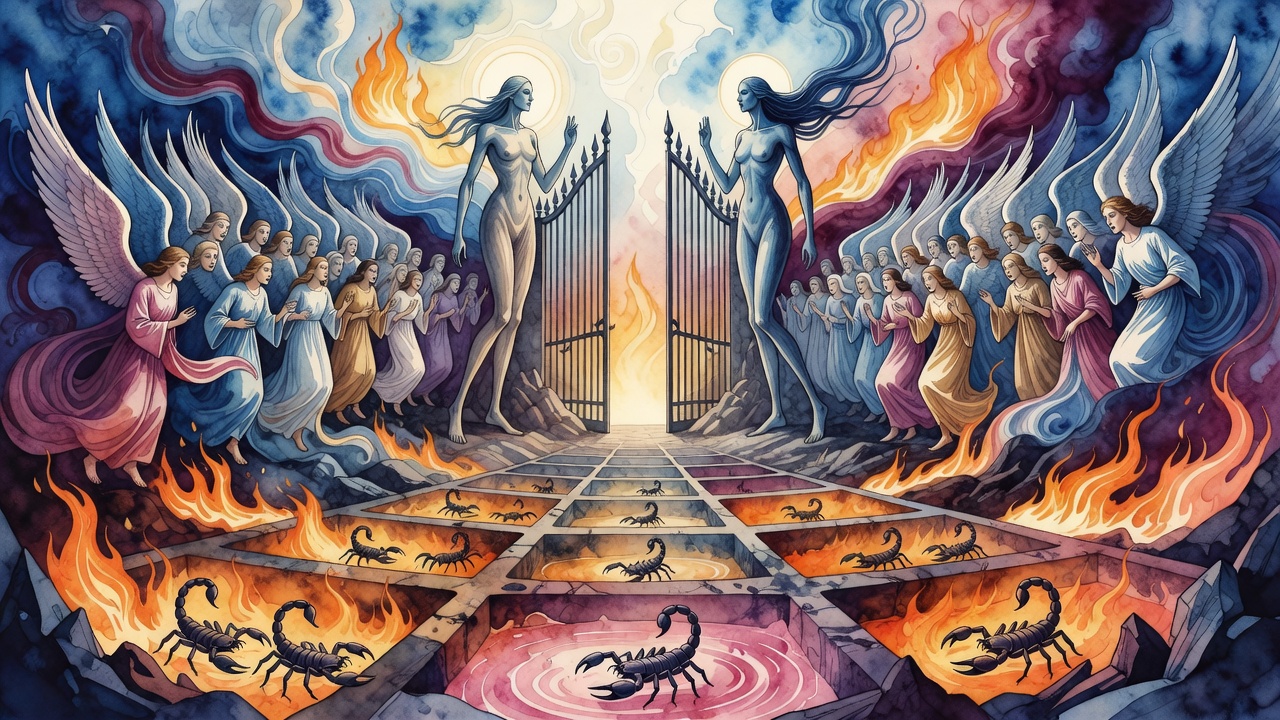
Lower than the houses, on a floor where the dead lie utterly flat and cannot rise, the scorpions move over them. Two thousand of them. Each scorpion is not a scorpion as the desert knows it. Each one carries seventy thousand heads, and on every head seventy thousand mouths, and in every mouth seventy thousand stings, and in every sting seventy thousand pouches of venom. The arithmetic is a kind of torture by itself. The prostrate sinners are made to drink the poison down, and as they drink their eyes melt in the sockets and run out over their faces.
The angel Nasargiel walks this floor and names the crimes, plainly, like a sentence read in a court. These are the ones who ruined fellow Israelites and stripped them of their money. The ones who lifted themselves above the community as though they were a finer kind of person. The ones who shamed a neighbor in public until the shame stuck. The ones who handed their own people over to the nations. And the worst of them, the ones who denied the Torah of Moses, who said the world had no Creator. For these the scorpions were made.
The Black Fire Wall and the Gate That Will Not Stay Open
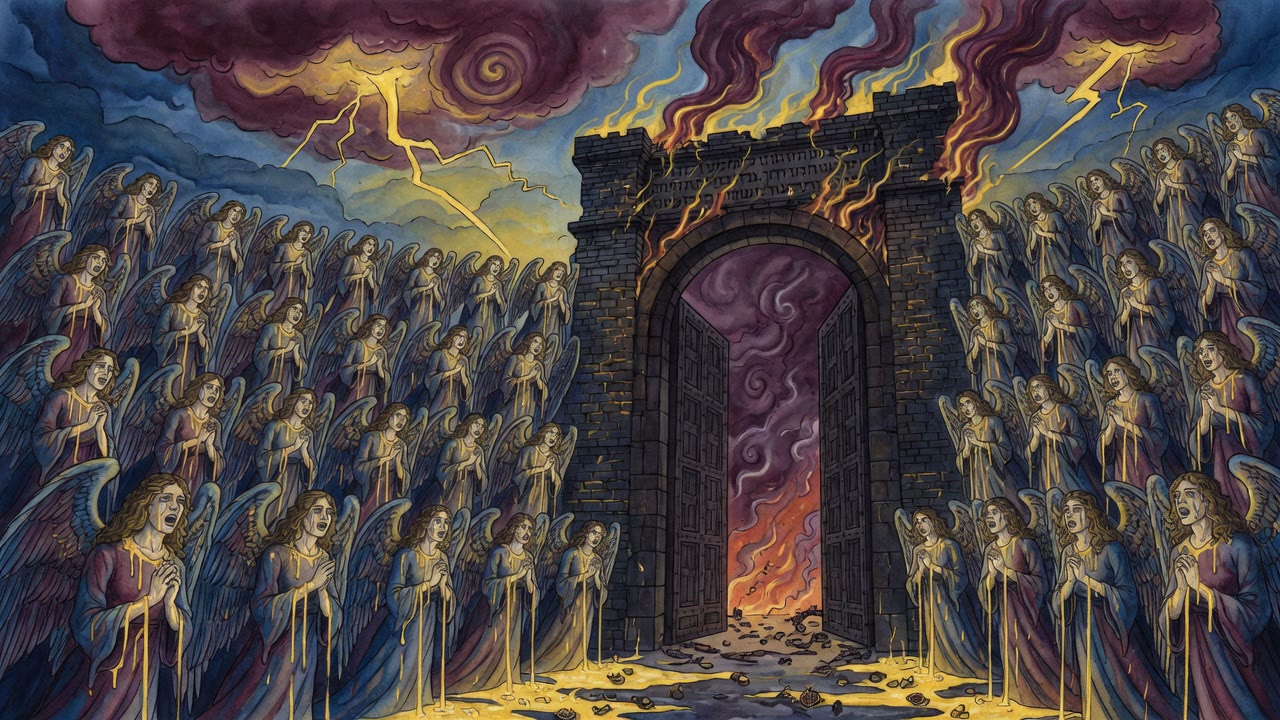
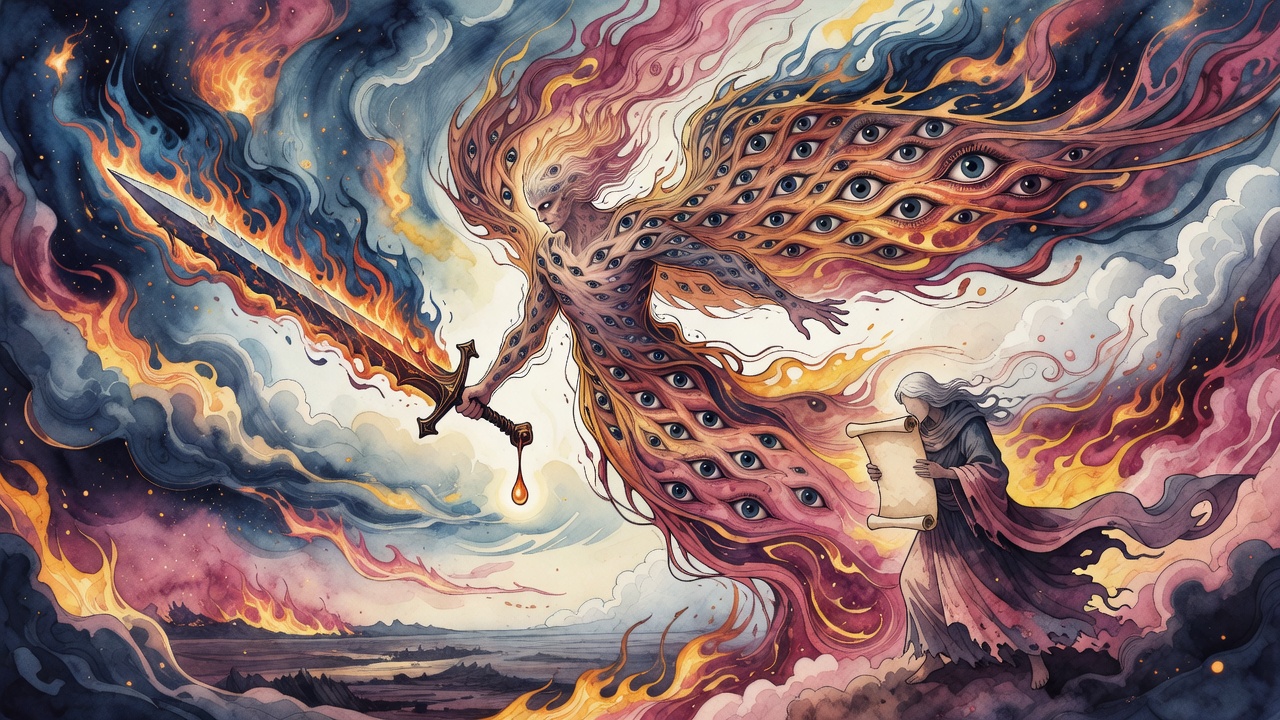
And yet Gehinnom (the fiery place of punishment after death) is not the end of every road. Far above, the outer wall of Gan Eden (the Garden of Eden) stands, and it is built of black fire, seen and not seen, and a sword of flame turns around it without rest, day and night, eating every green thing within a mil of the garden. Four gates pierce the wall. Between the outer wall and the second is a band of six hundred cubits, and the souls who stand in that band are the in-between dead, the righteous of the nations, the kings who once rescued Israel, the converts who came in imperfectly.
Their rest is not rest. From the hour of the afternoon prayer the angels of destruction gather at their backs to drag them down toward Gehinnom, and they cry out, and an angel named Azriel comes and tears them loose from the destroyers' hands. Three times between afternoon and evening the destroyers seize them and Azriel pulls them back, and the whole repeated rescue is itself a kind of torment, a soul snatched from the fire only to be marched toward it again. But those who go into the fire and come out the other side, purified, are carried up past the turning sword by three ministering angels, and they pass within the black wall, and there they stand at last and take a little of the radiance of the righteous, and no one strikes them anymore.
← All myths