5 min read

Moses Walked Through Gehinnom Before He Died

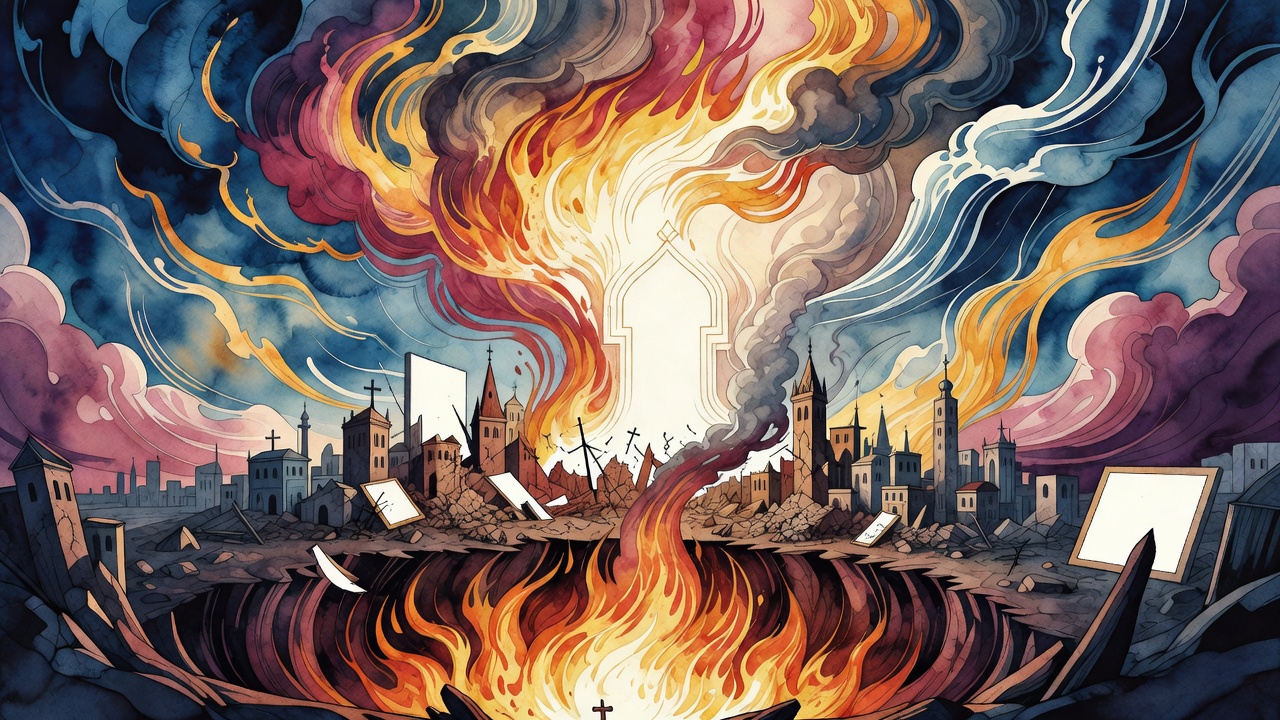
Before Moses died, he saw mud, fire, venom, and souls held by the limbs that sinned. Gehinnom had a terrible order beneath mercy.

Curated by Arthur · Told by Maggid ·
Table of Contents
  1. The Mud Held Them at the Navel
  2. The Limbs Remembered Their Crimes
  3. Three Gates Opened Below the World
  4. Seven Levels Descended Into Venom
  5. The Mountain Looked Like Reprieve

Moses saw the mud before he saw the mountain.

An angel led him through the places where consequences had bodies. This was not comfort before death. It was a tour of order sharpened into terror. No punishment floated loose. Every chamber knew what it was for.
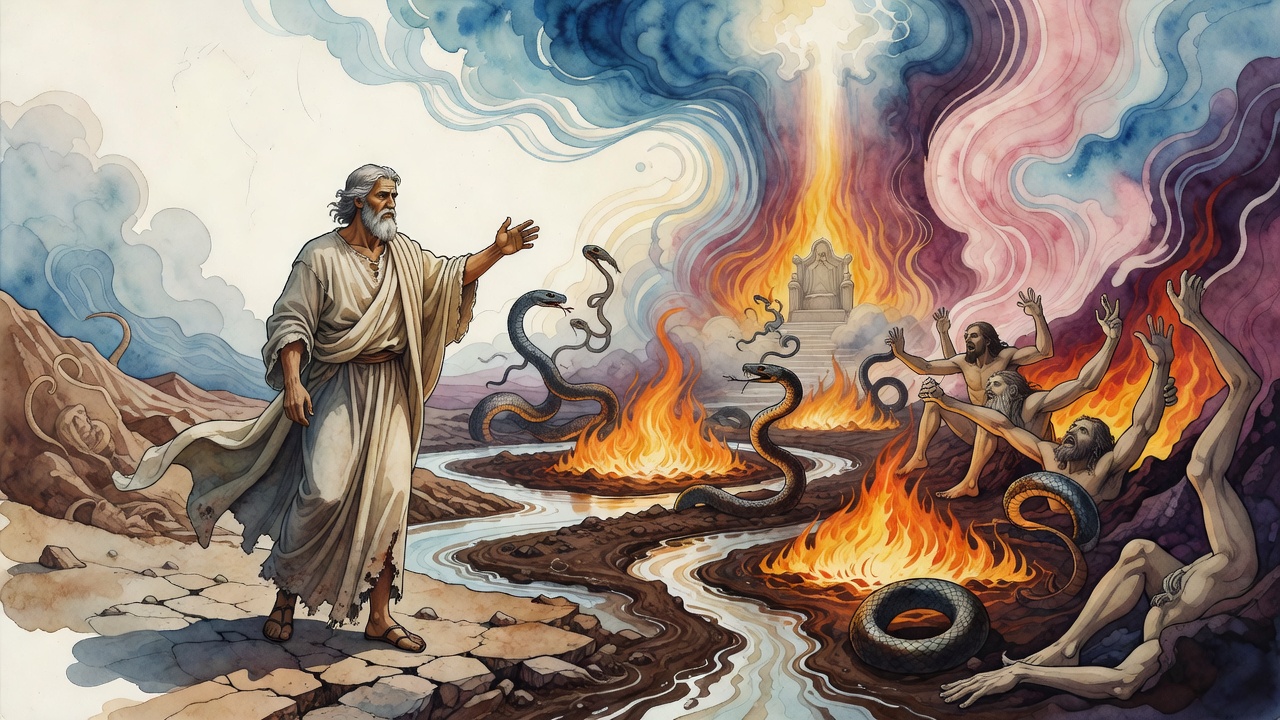
One place was called Tit ba-Yawen, the deep mire.

The Mud Held Them at the Navel

The sinners stood buried to their navels.

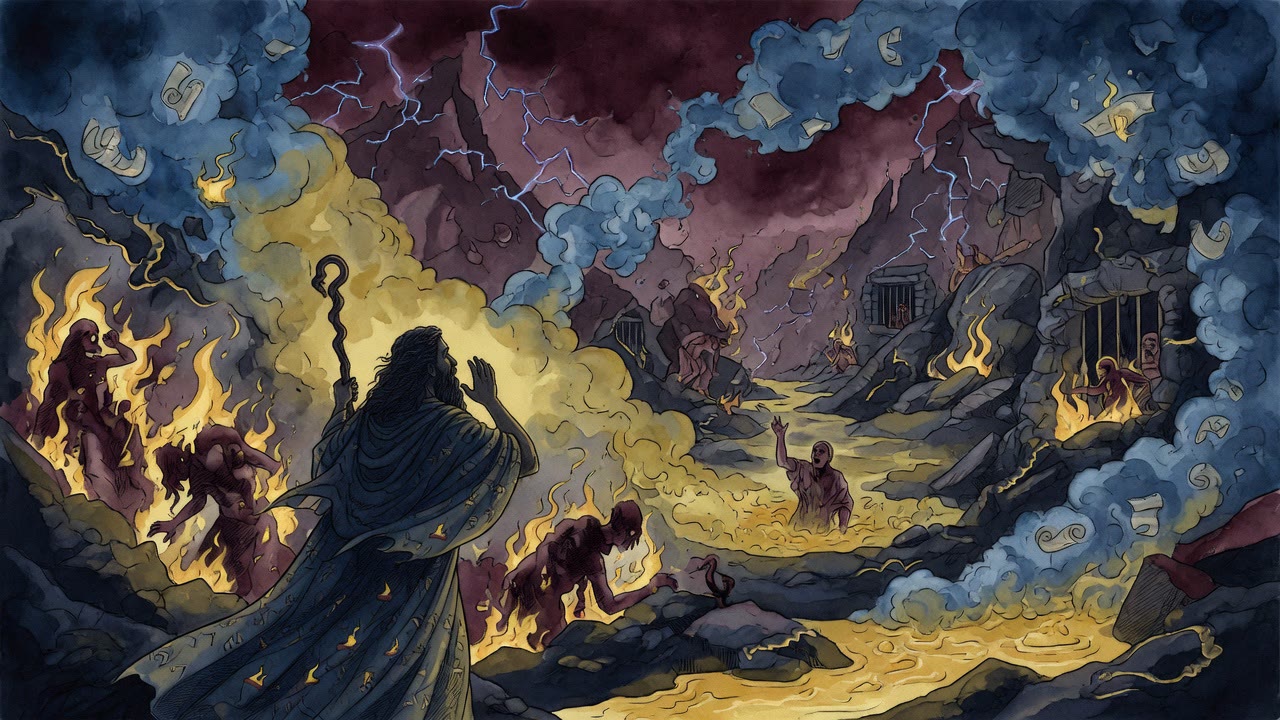
They could not climb. They could not sink away. Angels of destruction lashed them with fiery chains. Stones of fire shattered their teeth from morning until evening. Night restored the teeth to impossible length, only so morning could break them again. The body was not allowed to finish suffering by falling apart.

Moses looked at judgment that repeated itself because the wrong it answered had repeated itself in life.

The Limbs Remembered Their Crimes

In another place, the guilty hung by the parts of the body that had sinned.

Eyes that had reached greedily toward another's property were chained by the eyelids. Tongues that had lied and slandered swung in fire. Ears that had turned away from Torah hung with the tongue that filled the silence with emptiness. The keeper of the place did not speak in generalities. The body itself gave testimony.

Moses saw that nothing human was too small to be counted. A glance had weight. A word had weight. Refusal to hear had weight.

Three Gates Opened Below the World

Gehinnom had gates.

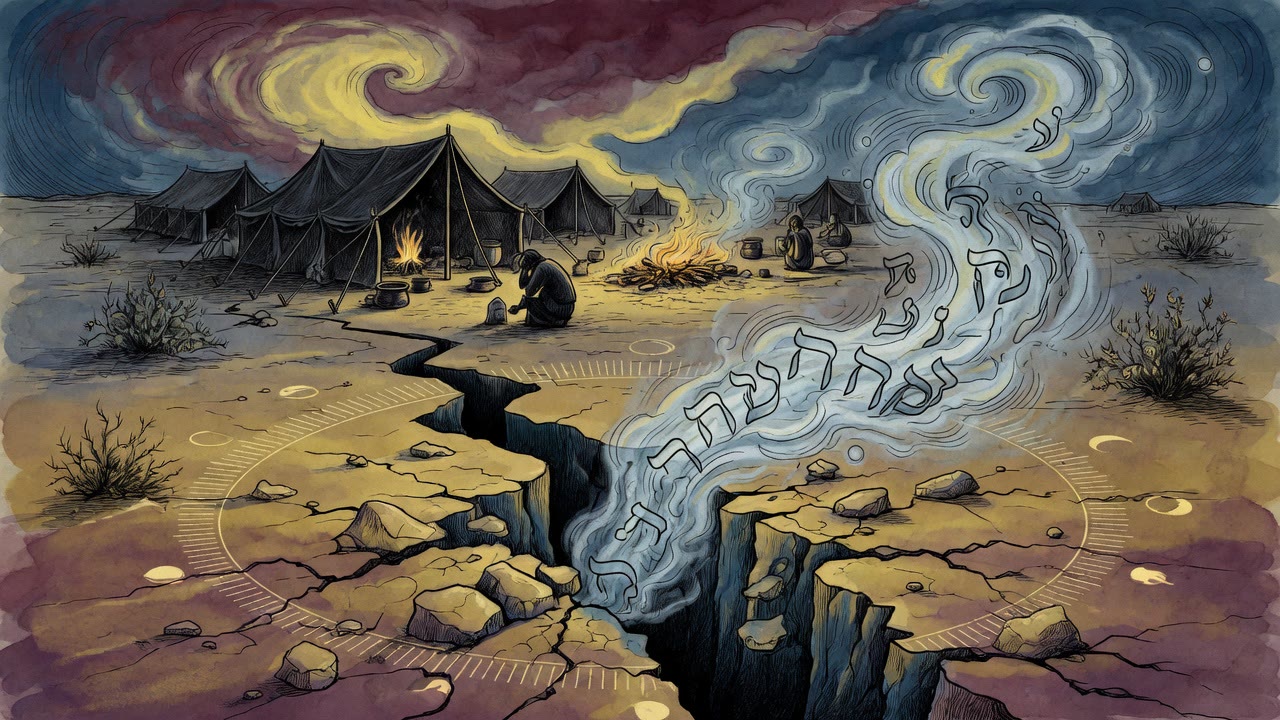
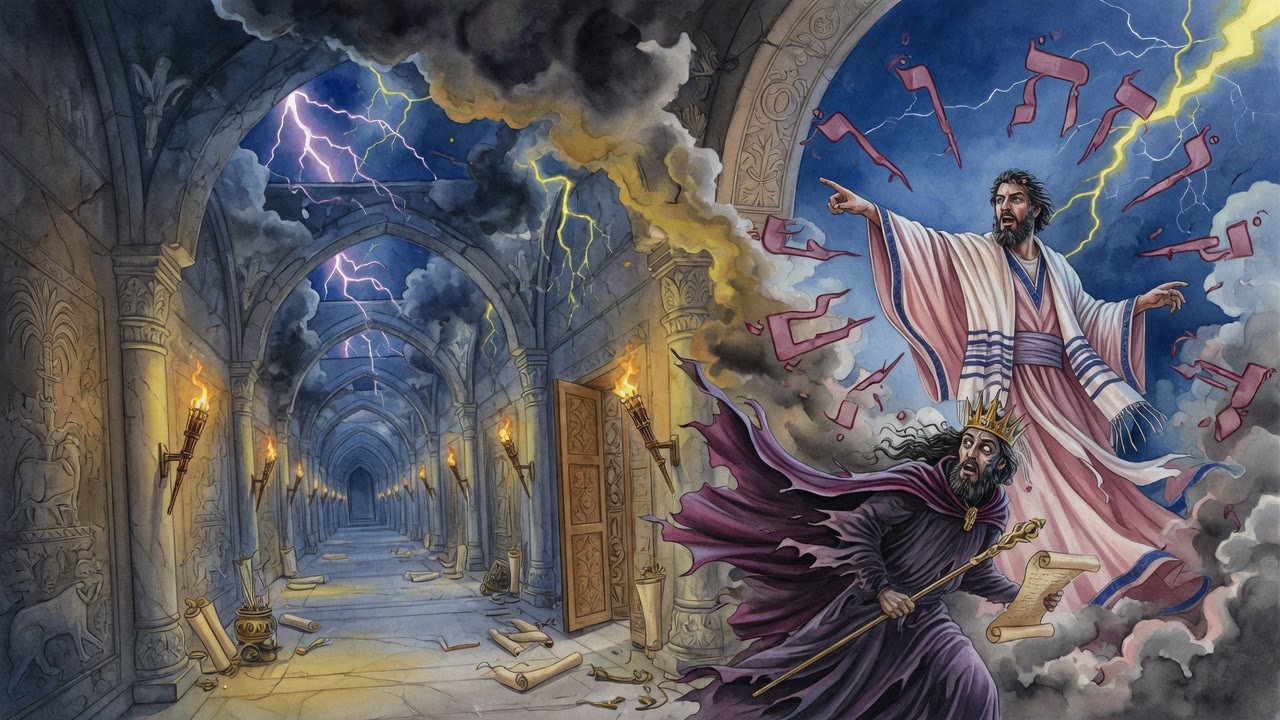
One opened at the sea, where Jonah cried from the belly of Sheol. One opened in the wilderness, where Korah's company went down alive. One stood in Jerusalem, where the prophet spoke of God's fire in Zion and furnace in the city. The gates were not random holes beneath the earth. They were wounds in the map of Israel's memory.

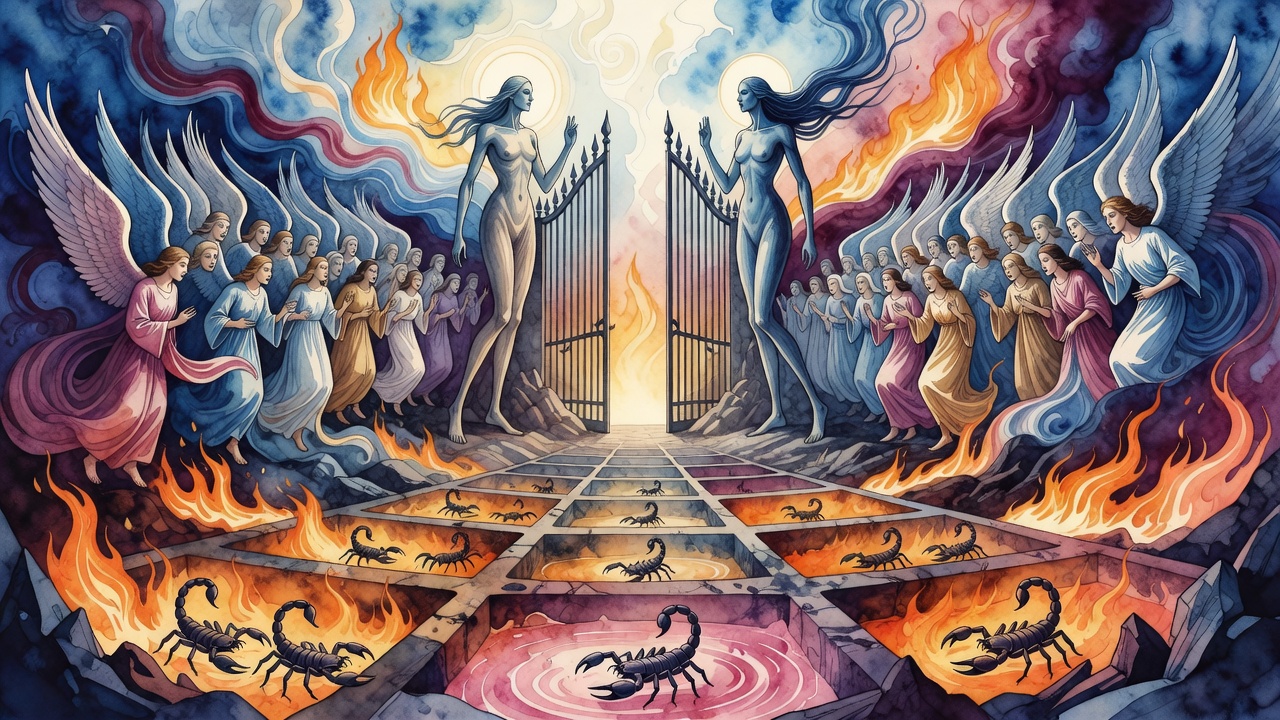
Five kinds of fire burned within. One devoured and absorbed. One absorbed without devouring. One neither devoured nor absorbed. Another fire could eat fire.

Seven Levels Descended Into Venom

The depths had names.

Sheol. Beer Shahat. Tit-Hayaven. Shaare Mavet. Abadon. Shaare Salmavet. Gehinnom. Each level stretched hundreds of years' journey in every direction. Crevices opened into scorpions. Scorpions carried chambers. Chambers held pouches of venom that poured rivers of poison. When the venom burst a body apart, angels gathered the limbs, rebuilt the person, and began again.

Even here, the system had boundaries. Torah and suffering could become rod and staff. A single act of mercy could matter at the gate.

The Mountain Looked Like Reprieve

Then Moses reached Mount Avarim.

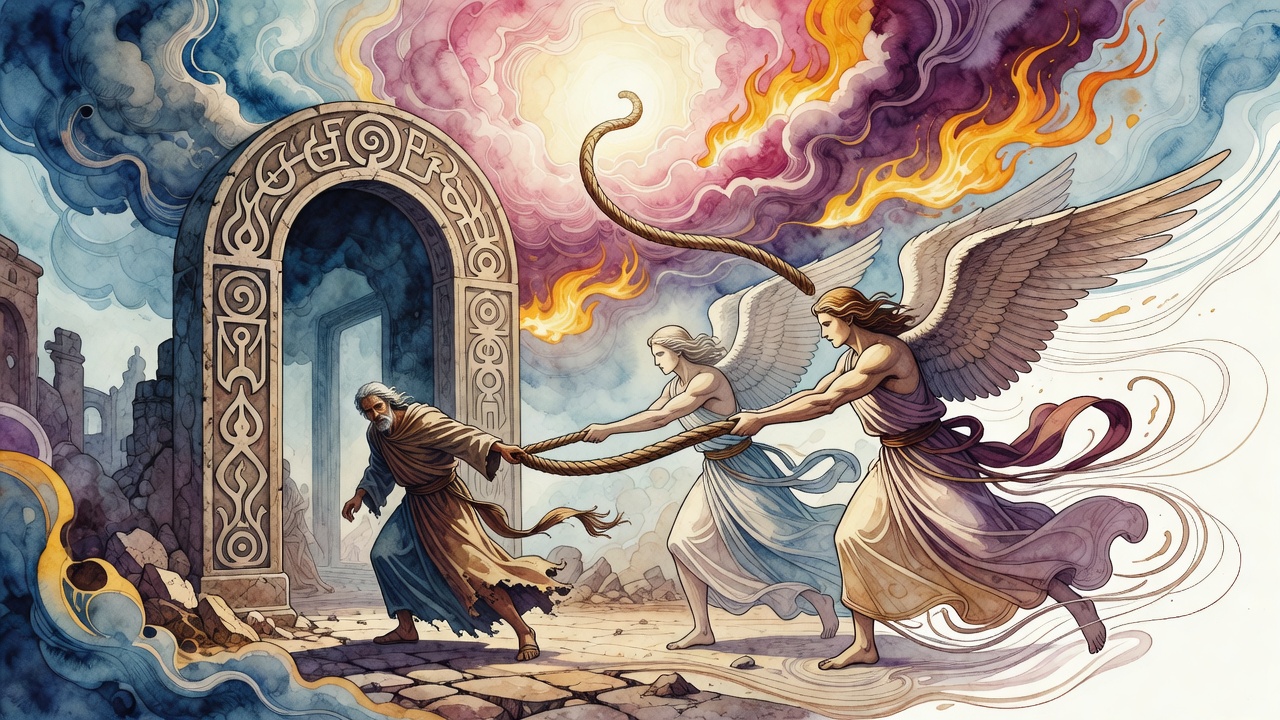
The land lay close enough to wound him. He saw the inheritance of Reuben and Gad, land east of the Jordan, and for a moment hope rose. Perhaps the decree had loosened. Perhaps he had already entered enough. He prayed again, like a son walking through the palace rooms toward the one chamber his father had forbidden.

The answer stopped him at the border. See with your eyes, but do not cross.

The same Moses who had seen souls unable to rise from mud now stood where he could see the land and not enter it. His own judgment was not Gehinnom. It was nearness. It was a door left visible and closed.

Then came the deeper mercy. If Moses was buried with the generation that died in the wilderness, they would rise by his merit. He would be the gold coin dropped in the dark so the copper coins could be gathered after him. His grave outside the land would become a pledge for those who had never reached it.

Moses had walked through punishments where every limb answered for itself. He ended by giving his whole body to the wilderness, so the lost could one day follow him home.

The tour also denied Moses the comfort of vagueness. He could not say the wicked suffer somewhere, somehow, in a way no one can name. The names were given to him. The gates were shown. The mud had a title. The fires had kinds. The levels had distances measured by years of walking.

Then the Jordan gave him another named boundary. Not punishment like the underworld, but decree. A line can be made of flame, water, mud, or riverbank. Moses learned that every border in heaven's order has its own law.


← All myths

From the tradition

Sources

6 sources

The texts this telling draws on, in full. Open a card to read inline, or expand it for a wider, quieter read.

Legends of the Jews 4:184Legends of the Jews

Jewish tradition certainly doesn't shy away from describing the consequences of truly wicked deeds.

Let's take a little journey Imagine Moses, guided by an angel, getting a guided tour of the afterlife. It’s quite the thing to behold, full of wonder and, well, terror.

One particularly grim stop on this tour is a place called Tit ba-Yawen. The name itself doesn't offer much comfort, does it? What Moses sees there is enough to make anyone reconsider their life choices.

Sinners, stuck in mud up to their navels. Already sounds pretty awful. But it gets so much worse. These poor souls are constantly lashed by the Angels of Destruction – terrifying figures wielding fiery chains. And if that weren’t enough, their teeth are broken with fiery stones… from morning until evening. Ouch.

Just when you think it couldn’t get any more gruesome, here's the kicker: during the night, their teeth miraculously grow back. A whole parasang long, we are told. (A parasang is an ancient Persian unit of distance, so we’re talking a seriously long tooth!) Only to have them broken again the next morning. It's a cycle of unending torment.

So, who ends up in this nightmarish mud pit? The angel Nasargiel helpfully explains to Moses, as we find in Legends of the Jews, the classic compilation of Jewish lore by Louis Ginzberg. It’s not a pretty list.

These are the people who ate nevelah (carrion, or meat from an animal that died naturally and wasn't properly slaughtered) and other forbidden foods. These are the ones who profited from usury – lending money at exorbitant interest rates. Those who, shockingly, wrote the Name of God on amulets for Gentiles. Can you imagine?

And the list goes on. Those who used false weights, cheating their customers. Those who stole from their fellow Israelites. Those who brazenly ate on Yom Kippur, the Day of Atonement, the holiest day of the year, a fast day. Those who consumed forbidden fats (chelev), abominable animals and reptiles, and…drank blood.

It’s a stark warning, isn’t it? A vivid illustration of the consequences of actions that violate fundamental principles of honesty, compassion, and respect for sacred boundaries. The Zohar, the foundational text of Kabbalah, often speaks of the interconnectedness of our actions and their repercussions in the spiritual realms. This image of Tit ba-Yawen certainly drives that point home.

It makes you think, doesn't it? About the weight of our choices, and the kind of world we’re creating, both here and… elsewhere.

Full source
Sifrei Bamidbar 134:4Sifrei Bamidbar

The verse in question is Bamidbar 27:12: "And the L-rd said to Moses: Go up to this Mount Avarim." Now, Mount Avarim overlooked the promised land. But it wasn't just any land; it was, according to this text, specifically the inheritance of the tribes of Reuven and Gad.

He'd been told he wouldn't. So, imagine his surprise, his surge of hope, as he's led to this place that's practically in the land!

Sifrei Bamidbar tells us that Moses, upon entering this territory, rejoiced. He thought, "It seems to me that He has revoked His decree!" Can you feel that optimism? That sense that maybe, just maybe, things are going to be okay? Overcome with hope, he "poured out supplication before the King" – he prayed with renewed fervor.

The text then gives us a powerful analogy. Imagine a king who has forbidden his son from entering his palace. The son gets closer and closer, passing the gate, then the storage room. Each step fuels his hope. But then, just as he's about to enter the inner chamber, the king stops him: "My son, from here on, you are forbidden."

Ouch.

That's what happened to Moses. He got so close, felt that hope so strongly, only to be reminded of the divine decree.

But here’s the key takeaway, the bit of wisdom that makes this passage resonate even today: even knowing the decree was in place, Moses still prayed. He still supplicated.

The text concludes with a powerful a fortiori argument – a method of argument from the lesser to the greater. It asks: "If Moses, the great sage, the father of the sages and the father of the prophets, even though he knew that a decree had gone forth against him, did not keep himself from supplication, how much more so should this hold true for other men!"

In other words, if even Moses, with all his wisdom and understanding, continued to pray despite knowing the likely outcome, how much more so should we?

Even when we face seemingly insurmountable obstacles, even when we know the odds are stacked against us, we should never stop praying, never stop hoping, never stop reaching out to the Divine. Because who knows? Maybe, just maybe, like Moses, we'll catch a glimpse of that inner chamber, that possibility of a change, that reason to pour out our hearts in supplication. And maybe, even if the decree remains, the act of prayer itself will bring us closer to understanding, acceptance, and ultimately, peace.

Full source
Sifrei Devarim 29:6Sifrei Devarim

Sifrei Devarim turns to Jordan, Covenant of Moses.

The verse in Devarim, Deuteronomy, says, "for you shall not cross this Jordan." It seems harsh, doesn’t it? After leading the Israelites for forty years, enduring hardship after hardship, Moses is denied entry into the very land he’d strived to reach. Why? The Torah tells us he disobeyed G-d's instructions earlier, striking a rock instead of speaking to it to bring forth water (Numbers 20:1-13). But the pain of that denial still resonates.

Sifrei Devarim, a collection of legal interpretations on the book of Deuteronomy, offers a powerful analogy to help us understand this moment. It paints a picture of a king and his son.

The king decrees that his son cannot enter his bedchamber. But what happens? The son enters the palace entrance, chatting with his father. He then walks into the reception room, continuing their conversation. He’s spending time with his father, engaging with him, but still skirting the one place he's forbidden to go.

It’s only when he actually tries to enter the bedchamber itself that the king firmly says, "From here on, you are forbidden."

That's the key to understanding this moment for Moses. He argued "All of me is separated from Eretz Yisrael, the Land of Israel, only by a fifty-ell string-length of this Jordan!" He was right there.

In ancient measurements, an ammah, or ell, was the length of a forearm, so we're talking about a relatively short distance. Moses was so close he could almost touch it. He’d poured his entire life into this mission, and the final barrier was so tantalizingly thin.

And yet..

G-d responds, "and see with your eyes, for you will not cross this Jordan." The nearness only seems to intensify the pain. He can see the land, envision its beauty, but he can't set foot there.

Why this analogy? What does it tell us? Perhaps it highlights the subtle nature of boundaries. The king didn't forbid his son from being near the bedchamber, only from entering it. Similarly, G-d allowed Moses to get incredibly close to the Promised Land, to see it, to understand its significance. But the crossing itself was forbidden.

It also speaks to the weight of leadership. Moses wasn’t just a man; he was a symbol. His actions carried immense weight. His transgression, however slight it might seem, had consequences not just for him, but for the entire nation.

Maybe the lesson here isn't just about obedience, but about the burden of responsibility that comes with leadership, and the heartbreaking reality that even the greatest among us sometimes fall short of their ultimate goals. It's a reminder that sometimes, seeing the Promised Land is all we're granted, and that even in that vision, there can be profound meaning and purpose.

Full source
Gaster, Hebrew Visions of Hell and Paradise, Revelation of Moses (A), sec. 35-38Hebrew Visions of Hell and Paradise

Inside Gehinnom Moshe came upon crowds of the guilty in the grip of the angels of destruction, and the sight of their suffering was almost too much to bear. Some hung by their eyelids, some by their ears, some by their hands, others by their tongues, every one of them swinging from chains of living fire and crying out without rest.

What struck Moshe was not the cruelty of the scene but its exactness. He asked the keeper of the place why one group should hang by the eyes and the tongue, and the answer revealed the logic of the whole region. Each person is held by the very part of the body through which the sin was committed. Those suspended by the eyes had looked with greed and lust at what belonged to their neighbors; those held by the tongue had borne false witness and poured out slander.

Others dangled by the ears and tongue together, and these, the keeper said, had turned away from the study of Torah and filled the silence with idle and empty talk. The vision is not meant to terrify for its own sake. It teaches that no deed evaporates, that the channel of a wrong becomes the measure of its accounting, and that words and glances weigh as heavily on the scale as the hand that takes.

Full source
Chronicles of Jerahmeel XIVChronicles of Jerahmeel (Gaster, 1899)

Two bands of angels stand at the gates of Gehinnom (גהינום) and call out one word: "Come! Come!" According to the Chronicles of Jerahmeel, a 12th-century Hebrew chronicle compiled by Jerahmeel ben Solomon, Rabbi Eliezer explained that these angels are the "two daughters of the leech" mentioned in (Proverbs 30:15). The name Gehinnom itself means "Valley of Wailing" because the sound of its screaming traverses the entire world from end to end.

Gehinnom has three gates. One gate opens at the sea, referenced by Jonah when he cried from the belly of Sheol. One gate opens in the wilderness, alluded to when Korah and his followers went down alive into the earth (Numbers 16:33). The third gate stands in Jerusalem itself, as Isaiah wrote: "The Lord, whose fire is in Zion and His furnace in Jerusalem" (Isaiah 31:9).

Five different kinds of fire burn there. One devours and absorbs. Another absorbs but does not devour. A third neither devours nor absorbs. And there is fire that devours other fire. The coals are the size of mountains. Rivers of pitch and sulphur flow and seethe.

The angels of destruction seize the sinner and hurl them toward the flame. Gehinnom opens its mouth wide and swallows them whole. But this fate only befalls someone who has not performed even a single act of mercy that might tip the scales. The person who has studied Torah and endured suffering is saved, as David wrote: "Though I walk through the valley of the shadow of death, I will fear no evil, for You are with me. Your rod and Your staff comfort me" (Psalms 23:4). The rod is suffering. The staff is Torah.

Full source
Chronicles of Jerahmeel XVIIChronicles of Jerahmeel (Gaster, 1899)

Every compartment of Gehinnom (the place of spiritual purification after death) contains 7,000 crevices. Every crevice contains 7,000 scorpions. Every scorpion has 300 cavities, and every cavity holds 7,000 pouches of venom, each pouring six rivers of deadly poison. According to the Chronicles of Jerahmeel, a 12th-century Hebrew chronicle compiled by Jerahmeel ben Solomon, when a person touches this venom, their body bursts apart. The angels of destruction collect the scattered limbs, reassemble the body, revive it, and begin the punishment all over again.

The underworld has seven named levels, each measuring 300 years' journey in every direction. From the surface downward: Sheol. Beer Shahat (the Pit of Corruption). Tit-Hayaven (the Mire of Clay). Shaare Mavet (the Gates of Death). Abadon (Destruction). Shaare Salmavet (the Gates of the Shadow of Death). And Gehinnom itself. The total span of the underworld is 6,300 years' walking distance. The fire in each level is sixty times hotter than the level above it.

Sheol, the uppermost, consists of half fire and half ice. When sinners escape the flames, the ice tortures them. When they escape the ice, the fire burns them. The angels keep their souls locked inside their bodies so they cannot die.

Sinners spend twelve months in each level before being lowered to the next. When they finally reach the deepest point, the righteous see them and plead with God: "Have mercy. Let it be enough." But God replies, "It is not yet enough. They destroyed My Temple and sold My children as slaves." Those lowered into Arqa, the layer beneath the river of fire that flows from the heavenly throne, never ascend again.

Above Arqa lies the cosmic geography: Tehom, Tohu, Bohu, the sea, the waters, and finally the inhabited world with its mountains, valleys, law, and charity. At the time of final judgment, 6,000 angels surround each person and lead them to the scales. If guilt outweighs merit, the angels of terror pass the soul downward through successively worse angelic custodians until the Angel of Death hurls it into the depths. If merit outweighs guilt, the angels of peace pass it upward to the angels of mercy, who escort it into the Garden of Eden.

Full source