Parshat Korach5 min read

Korah Still Cries From Under the Earth Every Thirty Days

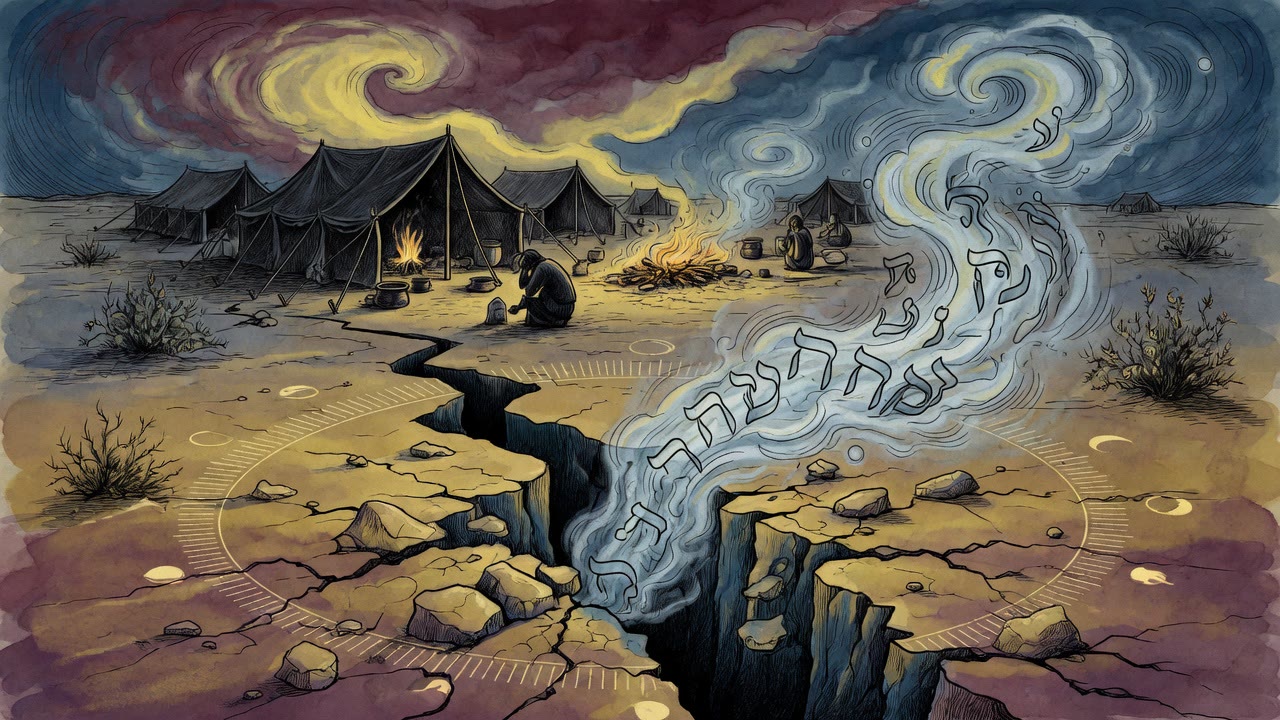
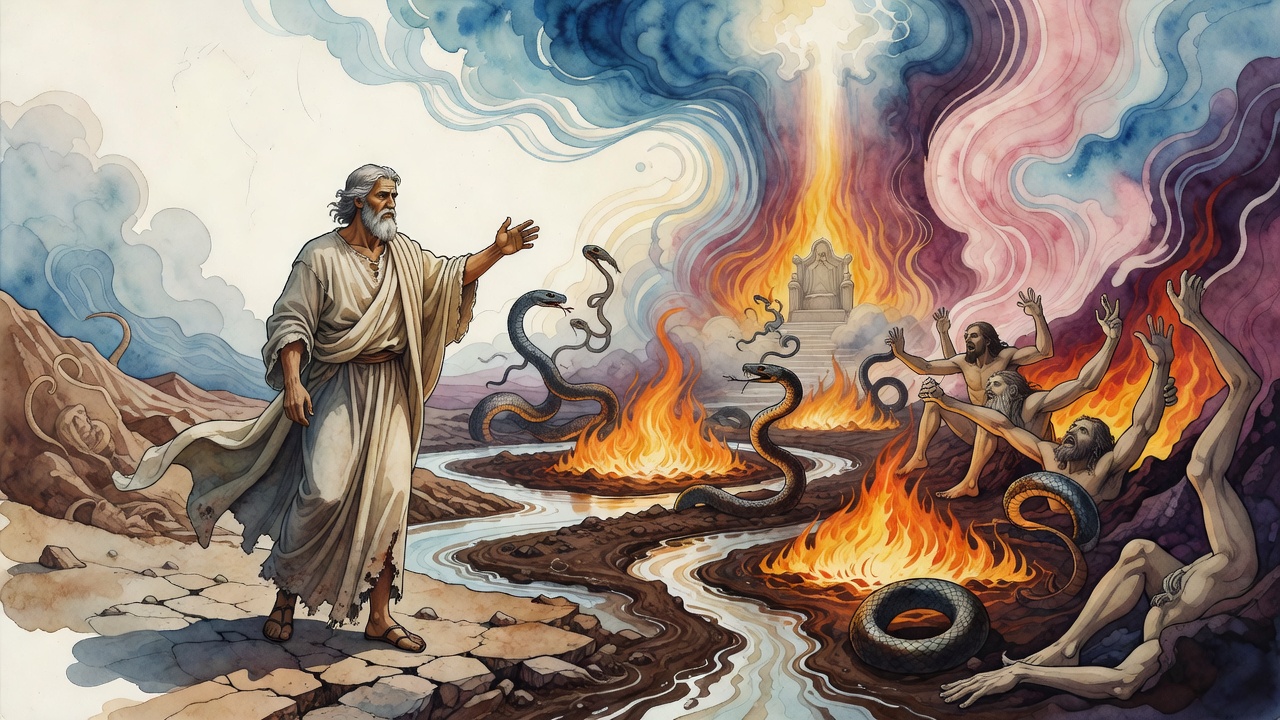
A Bedouin showed a Talmudic sage the fissures where the earth swallowed Korah alive. Every thirty days Korah surfaces and cries out that Moses was right.

Curated by Arthur · Told by Maggid ·
Table of Contents
  1. The Bedouin's Offer
  2. The Test
  3. The Thirty-Day Cycle
  4. The Gates of Gehinnom
  5. What the Crying Means

The Bedouin's Offer

Rabbah bar Bar Hannah was a traveler known for stories that stretched credulity, and this one began the way several of his accounts began: a Bedouin approached him in the desert with a proposition. "Come," the Bedouin said, "I will show you where Korah and his followers went down."

The Talmud records this in tractate Bava Batra 74a without apology for how it sounds. A Bedouin guide, a wandering sage, a desolate place, and an offer to see the specific geography of a punishment described in Numbers 16. Rabbah agreed.

The Test

The Bedouin led him to two fissures in the ground. Smoke curled from within. Rabbah took a bundle of wool, soaked it in water, and attached it to the end of a spear. He lowered the spear into the crack. When he pulled it out, the wool was scorched. The heat down there, even after all the centuries, was still burning.

Then he pressed his ear to the earth. From below, like something rising through rock and time, he heard voices. "Moses and his Torah are true," the voices were saying. "And we are liars."

The Thirty-Day Cycle

The tradition the Talmud preserved was specific about the schedule. Every thirty days, Korah returns to the place where the earth swallowed him alive, and he cries out these words. Like a pot that boils and returns its contents, the text said, Korah and his company rise back to the surface of their punishment and speak.

What they say is not a complaint. They do not ask to be released. They do not argue their case. The rebellion that made them famous was built on the claim that Moses had taken too much authority for himself, that all the congregation was holy, that the special status Moses and Aaron held was self-appointed rather than divinely granted. Korah had been eloquent about this. He had gathered 250 princes of the congregation behind his argument. The people had been on the edge of agreeing with him.

And now, cycling up through the earth every thirty days, Korah said: Moses and his Torah are true.

The Gates of Gehinnom

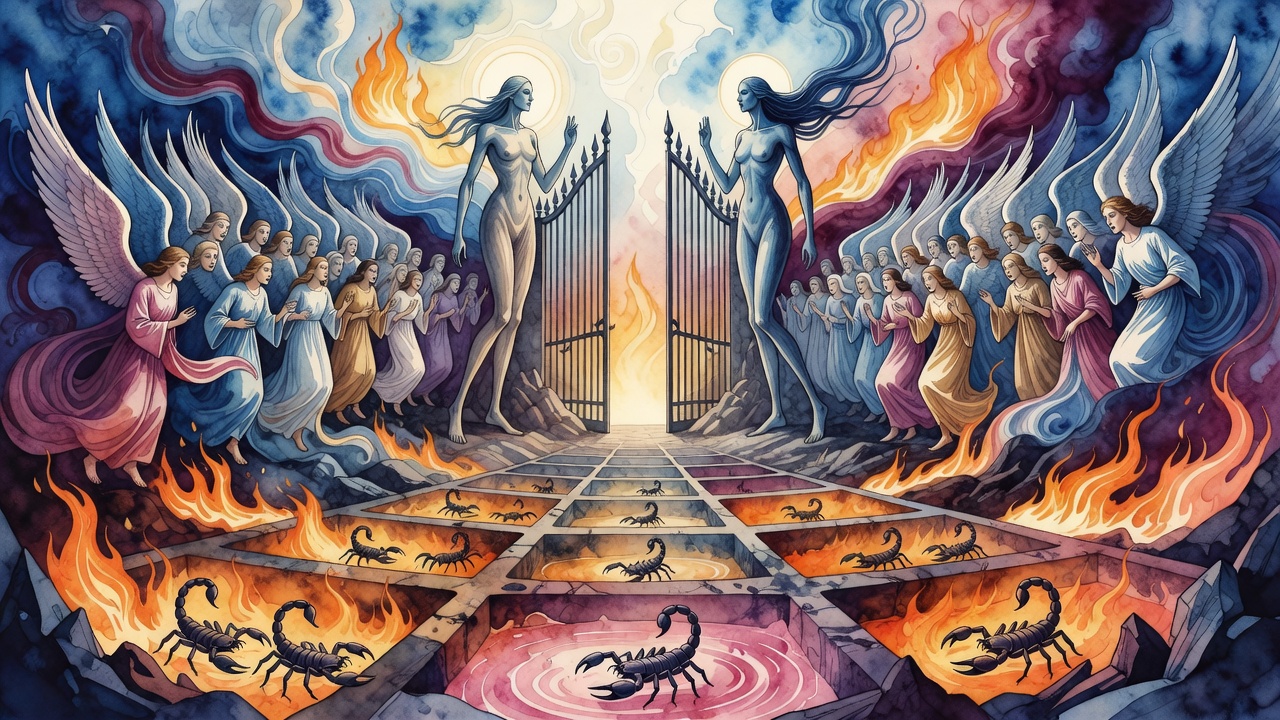
Korah went down alive into the pit, but the pit had geography. The Chronicles of Jerahmeel, a 12th-century Hebrew chronicle, described Gehinnom as having three gates. One opens at the sea, which is where Jonah cried from the belly of the deep. One opens in the wilderness, and that is the gate through which Korah and his company descended, referenced specifically in Numbers 16:33 when the text says they went down alive into the earth. The third gate opens in Jerusalem.

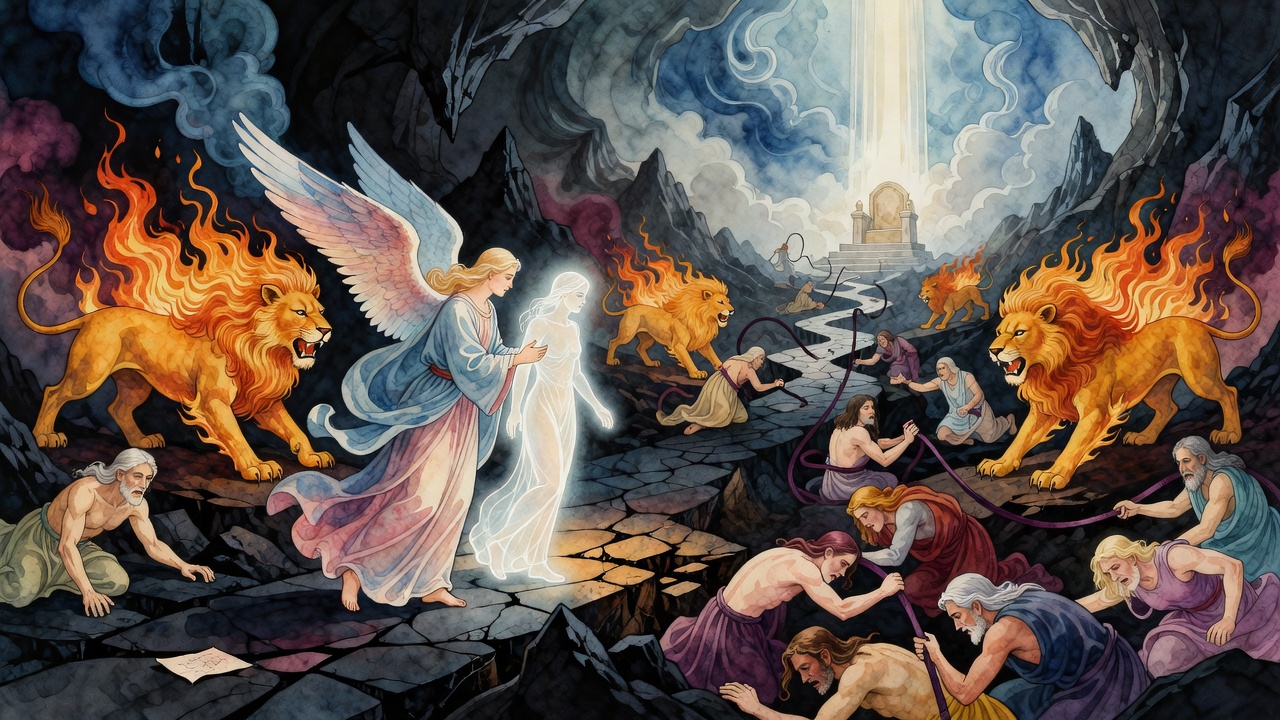
Gehinnom had seven chambers beyond those gates, each more severe than the last. Rabbi Joshua ben Levi, according to the same Chronicles of Jerahmeel, was escorted by the angel Qipod through these chambers when he pressed the Messiah to let him see the place. The first chamber measured a mile in length and breadth and held open pits filled with lions made of fire. The Messiah had been reluctant to allow the visit, saying it was not fitting for the righteous to see it. But Joshua pressed the matter, and what he saw confirmed that the geography was real and the inhabitants were real and the punishments were specific to what each person had done.

What the Crying Means

Korah's recurring declaration from below the earth is a strange form of vindication for Moses. It is not the vindication of the triumphant. It is the vindication that comes from a defeated opponent who finally saw what he refused to see in life. Korah was intelligent enough to make his challenge persuasive. He was eloquent enough to nearly split the Israelite nation. And he was wrong in a way that thirty-day cycles of declaration could not fully correct, because he had made the error when it still mattered.

The earth that swallowed him kept him in a state that was not quite death and not quite life, and in that state the argument he had made in the wilderness was still running, still being adjudicated, still producing a verdict. Moses and his Torah are true. The fire below was burning the wool off every piece of evidence Korah had ever marshaled for his case.


← All myths

From the tradition

Sources

6 sources

The texts this telling draws on, in full. Open a card to read inline, or expand it for a wider, quieter read.

Bava Batra 74aTalmud Bavli, Bava

And they were lying on their backs. And the knee of one of them was raised up, and an Arab merchant entered beneath his knee while riding a camel, with his spear upright, and he did not touch it. I cut off one corner of the sky-blue fringe of one of them, and we could not move on. He said to me: "Perhaps you took something from them?" Return it, for it is learned by tradition that whoever takes something from them cannot move on. I went and returned it, and then we could move on.

When I came before the Rabbis, they said to me: "Every 'Abba' is an ass, and every 'bar bar Chana' is a fool! For the sake of what halakhah did you do this? To know whether the law is like the House of Shammai or like the House of Hillel? You should have counted the threads and counted the joinings."

He said to me: "Come, I will show you Mount Sinai." I went, and I saw that a scorpion encircled it, and it stood like white asses. I heard a heavenly voice saying: "Woe is Me that I swore; and now that I have sworn, who will release Me from My oath?"

When I came before the Rabbis, they said to me: "Every 'Abba' is an ass, every 'bar bar Chana' is a fool! You should have said: 'You are released from your oath!'" But he reasoned: Perhaps it was the oath of the Flood. And the Rabbis: if so, why "Woe is Me"?

He said to me: "Come, I will show you those who were swallowed up of Korah." I saw two cracks, and they were emitting smoke. He took a tuft of wool and soaked it in water and stuck it on the head of his spear and inserted it there, and when he took it out it was scorched and singed. He said to me: "Listen to what you hear." And I heard that they were saying: "Moses and his Torah are true, and they are liars." He said to me: "Every thirty days Gehenna returns them to here like meat in a pot, and they say thus: 'Moses and his Torah are true, and they are liars.'"

He said to me: "Come, I will show you where the earth and the firmament kiss one another." I took my basket and placed it in a window of the firmament. While I was praying, I sought it and did not find it. I said to him: "Are there thieves here?" He said to me: "This was the wheel of the firmament that was turning; wait here until tomorrow and you will find it."

Rabbi Yochanan relates: One time we were traveling in a ship, and we saw a certain fish that put its head out of the sea, and its eyes were like two moons, and water spurted from its two gills like the two channels of Sura. Rav Safra relates: One time we were traveling in a ship, and we saw a certain fish that put its head out of the sea, and it had horns, and engraved upon it was: "I am a lowly creature of the sea, and I am three hundred parasangs long, and I am going into the mouth of the Leviathan." Rav Ashi said: That is the sea-goat, which forages and has horns.

Rabbi Yochanan relates: One time we were traveling in a ship, and we saw a certain chest in which were set precious stones and pearls, and surrounding it were kinds of fish that are called karsha. There descended

Full source
Chronicles of Jerahmeel XIVChronicles of Jerahmeel (Gaster, 1899)

Two bands of angels stand at the gates of Gehinnom (גהינום) and call out one word: "Come! Come!" According to the Chronicles of Jerahmeel, a 12th-century Hebrew chronicle compiled by Jerahmeel ben Solomon, Rabbi Eliezer explained that these angels are the "two daughters of the leech" mentioned in (Proverbs 30:15). The name Gehinnom itself means "Valley of Wailing" because the sound of its screaming traverses the entire world from end to end.

Gehinnom has three gates. One gate opens at the sea, referenced by Jonah when he cried from the belly of Sheol. One gate opens in the wilderness, alluded to when Korah and his followers went down alive into the earth (Numbers 16:33). The third gate stands in Jerusalem itself, as Isaiah wrote: "The Lord, whose fire is in Zion and His furnace in Jerusalem" (Isaiah 31:9).

Five different kinds of fire burn there. One devours and absorbs. Another absorbs but does not devour. A third neither devours nor absorbs. And there is fire that devours other fire. The coals are the size of mountains. Rivers of pitch and sulphur flow and seethe.

The angels of destruction seize the sinner and hurl them toward the flame. Gehinnom opens its mouth wide and swallows them whole. But this fate only befalls someone who has not performed even a single act of mercy that might tip the scales. The person who has studied Torah and endured suffering is saved, as David wrote: "Though I walk through the valley of the shadow of death, I will fear no evil, for You are with me. Your rod and Your staff comfort me" (Psalms 23:4). The rod is suffering. The staff is Torah.

Full source
Chronicles of Jerahmeel XXIChronicles of Jerahmeel (Gaster, 1899)

Rabbi Joshua ben Levi wanted to see Gehinnom (the place of spiritual purification after death). The Messiah refused. "It is not fitting for the righteous to see it," he said, "for there are no righteous people in hell." But Rabbi Joshua pressed the matter, and eventually the angel Qipod escorted him to the fiery gates. According to the Chronicles of Jerahmeel, a 12th-century Hebrew chronicle translated by Moses Gaster in 1899, what he found was a system of seven compartments, each more terrible than the last.

The first compartment measured one mile in length and breadth, filled with open pits containing lions made of fire. Two brooks ran through it, when the wicked fell in, the fire-lions standing above cast them back into the flames. When the Messiah accompanied Rabbi Joshua to the gates, the wicked saw his light and rejoiced, crying, "This one will bring us out of this fire!"

The second compartment held nations of the world with Absalom presiding over them. The nations argued among themselves, "If we sinned because we rejected the Torah, what sin did you commit?" They challenged Absalom: "Your ancestors accepted the Torah. Why are you punished?" He answered simply: "Because I did not listen to my father." The punishing angel Qushiel struck the wicked with a rod of fire, cast them into flames, and burned them, seven times daily and three times nightly. But Absalom himself was spared each time, because he descended from those who declared at Sinai, "We shall do, and we shall hear."

This pattern repeated through all seven compartments. Korah in the third, Jeroboam in the fourth, Ahab in the fifth, Micah in the sixth, and Elisha ben Abuya in the seventh. Each Israelite sinner was rescued from the worst punishments by the merit of their ancestors' covenant at Sinai. The darkness filling these compartments was the primordial darkness that existed before creation. So thick that no soul could see another.

Full source
Legends of the Jews 5:22Legends of the Jews

A pretty definitive ending, it first appears.

The story doesn't stop there. Oh no. Jewish tradition loves to explore the "what happens next?" What happens to these rebels after such a cataclysmic event?

In Legends of the Jews, even that terrifying death wasn't enough to fully atone for Korah and his followers' sins. Their punishment, it turns out, continues in Gehenna – that's the Jewish concept of hell. Imagine an eternity of torment. That's already a pretty bleak picture. But there's more.

The story takes another turn. Every thirty days, Gehenna spits them back out, right near the spot where they were originally swallowed by the earth. Can you picture it? There they are, brought back to the very place of their demise.

And here’s the truly chilling part: if you were to put your ear to the ground on that specific day, you would hear them crying out. What would they be saying? "Moses is truth, and his Torah is truth, but we are liars." A confession, born of unending torment. A stark admission of their monumental error.

It makes you wonder, doesn’t it? What kind of cosmic justice demands such a drawn-out, repetitive punishment?

Even in the face of their grave sin, Korah and his followers weren't condemned to eternal damnation. There is an end in sight, eventually. The Legends of the Jews tell us that their punishment will finally cease after the Resurrection.

So, what does this all mean? Is it just a scary story meant to keep us in line? Or is there something deeper going on here? Perhaps it's a reminder that even the most severe punishments are not necessarily eternal. Maybe it speaks to the enduring power of repentance, even if that repentance comes from the depths of Gehenna itself. It certainly gives you something to think about.

Full source
Sifrei Devarim 357:38Sifrei Devarim

Our journey starts with the Sifrei Devarim, a collection of legal commentaries on the Book of Deuteronomy. It asks a simple question about a seemingly simple phrase: "thirty days." But what's so special about thirty days?

The Sifrei Devarim tells us that this refers to the period of mourning Moses received before his death. A whole month set aside to grieve the loss of a leader before he's even gone. That's a powerful evidence of his significance.

The connection doesn't stop there. The text then asks, "And whence is it derived that the days of Naziritism are thirty?" Naziritism, or being a Nazir, refers to a special vow someone could take to dedicate themselves to God for a specific period. This involved abstaining from certain things, like wine and haircuts. So, how long did this dedication last?

The answer lies in a clever textual comparison. The Sifrei Devarim points out that the word "days" is used both in the context of Moses' mourning period and in the laws concerning Naziritism (Numbers 6:4). Since the "days" of mourning are explicitly stated as thirty, the text concludes that the "days" of Naziritism must also be thirty. It's a beautiful example of how ancient Jewish scholars used textual connections to derive laws and understand deeper meanings.

It's important to remember that this isn't just about numbers. It's about establishing precedents and connecting different aspects of Jewish life. The 30-day period becomes a sort of template for significant periods of observance.

And speaking of significant figures, let's turn to Joshua, Moses' successor. The Sifrei Devarim highlights a crucial detail about him: "And Joshua the son of Nun was full of the spirit of wisdom." Why? Because "Moses had placed his hands upon him."

This act of laying hands upon Joshua wasn't just a symbolic gesture. It was a transfer of authority, of leadership, and of wisdom. The text emphasizes that "There is no obedience greater than this." Joshua's wisdom wasn't simply innate; it was a direct result of his obedience to Moses and Moses' blessing.

Think about the weight of that for a second. Imagine receiving not just a job title, but also the very spirit of wisdom from your predecessor!

What does this all mean for us today? Perhaps it’s a reminder of the importance of mourning and remembrance. The 30-day period, established so long ago, continues to shape Jewish mourning practices. It also emphasizes the importance of mentorship and succession, passing down wisdom and knowledge from one generation to the next. And maybe, just maybe, it encourages us to consider the power of obedience and the potential for growth that comes from honoring those who came before us.

Full source
Bereshit Rabbah 98:2Bereshit Rabbah

The Torah tells us, "Jacob called to his sons, and he said: Gather, and I will tell you what will befall you at the end of days. Assemble and hear, sons of Jacob, and listen to Israel your father" (Genesis 49:1–2). But did he really tell them everything? to what the ancient rabbis had to say about this moment, based on Bereshit Rabbah 98.

The verse from Proverbs, "The lot is cast in the bosom, and all of one’s judgment is from the Lord" (Proverbs 16:33) is brought to bear here. It evokes the solemnity of Yom Kippur, the Day of Atonement. The rabbis saw a connection between this verse and Jacob's blessings, suggesting that just as lots are cast to determine destiny on Yom Kippur, so too were the destinies of the tribes divinely ordained through Jacob's blessings. It's a powerful image of God's hand in even the smallest details of our lives.

Who did Jacob call upon when he gathered his sons? Rabbi Yudan and Rabbi Pinḥas offer different interpretations. Rabbi Yudan suggests that Jacob called upon the Almighty to be with his sons, while Rabbi Pinḥas believes he invited God to share in his joy that all his sons had remained righteous. Some understand that he asked God to be always available, mezuman, to come to his sons' aid, while Rabbi Avun thought Jacob appointed God as a steward for his sons.

What about the gathering itself? Rabbi Aḥa believed Jacob was calling for purification, drawing a parallel to Nehemiah's purification of the chambers in the Temple (Nehemiah 12:28, 13:9). Other rabbis felt Jacob was commanding them to avoid dissension. He wanted them to be "one assembly." This resonates with the prophecy in Ezekiel: "You, Son of man, take for you one piece of wood, and write on it: [For Judah] and for the children of Israel [his companions]" (Ezekiel 37:16). The rabbis note that "his companion" (ḥaverav) is written without a vav, suggesting a singular unity amongst the children of Israel.

The big question: did Jacob reveal the End of Days? Rabbi Simon thought Jacob showed them the downfall of Gog, referencing (Ezekiel 38:16). Rabbi Yehuda believed he revealed the building of the Temple, citing (Micah 4:1). But the majority opinion was that he tried to reveal the End, but it was concealed from him.

Rabbi Yehuda, in the name of Rabbi Elazar bar Avina, highlights that Jacob wasn't alone in this experience. Daniel also had the End revealed and then concealed from him, as the verse says, "But you, Daniel, obscure the matters and seal" (Daniel 12:4). Why would this happen?

The Bereshit Rabbah uses a beautiful analogy: a king's confidant, on his deathbed, wants to reveal the king's secrets to his sons. But he sees in the king's expression that he doesn't want the secrets revealed, so instead, he tells his sons, "Be vigilant regarding the honor of the king." Similarly, Jacob saw the Divine Presence and understood that revealing the End was not meant to be. Instead, he told his sons, "Be vigilant regarding the honor of the Holy One."

And what about Reuben, the firstborn? The text connects Jacob's blessing of Reuben ("Reuben, you are my firstborn, my strength, and the first of my potency; greater honor and greater power" - Genesis 49:3) with the concealing of the End. The rabbis argue that Jacob began with the intention of revealing the End but then switched to blessing Reuben, indicating that the End was deliberately hidden.

The Bereshit Rabbah also includes a fascinating, almost parenthetical, note about Reuben's status. It draws a parallel to the congregation of Korah, who were punished and ostracized. Just as Hannah's prayer ("The Lord puts to death and brings to life; He lowers to the netherworld and elevates" - I Samuel 2:6) brought redemption, so too was Reuben ostracized until Moses restored him.

So, what do we take away from this glimpse into Jacob's final moments? Perhaps it's a reminder that some things are not meant for us to know. Maybe it's about trusting in a divine plan, even when we can't see the full picture. And perhaps, most importantly, it's a call to focus on the present – on honoring God and living a righteous life, rather than obsessing over what the future holds.

Full source