7 min read

Dumah Led the Soul Down the Seven Floors of Gehinnom

An angel walks a trembling soul down seven descending floors of fire, where the gates lock the feet and each punishment is cut to fit the sin.

Curated by Arthur · Told by Maggid ·
Table of Contents
  1. The First Floors Were Fire and the Cold That Hated It
  2. Lower, the Scorpions Waited in Every Crack
  3. The Warden's House and the Three Who Worked Beneath Him
  4. The Night the Fire Went Out
  5. What the Bottom of the Pit Was For

The soul arrived at a valley outside the holy city, where two date trees stood with smoke pouring off their leaves, and it knew before anyone spoke that the trees marked a door. A hand closed on its shoulder. The hand belonged to Dumah, the angel set over the dead, and Dumah did not explain. He simply turned the soul toward the smoke and said, "Walk."
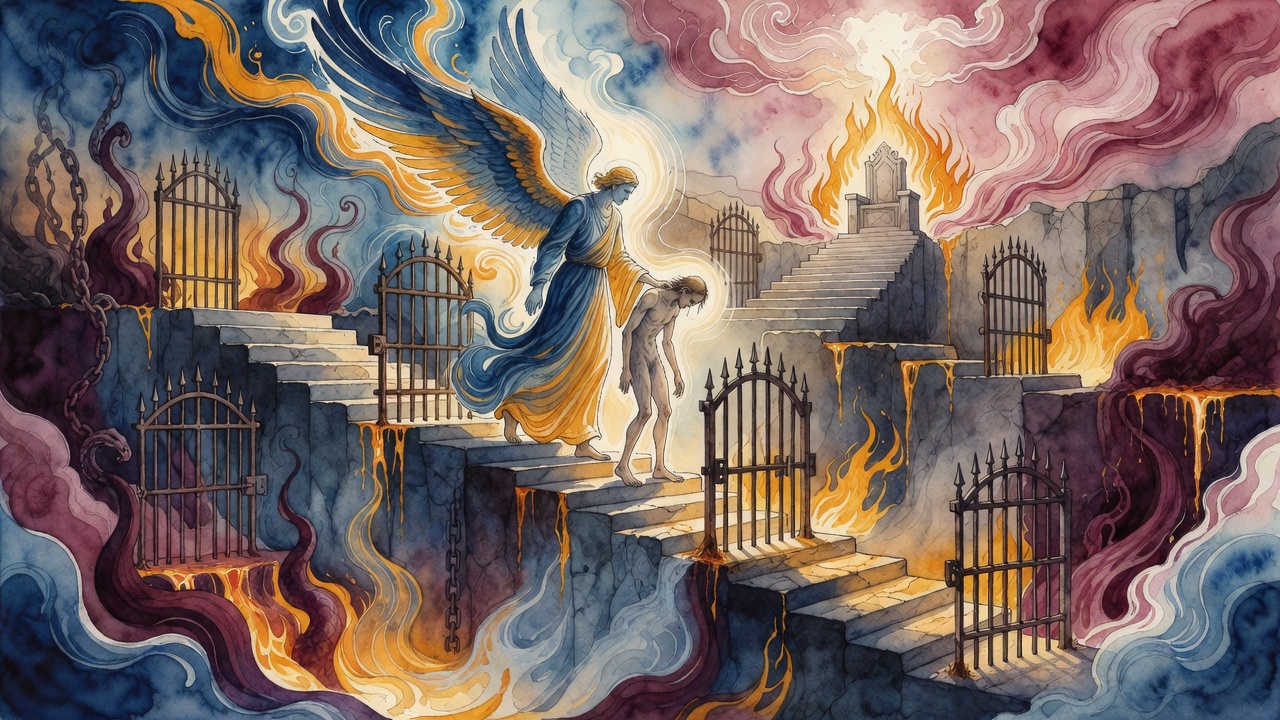
Below the two trees the ground sloped down, and down, in seven long steps, each one a floor sunk beneath the last. At the head of the descent stood a gate. The gate had holes bored into its threshold, and the soul understood the holes were shaped for feet, so that whoever entered could be fastened in place and could not turn and climb back out. Dumah pressed it through. Behind them the gate swung shut with a sound like a struck bell, and the bell was answered, far below, by another, and another, all the way down.

The First Floors Were Fire and the Cold That Hated It

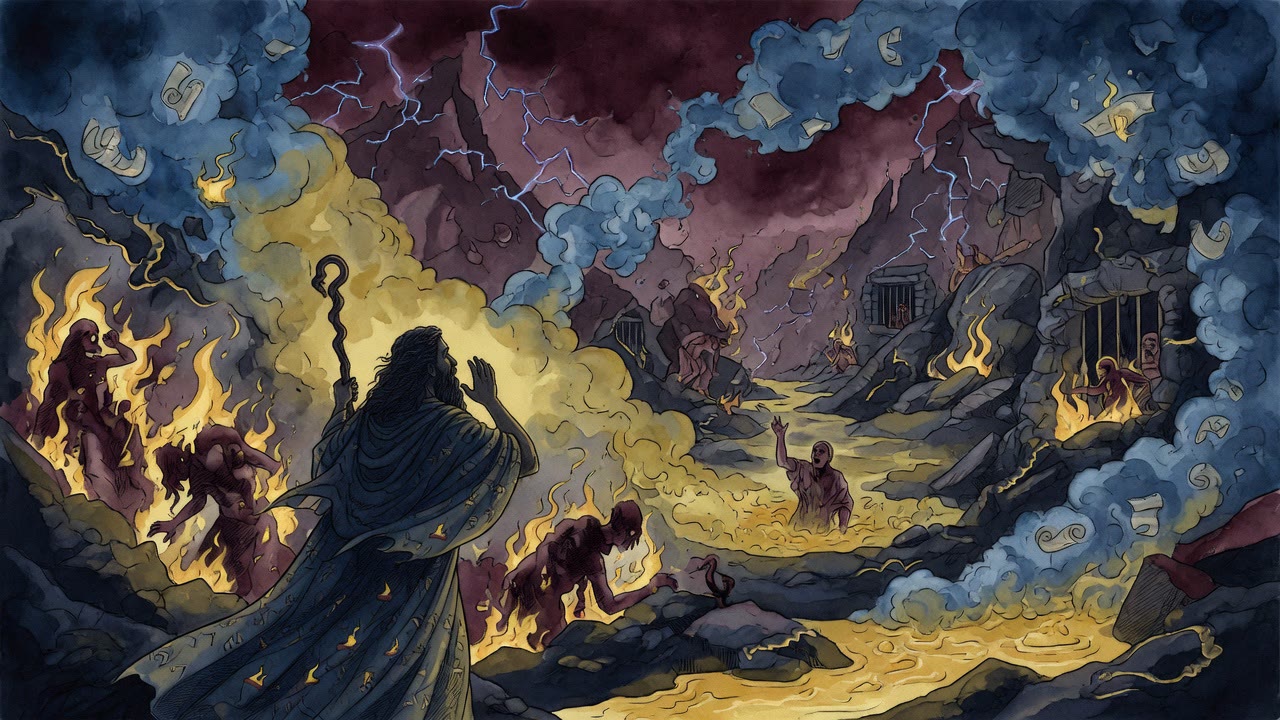
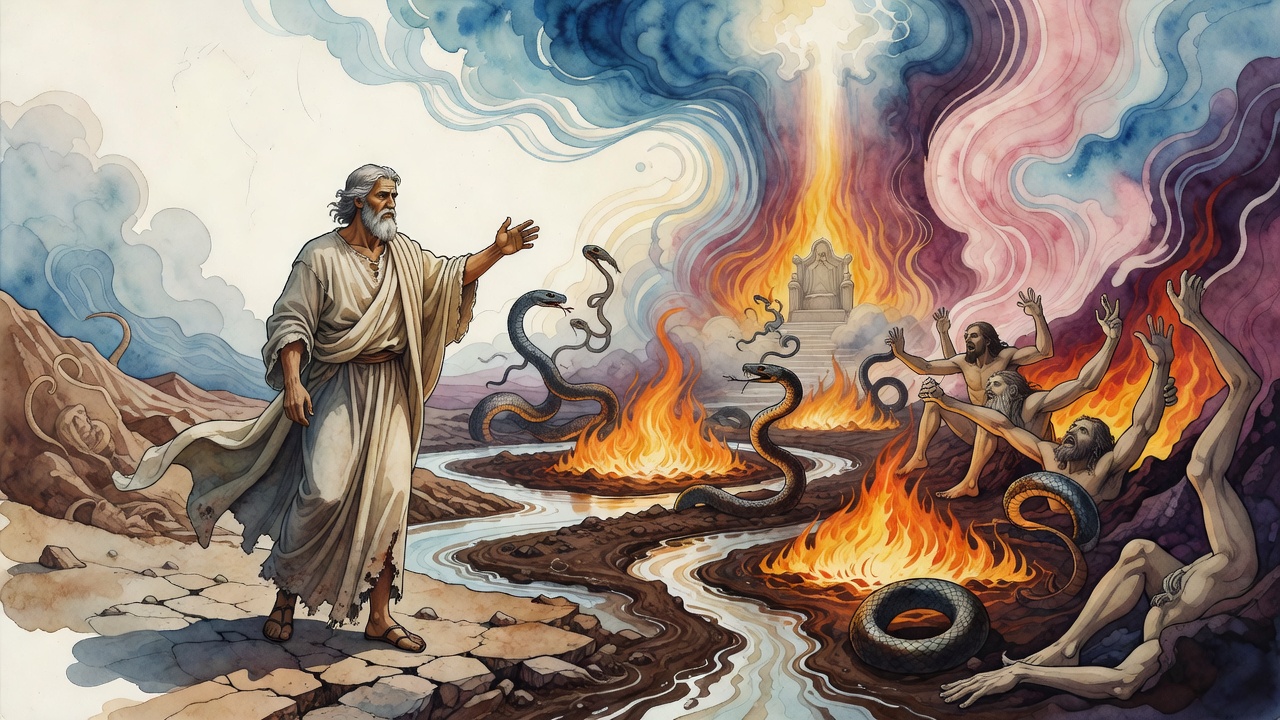
On the upper floors the heat came first. Coals stood heaped like mountains, each ember the size of a hill, and between the mountains ran chasms as wide as the Dead Sea, brimming not with water but with pitch and sulfur that fumed and seethed and would not stop moving. The rivers boiled along their banks. The soul flinched from the heat and ran, the way the burning always run, toward the far wall where the air went white and brittle.

But the far wall was ice. The cold there bit harder than the fire, and the soul wheeled and bolted back toward the flames, and the flames were no mercy either. This was the rhythm of the place. Fire, then ice, then fire. There was no third country between them. Dumah watched without moving, because he had watched it ten thousand times, and he knew the running changed nothing.

"This is the gentle part," he said. "You have six floors to go."

Lower, the Scorpions Waited in Every Crack

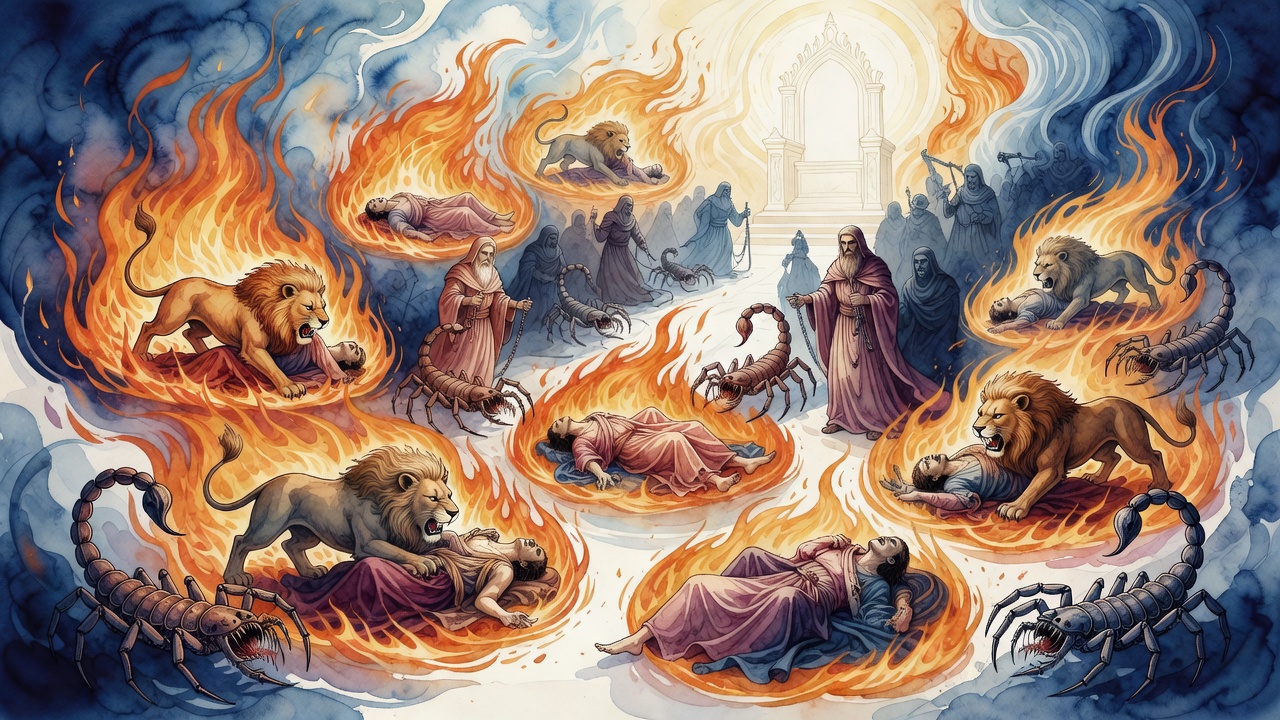
Deeper down, the walls began to seethe on their own. Out of every crevice in the rock came scorpions, and these were not the small stinging things of the upper world. There were seven thousand of them on this floor alone, each one swollen with seventy thousand pouches of venom, and from the pouches drained six rivers of poison that pooled across the floor and steamed.

The soul stepped, because Dumah made it step, and its foot touched the poison. At once the body burst. It split open along its whole length and dropped face down, dead on the stone, the way a sinner falls when the venom of that place reaches him. The soul lay there in pieces. It thought, with whatever thought remained, that this at last was the end.

It was not the end. The mal'akhei ha-khabbalah, the avenging angels, came down the rivers gathering limbs. They fitted the scattered pieces back together, breathed the soul awake, set it on its feet, and walked it forward to the next pool. There the body burst again. They revived it again. Burst, gather, revive, walk. The arithmetic of that floor had no last number that the soul could find.

The Warden's House and the Three Who Worked Beneath Him

All of it answered to Dumah, and Dumah did not work alone. Beneath him stood three angels of destruction, Mashit and Af and Hema, and beneath those three marched whole legions of avenging angels, and the legions never quieted. The din of them filled every floor. The shrieks of the punished braided into the roar until the noise climbed all the way to the gate of heaven and beat against it, and that, the soul understood, was why no one above seemed to hear, and why no one came down with mercy. The cry was simply lost in the size of the sound.

The soul tried to speak, to name something it had done that did not deserve this floor. Dumah lifted a hand. "Each step down is measured," he said. "The fire is cut to fit. Whatever was conceived in the dark is paid in the dark. You will not be burned for what you did not do, and you will not skip what you did."

The Night the Fire Went Out

Then, with no warning, the legions stopped. The combs lifted off the flesh. The scorpions drew back into their cracks. The rivers of pitch ran slow and then went still, and for the first time since the gate rang shut, the soul heard silence, and the silence was so strange it was almost worse than the noise.

"It is Shabbat," Dumah said.

From the moment the Sabbath came in, judgment vanished from the whole world, even here. The angels of destruction set down their work. No one was burned, no one was revived to be burned again. The soul sat on the cooling stone and breathed, if a soul breathes, through one full day of rest that reached even to the bottom of the pit. Then, far above, a star came out, and another, and the Sabbath went out with them. The angels rose. The rivers woke. The soul was dragged back to its place among the holes in the floor, and the punishment took up exactly where it had set it down.

What the Bottom of the Pit Was For

Down through the seven floors the soul went, and at each floor the reckoning grew more exact, the fire fitted closer to the deed, until the sum was paid. And there was a sum. That was the thing the soul had not understood at the smoking trees. The gates that locked the feet, the burst and the gathering, the scorpions, the warden and his three, all of it had an edge, a last floor, a far wall that was not ice.

One soul, when its measure was full, was lifted out of the fire pure and white, scrubbed clean by the very rivers that had torn it. And a promise stood over even the deepest floor, spoken once to a people who would one day walk down into the flame together with all the nations and walk back out unscorched. Dumah opened the gate from the inside, which the soul had not known a gate down there could do, and pointed it up the long stair toward the smoke and the two trees and the light beyond them.


← All myths
From the tradition

Sources

4 sources

The texts this telling draws on, in full. Open a card to read inline, or expand it for a wider, quieter read.

Orhot HayimOrchot Chaim

Gehenna.

Gehenna (sometimes called Gehinnom (the place of spiritual purification after death)) is often translated as "hell," but it's actually more like Gehinnom, the place of spiritual purification in Jewish tradition, rather than a place of eternal damnation for most. But that doesn't mean it's a walk in the park. So, what does this place actually look like? The descriptions are... intense.

Some say that within Gehenna, there are coals as big as mountains, and chasms as vast as the Dead Sea, ready to sear the wicked. And if that wasn't enough, picture rivers of pitch and sulfur, constantly flowing, fuming, and seething throughout the entire place. (Schwartz, Tree of Souls). Not exactly a relaxing spa day, is it?

It gets weirder.

Other traditions paint Gehenna as a land of extremes. Half fire, half ice. Can you even imagine such a place?: Sinners, desperate to escape the agonizing flames, flee towards the icy regions, only to find that the cold is just as unbearable. They rush back to the fire, but there’s no true escape. As the Orhot Hayim, the Baraita (a teaching from outside the Mishnah) de-Masekhet Gehinnom in Hesed le-Avraham, and the Midrash Konen in Beit ha-Midrash (2:24-39) all tell us, there’s no respite from the punishments of Gehenna.

It’s fascinating to note that in many ways, Gehenna is a distorted mirror image of Paradise. Where heaven has rivers of balsam, offering healing and sweet fragrance, Gehenna has those rivers of pitch and sulfur. One is part of the reward, the other part of the punishment.

So, what’s the takeaway here? Is it just a scary story to keep us in line? Maybe. But perhaps it's also a powerful reminder. A reminder of the consequences of our actions, a reflection on the choices we make in this life. The image of Gehenna, however unsettling, serves as a potent symbol of the importance of living a life guided by compassion, justice, and kindness.

Full source
Midrash Konen in Beit ha-Midrash 2:24-39Midrash Konen

It even shows up in our ideas about Gehenna.

Gehenna. It’s a loaded word. Often translated as "Hell," it’s really more complex than that. It’s a place of purification, of reckoning, where souls face the consequences of their actions. But where is this Gehenna, exactly? Where does one even enter such a place?

That's where things get interesting, because the answers are… varied, to say the least.

Some traditions, as we find in Midrash Konen, say there are three entrances. One in the desolate wilderness, echoing the wandering and hardship of a life gone astray. Another in the vast, unknowable sea, representing the depths of our own souls, perhaps. And a third… right in Jerusalem! Imagine that. The holy city, also a gateway to… well, to facing the music.

Then there’s another image: two date trees in the valley of Gehinnom (the place of spiritual purification after death) – that's the physical valley outside Jerusalem, the one whose name became synonymous with this whole concept – with smoke rising from them, marking the spot. A grim landmark.

But wait, there’s more! According to other accounts, there aren't just three entrances. Oh no. There are four openings on each side of the universe – sixteen in total! Talk about inescapable. Midrash (rabbinic interpretive commentary) Aggadat Bereshit paints a picture of the wicked desperately trying to flee Gehenna, only to blunder into yet another of its many mouths. It's like a cosmic maze of consequence.

And the variations don't stop there. Fifty gates, some say, each with holes to lock the feet of the condemned. Quite the elaborate security system, isn’t it?

Then there's the most unsettling idea of all: that the mouth of Gehenna can be found anywhere. Any place, any time, the earth could simply open up and… swallow you whole.

Sound familiar? Remember the story of Korah in the Book of Numbers (16:32)? He challenged Moses, and the ground opened up and swallowed him and his followers. A pretty stark image of divine retribution. Well, that story becomes a kind of prototype for this idea of Gehenna being ever-present, ever-ready.

So, how do we make sense of all these different accounts? Some say this myth attempts to resolve the contradictions by settling on the idea of three entrances. But perhaps the alternate explanation is more powerful: that Gehenna, in a sense, is always accessible. That the potential for reckoning, for facing the consequences of our actions, is always there, lurking beneath the surface of our everyday lives.

Maybe the real question isn't where is Gehenna, but when will we encounter it? And more importantly, how can we live our lives in a way that prepares us for that inevitable encounter?

Full source
Baraita de-Masekhet Gehinnom in Hesed le-AvrahamMidrash Aggadah

Midrash Aggadah turns to The Scorpions Of Gehenna.

Gehenna, often translated as hell, is understood in Jewish tradition as a purification process, a place where souls are cleansed of their sins. But that cleansing? Let's just say it's not a spa day. And among the many torments described, there's one that really makes my skin crawl: the scorpions of Gehenna.

The familiar version gives us scorpions can pack a nasty sting. But imagine scorpions so potent, so utterly filled with venom, that they make our earthly versions look like cuddly teddy bears. According to the Baraita (a teaching from outside the Mishnah) de-Masekhet Gehinnom (the place of spiritual purification after death), found in Hesed le-Avraham, there are seven thousand of these monstrous creatures lurking in every crevice of Gehenna. Seven thousand! And each one. each one has seventy thousand pouches of venom.

Can you even picture that?

From these pouches flow six rivers of deadly poison. And what happens when a sinner, undergoing their period of purification, comes into contact with this horrifying toxin? Instant disintegration. The person "immediately bursts, and his body is cleft asunder, and he falls dead on his face."

Okay, that's bad enough. End of story? Nope. This is Gehenna.

The mal'akhai ha-khabbalah, the avenging angels, aren't done yet. They gather up the scattered limbs, revive the person, stand them back on their feet, and. inflict the whole process again. And again. And again. This cycle of agonizing death and resurrection continues until the soul has atoned for its sins.

It’s a chilling reminder, isn't it? These deadly scorpions, far more lethal than any found on earth, are one more example of the kinds of punishments of Gehenna, where a sinner can be killed and revived over and over again, so that his suffering continues until his time in Gehenna comes to an end.

Why such a gruesome image? Perhaps it's a way of emphasizing the severity of our actions and the importance of living a life of tzedakah (righteousness) and chesed (loving-kindness). Maybe it’s meant to scare us straight. Or perhaps, on a deeper level, it's a metaphor for the internal torment we inflict upon ourselves when we stray from the path.

Whatever the interpretation, the scorpions of Gehenna certainly leave a lasting impression, a stark reminder of the consequences of our choices and the enduring power of repentance and redemption.

Full source
Beit HaMidrash 5:44Beit HaMidrash (Jellinek)

Jewish tradition has a place for them, a place of purification and, yes, punishment called Gehenna. It's not exactly hell, but it's definitely not a pleasant resort.

Who's in charge down there? According to tradition, Gehenna is ruled by the angel Dumah. Think of him as the warden of the netherworld. Schwartz, in Tree of Souls, tells us that Dumah was specifically appointed to this daunting task. He’s not alone, either. He commands three terrifying angels of destruction: Mashit, Af, and Hema. (Try saying those names three times fast!). These three aren’t just middle management; they, in turn, command legions of avenging angels. Imagine the sheer cacophony!

The Zohar, that foundational text of Jewish mysticism, paints a vivid picture. All of Gehenna is filled with the din of these angels and the shrieks of the punished. The noise is so intense, it reaches all the way up to heaven! That’s why, the tradition says, the cries of the wicked are barely heard. And why, perhaps, no one has mercy on them.

In these accounts, every night – except for one – the angels of destruction get to work, punishing those whose evil deeds were conceived in darkness. That one exception? The Shabbat, the Sabbath.

Isn't that amazing? Even in Gehenna, Shabbat brings respite. From the moment Shabbat begins, judgment vanishes from the world. The wicked get a break! The angels of destruction cease their torment, all the way until Shabbat ends. It's a universal day of rest, affecting even the afterlife.

Then, alas, the reprieve is over. As Shabbat departs, the wicked are dragged back to the dungeons of Gehenna, and their punishment resumes. It’s a stark reminder of the consequences of our actions.

But here's where things get really interesting and, perhaps, a little hopeful. There's a fascinating tradition that in the future, all the people of Israel will enter Gehenna together with the nations of the world. But, the tradition continues, the nations will perish, while Israel will emerge unharmed. As it says in (Isaiah 43:2): "When you walk through fire, you shall not be scorched; through flame, it shall not burn you."

What does this mean? It's open to interpretation, of course. Some see it as a symbolic cleansing, a final purification before the messianic age. Perhaps it's a statement about resilience, about the enduring spirit of the Jewish people. Or maybe it speaks to the idea that even in the darkest of times, hope and redemption are always possible.

Gehenna, then, isn't just a place of punishment. It's a reminder of the importance of our choices, the universality of Shabbat, and the enduring promise of eventual redemption. It is a complex concept that continues to provoke thought and discussion.

Full source