6 min read

The Traveler Who Thanked God After the Scorpion

Thorns, sun, and a scorpion stop a traveler short of his caravan's ruin, and he learns to thank the anger that became his salvation.

Curated by Arthur · Told by Maggid ·
Table of Contents
  1. Gates of Robbers and Gates of Righteousness
  2. Thanks for the Anger
  3. What Can Still Be Straightened
  4. Generations That Ate in Darkness

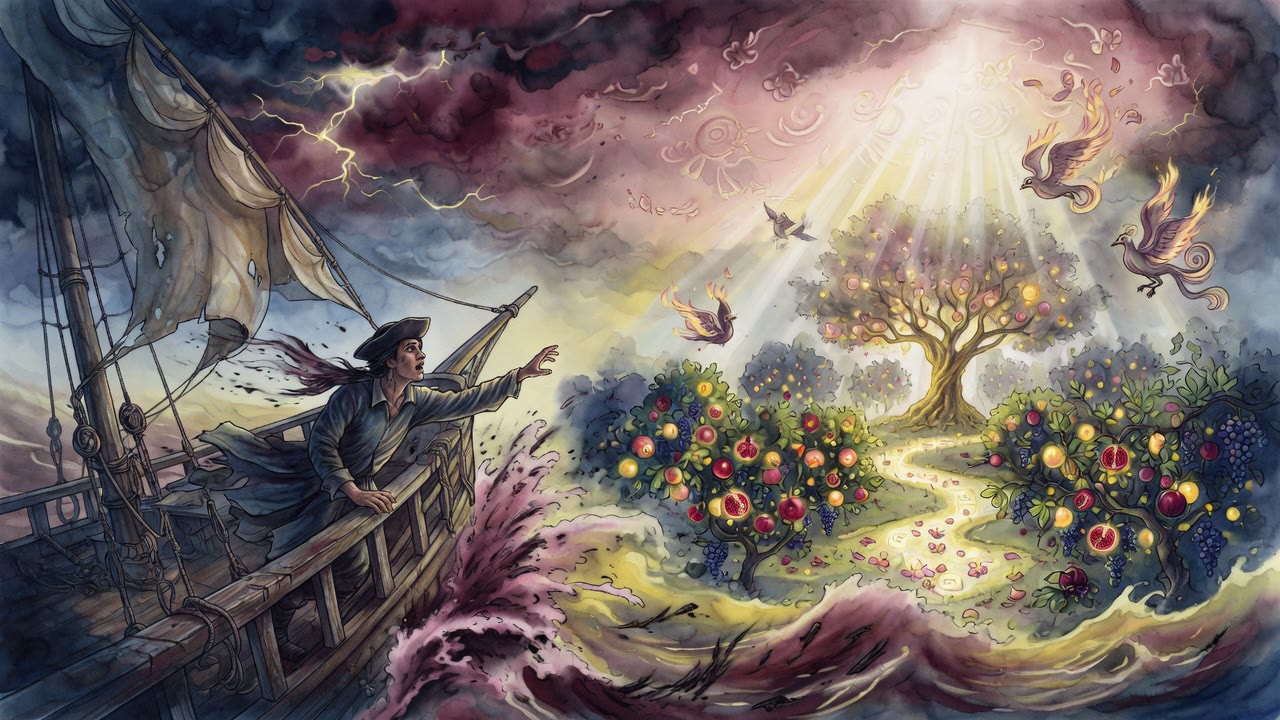
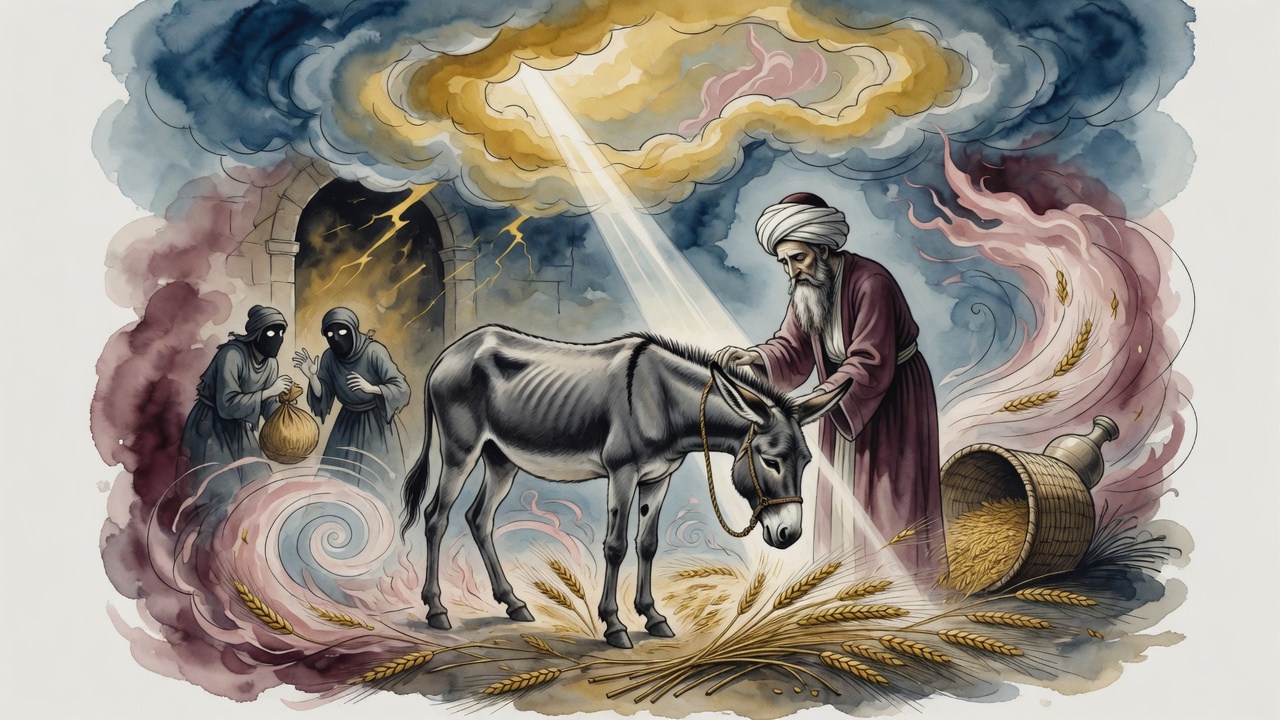
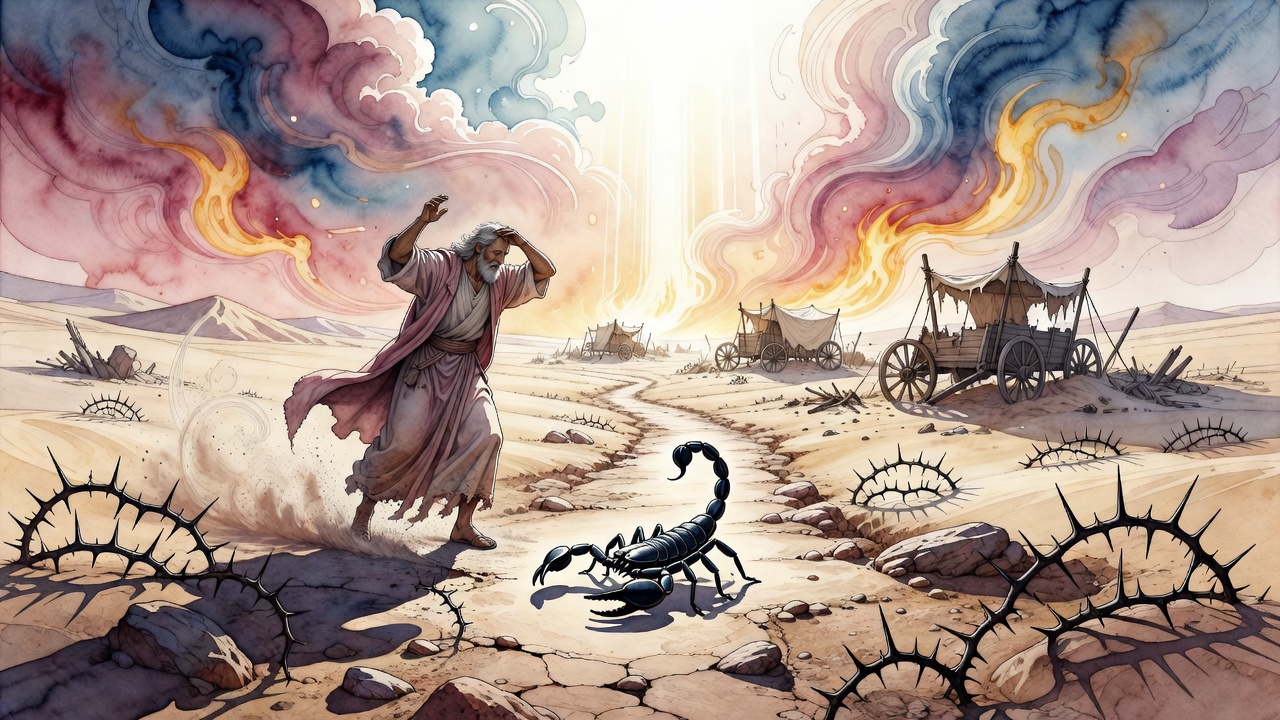
The scorpion found him first. He had already been pricked by thorns and beaten by the sun. His donkey stood with its head low. Alone on a road outside his country, he lifted his face and asked what sins had earned him this stretch of misery.
The Traveler Who Thanked God After the Scorpion Click for full size

Not long after, word came that his caravan had been lost. He stood again, this time to praise. "If I had been there," he said, "I would have been one of them."

Gates of Robbers and Gates of Righteousness

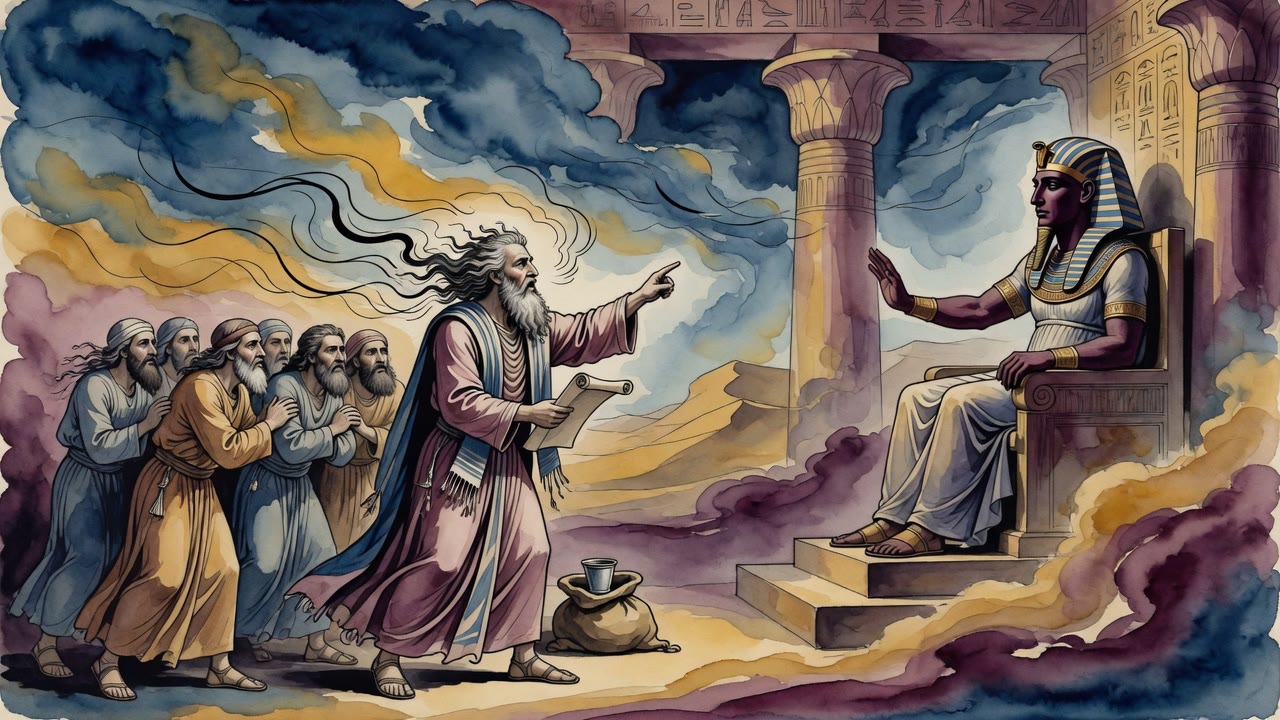
Midrash Tehillim reads (Psalm 118:20), "This is the gate of the Lord; the righteous shall enter through it," through a traveler's body. A man walks with merchandise. Robbers meet him; he gives what he has and survives. Later, in a foreign land, customs officials warn that without duties he will keep nothing. He cries, "Open for me the gates of righteousness." Life offers more than one kind of seizure. Some are pure theft. Some wear the face of law. The gate that still opens is the gate of integrity and faith, even when other doors slam.

The scorpion on the road is neither robber nor official. It is the third face of trouble: the blow that feels personal, unaccountable, and later turns out to have been a wall between him and a worse end.

Thanks for the Anger

(Isaiah 12:1) says, "I will give thanks to You, for You have become angry with me." The midrash ties the verse to the traveler who learns, late, that delay was rescue. Hardship that looks like divine anger can be the form salvation takes when the eye is still too close to the sting. He does not thank the poison. He thanks the One who used a small poison to keep him from a larger grave.

This is not a demand that every sufferer smile. It is a permission, later, to reread a road that made no sense while the feet were on it.

What Can Still Be Straightened

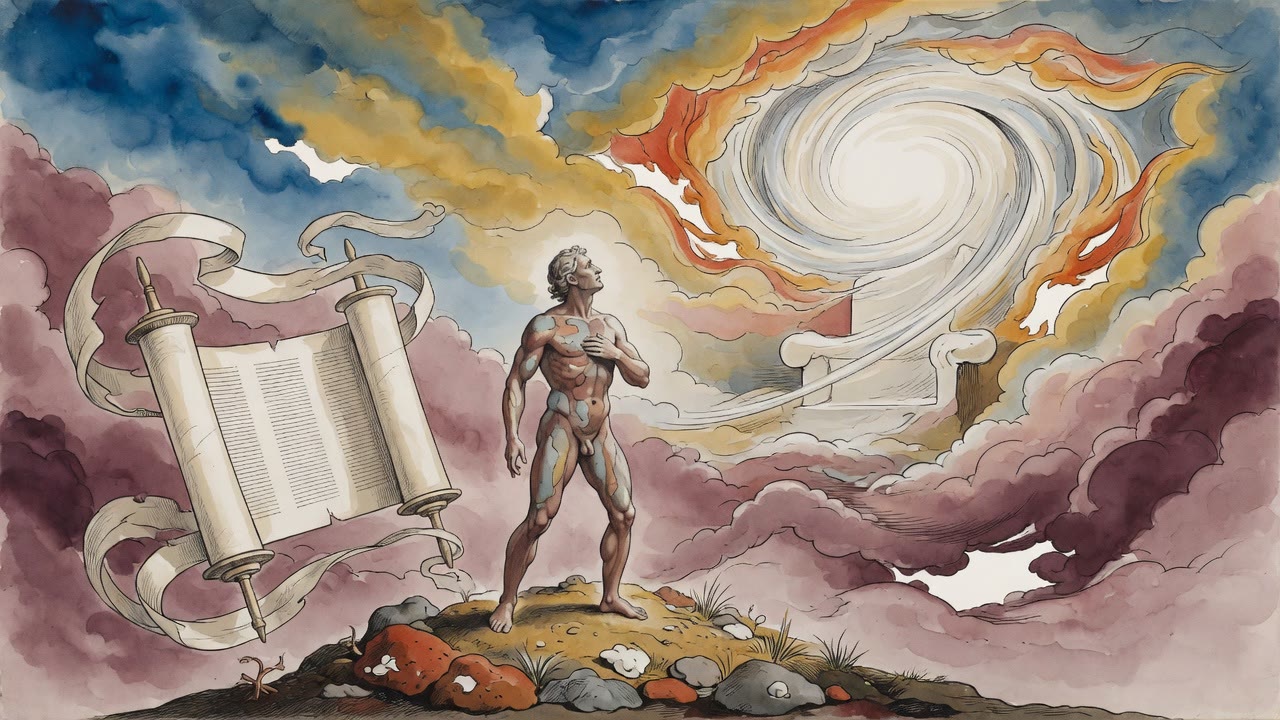
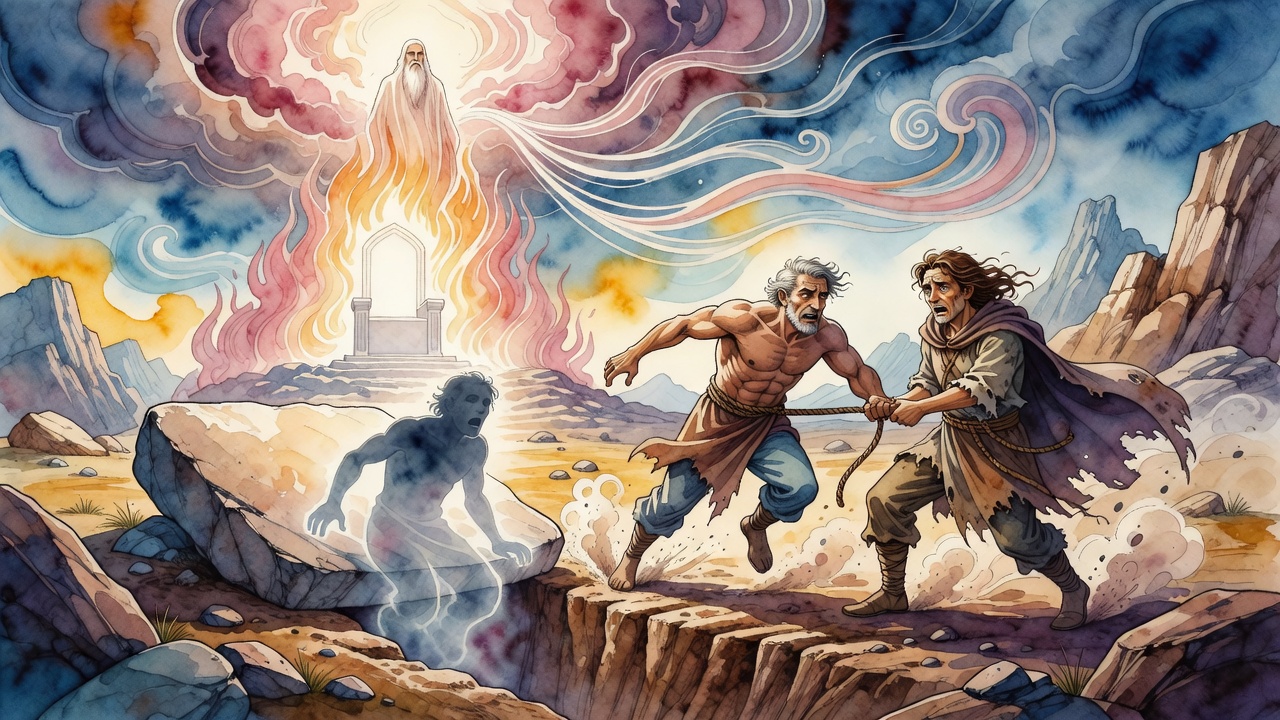
Kohelet says what is warped cannot be straightened and what is lacking cannot be counted. Kohelet Rabbah refuses to leave that verse as pure despair for this world. Here, a warped character can still turn. In the world to come, the warp hardens. Two friends share every theft in life. One repents before death and stands with the righteous. The other remains crooked and stands with the wicked. He cries favoritism: we stole together! They call him a fool. He was dragged to the grave with ropes, maggots under him, worms over him. His partner saw that end, took an oath, and changed. The unrepentant one asks to go back and fix it. Too late. This world is the eve of Shabbat; that world is Shabbat. Who does not prepare before sundown will find no meal when the day is holy. This world is dry land; that world is sea. Who does not load the ship in the harbor will not eat mid-ocean.

The traveler's thanks is a small repentance of vision. He cannot undo the scorpion. He can stop calling every wound pure waste while breath remains to change course.

Generations That Ate in Darkness

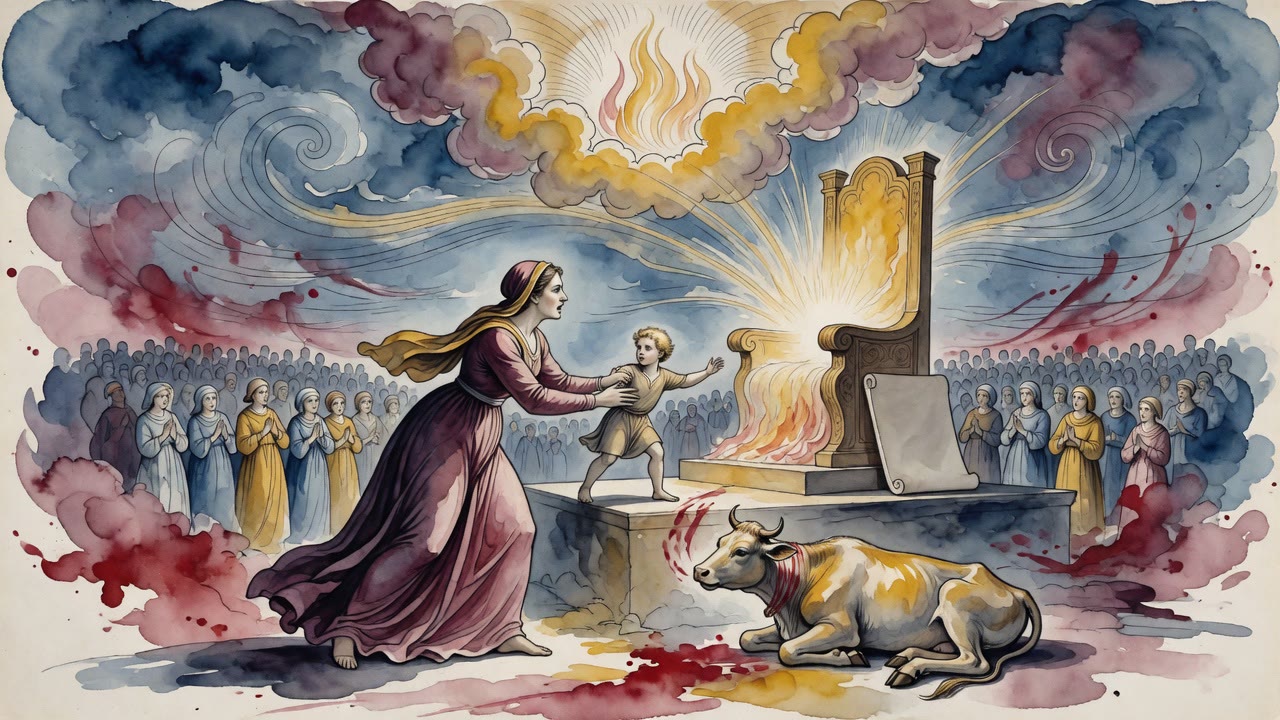
The same Kohelet verse about eating in darkness, anger, illness, and rage maps onto whole generations. The age of the Judges walked in darkness and raged at God when a tribe was lacking. The age of Samuel still asked why the Lord had struck them. Collective misery is not always a private scorpion with a secret kindness inside. Sometimes it is the harvest of deeds a people will not leave. The midrash holds both pictures: the individual saved by a delay, and the generation that lives on rage because it will not turn.

A wise traveler learns to ask which story he is in before he composes his psalm. If the caravan is lost without him, praise may be due. If the whole camp insists on night, the work is teshuvah, not a pretty reframe. Midrash Rabbah and the psalm midrashim keep the two lessons on one shelf so that gratitude does not become an excuse for staying warped.

He sat in the shade of a rock and wrapped the sting with a strip of cloth. Pain still climbed his arm in slow pulses. Gratitude did not erase the pulse. It only stopped him from turning the whole road into a verdict against his life. He had asked what sins earned him the scorpion. He now asked a second question: what ruin the scorpion had blocked. Both questions can be true in turns. Only one of them leaves a person free to walk again.

In a town farther on he told the story badly, with too much triumph. A listener who had lost a child to fever stood up and left. The traveler learned then that a parable of delayed mercy is not a club for other people's grief. Midrash offers the tale as a possible reading of anger-as-salvation, not as a tax every sufferer must pay in cheerfulness. He kept the thanks and retired the speech.

Years later, when he caught himself repeating a small cheat he had loved in youth, he remembered the two friends in the world to come, one warped, one straightened, and the sea that will not feed an empty ship. The scorpion had saved his body once. The memory of the unrepentant thief might yet save his name. He returned a coin he had planned to keep and felt, for a moment, the gate of righteousness open without robbers or customs men in sight. Darkness that whole generations ate as rage does not have to be the menu of every private house. Preparation before Shabbat is still possible while the sun is up.


← All myths
From the tradition

Sources

3 sources

The texts behind this telling. Some cards carry a translation of the source; others are our own retelling of it, and each card says which. Every card links out to the original.

Midrash Tehillim 118:18Midrash Tehillim

Retold in our words. Read the original at the link below.Rabbi Mike Feuer, Jerusalem Anthology · CC-BY

They found wisdom, comfort, and even a little humor in stories we call midrashim (rabbinic interpretive commentary) – interpretations that expand on the meaning of the Bible.

This particular midrash homes in on (Psalm 118:20): "This is the gate of the Lord; the righteous shall enter through it."

So, what does that gate really mean?

The midrash tells a parable, a short allegorical story designed to illustrate a moral or spiritual lesson. Suddenly, robbers appear! He’s forced to surrender everything he owns, but at least he survives. it first appears, "Wow, that's terrible luck." But hold that thought.

He continues his journey, arriving in a foreign land. Here, he faces a new challenge: customs officials. These aren’t common thieves; they're the legal gatekeepers. They warn him: if he doesn't pay the required duties, he won't be allowed to keep any of his goods. In desperation, he cries out, "Open for me the gates of righteousness!"

What's the message here? Life throws curveballs. Sometimes it's outright thievery, sometimes it's the seemingly legitimate demands of the system. But the "gates of righteousness" – that path of integrity and faith – remain open, even when other avenues are blocked.

Now, let's move on to (Psalm 118:21): "I will give thanks to You, for You have answered me and You have become my salvation."

The midrash presents another parable. A person prepares their donkey for a journey, venturing far from home. The road is brutal. Thorns prick him, a scorpion stings him, the sun beats down relentlessly. Exhausted and alone, he cries out to God, "What are my sins and transgressions that I deserve this?" He’s in deep despair.

But then, something unexpected happens. He hears news that his entire caravan has been lost. A disaster! And suddenly, he’s filled with a strange sense of relief. He begins praising God, saying, "If only I had been there, I would have been like one of them!"

The midrash then connects this to (Isaiah 12:1), stating, "I will give thanks to You, for You have become angry with me." Wait, what? Giving thanks for anger?

But the parable reveals a profound truth. The hardships we endure, the apparent "anger" of God (or fate, if you prefer), can sometimes be a form of salvation. What seems like misfortune might actually be a blessing in disguise, shielding us from something far worse. This is a concept that echoes throughout Jewish thought. We see it in stories like that of Joseph, who was sold into slavery only to rise to power in Egypt and save his family from famine.

These midrashic tales remind us that life's journey is rarely smooth. We will face obstacles, setbacks, and moments of profound doubt. But through it all, the gates of righteousness remain open, and even in our suffering, we can find reasons for gratitude. The key is to recognize that sometimes, the path we think we should be on isn't the path we need to be on. Maybe, just maybe, those detours are leading us to a place of unexpected salvation.

Full source
Kohelet Rabbah 1:15Kohelet Rabbah

Retold in our words. Read the original at the link below.The Sefaria Midrash Rabbah, 2022 · CC-BY

The book of Ecclesiastes, or Kohelet as it's known in Hebrew, touches on this very feeling. Specifically, there's a line in (Ecclesiastes 1:15) that says, "That which is warped cannot be straightened, and that which is lacking cannot be counted." But what does that really mean?

Well, Kohelet Rabbah, a Midrashic (rabbinic interpretive commentary) commentary on Ecclesiastes, digs deep into this verse. And it offers a fascinating, and frankly, chilling perspective. It suggests that in this world, the world we inhabit right now, there’s still hope. A warped character can be straightened out, and what is lacking can be made whole. But in the world to come? That's where things get serious. In that future reality, what’s warped stays warped, and what’s missing remains so for eternity.

Two wicked friends, thick as thieves, wreaking havoc together. But one of them has a moment of clarity, a teshuvah, a turning. He repents, changes his ways before his death. The other, though? He remains stuck in his wickedness.

What happens to them after they die?

The one who repented gets to hang out with the righteous, basking in the divine light. The other? He's stuck with the wicked. "Hey!" he cries out, according to Kohelet Rabbah. "We were partners! We stole together, we schemed together! How is it that he’s with the righteous and I’m not?"

The response is brutal. "Fool!" they tell him. "Your death was repulsive. No coffin, dragged to your grave with ropes. Your friend saw your end and was so disgusted he vowed to change! He repented and earned his place. You had the same chance! You could have turned back, but you didn't!" The imagery here is striking, drawing from (Isaiah 14:11), "The maggot is spread under you and worms cover you."

Desperate, the unrepentant soul begs for another chance. “Let me go back! Let me repent!”

But it's too late.

He’s reminded that this world is like the day before Shabbat, the day of preparation. The next world is like Shabbat itself, a day of rest, but also a day where the preparations must already be complete. If you don’t prepare your food before Shabbat, what will you eat on Shabbat? Similarly, he’s told, this world is dry land; the next is the sea. If you don’t prepare on dry land, what will you eat at sea? This world is a settlement, the next a wilderness. No preparation in the settlement means starvation in the wilderness. The Rabbis weren't messing around with these metaphors!

Consumed with regret, he "grits his teeth and eats his flesh," a vivid image taken from (Ecclesiastes 4:5), "The fool folds his hands, and eats his flesh." He then asks to see his friend’s glory, but even that is denied. We learn that there's a strict separation between the righteous and the wicked. As (Psalm 118:20) says, "This is the gate of the Lord, the righteous will enter it."

His rage and despair are complete. He tears his clothes, pulls out his hair, fulfilling the prophecy in (Psalms 112:10), "The wicked will see and be angered."

This Midrash isn't just a spooky story. It's a powerful reminder about the choices we make now. It's a call to action. We have the power to shape our destinies, to straighten what's warped, to fill what's lacking.

The message is clear: Don't wait. Don't assume there will always be another chance. The time to act, to repent, to become the person you want to be, is now. Because as Kohelet Rabbah makes abundantly clear, the future is not a given. It's something we create, one choice at a time.

Full source
Kohelet Rabbah 5:16Kohelet Rabbah

Retold in our words. Read the original at the link below.The Sefaria Midrash Rabbah, 2022 · CC-BY

Ecclesiastes has a way of naming the ache of a miserable life in language so spare it stops you cold. The rabbis of Kohelet Rabbah zeroed in on (Ecclesiastes 5:16): "In addition, all his days, he eats in darkness, and has much anger, illness, and rage." What does it mean to live in darkness? Who is this "he" that the verse speaks of?

Kohelet Rabbah, a collection of rabbinic interpretations on Ecclesiastes, uses this verse to describe not just an individual, but entire generations that struggled. It paints a picture of collective suffering and divine displeasure.

The first example the rabbis give is the generation of the Judges. Remember them? After Joshua, before the kings, a series of charismatic leaders rose up to guide Israel. But it was a chaotic time, a real rollercoaster. "All his days, he walks in darkness" – this, Kohelet Rabbah says, refers to that very generation. They angered God, the text continues, "with their wicked deeds." The "illness" mentioned in the verse represents their suffering, and the "rage" is their own fury directed at God. They even cried out, as we find in (Judges 21:3): “Why, Lord, God of Israel, has this been in Israel, to have one tribe lacking in Israel today?” It's a raw, painful question born of a deep sense of loss and bewilderment.

The story doesn't end there.

The rabbis then turn their attention to the generation of Samuel. Samuel, the prophet and kingmaker, bridged the gap between the Judges and the Kings. But even in his time, darkness lingered. Again, we hear that "they would anger the Holy One, blessed be He, with their wicked deeds." The "illness" is their suffering, and the "rage" is reflected in their desperate question in I (Samuel 4:3): “Why did the Lord cause us to be smitten?” It's a cry of anguish, a feeling of abandonment. The Kohelet Rabbah goes on to say that the ten tribes were exiled, and none remained of them. Judah and Benjamin were exiled, and some remained.

What’s the takeaway here? It's easy to look back at these periods and see them as failures, as times when the Jewish people strayed from the path. But maybe it's more about recognizing the cyclical nature of history, the ebb and flow of faith and doubt. The Kohelet Rabbah isn't just pointing fingers; it's holding up a mirror. It's saying that these feelings of darkness, anger, illness, and rage are part of the human experience, and that even entire generations can confront them.

Perhaps the most important thing is to remember that even in the darkest times, there's always the potential for light. Even when we feel lost and angry, we can still turn to each other, to our traditions, and to the divine for guidance. The darkness doesn't have to be the end of the story. It can be a catalyst for change, a reminder of what truly matters, and a path back to the light.

Full source