Parshat Vayetzei5 min read

The Well Followed Jacob from Beersheba to Haran

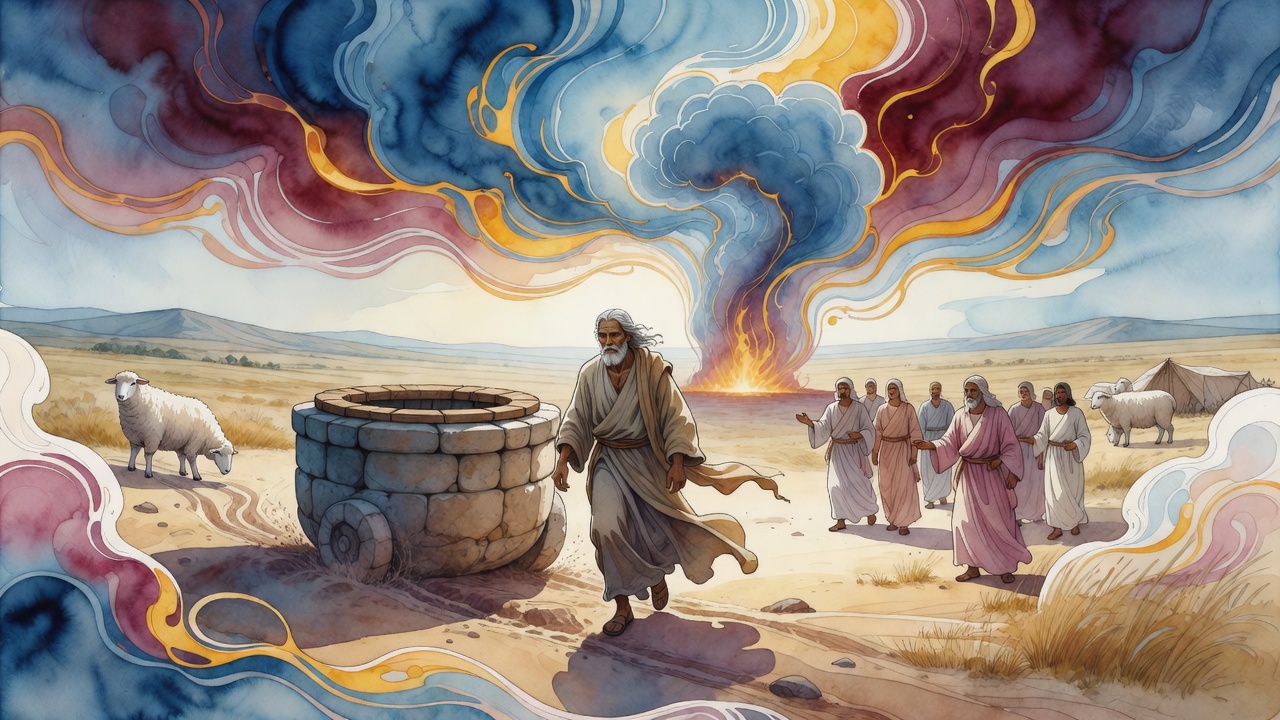
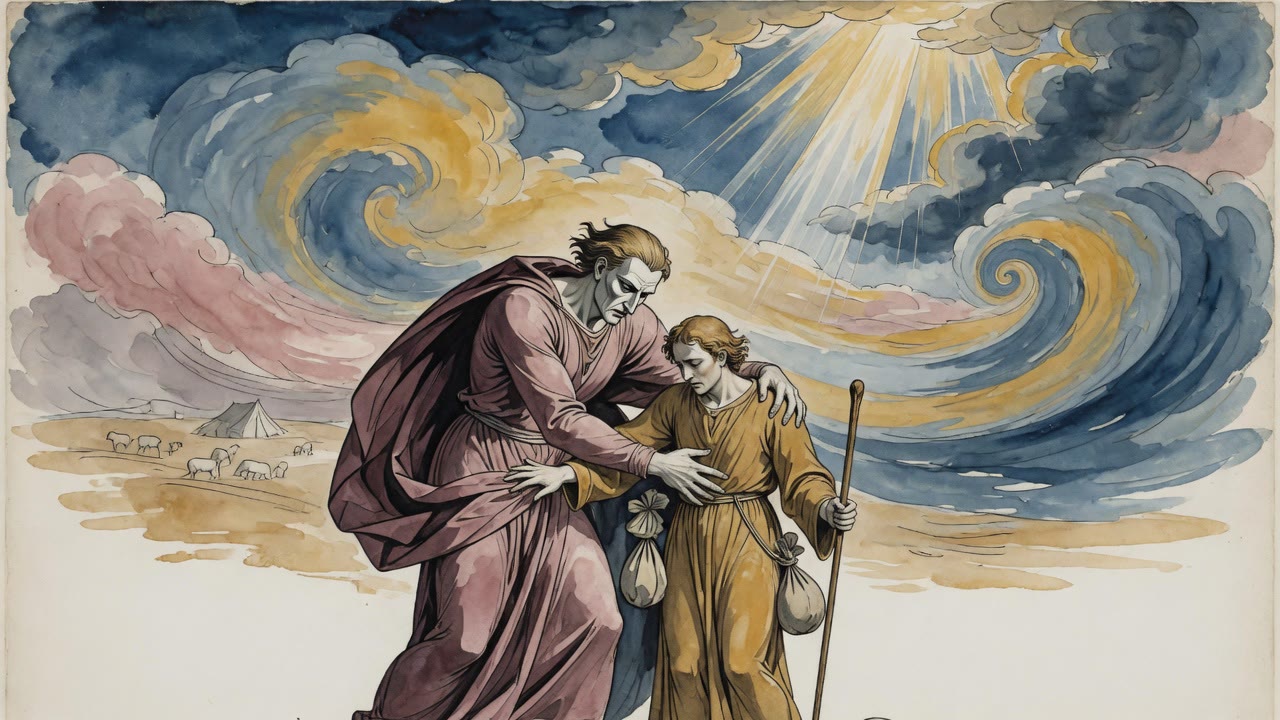
Jacob was seventy-seven when he left Beersheba with Esau's anger behind him. At a well in the east he rolled the heavy stone off alone for Rachel's sheep.

Curated by Arthur · Told by Maggid ·
Table of Contents
  1. Seventy-Seven and a Moving Well
  2. Brothers at a Stranger's Well
  3. Seven Years That Felt Like Days
  4. Water, Place, and the Road Home Later
The Well Followed Jacob from Beersheba to Haran Click for full size

Seventy-Seven and a Moving Well

Jacob was seventy-seven when he left his father's house. The number matters. This was not a boy on a first errand. This was a man already marked by blessing and flight, walking away from Beersheba with Esau's anger behind him and Laban's unknown face ahead.

The well that had sustained him did not stay planted. In Pirkei DeRabbi Eliezer it traveled with him, water keeping pace with a fugitive. A miracle that refuses to be left behind. Thirst would not be the thing that broke him on the road.

The ordinary distance from Beersheba to Mount Moriah takes two days. Jacob arrived at midday. The Holy One met him. "And he lighted upon the place," says the verse, and the sun was set so he tarried the night. The Place, HaMakom (המקום), is also a name for God, because wherever the righteous are, God is found with them.

Brothers at a Stranger's Well

Farther on, at another well in the east, Jacob did not wait to be noticed. "My brethren, whence be ye?" he asked men he had never met. The legends hear more than manners. He was teaching a posture. Treat the unknown worker like kin until the world proves otherwise.

Rachel arrived with her father's sheep. The stone on the well's mouth was heavy, a communal weight. Jacob rolled it alone, strength rising to meet a face that would cost him fourteen years. Water poured. Introductions turned into a future he could not yet price.

He wept. The midrash fills those tears with more than romance. He saw, in some tellings, the hard road still coiled inside her beauty. Love and prophecy can share one pair of wet eyes.

Seven Years That Felt Like Days

Jacob agreed to work seven years for Rachel. When the years were full he made a feast. Laban brought Leah under the veil, and the morning light committed a fraud the night had hidden. "Fulfil the week of this one," Laban said, and the second seven began for the woman Jacob had named first.

The Torah's line that the years seemed to him but a few days for the love he had for her is not erased by the cheat. It becomes bitter and sweet at once. Labor can feel light when the end of the labor has a name. Betrayal can still land after light labor like a stone larger than the well's.

Marriage in this house arrived as doubled covenant and doubled wound. Two sisters. Two sets of years. One man who had once stolen a blessing now learning what it is to be stolen from.

Water, Place, and the Road Home Later

The traveling well, the Place that met him at Moriah, the brother-word spoken to strangers, and the long purchase of a wife braid into one departure story. Jacob left with fear and arrived with a household. God went as Place. Water went as companion. Human welcome began as a question to men at a well and deepened into a life tangled with Laban's bargains.

When he finally turned home years later, he would meet another night alone at another river. The man who once rolled a stone for Rachel would limp after wrestling heaven. The well of Beersheba would be memory. The Place would still be near.

For now the eastern well shone under a foreign sky, and a seventy-seven-year-old fugitive practiced kinship on strangers because his own brother wanted him dead.

A well that travels is a mother's kindness rewritten as geography. Jacob left Rebecca and Isaac, yet water still accompanied him as if the household's care had grown wheels. Seventy-seven years of life had not made him too old for miracles. It had made him old enough to notice them without swagger.

At the Place, when the sun was hurried to set so he would stay, sleep brought a ladder and a promise. The midrash's stress on Makom as God keeps the scene from becoming only real estate. The stone under his head was pillow and future pillar. The road was not empty because the Place is not a point on a map alone. It is the claim that righteousness has company.

Saying "my brethren" to hired hands at Laban's well was practice for a life of complicated kinship. He would soon have wives who were sisters, sons who would sell a brother, and an uncle who treated contracts like clay. Starting with a generous word to strangers was not naivete. It was a chosen first move on a board stacked against him.

The seven years that felt like days did not make Laban's swap painless. They made the pain precise. Jacob knew what free labor for love felt like. He also learned what it felt like when love's wage was redirected by a veil and a feast. Rachel's price doubled. Leah's life tangled with a sister's. The man who once bought a birthright with stew was bought and sold in slower coin.

When he later fled Laban with household and herd, the traveling well of the first departure was memory. Other waters waited. The Yabbok. Tears on Esau's neck. For the young stretch of the journey, though, Beersheba's gift and Haran's well and a prophet-named Place were enough to keep a fugitive walking toward a future that would rename him.


← All myths
From the tradition

Sources

3 sources

The texts behind this telling. Some cards carry a translation of the source; others are our own retelling of it, and each card says which. Every card links out to the original.

Pirkei DeRabbi Eliezer 35:4Pirkei DeRabbi Eliezer

Retold in our words. Read the original at the link below.Pirke de Rabbi Eliezer, trans. Rabbi Gerald Friedlander, London (1916) · CC-BY

Maybe the story of Jacob's journey to Haran can shed some light.

In Pirkei DeRabbi Eliezer, a fascinating text filled with aggadic expansions of biblical narratives, Jacob was 77 years old when he left his father's house. Picture this: He's leaving Beersheba, and the well that sustained him miraculously travels with him. That’s quite a start to a journey!

The distance from Beersheba to Mount Moriah would normally take two days. Yet, Jacob arrives at Moriah at midday. The text says, "the Holy One, blessed be He, met him. "And he met in the place, and tarried there all night, because the sun was set" (Genesis 28:11).

Wait a minute.Why is God referred to as Maḳom? Maḳom (מָּקוֹם) literally means "the Place." The text explains that it's because wherever the righteous are, God is found with them. "In every place (Maḳom) where I record my name I will come unto thee, and bless thee" (Exodus 20:21). It's a beautiful reminder of God's omnipresence, His constant presence with those who seek Him.

Now, here's a little twist. God tells Jacob, "The bread is in thy bag, and the well is before thee, so that thou mayest eat and drink and sleep in this place." Seems straightforward. But Jacob, ever the thoughtful one, replies, "Sovereign of all the worlds! Till now the sun has still fifty degrees to set, and I am lying down in this place?" In other words, it’s the middle of the day! Why would he stop now?

And then, something extraordinary happens. The sun sets in the west, even though it's not yet time. Pirkei DeRabbi Eliezer emphasizes that it was not the proper time for sunset. Jacob looks up, sees the sun setting prematurely, and decides to stay there for the night. "And he tarried there all night, because the sun was set" (Genesis 28:11).

What does it all mean? Perhaps it signifies that God arranges events, even bending the laws of nature, to guide us to where we need to be. Jacob questioned the timing, but the early sunset became a sign, a divine nudge, confirming that he was indeed in the right Maḳom, the right place, at the right time.

Sometimes, life feels like a journey with unexpected detours and premature sunsets. But maybe, just maybe, those moments are God's way of saying, "You're exactly where you need to be."

Full source
Pirkei DeRabbi Eliezer 36:9Pirkei DeRabbi Eliezer

Retold in our words. Read the original at the link below.Pirke de Rabbi Eliezer, trans. Rabbi Gerald Friedlander, London (1916) · CC-BY

Pirkei DeRabbi Eliezer turns to Marriage of Jacob.

Jacob, as we know, agreed to work seven long years to earn Rachel’s hand in marriage. And when those seven years were up, he celebrated with a grand banquet and rejoicing for seven days. The verse reads, "and married Rachel, as it is said, 'Fulfil the week of this one' (Gen. 29:27). 'And Jacob did so, and fulfilled the week of this one' (Gen. 29:28)."

It wasn't just Jacob and his family celebrating. "All the men of the place were gathered together to show loving-kindness to our father Jacob, as it is said, 'And Laban gathered together all the men of the place, and made a feast' (Gen. 29:22)." Everyone came together to share in Jacob’s joy, demonstrating chesed (Lovingkindness), loving-kindness, a foundation of Jewish values.

This seemingly simple act of community support becomes something truly special.

Because God takes notice.

Pirkei DeRabbi Eliezer continues with an astonishing statement: "The Holy One, blessed be He, said: Ye have shown loving-kindness to Jacob, My servant, I also will give you and your sons your reward in this world, so that there be no reward for the wicked in the future world.."

Did you catch that? The act of showing kindness to Jacob, God’s servant, earned the people their reward in this world. And here's the really thought-provoking part: this reward was given precisely so that the wicked would receive no reward in the world to come.

It’s a fascinating and somewhat challenging idea. It suggests a divine calculus, a cosmic balancing of scales where acts of kindness have profound implications for the distribution of justice.

The text provides an example: "Now Naaman, captain of the host of the king of Aram… because by him the Lord had given victory unto Aram" (2 Kings 5:1). Naaman, a powerful figure in Aram, received victory through God. This, according to this understanding, was his reward in this world, leaving nothing for him in the world to come.

So, what are we to make of this?

Is it fair that some receive their reward in this world, forfeiting a future reward? Perhaps the message isn’t about fairness in a simplistic sense, but about the immediate impact of kindness. The people who celebrated with Jacob weren't thinking about cosmic justice; they were simply being good neighbors.

Maybe, just maybe, the takeaway is this: Do good, be kind, and let the divine sort out the rest. Focus on the chesed, the loving-kindness, in the here and now. Because, as the story of Jacob's wedding reminds us, even the smallest acts of goodness can ripple through eternity, impacting not only our lives but the very fabric of divine justice.

Full source
Legends of the Jews 6:108Legends of the Jews

Retold in our words. Read the original at the link below.The Legends of the Jews by Louis Ginzberg (1909) · Public Domain

What does he do? Does he stand back, waiting for someone to acknowledge him? Nope. He takes the initiative. "My brethren, whence be ye?" he asks. A simple question, but oh-so-powerful.

Here’s the kicker: Ginzberg, in Legends of the Jews, points out that Jacob isn't just being polite; he's setting an example. He's showing us that we should be "companionable, and address others like brothers and friends, and not wait for them to greet him." How often do we hold back, waiting for someone else to make the first move? Jacob teaches us to be proactive, to extend a hand (or a greeting!) and foster connection.

Why is this so important? Because, as the story suggests, initiating contact can invite "the angels of peace and compassion" into our lives. That by simply being friendly, by offering a shalom (peace) first, we open ourselves up to positive interactions and maybe even something…more.

So, Jacob finds out these folks are from Haran, the same place as his uncle Laban. Naturally, he wants to know more. "How's my uncle doing? Are you guys on good terms?" he asks. And their response? Well, they're a little…curt. “There is peace between us,” they say, “but if thou art desirous of inquiring further, here comes Rachel the daughter of Laban. From her thou canst learn all thou hast a mind to learn.”

Ouch! A little dismissive. But why did they send him to Rachel? The text implies a rather…interesting reason: "They knew that women like to talk, wherefore they referred him to Rachel. But it highlights a common perception, even back then. Perhaps they thought Rachel would be more forthcoming with information, more willing to chat. Whatever their reasoning, this sets the stage for one of the most famous meetings in the Torah.

What can we take from all this? Maybe it's the simple reminder to be the first to say hello. Maybe it's a nudge to think about how we approach new situations and new people. Or maybe, just maybe, it's a lesson in not always believing stereotypes. Whatever it is, the story of Jacob at the well offers a timeless lesson in human connection. It shows us the value of approaching others with warmth, curiosity, and a willingness to bridge the gap. And who knows? Maybe, just like Jacob, we'll find something truly special on the other side.

Full source