5 min read

The World Measured in Five Hundred Year Spans

Midrash Konen maps earth as a five-hundred-year journey, pillars hold the world, and a man leaves as empty-handed as he arrived.

Curated by Arthur · Told by Maggid ·
Table of Contents
  1. Five Hundred Years Across
  2. Pillars Under the Floor
  3. Worlds Built and Broken
  4. Empty Hands Both Ways
  5. Walk the Grid Without Owning It
The World Measured in Five Hundred Year Spans Click for full size

Five Hundred Years Across

Someone tried to walk the world and discovered it was not a mood but a measure. The inhabited earth is a journey of five hundred years. One third sea, one third wilderness, one third settled land. The years of the patriarchs become a ruler stretched from soil to heaven. The divine Name itself is pressed into the arithmetic until space feels like a sentence with numbers inside it.

A person standing in a field is standing on a fraction of a map that takes centuries to cross at walking speed. The midrash wants that vertigo. Small feet. Huge grid.

Pillars Under the Floor

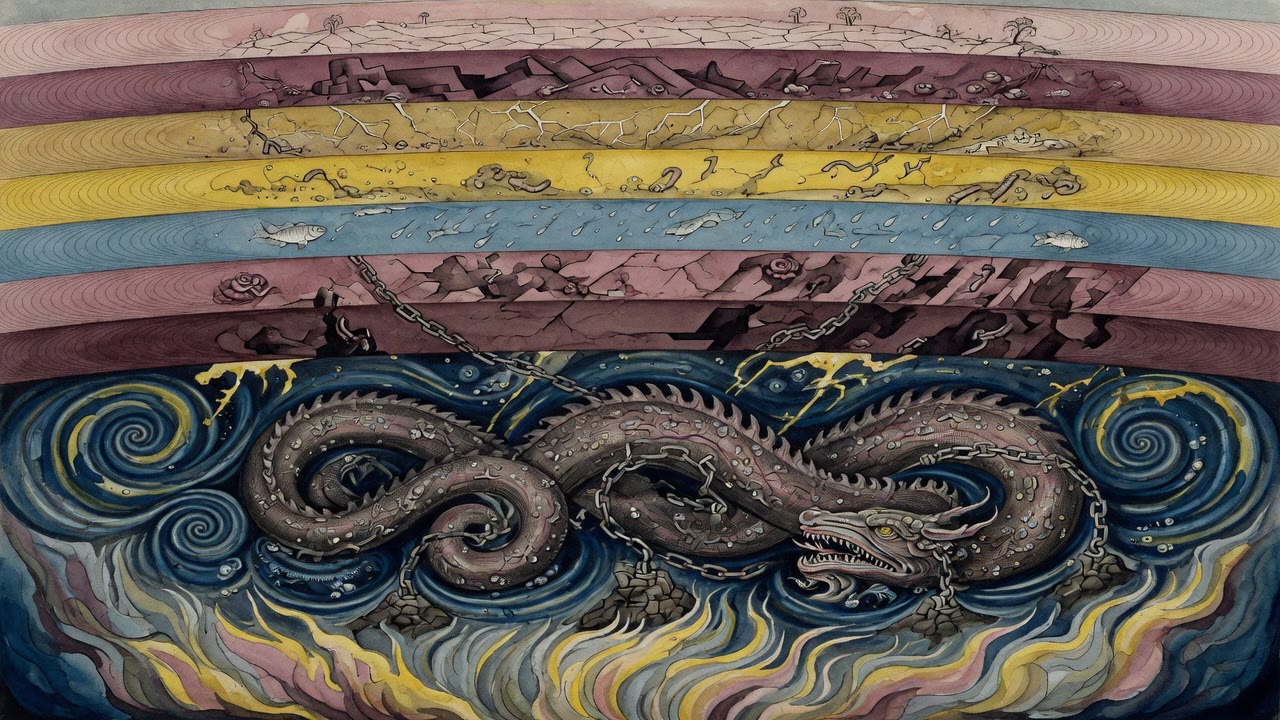
Other voices ask what holds the whole thing up. The pillars of the world are not only stone in these teachings. They are forces, righteous lives, structures of order that keep the ceiling from dropping on the living. When the sages speak of pillars they are speaking of load-bearing holiness. Remove them and the map Midrash Konen drew becomes a collapse plan.

The world is measured, then braced. Number, then support.

Worlds Built and Broken

Before this arrangement settled, the midrash of "very good" remembers worlds built and destroyed. Creation was not a single calm draft. Earlier structures rose and fell until death itself was woven into the decree that made this world livable. "Very good" includes the grim mercy of an ending. Without death, the sages imply, the story of humans under Heaven cannot hold. The decree is not cruelty alone. It is the hinge that keeps a measured world from freezing into endless unfinished claim.

Empty Hands Both Ways

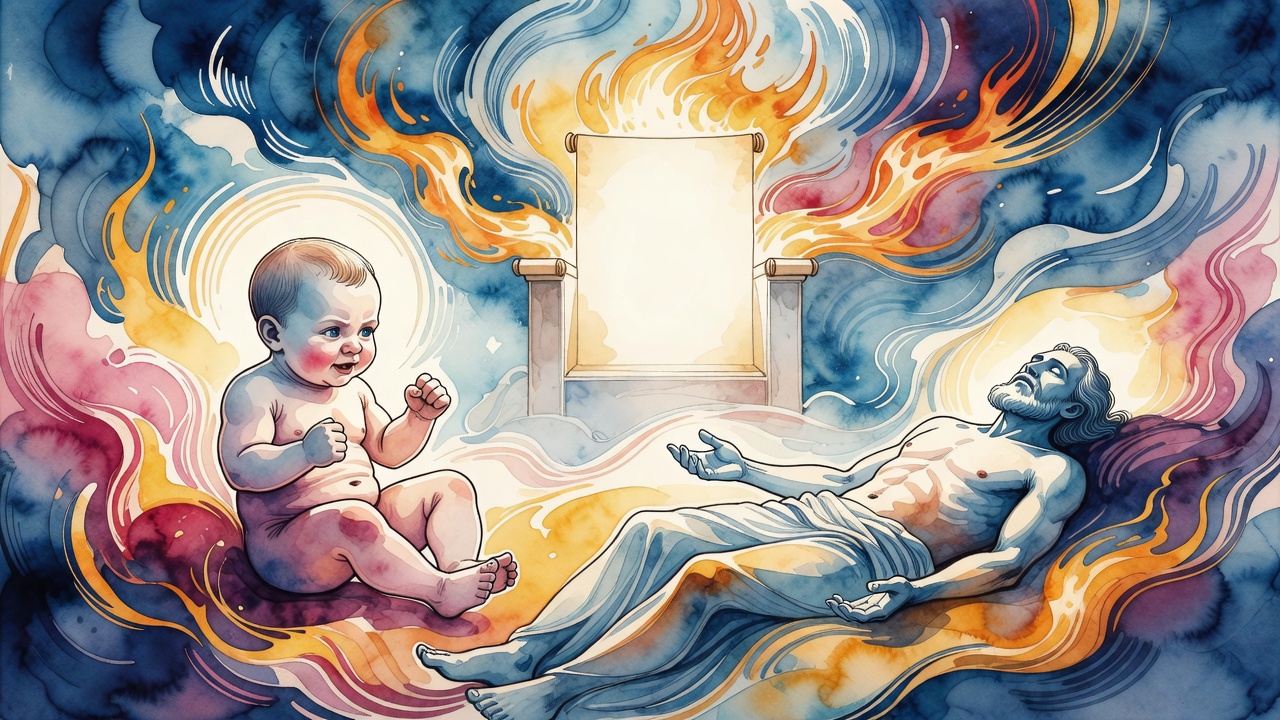
Kohelet's voice enters through the midrash on leaving as one came. Just as a man came into this world, so he will leave it. The fists that opened at birth open again at death. No treasure makes the crossing. The five-hundred-year map does not care what you stored in a chest. The pillars do not shift for a full barn. You arrive with nothing you can show a customs officer of Heaven, and you depart the same way, whatever titles you wore between the two empties.

The teaching is not only ascetic scolding. It is spatial. If the world is a measured span and you are a brief walker on one third of settled land, clutching is a misunderstanding of scale.

Walk the Grid Without Owning It

Hold the images until they press on each other. A cosmos sized in patriarchal years. Pillars that are lives and laws. Earlier worlds that failed. Death written into the success of this one. A human exit that mirrors the entrance. The teaching does not ask a walker to stop building. It asks for building that knows the grid is older and larger than any single name, and that the only load worth adding to the pillars is righteousness that helps hold the next walker's sky.

When Midrash Konen counts, it is counting so that pride loses its measuring stick. Five hundred years from edge to edge. Your threescore and ten are a crack of light on that road.

Children learn maps with borders and capitals. Midrash Konen teaches a map with walking-time and thirds of emptiness. Sea that will not host you. Wilderness that will not feed you. Settled land that still cannot be owned past a grave. The arithmetic is moral without becoming a sermon. It simply refuses to let a single lifetime pretend it is the whole diagram.

Death, in the "very good" teaching, is the permission structure for that honesty. If no one left, the pillars would have to hold infinite claimants. If everyone left empty-handed, the temptation to treat the grid as private property thins. Measure, pillar, broken prior worlds, empty exit: four sentences of the same strict mercy.

Stand at the edge of a sea third and feel how little of the map you own. Stand in wilderness and feel the same. Settled land flatters you with streets and deeds until Midrash Konen reminds you that even the settled third is a slice of a five-hundred-year walk. The patriarchs' years become yardsticks not to inflate them but to shrink us into honesty.

Pillars under that map are not tourist monuments. They are the reason the ceiling has not already come down. Righteous lives, sustaining orders, the quiet load-bearing work that never trends. When the sages say the world stands on pillars, they are issuing a job description disguised as cosmology.

Prior worlds that rose and fell before "very good" settled teach that this arrangement was chosen, not inevitable. Death entered the design so that measure could mean something. Empty-handed exit seals the measure. No walker takes the grid along. Each only decides, on a short segment, whether the weight added is one the pillars can trust or one they must waste strength to correct.


← All myths
From the tradition

Sources

4 sources

The texts behind this telling. Some cards carry a translation of the source; others are our own retelling of it, and each card says which. Every card links out to the original.

Otzar Midrashim, Midrash Konen ('He Established') 2:2Midrash Konen

Translation of the source text.Otzar Midrashim, New York, 1915 + JewishMythology.com faithful English Beta translation · Public Domain

The sages taught: the inhabited part of the world is a journey of five hundred years. One third is sea, one third is wilderness, and one third is settled land. How much is a third? One hundred sixty-six years and eight months.

A hint from Scripture is, "which the Lord swore to your fathers to give them, as the days of heaven upon the earth" (Deuteronomy 11:21). The years of the fathers amount to five hundred. This means the height of the world from earth to heaven is five hundred years, and as its height, so is its length, as it says, "For as the heavens are high above the earth" (Psalms 103:11), and "As far as east is from west" (Psalms 103:12), and "He stretched them out like a tent to dwell in" (Isaiah 40:22).

From where is this known? The word "He stretched them out" has the numerical value of five hundred and four. Remove from it the four directions of the world, in which there is no settlement. So too it is written, "Who set its measurements, if you know?" (Job 38:5). The words "if you know" have the numerical value of five hundred and four.

Two thirds are dry land and wilderness, half settlement and half desolate wilderness, as it is written, "and the dry land appeared" (Genesis 1:9). "The dry land" has the numerical value of three hundred twenty-two. One third is sea, as it is written, "and to the gathering of the waters He called seas" (Genesis 1:10). "And to the gathering" has the numerical value of one hundred eighty-one. Together these make five hundred and three. Remove three for the three directions.

If you say: there it was five hundred and four, and here it is five hundred and three, the answer is that there it counted the borders of dry land, but here, from sea to dry land, it does not need a border. And if you say that three directions are extra beyond the dry land, those belong to the other seas. Even though they are dry land, they are called seas and counted among the seas, as it says, "and to the gathering of the waters," and they are also counted among dry land, as it says, "God called the dry land earth" (Genesis 1:10), because they are the border of dry land. The waters of Ocean are not the border of dry land.

The word "dry land" has the numerical value of three hundred forty-seven. Two thirds of five hundred, wilderness and settlement, are three hundred thirty-three years and four months. The extra one belongs to the islands in the sea, and they are called dry land, as it says, "God called the dry land earth." These are the islands in the sea. Though they stand within the boundary of the sea, they are called earth.

"And to the gathering of the waters He called seas" refers to the Sea of Sodom, the Sea of Salit, the Sea of Yarmukh, the Salt Sea, the Sea of the Arabah, the Sea of Tiberias, and the Great Sea. Though they belong to the boundaries of the waters of Ocean, they are called seas, as it says, "and to the gathering of the waters He called seas."

Full source
Hagigah 12bTalmud Bavli, Hagigah

Translation of the source text.William Davidson Edition - Vocalized Aramaic · CC-BY-NC

Why do I need "the earth" (et ha'aretz)? To place the heavens before the earth. "And the earth was unformed and void" (Genesis 1:2). Now since He began first with the heavens, what is the reason that Scripture reckons the work of the earth? The school of Rabbi Yishmael taught: A parable to a king of flesh and blood who said to his servants: Rise early to my gate. He rose early and found women and men. Whom does he praise? The one whose way it is not to rise early, yet rose early.

It was taught: Rabbi Yose says: Woe to the creatures, who see and do not know what they see, who stand and do not know on what they stand. On what does the earth stand? On the pillars, as it is said: "He who shakes the earth from its place, and its pillars tremble" (Job 9:6). The pillars, on the waters, as it is said: "To Him who spread out the earth upon the waters" (Psalms 136:6). The waters, on the mountains, as it is said: "The waters stood above the mountains" (Psalms 104:6). The mountains, on the wind, as it is said: "For behold, He who forms the mountains and creates the wind" (Amos 4:13). The wind, on the storm, as it is said: "stormy wind fulfilling His word" (Psalms 148:8). The storm hangs from the arm of the Holy One, blessed be He, as it is said: "and underneath are the everlasting arms" (Deuteronomy 33:27).

And the Sages say: It stands on twelve pillars, as it is said: "He set the borders of the peoples according to the number of the children of Israel" (Deuteronomy 32:8). And some say: seven pillars, as it is said: "She has hewn out her seven pillars" (Proverbs 9:1). Rabbi Elazar ben Shammua says: On a single pillar, and its name is Righteous, as it is said: "And the righteous is the foundation of the world" (Proverbs 10:25).

Rav Yehudah said: There are two firmaments, as it is said: "Behold, to the LORD your God belong the heavens and the heaven of heavens" (Deuteronomy 10:14).

Resh Lakish said: Seven, and these are they: Vilon, Rakia, Shechakim, Zevul, Maon, Makhon, Aravot. Vilon serves no purpose at all, except that it enters at morning and goes out at evening, and renews each day the work of creation, as it is said: "He who stretches out the heavens like a curtain, and spreads them like a tent to dwell in" (Isaiah 40:22). Rakia is that in which the sun and moon, stars and constellations are fixed, as it is said: "And God set them in the firmament (rakia) of the heavens" (Genesis 1:17). Shechakim is that in which millstones stand and grind manna for the righteous, as it is said: "And He commanded the skies (shechakim) above, and opened the doors of heaven, and rained upon them manna to eat" (Psalms 78:23-24).

Zevul is that in which are Jerusalem and the Temple, and an altar is built, and Michael the great prince stands and offers an offering upon it, as it is said: "I have surely built You a house of habitation (zevul), a place for You to dwell in forever" (1 Kings 8:13). And from where do we know that it is called heaven? As it is written: "Look down from heaven and see, from Your holy and glorious habitation (zevul)" (Isaiah 63:15).

Maon is that in which are companies of ministering angels, who recite song at night and are silent by day, for the sake of the honor of Israel, as it is said: "By day the LORD commands His lovingkindness, and at night His song is with me" (Psalms 42:9).

Resh Lakish said: Anyone who occupies himself with Torah at night, the Holy One, blessed be He, draws over him a thread of lovingkindness by day, as it is said: "By day the LORD commands His lovingkindness." And what is the reason "by day the LORD commands His lovingkindness"? Because of "and at night His song is with me." And there are those who say that Resh Lakish said: Anyone who occupies himself with Torah in this world, which is like night, the Holy One, blessed be He, draws over him a thread of lovingkindness in the World to Come, which is like day, as it is said: "By day the LORD commands His lovingkindness, and at night His song is with me."

Rabbi Levi said: Anyone who breaks off from words of Torah and occupies himself with words of idle chatter is fed coals of broom-wood, as it is said: "Who pluck saltwort by the bushes, and the root of the broom-wood for their food" (Job 30:4). And from where do we know that it is called heaven? As it is said: "Look down from Your holy habitation (maon), from heaven" (Deuteronomy 26:15).

Makhon is that in which are storehouses of snow and storehouses of hail, and a chamber of harmful dews, and a chamber of drops, and the room of the whirlwind and storm, and the cave of mist. And their doors are of fire, as it is said: "The LORD shall open for you His good storehouse" (Deuteronomy 28:12).

Are these in the firmament? These are on the earth! As it is written: "Praise the LORD from the earth, you sea monsters and all deeps, fire and hail, snow and mist, stormy wind fulfilling His word" (Psalms 148:7-8). Rav Yehudah said that Rav said: David sought mercy concerning them, and brought them down to the earth. He said before Him: Master of the Universe, "You are not a God who desires wickedness, evil shall not sojourn with You" (Psalms 5:5). You are righteous, O LORD; evil shall not sojourn in Your dwelling. And from where do we know that it is called heaven? As it is written: "And You shall hear in heaven, the place of Your dwelling (makhon)" (1 Kings 8:39).

Aravot is that in which are righteousness, judgment, and charity, the treasuries of life and the treasuries of peace and the treasuries of blessing, and the souls of the righteous, and the spirits and souls destined to be created, and the dew with which the Holy One, blessed be He, will in the future revive the dead. Righteousness and judgment, as it is written: "Righteousness and judgment are the foundation of Your throne" (Psalms 89:15). Charity, as it is written: "And He put on righteousness as a coat of mail" (Isaiah 59:17). The treasuries of life, as it is written: "For with You is the fountain of life" (Psalms 36:10). And the treasuries of peace, as it is written: "And he called it: the LORD is peace" (Judges 6:24). And the treasuries of blessing, as it is written: "He shall receive blessing from the LORD" (Psalms 24:5).

The souls of the righteous, as it is written: "And the soul of my lord shall be bound in the bundle of life with the LORD your God" (1 Samuel 25:29). The spirits and souls destined to be created, as it is written: "For the spirit should faint before Me, and the souls which I have made" (Isaiah 57:16). And the dew with which the Holy One, blessed be He, will in the future revive the dead, as it is written: "A bountiful rain You poured down, O God; when Your inheritance was weary, You established it" (Psalms 68:10).

There are the wheels (ofanim) and the seraphim and the holy living creatures, and the ministering angels, and the throne of glory; the King, the living God, high and exalted, dwells over them in Aravot, as it is said: "Extol Him who rides upon the clouds (aravot), by His name Yah" (Psalms 68:5). And from where do we know that it is called heaven? It is derived by an analogy of "riding" and "riding": it is written here, "Extol Him who rides upon the clouds (aravot)," and it is written elsewhere, "who rides upon the heavens to your help" (Deuteronomy 33:26).

And darkness and cloud and thick darkness surround Him, as it is said: "He made darkness His covering, His pavilion around Him, dark waters and thick clouds of the skies" (Psalms 18:12). But is there darkness before Heaven? Is it not written: "He reveals the deep and hidden things; He knows what is in the darkness, and the light dwells with Him" (Daniel 2:22)! This is no difficulty: this [text uncertain]

Full source
Kohelet Rabbah 5:15Kohelet Rabbah

Retold in our words. Read the original at the link below.The Sefaria Midrash Rabbah, 2022 · CC-BY

The Book of Ecclesiastes, or Kohelet as it's known in Hebrew, certainly does. And the ancient rabbis weren't afraid to confront that feeling either.

Kohelet 5:15 laments, "This too is a grievous evil; just as he came, so he will go; and what is the advantage for him that he will toil for the wind?” A pretty bleak assessment. But what did the rabbis make of it?

Kohelet Rabbah, a collection of rabbinic interpretations on Ecclesiastes, explores this verse, trying to unpack its meaning. One interpretation sees a parallel between our entry into the world and our exit. Just as we arrive helpless, needing soft foods, so too, readers often depart needing the same. A full circle, perhaps? A reminder of our dependence?

The interpretation doesn't stop there. Rabbi Pinḥas offers a grander, almost historical perspective. He suggests that just as God began the world with four kingdoms, so too will the world conclude with four kingdoms. He points to (Genesis 14:9), listing Kedorlaomer, king of Elam; Tidal, king of Goyim; Amrafel, king of Shinar; and Ariokh, king of Elasar, as the initial quartet. He then identifies the final four as Babylon, Greece, Media, and Edom (Rome). Now, why these specific kingdoms? That’s a whole other fascinating rabbit hole to explore another time! But the key is the cyclical nature of power, the rise and fall of empires, echoing the individual's journey from helplessness to helplessness.

Then comes the real kicker: "And what is the advantage for him that he will toil for the wind?” Kohelet Rabbah interprets this as a direct address from God. But what good is it if I don't provide the wind to winnow it, to separate the wheat from the chaff? How will you survive?"

We work so hard, but we’re ultimately dependent on something beyond ourselves. We can control some things, but not everything.

And here’s where it gets really interesting. The text goes on to say that the omer is given as payment for that wind. The omer was a specific measure of barley offered during the time of the Temple in Jerusalem, connecting the physical act of harvesting to a spiritual offering. So, the omer, in this interpretation, becomes a symbol of gratitude for the very things we often take for granted – the wind, the rain, the very forces of nature that sustain us.

We are participants in a larger system, dependent on forces beyond our control. And perhaps, just perhaps, that realization can offer some comfort when we feel like we're toiling for the wind.

So, the next time you feel like you're working tirelessly without reward, remember the words of Kohelet, and the wisdom of the rabbis. Remember the wind, and the omer, and the interconnectedness of all things. And maybe, just maybe, you'll find a new appreciation for the unseen forces that shape our lives.

Full source
Yalkut Shimoni on Torah 16:10Yalkut Shimoni on Torah

Translation of the source text.Torat Emet (Yalkut Shimoni) · CC-BY-NC

"And God saw all that He had made, and behold, it was very good" (Genesis 1:31). From here we learn that He was creating worlds and destroying them until He created these. He said, "These please Me; those did not please Me." "And God saw all that He had made." A king of flesh and blood who builds a palace looks at the upper stories with one glance and the lower stories with another glance, but the Holy One, blessed be He, looks at the upper worlds and the lower worlds with a single glance. "And behold, good" refers to this world; "very" refers to the world to come. The Holy One, blessed be He, looked upon them with a single glance. This is like a king who built a palace, saw it, and it pleased him; he said, "Palace, palace, may you find favor in my eyes at all times as you have found favor before me in this hour." It is like a king who married off his daughter and made her a wedding canopy, plastered it and decorated it, and saw it and it pleased him; he said to her, "My daughter, my daughter, may this canopy find favor before me," and so on.

In the Torah scroll of Rabbi Meir they found written, "And behold, good" refers to death. The first man was fit never to taste the taste of death, but the Holy One, blessed be He, foresaw that Nebuchadnezzar king of Babylon and Hiram king of Tyre were destined to make themselves into gods; therefore death was decreed upon man. This is what is written, "You were in Eden, the garden of God" (Ezekiel 28:13). Was Hiram in the garden of Eden? Rather, He said to him, "You caused the one who was in Eden to die." If so, let Him decree death upon the wicked and not decree death upon the righteous. Rather, it is so that the wicked should not perform repentance out of deceit and say, "Are the righteous alive only because they store up commandments and good deeds?" so that their deeds would be found to be not for their own sake.

Full source