6 min read

The Three Ledgers Open and Every Soul Passes the Throne

Three ledgers open above the throne, and every soul files past one by one to be weighed, sealed, or sent through the refining fire.

Curated by Arthur · Told by Maggid ·
Table of Contents
  1. The Shepherd Counts at the Narrow Gate
  2. Three Ledgers Are Opened Before the Throne
  3. Six Questions Put to the Trembling Soul
  4. The Middle Souls Pass Through the Refining Fire

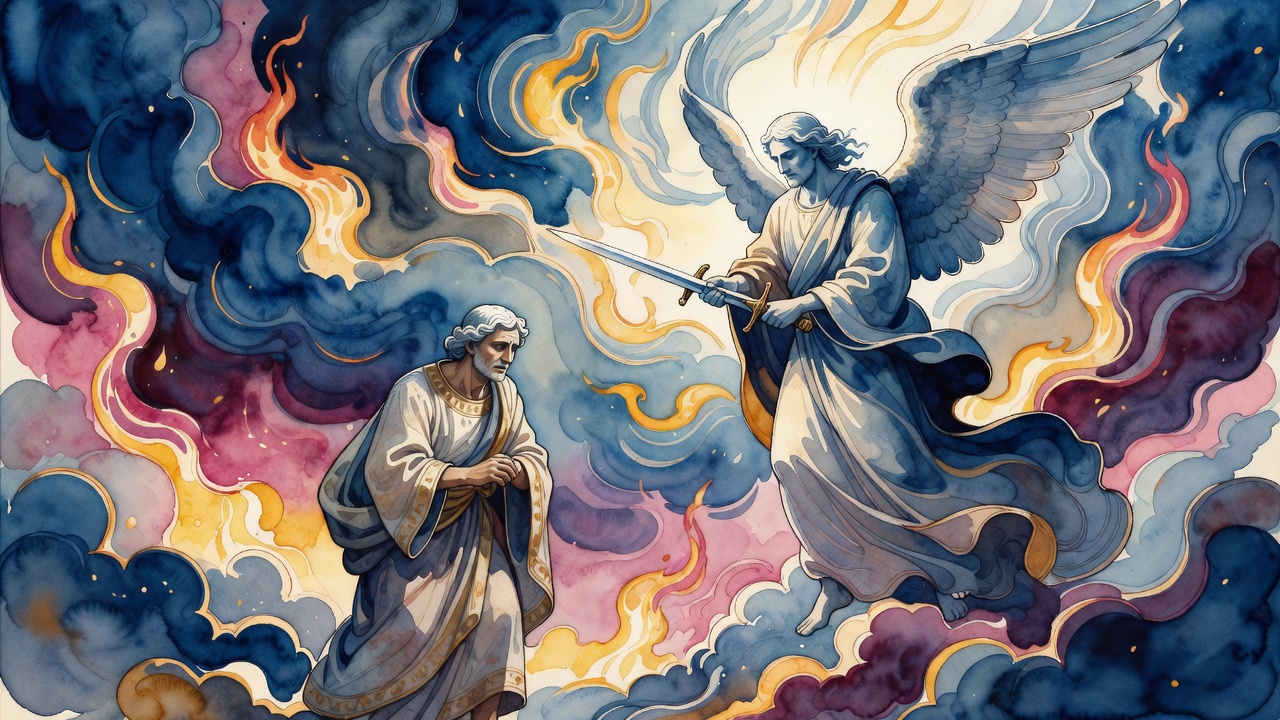
The gate is narrow. It is no wider than one body at a time, and the line stretches past where the eye can hold it, every soul that breathes pressed shoulder to shoulder, shuffling forward. There is no jostling. Each one feels the weight ahead and goes quiet. Far up the column, where the file thins to a single thread, a shepherd waits at the opening and counts. He lifts each head with his crook, looks once, and lets it pass. One. Then the next. Then you.
The Shepherd Counts at the Narrow Gate

This is how the New Year comes, not as a feast with bread and wine, but as a reckoning. On this morning every creature alive passes before the throne the way sheep pass under the rod of the one who owns them, single file, each measured against the year behind it. The high ones go. The low ones go. The king in his finery and the beggar in his rags enter the same narrow place, and at that threshold the finery means nothing, because what is being counted is not what hangs on the body but what the body did.

And it is not only the bodies of men that pass. The rains for the year are weighed at this gate. The harvests are weighed, the cities, the fates of whole nations. Whether a field will drink or crack, whether a town will stand or fall, all of it is set on this one day, when the order of the world is taken apart and put together again.

Three Ledgers Are Opened Before the Throne

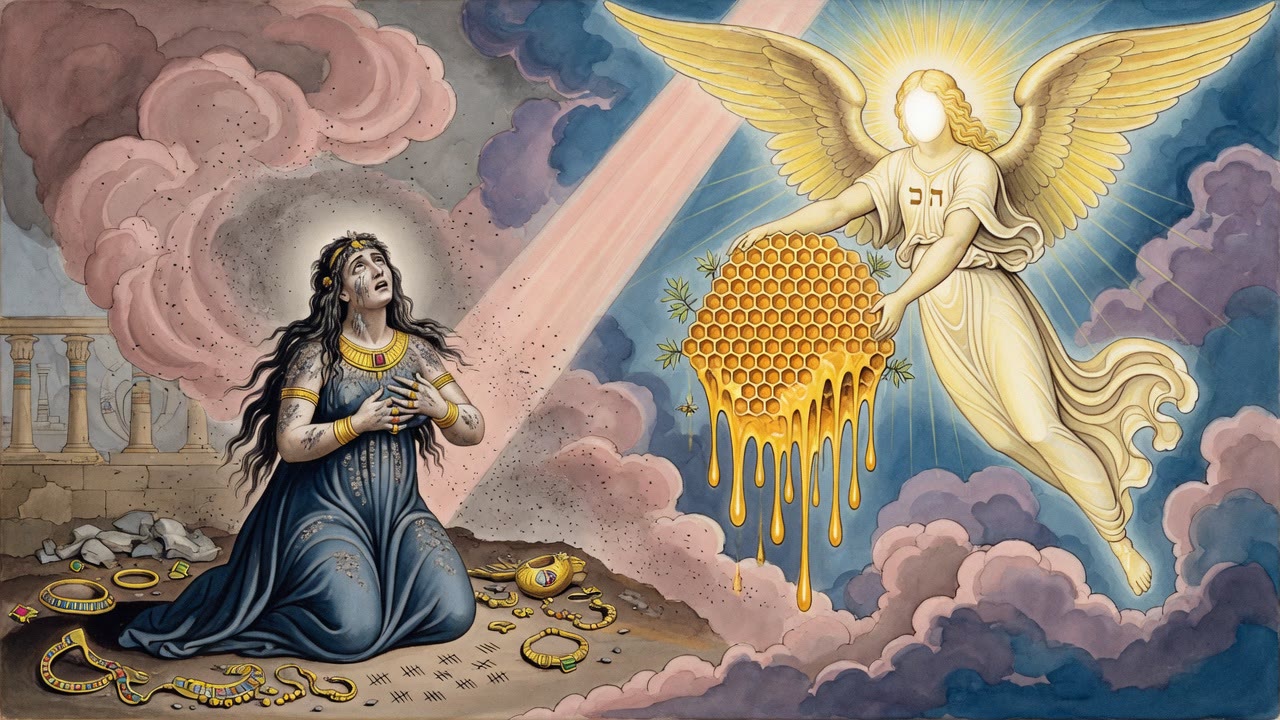
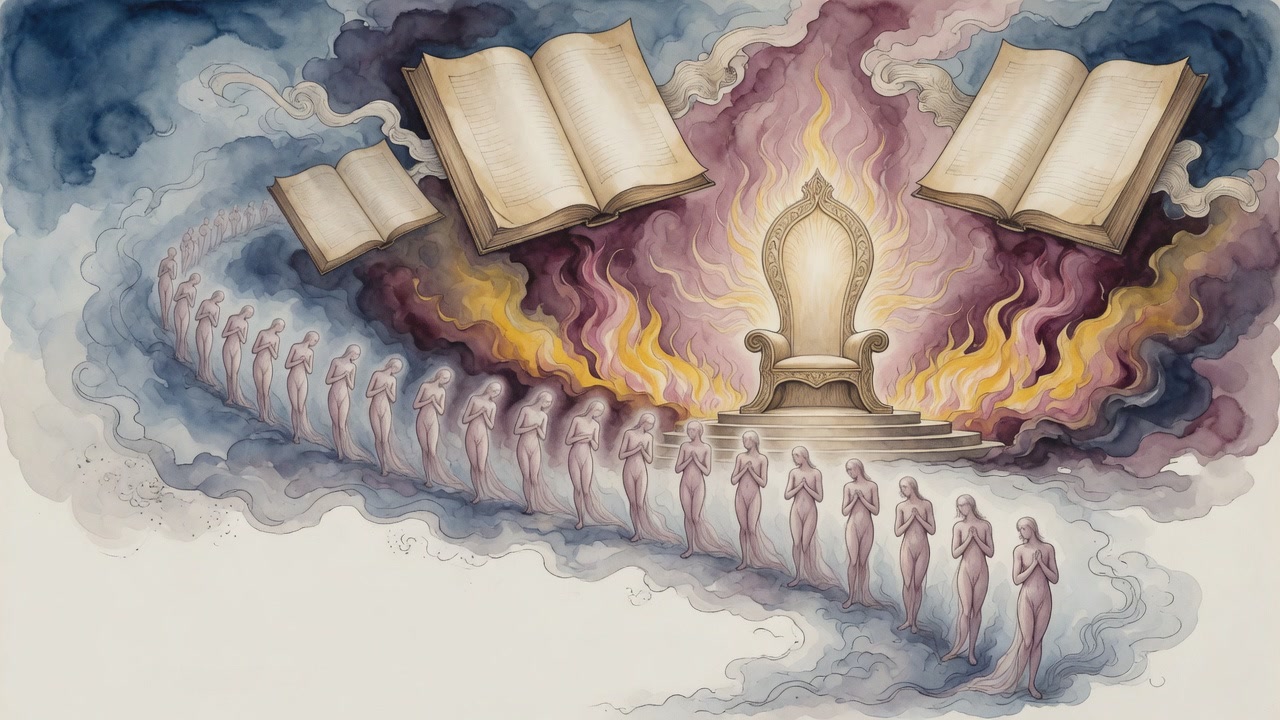
At the head of the line three books lie open. Their pages are turning though no hand turns them. The first is thin and bright, and into it are written the names of the wholly righteous, and the moment a name lands there it is sealed, and the soul is sent on toward life with no question asked. The second is black at the edges, and into it go the wholly wicked, sealed at once, sent down to the burning place called Gehinnom, the pit of fire. Of these two the prophet had already spoken: many who sleep in the dust will wake, some to everlasting life, and some to shame and everlasting contempt (Daniel 12:2).

But the third book is the thick one. It is the one almost everyone is written into, because almost no one is wholly anything. Not righteous. Not lost. The great middle, the ones who lied a little and gave a little, who prayed and then forgot, who loved badly and meant well. Their names go into the third ledger, and the third ledger is not sealed. It is left open, hanging, suspended between this day and the day of atonement ten days on, while the case is argued and the verdict held back.

Six Questions Put to the Trembling Soul

You reach the front. The shepherd's face is gone now and there is only the throne and the open books, and a voice that does not raise itself begins to ask. These are not riddles meant to trap. They are the questions of an examination you have been sitting for your entire life without knowing the paper was being marked.

The first question is not about prayer. It comes before prayer, before the candles, before any word said toward heaven. The first question is: were you honest in your trade? Did your scales weigh true, did your word in the market hold? The court opens the ledger of your dealings before it opens the ledger of your worship. Then the second: did you set aside a fixed portion of your days to study, to turn the pages, to keep the learning alive in you? Then the third, plain and bodily: did you build a family, did you bring life after you into the world?

The voice does not hurry. Did you, when trouble came down on you and the ground gave way, did you still hope, did you still trust that you were held? Did you speak with wisdom, or did your tongue scatter ruin? And the last, the one that asks not what you did but what you reached for: did you seek the deeper meaning under things, or did you take the surface and never look beneath it? Six questions. Then silence. Then the verdict, or the lack of one.

The Middle Souls Pass Through the Refining Fire

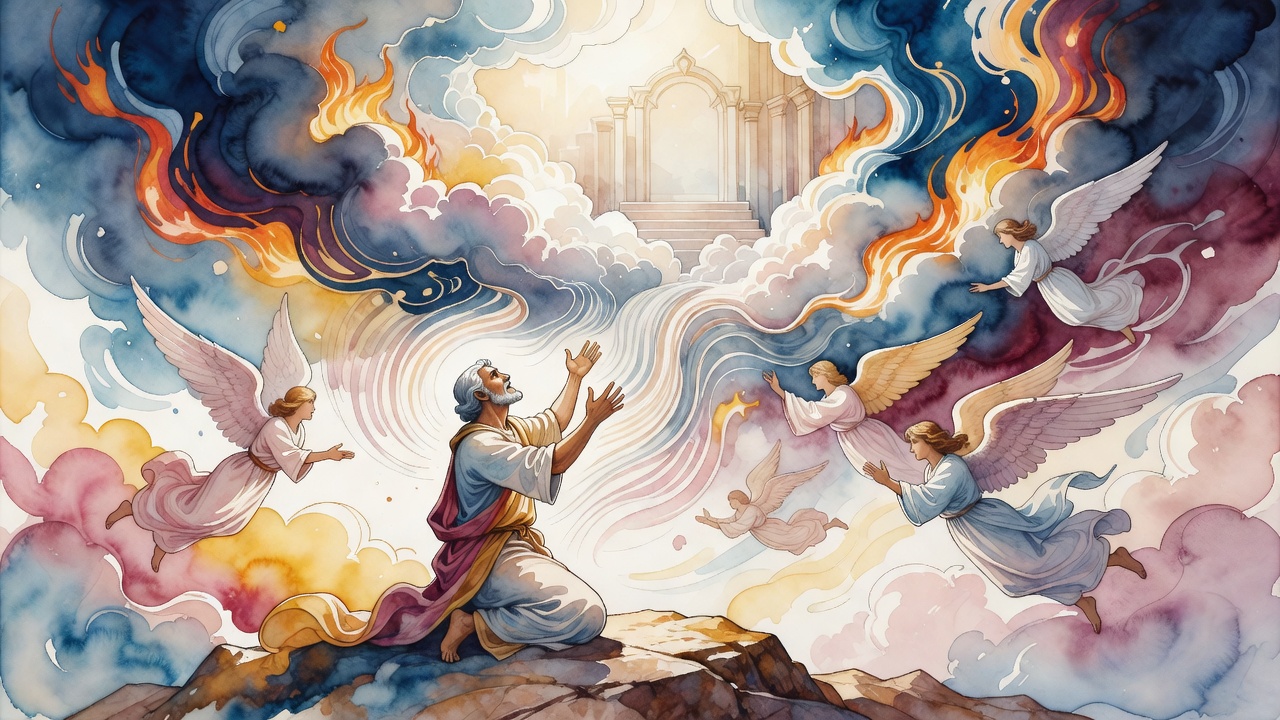
For the righteous the silence breaks into light and they go on. For the wicked it breaks into fire and they go down. For you, and for nearly all the rest, the third book stays open and you are sent to wait in dread for ten days, your name unsealed, your sentence unwritten, while above you the argument continues over what you are.

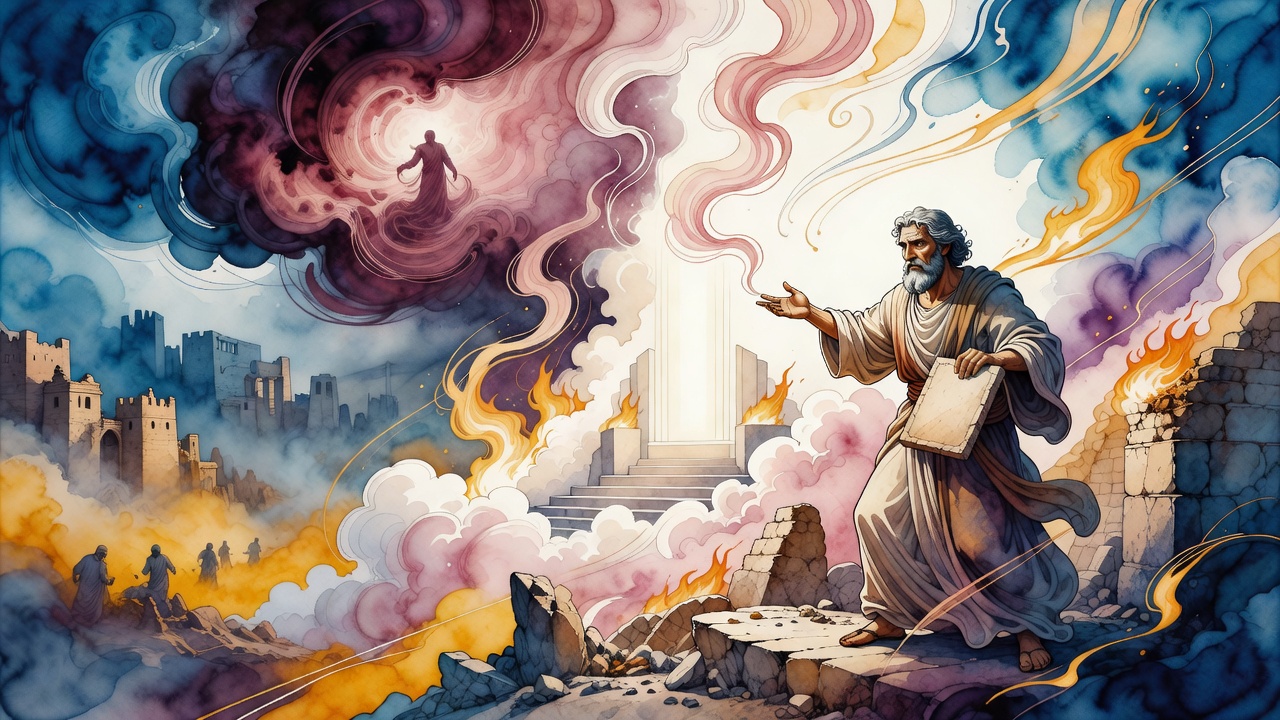
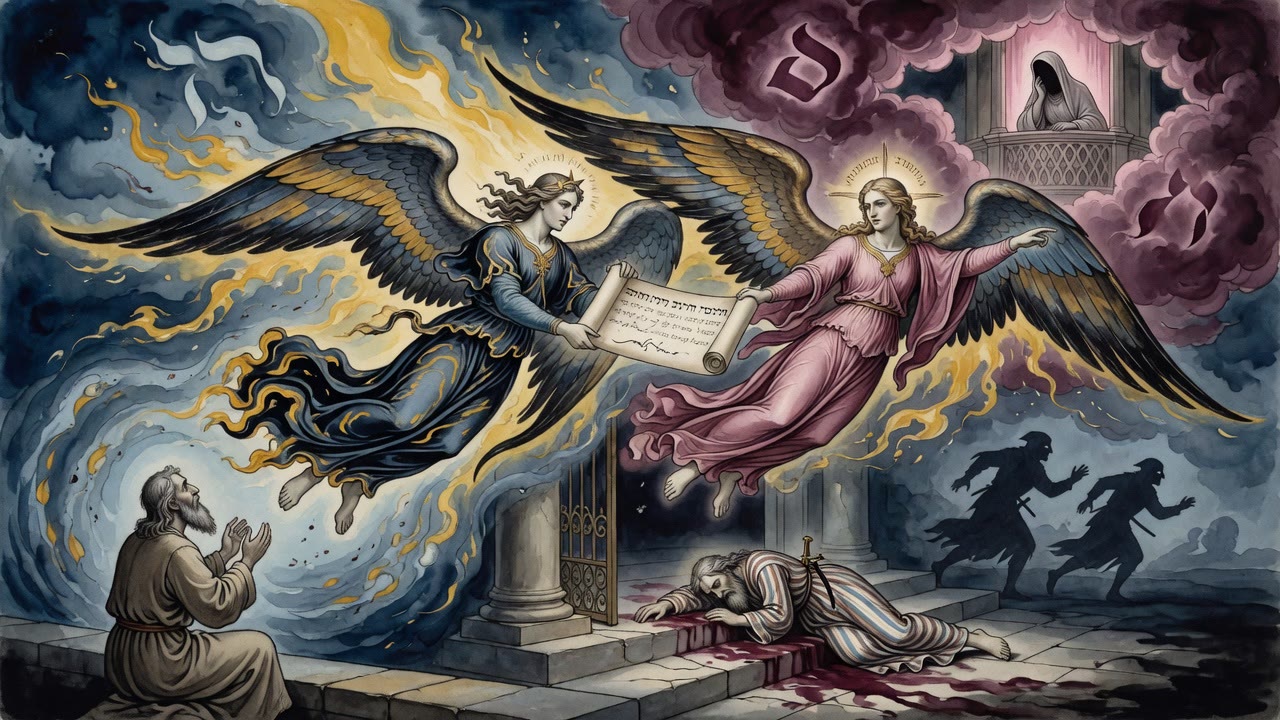
And if at the end the scale tips wrong, even then the story does not end in the black book. The middle souls go down into the fire, but not to stay. They descend into Gehinnom and they cry and howl there for a time, and the fire that takes them is not a fire of destruction but a fire of refining, the kind that burns silver clean and tries gold until only the true metal is left. The prophet heard the promise of it spoken in the divine voice: I will bring the third part through the fire, and refine them as silver is refined, and try them as gold is tried; they shall call on my name, and I will answer them (Zechariah 13:9). They come out the far side scoured and lightened, and they too are let through.

The line moves. The narrow gate takes the next body, and the next, and the books keep their pages turning, and the shepherd counts on toward the end of the world's flock, which is every living thing.


← All myths
From the tradition

Sources

4 sources

The texts this telling draws on, in full. Open a card to read inline, or expand it for a wider, quieter read.

Rosh Hashanah 16bHebraic Literature (1901)

Tractate Rosh Hashanah (folio 16, column 2) teaches that on the Day of Judgment three ledgers are opened and three groups of souls appear before the Holy One, blessed be He.

The perfectly righteous are written and sealed at once for eternal life. The thoroughly wicked are written and sealed at once for Gehinnom. But there is a third group, the great middle, neither saintly nor lost. And these are not so easily disposed of.

Of the first two groups the prophet Daniel wrote: "Many of them that sleep in the dust of the earth shall awake, some to everlasting life, and some to shame and everlasting contempt" (Daniel 12:2). But of the intermediate souls, the rabbis turned to the prophet Zechariah, who said in the name of the Holy One: "I will bring the third part through the fire, and will refine them as silver is refined, and will try them as gold is tried; they shall call on my name, and I will hear them" (Zechariah 13:9).

They descend into Gehinnom, they cry and howl for a time, and then they ascend. It was of them that Hannah sang in her prayer at Shiloh: "The Lord killeth, and maketh alive; He bringeth down to she'ol, and bringeth up" (1 Samuel 2:6).

Most of us, the rabbis are whispering, will be refined rather than destroyed. That is a strict mercy.

Full source
Shabbat 31aHebraic Literature (1901)

The sages taught that when a person stands at the judgment seat of the Holy One after death, six questions are put to the soul. They are not trick questions. They are the exam the person has been taking all their life.

"Have you been honest in your business dealings?" comes first, because the court of Heaven judges ledgers before it judges liturgy. "Have you set aside a fixed portion of your time for the study of Torah?" comes second, because a Jew who never opens a book has no defense when the Book asks about him. "Have you observed the first commandment, to be fruitful and multiply?" follows. "Did you, in trouble, still hope and believe in God?" "Did you speak wisely?" And last, "Did you seek the deeper meaning of things?" (Shabbat 31a).

The anthology then turns to a second set of teachings, about women in the household. All blessings, the sages say, enter a house through the wife. A man must honor her or the blessings leave. He must take care never to make her weep, because God counts every tear that falls from a wife's eyes, and the husband who caused them will one day pay for each one.

When charity is distributed and both men and women need help, the women are helped first. If there is not enough for both, the men should gladly give up their claim. A widow is honored before a widower, because a woman's grief is harder to bear and easier to miss.

One final line sits at the bottom of this collection, sharp as a knife. "Tears are shed on God's altar for the one who forsakes his first love." The altar is the altar of the Temple, and the weeping is God's own.

Full source
Pesikta, Pesikta ChadataOtzar Midrashim (Eisenstein)

Rabbi Yehuda said, "Three books are opened on Rosh Hashanah (the Jewish New Year) before the Holy One, Blessed be He: One of wholly righteous people; and they are immediately written and sealed for life. One of middling people; and they are left with their judgment suspended from Rosh Hashanah until Yom Kippur (the Day of Atonement). If they merit, they are written for life; if they do not merit, they are written for death." Rabbi Avin said, "What is the verse [that alludes to this]? 'Let them be blotted out of the book of the living, but not be written with the righteous' (Psalms 69:29)." "One of wholly wicked people; they are immediately written and sealed for death." Lest you say, "Behold we see that [some] wicked people live long lives and [some] righteous people do not live long!" [Hence] Rabbi Yochanan says, "[This is talking about] wholly righteous people and wholly wicked people." Or perhaps it is speaking about the judgement of the Garden of Eden and Geihinnom after their death. It was learned [about the latter]: Beit Shammai says, "Three groups will pass by on the Day of Judgment: One of wholly righteous people, one of wholly wicked people, and one of middling people. Wholly righteous people will immediately be written for the Garden of Eden; wholly wicked people immediately for Geihinnom. Middling people will descend to Geihinnom and they will cry out and ascend, as it is stated (Zechariah 13:9), "And I will bring the third part through the fire, and will refine them as silver is refined, and will try them as gold is tried." And about them, Channah said (I Samuel 2:6), "The Lord kills, and gives life; he brings down to the grave, and brings up." Beit Hillel says, "'And abundant in kindness' (Exodus 34:6) tilts the scales in favor of kindness [for the middling people]. And about them, David said (Psalms 116:1), 'I love the Lord, Who hears my voice and my supplications.'" Rava said, "That which is written, 'I love the Lord, Who hears my voice" - the Congregation of Israel said before the Holy One, Blessed be He, 'When am I beloved in front of You? When You hear the voice of my supplications. Although 'I am poor' in mitzvot (commandments), nevertheless it is fitting to 'save me.'" A matron asked Rabban Gamliel, "In your Torah, it is written (Deuteronomy 10:17), '[God...] Who shows no favor nor takes graft'; yet it written (Numbers 6:26), 'The Lord shall show favor to you and give you peace!'" Rabbi Yose the Priest joined in and said, "It is not difficult. Here it is about sins between a person and his fellow; but there it is about sins between a person and his Maker." [That was] until Rabbi Akiva came and taught, "Here it is before the sentence is issued; there it is after the sentence has been issued" (see Bamidbar Rabbah 11). Rav Shmuel bar Oniya said in the name of Rav, "From where [do we know] that the sentence of a community is never sealed?" But isn’t it written (Jeremiah 2:22), "the stain of your iniquity [is before Me]" (implying that the sentence of a community can be sealed). Rather, "[From where do we know that] although it is sealed, it can still be torn up?" As it is stated (Deuteronomy 4:7), "As is the Lord our God whenever we call out to Him." But behold, it is written (Isaiah 55:6), "Seek the Lord while He may be found!" There it is about an individual. And when is He close? During the Ten Days of Repentance, which are between Rosh Hashanah and Yom Kippur.

Full source
Pesikta DeRav Kahana 24:3Pesikta de-Rav Kahana

"And the LORD utters His voice before His army" (Joel 2:11). "And the LORD utters His voice before His army" -- on Rosh Hashanah. "For His camp is very great" (Joel 2:11) -- these are Israel. "For mighty is the one who carries out His word" (Joel 2:11) -- for He gives strength to the righteous who do His will. "For great is the day of the LORD and very awesome" (Joel 2:11) -- this is the Day of Atonement. "And who can endure it?" (Joel 2:11) -- for Rabbi Crispa said in the name of Rabbi Yochanan: there are three ledgers, one of the wholly righteous, one of the wholly wicked, and one of those in between. "These to everlasting life" (Daniel 12:2) -- said Rabbi: these are the wholly righteous. "And these to reproaches and everlasting abhorrence" (Daniel 12:2) -- these are the wholly wicked. "Let them be blotted out of the book" (Psalms 69:29) -- these are the wicked. "Of the living" (Psalms 69:29) -- these are the righteous. "And let them not be written with the righteous" (Psalms 69:29) -- these are the in-between, to whom the Holy One, blessed be He, has given the ten days between Rosh Hashanah and the Day of Atonement: if they repent, they are written with the righteous, and if not, they are written with the wicked. Therefore Hosea warns Israel and says to them, "Return, O Israel" (Hosea 14:2).

Full source