Tobit Holds His Shavuot Dinner for the Poor
In Nineveh on the Feast of Weeks Tobit will not eat until his son finds a hungry kinsman, and later the son runs home with healing.
Table of Contents
 Click for full size
Smell of a Feast in a Foreign City
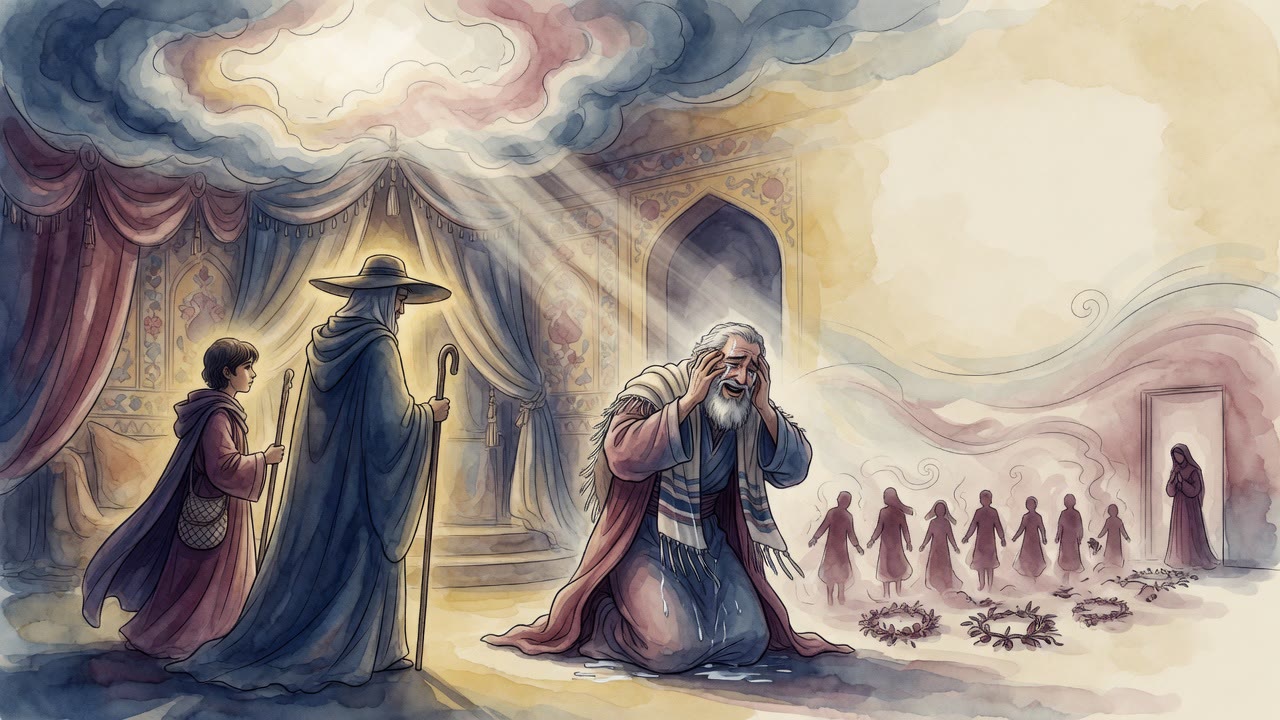
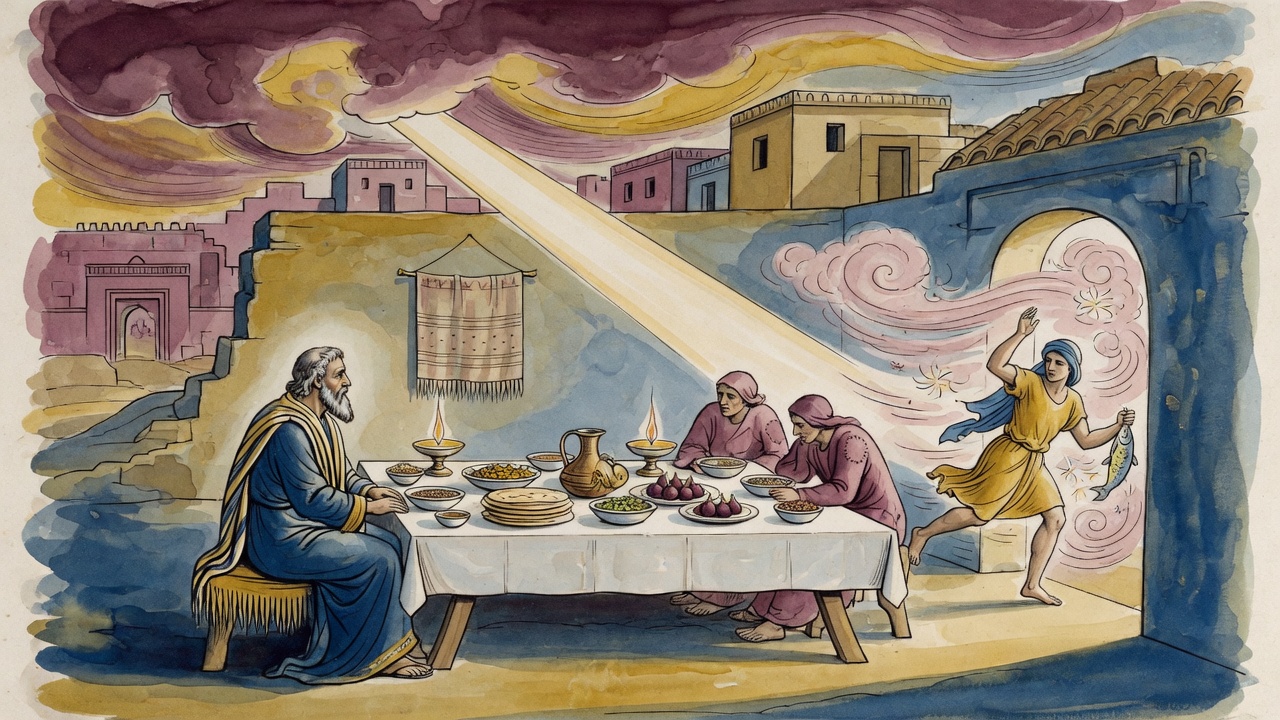
In Nineveh the calendar still belonged to Israel if a man insisted. Tobit insisted. It was the Feast of Weeks, Shavuot, first fruits and the giving of Torah remembered in a city that did not care for either.
Food filled the house. Spices. Bread. The kind of spread exile makes expensive. Tobit did not lift a piece to his mouth.
"Go," he told his son Tobiyyah, "and bring one of our poor brethren to eat with us, and I and all who sit with me will not eat until you come."
The guests already seated felt the rule settle over the room. No one would pretend the holiday was complete while a kinsman went hungry in the same streets.
The Table Waits on a Street Search
Tobiyyah went out into exile's lanes to find a hunger that matched the holiday. Assyrian noise, Jewish need. The father held the meal like a vow. Celebration without a poor guest was not celebration in that house.
This was not a coin tossed at a door. It was a plate kept empty on purpose. Tobit made his own stomach the clock that measured justice. Steam thinned over the dishes. Someone joked softly and stopped.
Nineveh roared outside. Inside, the feast cooled a little, and the delay was the point. A righteous man in a cruel capital trains his child by making him walk until charity has a face and a seat.
When Tobiyyah returned with a guest, the house began again. Blessings. Hands. The ordinary miracle of shared bread under a foreign sky.
Years Later, the Son Runs Ahead
Much later Tobiyyah came home another way: not hunting a guest, but carrying a cure. He walked rejoicing and glad in heart, blessing the Lord who had shown him wonders and kindness (Tobit 11).
Beside him walked a man the family called a guide. His name, when the mask came off, was Raphael, "God heals." The angel kept human manners until the work was done: road talk, travel dirt, advice that sounded like practical friendship.
Near Nineveh, Raphael slowed the party. "You know how you left your father and mother. You and I will go first. Let your wife come behind with the servants." He was arranging a reunion the way a surgeon arranges a room before the cutting that heals.
Tobiyyah had left a blinded father and a worried mother. He returned with a bride, Sarah, and with orders that put the parents' first sight of him ahead of the full procession.
Gall in the Hand, Blindness in the House
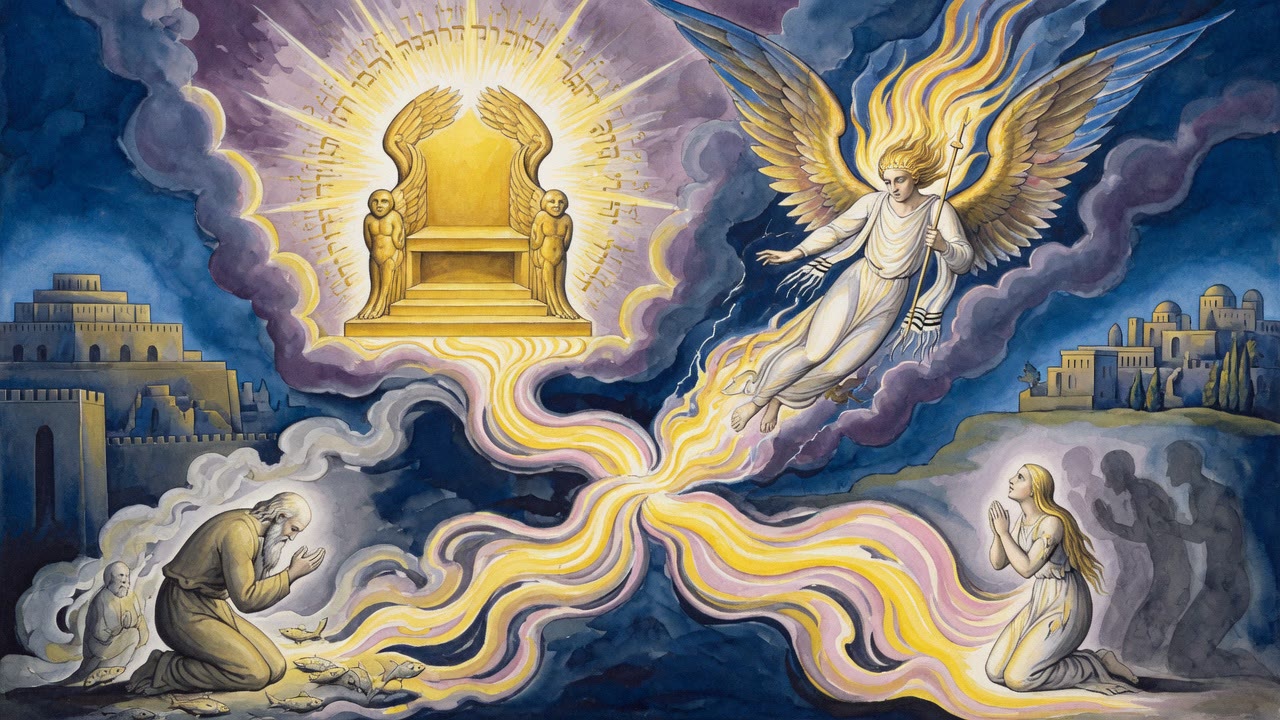
"Take with you the gall of the fish," Raphael said. The strange medicine for Tobit's eyes rode in the son's fist while the road shortened. Miracle dressed as mess. Healing that would not look clean until it worked.
Tobiyyah had left a father who would not eat without the poor. He returned a son who would not enter without the means to give sight. The house that paused a Shavuot table for charity was the same house about to receive a wonder that looked like biology scraped from a river creature.
Sarah came after them on the road with the servants. Wedding and healing braided into one approach to the door. The exile that had taught them hunger was about to teach them light again.
Tobit inside still lived by the old habits: prayer, memory, the stubborn dignity of a man who buries the dead when kings make burial a crime. He did not know the gall was coming. He knew how to wait.
What the Held Plate Bought
Exile teaches men to eat fast and look down. Tobit taught his son to stop the meal for a stranger's stomach. The angel later taught the son to run ahead for a father's eyes.
Between those two errands, a family in Nineveh stayed Jewish by the shape of its table and the stubbornness of its care. Festival law without a poor guest was incomplete. Homecoming without healing tools was incomplete. Both times, someone had to go out and come back carrying what the house lacked.
When Tobiyyah's feet hit the last stretch of home road, the Feast of Weeks was long past. The habit of not swallowing joy alone was not past. It walked in with him, sticky as fish gall and bright as a blessing said out loud before the ointment touched the eyes.
Nineveh did not convert. The house did not need the city to convert. It needed a father who could wait for a guest and a son who could run for a cure.
Hannah would later wait on roads and argue in doorways; the house was never only Tobit's virtue. On that Shavuot the rule was his to set, and he set it as law inside four walls. The poor guest chewed and the festival became real in a way incense alone never manages in a capital of idols.
When sight returned years after, Tobit did not need a lecture on why the old empty plate had mattered. Charity and healing were both ways of refusing to let exile decide who eats and who sees.
← All myths