5 min read

Torah Sets Donkeys on a Roof Then Steals Strength

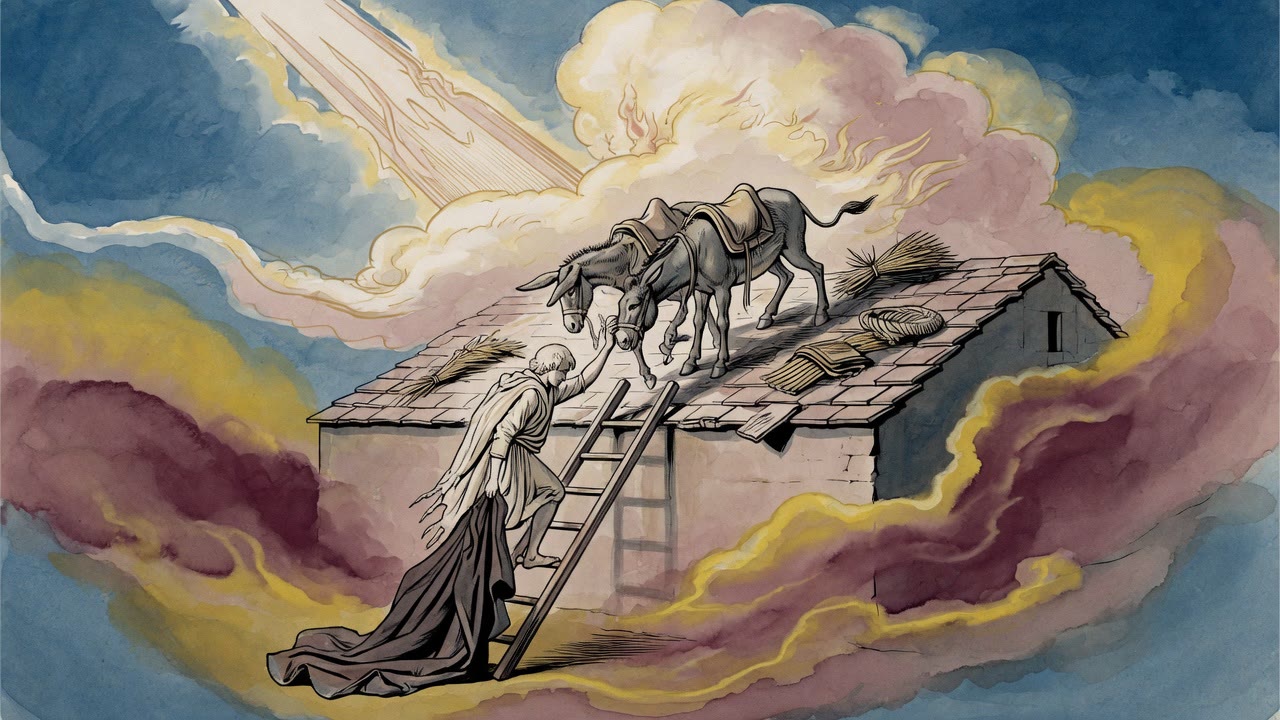
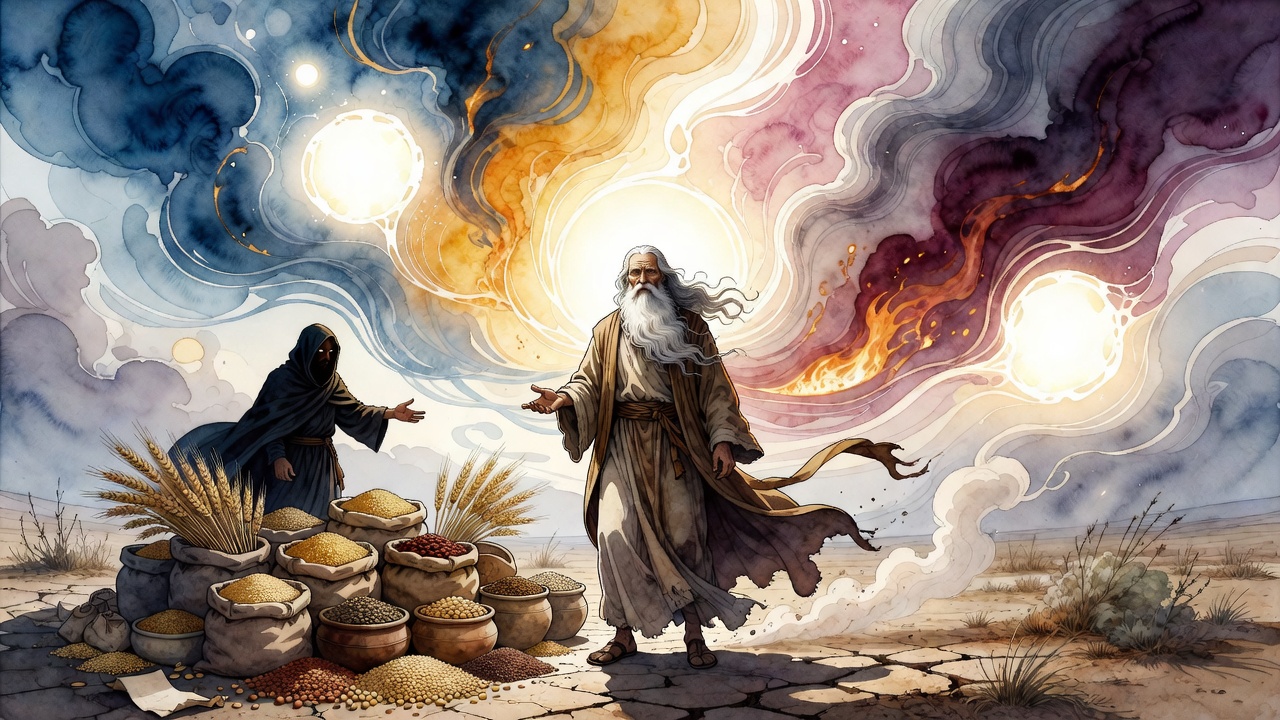
Young Elazar hauls pack animals onto a roof; after years of Torah he can barely lift the cloak from his own shoulders.

Curated by Arthur · Told by Maggid ·
Table of Contents
  1. Bread by the Oven
  2. Apology on the Ground
  3. Sapphire on the Anvil
  4. After the Sifra, a Scarf Too Heavy
  5. The Wage of the Page
Torah Sets Donkeys on a Roof Then Steals Strength Click for full size

Bread by the Oven

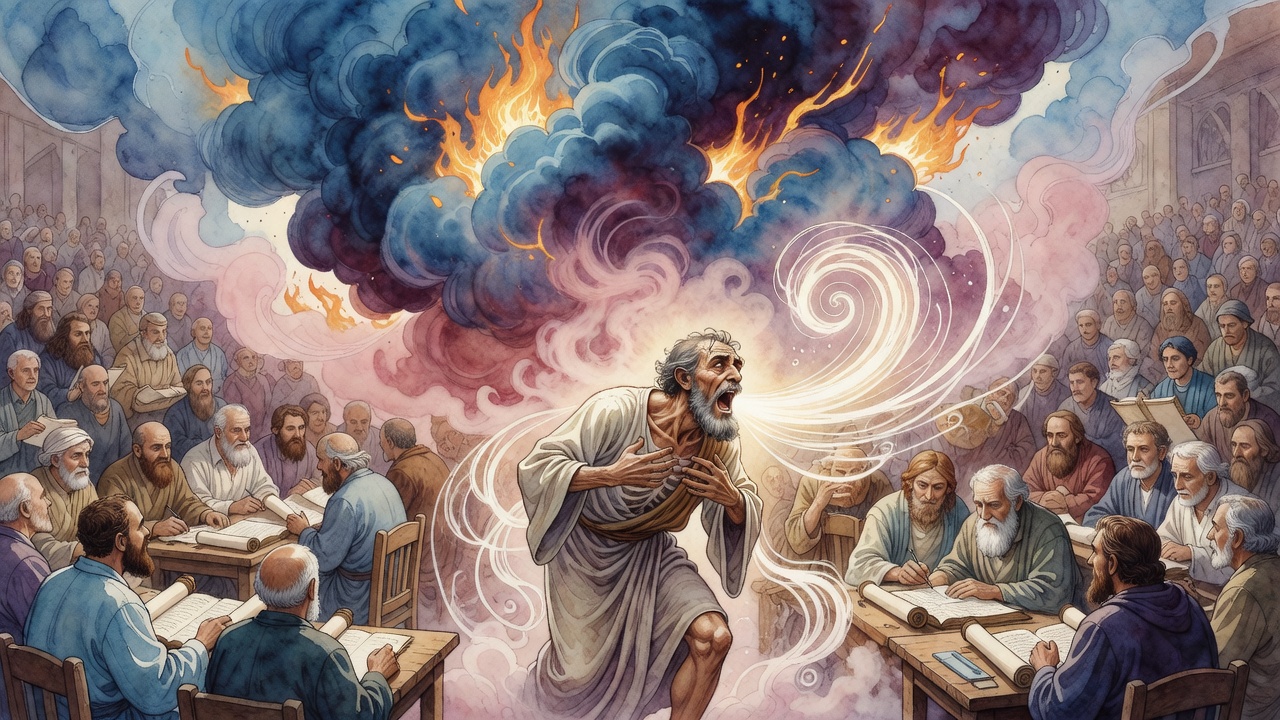
Elazar son of Rabbi Shimon sat near an oven and ate the bread as his mother drew it out, loaf after loaf, heat still rising from the crust. His hunger looked endless to strangers. Donkey drivers who had come to buy produce saw the appetite and muttered that an evil snake lived in his guts, that this boy would bring famine on the world if left unchecked.

They left to load their animals, still laughing at their own wit. Elazar heard every word. When they returned, the donkeys were gone from the yard. The drivers looked up. Their beasts stood on the roof, ears flicking against the sky. Two at a time, the young man had carried them into the air while their owners were still enjoying the joke.

Strength answered insult without a speech. The yard smelled of bread and animal fear. The drivers' mouths closed.

Apology on the Ground

They ran to Elazar's father. The sage understood at once. Had they spoken of his son with a tight, begrudging mouth? The drivers confessed. The father asked why they measured another man's hunger as if the Creator who made him could not also make his bread. Was he eating from their sacks? Was his life their payroll? He sent them to apologize before anything worse than a roof became the lesson.

Elazar brought the donkeys down, again two at a time. The midrash notes that descent was harder than the lift. Raw strength still filled his limbs. Torah had not yet taken its toll. The drivers led their animals away with new manners and old bruises on their pride.

The story could have ended as a wonder-tale of a strong youth. It does not. The midrash keeps him alive long enough for the strength to change its address.

Sapphire on the Anvil

Elsewhere the sages read a verse about sapphires covering the beloved and hear a second sound in the Hebrew: a word that means to sap or weaken. Torah, they say, can take strength the way a true sapphire breaks the tools that test it. A merchant in Rome set a sapphire on an anvil and struck. The anvil cracked. The hammer split. The stone did not.

Rabbi Abba bar Mamal adds that one who weakens himself in the study of Torah and law may later solve what others call impossible, even rising like a king whose lips carry a kind of ruling clarity (Proverbs 16:10). The weakening is not failure. It is transfer. Force leaves the shoulders and takes up residence in the mind that can untie knots.

The sapphire image and Elazar's body become the same teaching told twice: what looks like loss from outside may be hardness moving inward.

After the Sifra, a Scarf Too Heavy

Elazar poured himself into Torah. The arms that had lifted donkeys thinned in purpose. He could no longer carry his own cloak. A man of Rabban Gamliel's household once hauled forty se'a of grain without thought; after he finished the Sifra, he could not lift a single se'a, and some say he needed help to raise the scarf from his head. Covered with sapphires, the midrash calls them, as if study had plated their bodies with a weight that was also glory.

The righteous eats to the satisfaction of his soul, says the proverb the sages turn over, while the belly of the wicked stays hungry. Eliezer, Abraham's servant, asked only a sip and was satisfied. Esau lunged at red stew and was never full. Ruth ate, was satisfied, and still had leftovers because a blessing settled inside her. Elazar's hunger moved from bread to book. The body paid. The soul ate.

When the drivers first insulted him, strength answered from the roof. When Torah finished with him, weakness answered from the cloak. Both answers belonged to the same man, before and after the page took its wage. The roof miracle is the easier story. The cloak is the truer one for anyone who has felt study rearrange what the limbs can still do.

The Wage of the Page

Students who love the roof story must also love the cloak story, or they have only loved a circus. The midrash is not embarrassed by either image. It wants the full arc: force that can shame mockers, and force that has been spent into understanding until a scarf is heavy. The righteous belly that is satisfied with little and the wicked belly that never fills are the same teaching told at table instead of on a roof.

Elazar's life becomes a walking proverb. Once he lifted what others could not. Later he needed help with what others lift without thought. Between those hours sits the page that took its wage and paid him back in a different currency.


← All myths
From the tradition

Sources

2 sources

The texts behind this telling. Some cards carry a translation of the source; others are our own retelling of it, and each card says which. Every card links out to the original.

Shir HaShirim Rabbah 5:14Shir HaShirim Rabbah

Retold in our words. Read the original at the link below.The Sefaria Midrash Rabbah, 2022 · CC-BY

Specifically,

The first reading, this sounds beautiful. Sapphires are gorgeous! But the Rabbis, as they often do, see something deeper. The text uses the Hebrew word me’ulefet (מעולפת), which is translated as "covered." However, the Rabbis cleverly connect me’ulefet to a similar-sounding word meaning "saps" or "weakens" (also me’olefet!). This leads to the idea that the Torah itself can sap a person's strength, like the hardness of a sapphire.

Rabbi Yudan and Rabbi Pinḥas illustrate this with a story. Rabbi Yudan says that if you think sapphires are soft, consider this: A man brought a sapphire to Rome to sell. The potential buyer wanted to test its authenticity by breaking off a piece. They placed it on an anvil and struck it with a hammer. Guess what happened? The anvil cracked, the hammer split, but the sapphire? It remained perfectly intact! A truly strong stone. This illustrates that the Torah is similarly powerful and perhaps takes strength from those who study it deeply.

What does it mean for Torah study to "weaken" someone? Rabbi Abba bar Mamal offers an intriguing perspective: he says that if a person weakens themselves through intense study of Torah and halakha (Jewish law), they can ultimately become like a magician, capable of finding clear solutions to seemingly impossible problems. The Rabbis add that someone who achieves this level through Torah study might even become a king! They point to (Proverbs 16:10): "There is magic on the lips of a king."

This idea is further illustrated with a remarkable anecdote about Rabbi Elazar bar Rabbi Shimon. Donkey drivers came to his father to buy produce, and they found Elazar sitting near an oven, devouring bread as his mother took it out. The drivers, witnessing his insatiable appetite, grumbled, "Alas, there is an evil snake in this one's intestines; it appears that this one is bringing famine to the world!"

Elazar overheard them, and after they left to load up their donkeys, he used his great strength (likely before devoting himself to Torah study) to carry all their donkeys onto the roof! When the drivers returned and couldn't find their animals, they looked up and saw them perched high above. They went to Elazar's father, who, understanding his son, suggested they might have offended him. The drivers confessed their unkind words. The father rebuked them, saying, "Why did you relate to him begrudgingly and negatively? Was he eating from your [food]? Is his sustenance your responsibility? No, it is He who created him who creates his sustenance."

He instructed them to apologize, and Elazar, in turn, brought the donkeys down – two at a time! The Midrash (rabbinic interpretive commentary) emphasizes that this second act was more difficult than the first, highlighting Elazar’s immense strength. However, after dedicating himself to Torah study, Elazar became so weakened by the intense exertion that he couldn't even carry his own cloak. This, the Midrash concludes, is what it means to be "covered with sapphires" – the Torah had taken a toll on his physical strength, even as it elevated his spiritual and intellectual powers.

The story continues with a member of Rabban Gamliel's household. This person was incredibly strong, able to carry a box containing forty se’a (a measurement of volume, roughly thirty liters) of grain to the baker. Rabban Gamliel, seeing this raw strength, challenged him: "You have all this great strength, and you do not engage in Torah study?" Once he dedicated himself to studying Torah, his physical strength diminished. He could carry less and less, until, after finishing the Sifra (a significant achievement – a compendium of halakhic midrash on Leviticus), he couldn't even carry a single se’a! Some say he couldn't even lift the scarf from his head, needing others to help him. Again, “Covered with sapphires."

What are we to make of all this? It’s not that Torah study makes you physically weak in a literal sense. Instead, these stories suggest that dedicating oneself to deep, meaningful Torah study demands a profound investment of energy, focus, and even a kind of sacrifice. It requires us to pour our strength into something greater than ourselves. Perhaps, by "weakening" ourselves in this way, we actually become stronger in other, more meaningful ways – in wisdom, in understanding, and in connection to something truly eternal.

Full source
Midrash Mishlei 13:5Midrash Mishlei

Translation of the source text.Midrash Mishlei (Buber) · CC-BY

(Proverbs 13:25): "The righteous eats to the satisfaction of his soul" - this is one who fills his soul with words of Torah. "But the belly of the wicked shall want" - this is one who has no words of Torah in him. Another interpretation: "The righteous eats to the satisfaction of his soul" - that if a man learned in his youth, he should not abandon it in the days of his old age, but all his days he should fill his soul with words of Torah. "But the belly of the wicked shall want" - that if a man learned Torah in his youth and forgot it, if he does not return to it, the Holy One, blessed be He, deprives him of the goodness of the Garden of Eden in the time to come, and says to him, 'Since you deprived your soul of words of Torah in this world, I too will deprive you of the goodness that I have hidden away for the righteous in the time to come,' as it is said (Psalms 31:20): "How great is Your goodness which You have hidden away for those who fear You, which You have wrought for those who take refuge in You, before the sons of men." It does not say here "between themselves," but rather "before the sons of men," before all the people of the world. Rabbi Yochanan says: Not so, but rather they show the eye what it is able to see and let the ear hear what it is able to hear; but what He has prepared for the righteous in the time to come, no eye is able to see and no ear is able to hear, as it is said (Isaiah 64:3): "No eye has seen, O God, beside You, what He will do for the one who waits for Him." Another interpretation: "The righteous eats to the satisfaction of his soul" - this is Eliezer the servant of Abraham, who said to our mother Rebecca (Genesis 24:17): "Let me sip, I pray you, a little water from your jar," a single sip; "but the belly of the wicked shall want" - this is Esau the wicked, who said to Jacob (Genesis 25:30): "Let me gulp down, I pray you, some of that red red stuff," that wicked one opened his mouth wide like a camel and said, 'Please, open it into my mouth and let it pour and go down,' as we have learned there (Mishnah Shabbat 24:3): "One may not stuff a camel nor force-feed it, but one may pour food into its mouth."

Another interpretation: "The righteous eats to the satisfaction of his soul" - this is Ruth the Moabite, of whom it is written (Ruth 2:14): "And she ate and was satisfied and left over." You may understand from it two things: either a blessing rested on the hand of the righteous one [Boaz], or a blessing rested in the belly of that righteous woman; but from what is written, "And she ate and was satisfied and left over," it appears that a blessing rested in the belly of that righteous woman. "But the belly of the wicked shall want" - these are the nations of the world. Rabbi Meir said: Rabbi Dostai of Bei Yeshev asked me: What is the meaning of "but the belly of the wicked shall want"? I said to him: There was a certain gentile in our city, and he made a feast for all the people of the city, and he invited me along with them, and they brought before us everything that the Holy One, blessed be He, created in His world during the six days of creation, and his table lacked nothing but cracked nuts alone. What did he do? He took the tray from before them, which was worth six talents of gold, and he smashed it. I said to him: Why did you do this? He said to me: You [Israel] say that this world is ours and the world to come is theirs; if we do not eat now, when shall we eat?! And I applied to him, "but the belly of the wicked shall want." Another interpretation: "The righteous eats to the satisfaction of his soul" - this is Hezekiah king of Judah, who would eat two bundles of vegetables, and one pound of meat would be brought before him each day, and Israel mocked him behind his back and said, 'This is a king?! Rezin son of Remaliah is a king, and the kingdom is fit for Rezin son of Remaliah,' as is the meaning of what is written (Isaiah 8:6): "Because this people has rejected the waters of Shiloah that flow gently, and rejoices in Rezin and the son of Remaliah." What is "gently"? Rather, this is Hezekiah king of Judah, who would purify Israel in a ritual bath of forty se'ah, from where comes the [numerical value of] "gently." The Holy One, blessed be He, said to them: You eat and are satisfied, (Isaiah 8:7): "therefore, behold, the Lord brings up over them the mighty and abundant waters of the River." "But the belly of the wicked shall want" - this is Mesha king of Moab, who was a sheep-breeder, as it is said (II Kings 3:4): "And Mesha king of Moab was a sheep-breeder." What is a sheep-breeder - a shepherd.

Another interpretation: "The righteous eats to the satisfaction of his soul" - this is the Holy One, blessed be He, who said to Israel: My children, of all the offerings that you offer before Me, do I derive any benefit from them except the fragrance? as it is said (Numbers 28:2): "My pleasing fragrance you shall be careful to offer to Me at its appointed time." "But the belly of the wicked shall want" - these are the nations of the world, who are deprived of the goodness stored away for the righteous, as it is said (Isaiah 65:13): "Behold, My servants shall eat, but you shall be hungry."

Full source