When a Spring Chose Lives Over City Laundry
A spring at a Levite gate ran cold enough to hurt the teeth. Women with wet cloth argued with a traveler whose child could not drink.
Table of Contents
The spring came up at the edge of a Levite city, cold enough to hurt the teeth. Two lines formed with jars. Residents of the city. Travelers from elsewhere whose animals also panted. A woman from the town set wet cloth on a stone and began to scrub. A stranger's child stood with a mouth already gray from thirst.
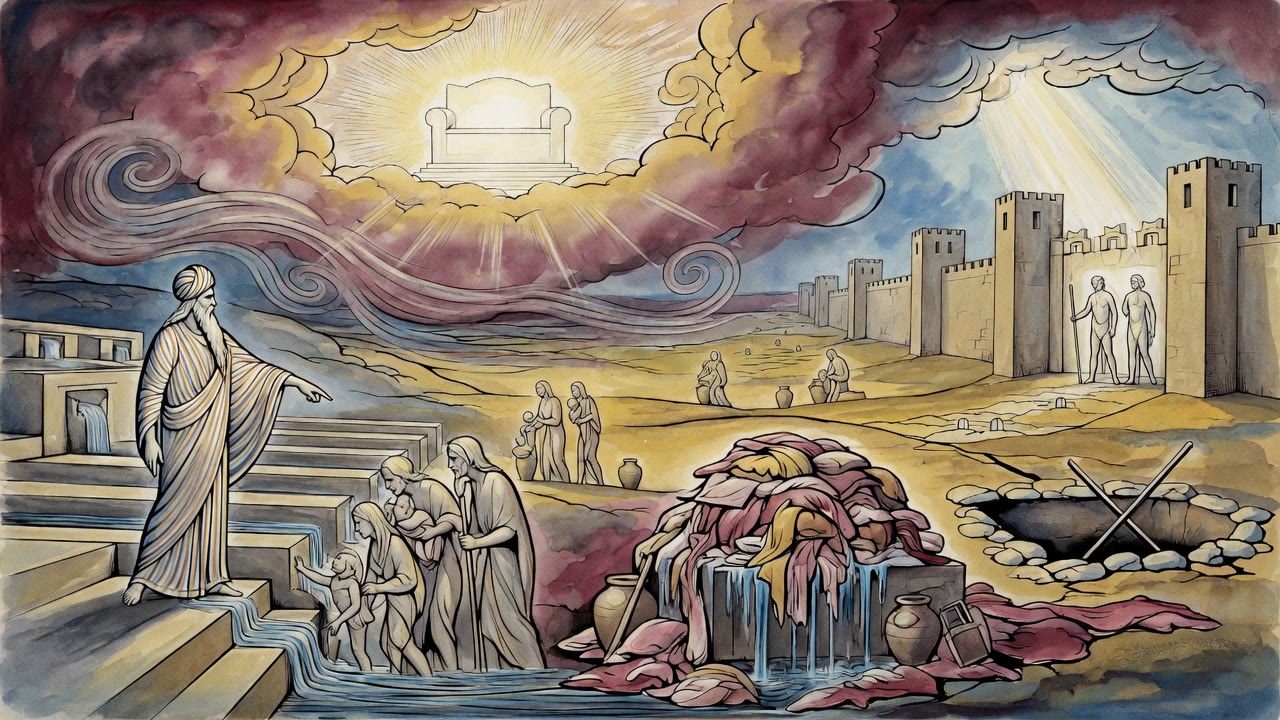 Click for full size
The spring did not care who was right. Someone had to.
Jars Met at the Cold Spring
"Lives of the city's people first," a Levite at the gate said. Then their animals before other animals. Then their laundry before other laundry. But when another community's lives stand against this city's laundry, those other lives win.
The woman kept scrubbing. She knew scab. She knew fever. She also saw the child's mouth. Water slapped stone in a rhythm older than any ruling spoken that week.
One neighbor sent a skin of water to the traveler's child before she finished her own wash. Another kept the stone and the soap and would not yield the queue. Jars knocked. A donkey stamped. The spring kept rising.
Rabbi Yose Chose the City's Wash
Rabbi Yose pushed harder. The city's laundry comes first even against others' lives, he said, because lack of washing breeds real bodily distress, a torment of the flesh that is not vanity. Dirt on skin and cloth becomes illness. Illness becomes a death the city did not choose.
"Their life," he said, reading the line about open land for cattle, goods, and all their life. Not only beasts. Vitality itself, including the misery that unwashed skin can become.
Women at the stones argued without a school. They lived inside the ruling whether they named Yose or the majority. A stranger's child turning gray is a fact. A town's fever is a fact. The spring did not split itself to make both easy.
Moses Named Safety He Would Never Walk
Before his death, Moses founded cities of refuge among the holdings of the two and a half tribes east of the Jordan. God had told him he would not cross. He still insisted on fixing the sites of mercy on the side he could touch. Whoever loves pious deeds never has enough of them.
Israel had asked for this. "Lord of the world," they said, "You promised long life for commandments, but if a man kills unawares and the blood-avenger slays him, he dies before his time." God told Moses they spoke wisely. Appoint cities so the manslayer who kills his neighbor unawares may flee there (Deuteronomy 19:3-4).
Moses rejoiced and moved at once. He had tasted flight after the Egyptian. He knew the flavor of being hunted for blood, even when the killing was more tangled than murder in a cold heart. So the map of refuge began under a leader who would never walk its western half. He pressed a heel into eastern dust and named safety for men he would not meet.
A Ladder Came Down and a Man Had to Run
A carpenter's apprentice stood on a roof with a heavy roller. He pressed it downward across the clay. The roller went over the edge, fell, and crushed a man below. The apprentice felt the world tilt. No hate had been in his hands. The motion had been down, and down is the path that sends a man running.
He ran. The blood-avenger would not wait for a lecture on angles. Pulling a load upward, or a rope snapping on a raised barrel, might have spared him exile. A ladder coming down, or a roller falling in its descent, does not. Iron slipping from its haft divides sages. A chip flying from a split log divides them again. He did not have time to argue chips. He had a road and a gate.
The road to the Levite city was the only pause the ruling would give him. Laundry lines would flap over a head that never planned to live among singers and gatekeepers. Refuge is not a vacation. It is a long stay in a town measured in cubits, while the high priest's years tick elsewhere like a second clock on the killer's neck.
The City Was Built for Life
Rabbi Abbahu said cities of refuge were given for life, not burial. Objectors answered that the killer's dwelling, death, and burial are there. The reply cut a line. The killer is a special case. The rest of the city's purpose remains life.
Around the walls, measures argued with each other. One thousand cubits from the wall. Two thousand cubits around. Open land, then fields and vineyards. A belt of green and grazing so the Levite towns would not choke. Children played in the thousand-cubit ring without knowing they ran through a measured belt of land. A goat chewed a vine leaf and was shouted off. A surveyor's peg marked a corner where laundry lines would later claim the sun.
The apprentice reached the gate with dust in his mouth. The spring was still running. The woman with wet cloth looked up, then went back to the stone. He was not a traveler's child. He was a man who had to live here now, in a city given for life, while a high priest he had never met kept him alive by staying alive.
← All myths