When Moses Tore Up Israel's Death Sentence
The elders set out with Moses for Pharaoh's court. One by one they found reasons to slow down, and only Moses and Aaron reached the door.
Table of Contents
The elders came out of their doorways to walk with them, and the road to Pharaoh's palace was crowded at the start.
 Click for full size
Moses and Aaron had been told to bring them. "Go, you and the elders of Israel," so the whole delegation moved through Egypt toward the one man who could refuse them. Then the palace came into view. One elder found something he had to attend to and slipped back. A little farther on, two more. The nearer the gate came the thinner the group behind them got, until Moses and Aaron reached the entrance, turned around, and found nobody there.
They went in as two.
The Ledger of Dead Gods
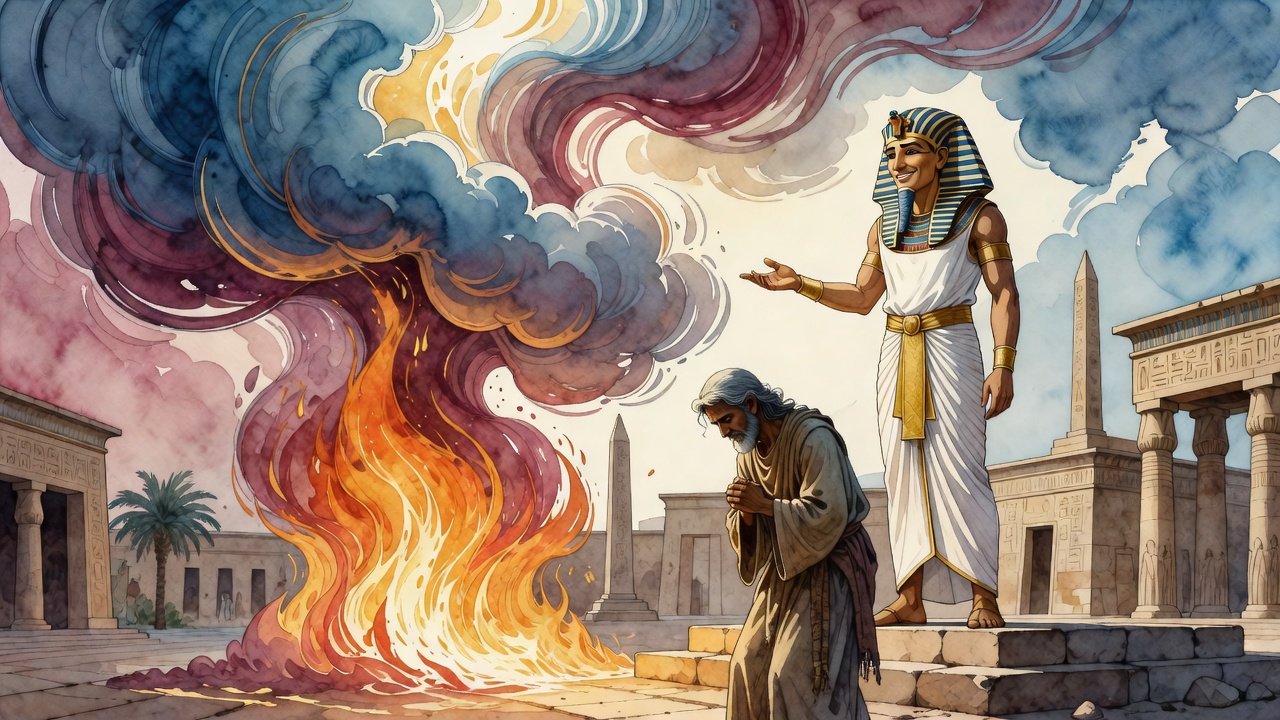
Inside, kings were laying crowns in front of Pharaoh on the day the world came to call him its ruler, and every one of them had brought his own god in behind him. Because they had brought neither crown nor tribute, the servants announced them as nothing more than two old men. Moses and Aaron said the Lord God of Israel had sent them, and that Israel was to be let go.
"Who is the Lord, that I should heed His voice?" Pharaoh said. "I do not know the Lord."
Then, since he was a careful administrator, he told them to wait while he checked. He went back into the palace and had the lists brought out and went down them, the gods of Moab, the gods of Ammon, the gods of Sidon, and came out again to report that no such name appeared anywhere in his records.
"Only a fool walks into a graveyard to look for a living man," they told him. "The ones on your list are dead. Ours is alive, and He was there before the world was made, and He will be there when it ends."
Pharaoh wanted measurements. Was this god young or old, how many years did He have, how many cities had He taken. He had one category for power, and when this would not go into it he called them liars and said he had made himself and made the Nile.
The Debt Came Due at Sinai
Heaven kept a note of the elders who had turned back on that road.
It came due at the mountain. They climbed with Moses as far as the base of Sinai, and there they were stopped and told to sit. "Wait here for us." So they sat down on the rock while two men went on up into the cloud, the exact arrangement they had chosen for themselves years before on an Egyptian street.
That is why nobody was standing next to Moses when the worst of it happened. He was above the cloud and the elders were beneath it, and in the space between them the people were putting their gold into a fire.
Heaven Moves to Destroy Israel
"Let Me be," God said, "and I will destroy them."
Moses did not step aside. He stood in the breach the way a man stands in the gap of a collapsed wall, and what he did in that gap was nearer to shoving than to prayer. A tutor who watches the prosecutor build the case against the king's son does not wait his turn politely. He pushes the prosecutor away from the bench and takes the floor himself.
If any advocacy was going to work in that hour it was insolence, and Moses had the stomach for it.
The Slave the Buyer Was Warned About
"Master of the Universe. Did You not tell me to go down to Pharaoh?"
He was reaching back to the bush. He had not wanted the work then, and his objection had not been modesty. The promises had been made to Abraham and to Jacob by God, not by Moses, so let the one who made them keep them. He had also asked the ugly question nobody else would ask: "On what merit are You redeeming these people, when they serve idols?" And he had been answered. "I see them coming out of Egypt. I see them taking the Torah. I see them, forty days later, denying Me and making the calf."
So now he took that answer and turned it into a weapon.
A man sells a slave and warns the buyer to his face that the slave is bad, but the buyer takes him anyway at the stated price. Then the slave behaves exactly as advertised, so the new master reaches for a stick and threatens to kill him for wickedness. The slave has one line, and it is unanswerable. "You knew what you were buying."
That was the argument. "You saw the calf before You saw the sea. You brought them out anyway, on those terms, so the terms hold."
The Quill Snatched From the King's Hand
God was reaching for the seal. The law had already been written down, that one who sacrifices to any god other than the Lord alone shall be destroyed, and Israel had sacrificed to a calf, so the death sentence needed nothing further except a signature.
An aide who sees a ruinous order about to be signed does not argue. He snatches the pen out of his master's hand.
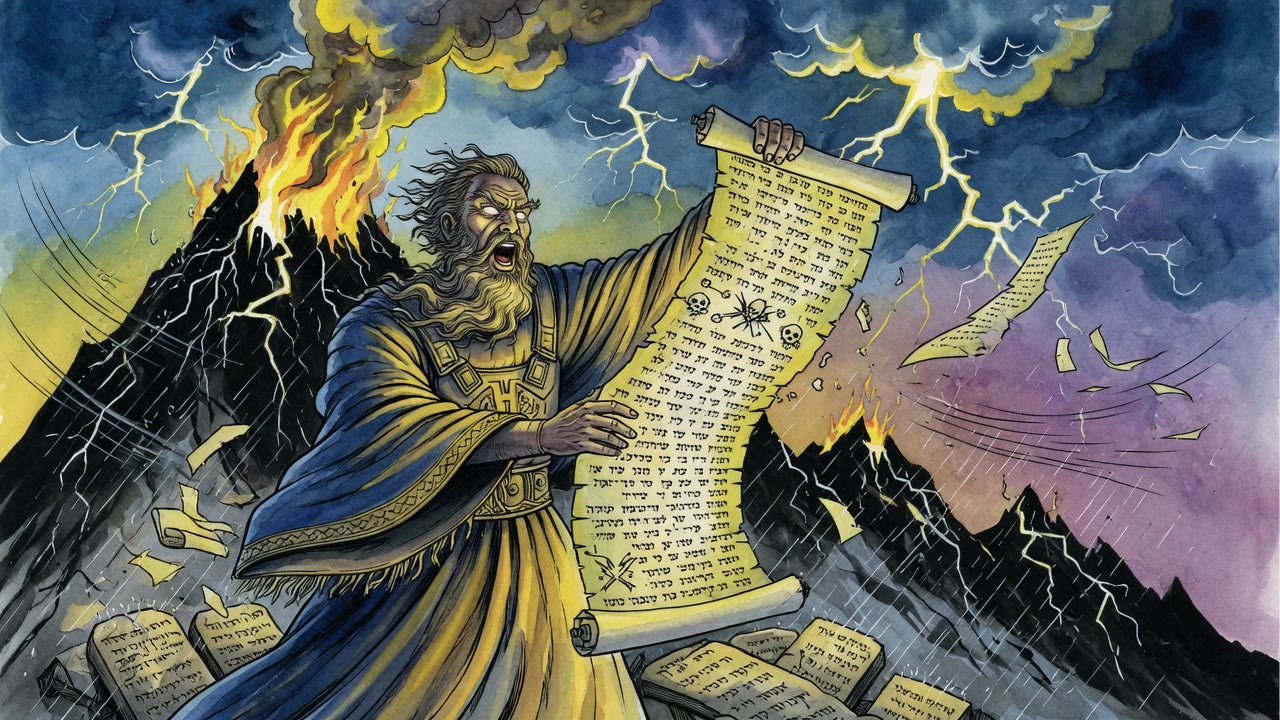
Moses was carrying the two tablets. They were the covenant itself, cut and written and finished, the thing he had gone up for and gone forty days without bread to receive. They were also the instrument under which Israel was about to be condemned, because a people that has taken a contract can be judged under it and a people that has not taken it yet cannot. He held them out, and for one breath he was an old man about to smash the most valuable object in the world, and then he opened his hands.
The covenant tore apart on the rock at his feet.
Better she be judged as a woman still only betrothed, he argued afterward, and not as a wife. The document was destroyed, so the case could not be brought on the greater charge. God relented, and the nation that had been sentenced was not destroyed.
The elders were still sitting where they had been told to wait, because nobody had come down to release them. They looked up and saw the man who had gone in to Pharaoh without them coming down with his hands empty and stone dust in the creases of his sleeves.
← All myths