Translation of the source text.William Davidson Edition - Vocalized Aramaic + William Davidson Edition - English · CC-BY-NC
is 611, the number of mitzvot that were received and taught by Moses our teacher. In addition, there are two mitzvot: “I am the Lord your God” and: “You shall have no other gods” (Exodus 20:2, 3), the first two of the Ten Commandments, that we heard from the mouth of the Almighty, for a total of 613. The Gemara provides a mnemonic for the biblical figures cited in the course of the discussion that follows: Dalet, mem, shin, mem, kuf; samekh, kuf; representing David, Micah, Isaiah, Amos, Habakkuk, Amos, and Ezekiel.
Rabbi Simlai continued: King David came and established the 613 mitzvot upon eleven mitzvot, as it is written: “A Psalm of David. Lord, who shall sojourn in Your Tabernacle? Who shall dwell upon Your sacred mountain? He who walks wholeheartedly, and works righteousness, and speaks truth in his heart.
Who has no slander upon his tongue, nor does evil to his neighbor, nor takes up reproach against his relative. In whose eyes a vile person is despised, and he honors those who fear the Lord; he takes an oath to his own detriment, and changes not. He neither gives his money with interest, nor takes a bribe against the innocent. He who performs these shall never be moved” (Psalms, chapter 15).
Eleven attributes that facilitate one’s entry into the World-to-Come appear on this list. The Gemara analyzes these verses: “He who walks wholeheartedly”; this is referring to one who conducts himself like our forefather Abraham, as it is written concerning him: “Walk before Me and be wholehearted” (Genesis 17:1). “Works righteousness”; this is referring to one such as Abba Ḥilkiyyahu, a laborer who would not pause from his labor even to greet people; he righteously continued working.
“And speaks truth in his heart”; this is referring to one such as Rav Safra, who was reciting Shema when a person approached him to purchase an item. He intended to accept the man’s offer, but he was unable to respond because it is prohibited to interrupt the recitation of Shema. The buyer misinterpreted Rav Safra’s silence and concluded that Rav Safra demanded a higher price, so he raised his offer.
Rav Safra insisted on selling him the item for the sum that he was offered initially. “Who has no slander upon his tongue”; this is referring to one who conducts himself like our forefather Jacob, who did not want to mislead his father in order to receive his blessings, as it is written: “Perhaps my father will feel me, and I will be in his eyes like a fraud” (Genesis 27:12). “Nor does evil to his neighbor”; this is referring to one who did not infringe upon another’s trade, constituting illegal competition.
“Nor takes up reproach against his relative”; this is referring to one who draws his relatives near, and does not distance them when they embarrass him. “In whose eyes a vile person is despised”; this is referring to one who conducts himself like King Hezekiah, who dragged the bones of his evil father, King Ahaz, in a bed of ropes, because he despised those considered vile by God. “And he honors those who fear the Lord”; this is referring to one who conducts himself like Jehoshaphat, king of Judea, who when he would see a Torah scholar would arise from his throne and hug him and kiss him, and call him: My father, my father, my teacher, my teacher, my master, my master.
“He takes an oath to his own detriment, and changes not”; this is in accordance with the conduct of Rabbi Yoḥanan, as Rabbi Yoḥanan would say in the form of a vow when seeking to refrain from eating in another’s home: I shall fast until I will come to my house. He would fulfill that vow and refrain from eating, even though he took the vow only to avoid eating in that place. “He neither gives his money with interest”; meaning he does not lend money with interest even to a gentile, which is permitted by Torah law.
“Nor takes a bribe against the innocent”; this is referring to one such as Rabbi Yishmael, son of Rabbi Yosei, who refused to sit in judgment in a case involving his sharecropper. Since the latter would bring him a basket of fruit, he was concerned that he might unconsciously favor him. At the conclusion of the verses, it is written: “He who performs these shall never be moved.” The Gemara relates: When Rabban Gamliel would reach this verse he would cry, and he said: It is one who performed all these actions who shall never be moved; but if he performed only one of them, he shall be moved.
The Sages said to him: Is it written: He who performs all these? Rather, the phrase “he who performs these” is written, indicating that one is blessed even in a case where he performed one of them. As if you do not say so, compare that to a different verse that is written with regard to severe transgressions punishable by karet: “Do not impurify yourselves with all these” (Leviticus 18:24). Would you say that there too it means that it is one who comes into contact with all these who becomes impure, but one who comes into contact with one of these, no, he does not become impure?
Rather, is it not that the phrase “with all these” means: With one of all these? Here too it means that one who performs one of all these has a place in the World-to-Come. Rabbi Simlai’s exposition continues: Isaiah came and established the 613 mitzvot upon six, as it is written: “He who walks righteously, and speaks uprightly; he who despises the gain of oppressions, who shakes his hands from holding of bribes, who stops his ears from hearing blood, and shuts his eyes from looking upon evil” (Isaiah 33:15).
The Gemara elaborates: “He who walks righteously”; this is referring to one who conducts himself like our forefather Abraham, as it is written concerning him: “For I have known him, that he will command his children…to perform righteousness and justice” (Genesis 18:19). “And speaks uprightly”; this is referring to one who does not shame another in public. “He who despises the gain of oppressions”; this is referring to one such as Rabbi Yishmael ben Elisha, who refused to sit in judgment in a case involving one who gave him priestly gifts, to avoid the appearance of impropriety.
“Who shakes his hands from holding of bribes”; this is referring to one such as Rabbi Yishmael, son of Rabbi Yosei, who, as explained above, refused to sit in judgment in a case involving his sharecropper. “Who stops his ears from hearing blood”; this is referring to one who would not hear derision of a Torah scholar and remain silent, such as Rabbi Elazar, son of Rabbi Shimon, who was well known for this.
“And shuts his eyes from looking upon evil” is to be understood in accordance with the statement of Rabbi Ḥiyya bar Abba, as Rabbi Ḥiyya bar Abba says: This is referring to one who does not look at women when they stand over the laundry at the river. The women would lift the garments they were wearing to keep them out of the water, and thereby expose part of their bodies. And it is written with regard to one who performs these matters: “He shall dwell on high; his fortress shall be the munitions of rocks; his bread shall be given, his waters shall be sure” (Isaiah 33:16).
Micah came and established the 613 mitzvot upon three, as it is written: “It has been told to you, O man, what is good, and what the Lord does require of you; only to do justly, and to love mercy, and to walk humbly with your God” (Micah 6:8). The Gemara elaborates: “To do justly,” this is justice; “to love mercy,” this is an allusion to acts of loving-kindness; “and to walk humbly with your God,” this is an allusion to taking the indigent dead out for burial and accompanying a poor bride to her wedding canopy, both of which are to be performed without fanfare glorifying the doer.
The Gemara notes: And are these matters not inferred a fortiori? If, with regard to matters that tend to be conducted in public, e.g., funerals and weddings, the Torah states “walk humbly” when doing them, then in matters that tend to be conducted in private, e.g., charity and Torah study, all the more so should they be conducted in private. Isaiah then established the 613 mitzvot upon two, as it is stated: “So says the Lord: Observe justice and perform righteousness” (Isaiah 56:1).
Amos came and established the 613 mitzvot upon one, as it is stated: “So says the Lord to the house of Israel: Seek Me and live” (Amos 5:4). Rav Naḥman bar Yitzḥak objects to this: There is no proof that the verse in Amos is establishing all the mitzvot upon one; say that Amos is saying: Seek Me throughout the entire Torah, as the verse does not specify the manner in which one should seek the Lord.
Rather, say: Habakkuk came and established the 613 mitzvot upon one, as it is stated: “But the righteous person shall live by his faith” (Habakkuk 2:4). § Rabbi Yosei bar Ḥanina says: Moses our teacher issued four decrees upon the Jewish people, and four prophets came and revoked them. Moses said: “And Israel dwells in safety, the fountain [ein] of Jacob alone” (Deuteronomy 33:28), indicating that the Jewish people will dwell in safety only when they reach a lofty spiritual level similar to [me’ein] that of Jacob our forefather.
Amos came and revoked it, as it is stated: “Lord God, cease, I beseech You; how shall Jacob stand, as he is small” (Amos 7:5), and immediately afterward it states: “The Lord regretted this; it too shall not be, says the Lord God” (Amos 7:6). Moses said: “And among these nations you shall have no repose” (Deuteronomy 28:65). Jeremiah came and revoked it, and said: “Even Israel, when I go to cause him to rest” (Jeremiah 31:1), indicating that the Jewish people will find rest even in exile.
Moses said: “He visits the transgression of the fathers upon the sons” (Exodus 34:7). Ezekiel came and revoked it: “The soul that sins, it shall die” (Ezekiel 18:4), and not the children of that soul. Moses said: “And you shall be lost among the nations” (Leviticus 26:38). Isaiah came and revoked it, and said: “And it shall be on that day the great shofar shall be sounded, and those lost in the land of Assyria shall come” (Isaiah 27:13).
Rav says: I am afraid of that verse: “And you shall be lost among the nations.” Rav Pappa objects to this: Perhaps it means that the Jewish people will be like a lost item that is sought by its owner, and God will restore those lost in exile, as it is written: “I have gone astray like a lost lamb; seek Your servant” (Psalms 119:176). Rather, Rav was afraid from that which is written in the latter portion of that verse, where it is written: “And the land of your enemies shall consume you.”
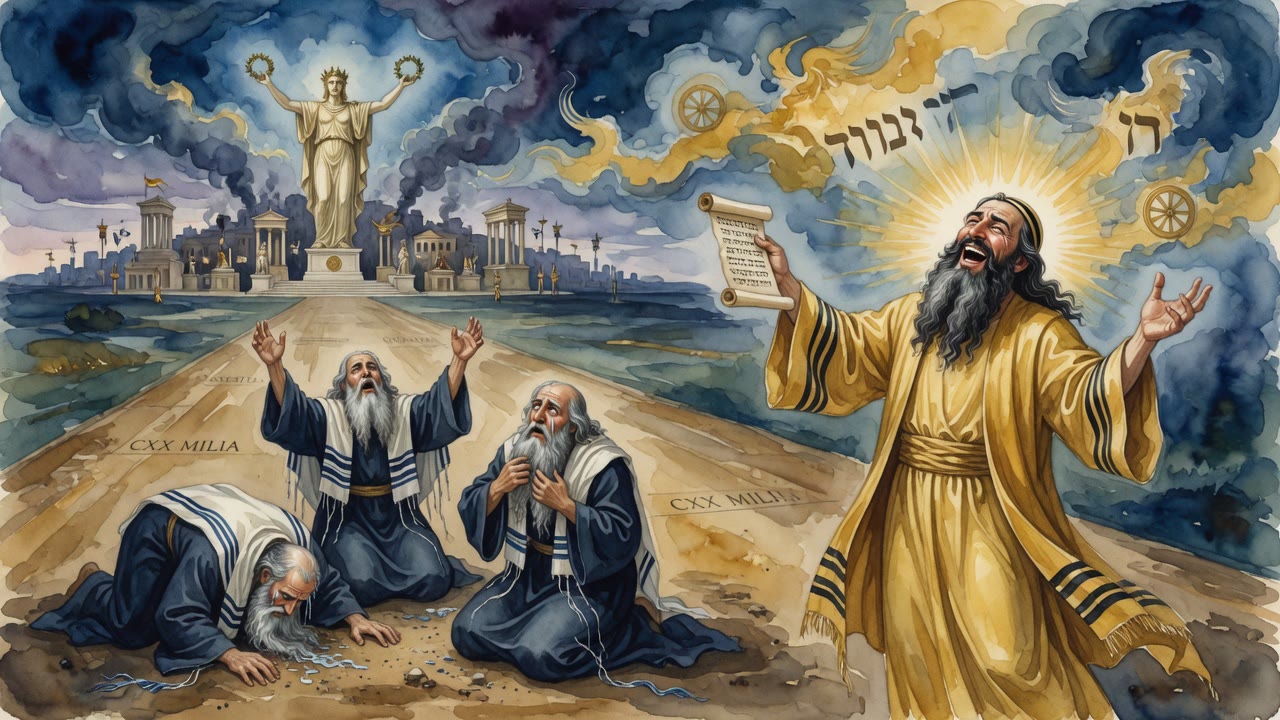
Mar Zutra objects to this: Perhaps it means like the consumption of cucumbers and gourds, which are not consumed in their entirety. Some is left over, from which additional plants can grow. § Apropos tribulations of exile and hope for redemption, the Gemara relates: And it once was that Rabban Gamliel, Rabbi Elazar ben Azarya, Rabbi Yehoshua, and Rabbi Akiva were walking along the road in the Roman Empire, and they heard the sound of the multitudes of Rome from Puteoli at a distance of one hundred and twenty mil.
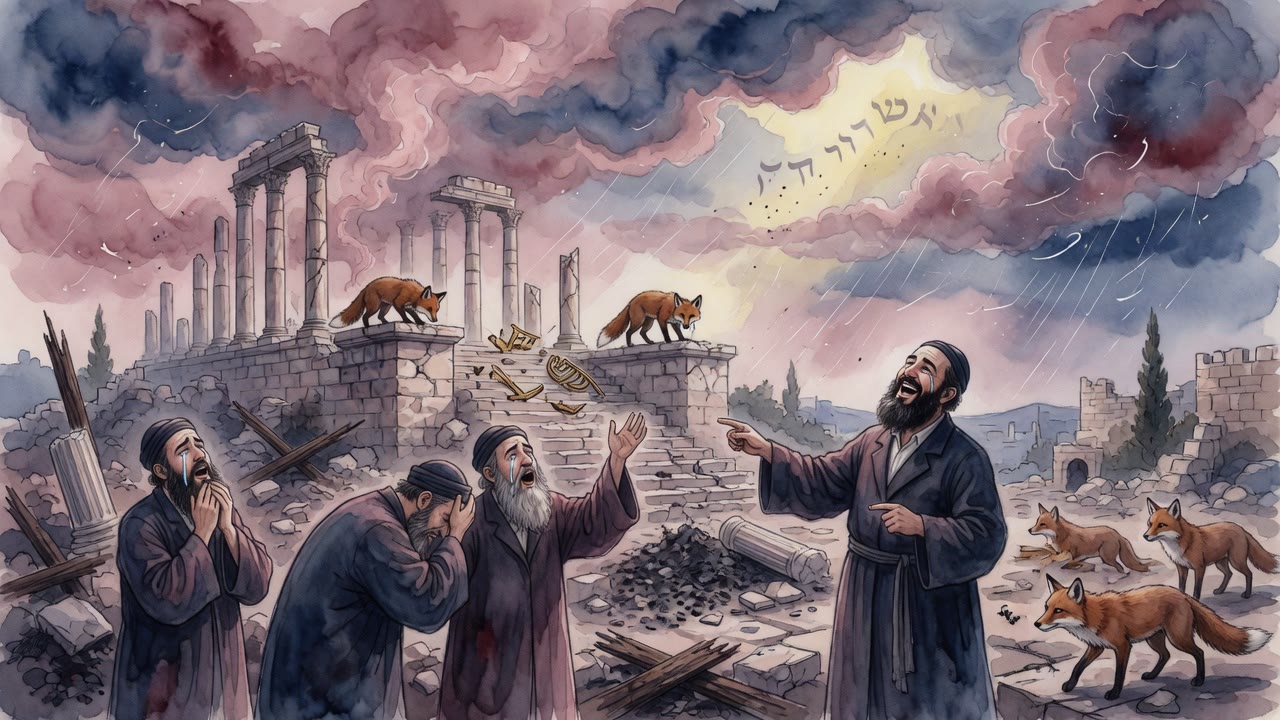
The city was so large that they were able to hear its tumult from a great distance. And the other Sages began weeping and Rabbi Akiva was laughing. They said to him: For what reason are you laughing? Rabbi Akiva said to them: And you, for what reason are you weeping?
They said to him: These gentiles, who bow to false gods and burn incense to idols, dwell securely and tranquilly in this colossal city, and for us, the House of the footstool of our God, the Temple, is burnt

 Click for full size