5 min read

The Ark Walked Three Days Ahead of Israel

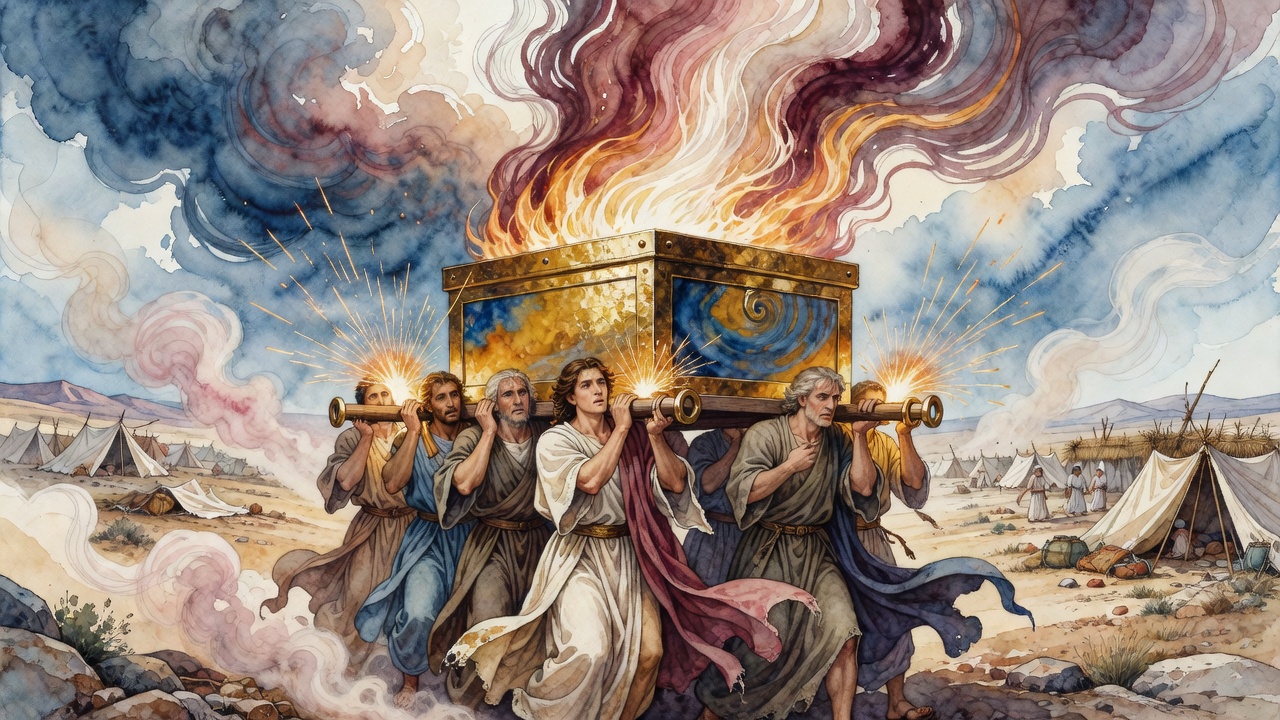
The poles bit into the carriers' shoulders while the camp still tied packs and counted children. Behind them Sinai shrank to a dark seam, then to nothing.

Curated by Arthur · Told by Maggid ·
Table of Contents
  1. God Rose When the Ark Moved
  2. A King Dragged Through Foreign Cities
  3. Three Camps and One Dwelling
  4. The Road Refused to Be Ordinary

The poles bit into the shoulders of the carriers. Dust lifted in two long lines. The Ark left the rows of tents and went out into empty ground while the rest of Israel still tied packs, counted children, and argued over who would walk with the weak.

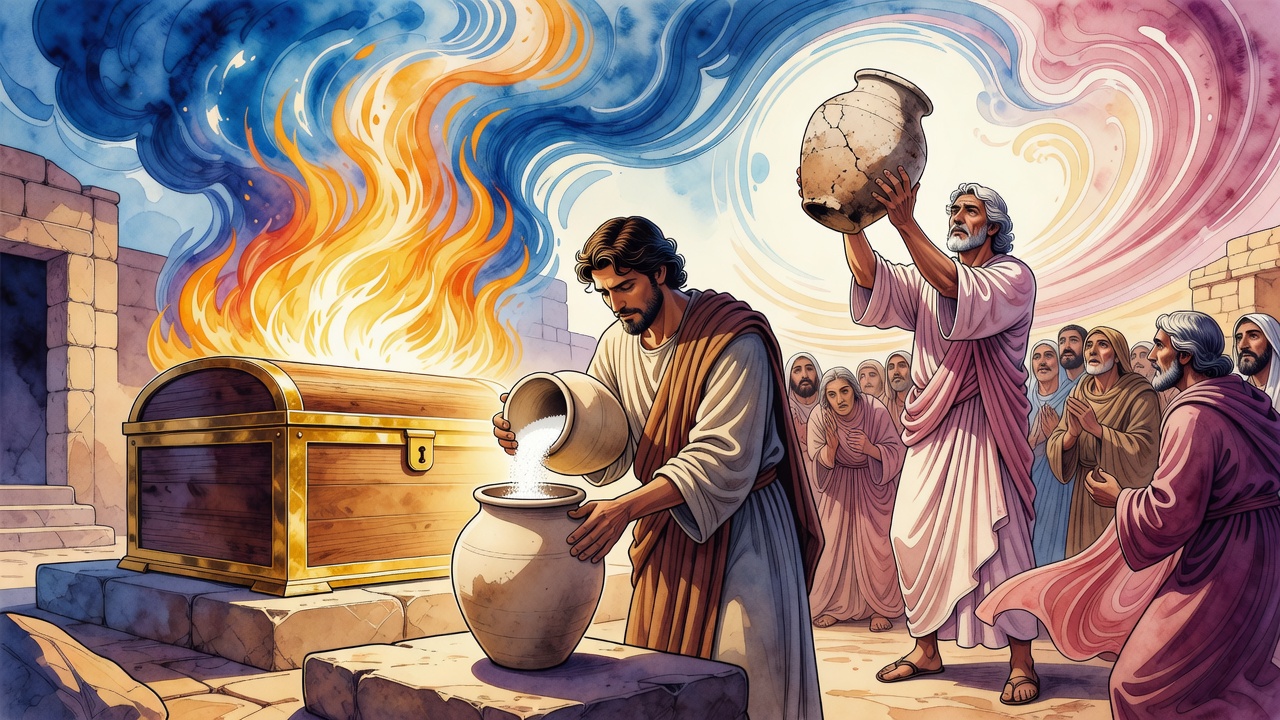
The Ark Walked Three Days Ahead of Israel Click for full size

Three days of road opened in front of the boards and gold. The camp followed late, a river of feet trying to match a pace set by something that did not tire. Heat stuck to the skin. Behind them, Mount Sinai shrank to a dark seam on the horizon and then to nothing at all.

God Rose When the Ark Moved

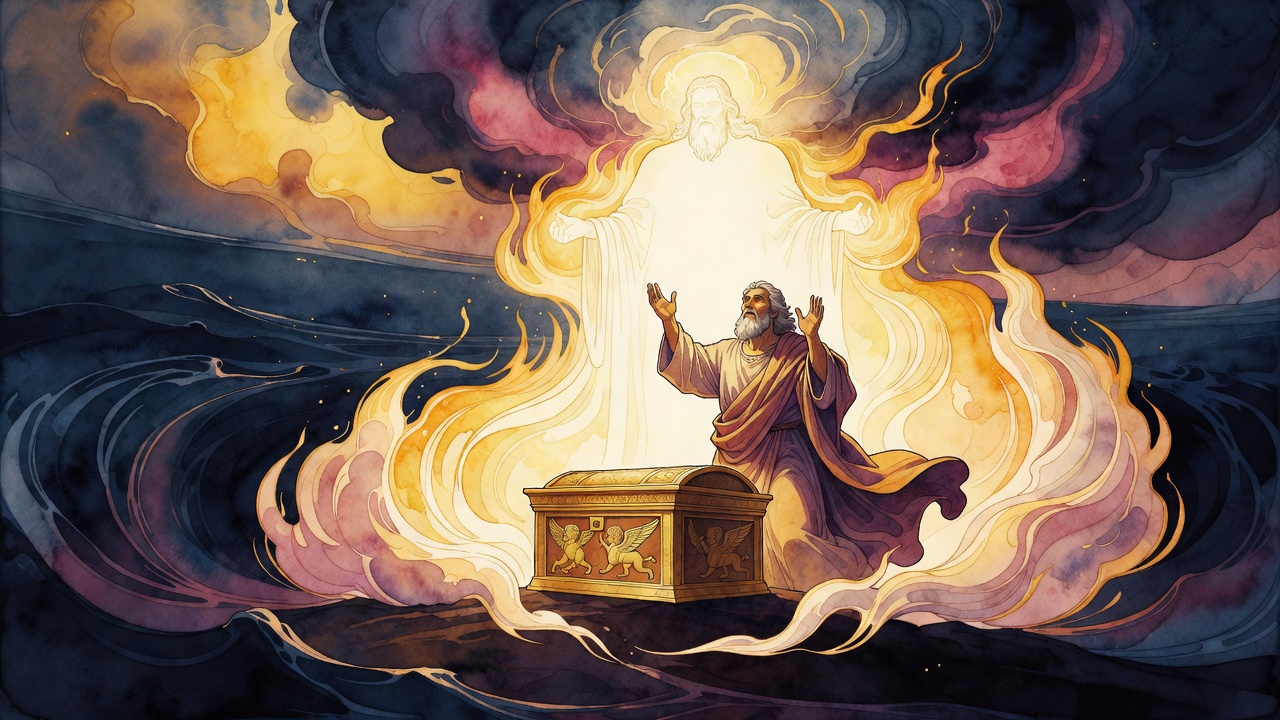
When the Ark traveled, a cry went up with it. God rose to scatter enemies and to make the road hold under boots that had only just learned freedom. The cloud that had sat like a roof over the mishkan (the portable sanctuary Israel carried through the wilderness) shifted and leaned forward. Feet found sand that had not been their sand the day before.

Israel walked because the box walked. No vote. No map drawn by committee. The presence that had chosen the low mountain now chose the path one stretch at a time, and the people learned the cost of nearness by sweating for it.

Then the mood in the rear ranks changed. Throats dried. Someone sought a pretext the way a hand seeks a loose thread. Grumbling found a seam in the heat. The people who had begged for God to dwell close began to treat the march as a burden the King had forced on them.

A King Dragged Through Foreign Cities

A company invites a king to ride with them to the governor of Acco. They arrive dusty and hopeful. The governor has already gone to Tyre. They press on to Tyre with the king still among them. He has moved to Tzidon. They chase him toward Antioch, grit in their teeth, water low, and then some of the party turn on the king for the length of the road.

The king should be the one with a claim. He left his house. He matched their pace. They asked him to come. They are the ones who keep moving the destination.

So too the Ark ahead of Israel. God went first into empty land. The people who had stood under Sinai's fire now measured the journey by their thirst and called the escort a problem. The two short verses that mark the Ark's going out sit in the scroll with inverted nuns before and after them, like brackets around a sealed room. Rebbi counted those eighty-five letters as almost a book inside the book, complete enough that a damaged scroll retaining them still carries a measure of sanctity to the hands that touch it. Rabbi Shimon placed the section right after Israel leaves the mountain of the Lord, before the first wave of complaint hardens into open grievance.

Either way, the journey itself is the weight. The Ark does not wait for gratitude to catch up.

Three Camps and One Dwelling

When the people finally pitched tents again, holiness did not sit in a single ring. It stacked like nested walls.

Outermost: the Israelite camp, ordinary dust and cooking smoke and the noise of flocks. Inward: the Levite camp, where the Ark's keepers slept near their charge and woke to its poles. Innermost: the camp of the Shechinah (שכינה), the Divine Presence, from the courtyard edge into the place no casual foot entered without consequence.

A man who had touched death walked those lines at dusk and felt each threshold push him outward. "Outside the camp shall you send them" (Numbers 5:2). Not a corner inside the ropes for the unclean to wait out their days. Outside. The camps must not be made unclean, "in whose midst I dwell" (Numbers 5:3).

He stood beyond the outermost pegs with ash on his clothes and watched the cloud still seated over the center. Exile from the rings did not empty the middle. God had said the Presence remains among Israel even when impurity forces bodies to the edge. The man outside still slept under the same sky that covered the boards of the Ark. Distance hurt. Abandonment was not the sentence.

The Road Refused to Be Ordinary

Morning came hard and early. Poles lifted again. Straps cut shoulders that had not fully healed from the day before. The Ark took the front without asking who was ready. Inverted marks waited in the future scroll like scars that remember a self-contained march, a pocket of text that can stand alone when other columns fail.

Someone in the rear would complain again before the next water. Someone impure would count the three camps with his eyes and step out past the last rope. The cloud would not leave the center for either reason. The king who had been invited kept walking first.

Israel moved because the Ark moved. God rose because the Ark rose. Carriers shifted the poles and felt the weight settle into bone. The sealed verses held the moment when Heaven took the lead and the people learned, too slowly, who should apologize for the length of the road.


← All myths
From the tradition

Sources

3 sources

The texts behind this telling. Some cards carry a translation of the source; others are our own retelling of it, and each card says which. Every card links out to the original.

Sifrei Bamidbar 1:3Sifrei Bamidbar

Retold in our words. Read the original at the link below.Sifrei by Rabbi Shraga Silverstein · CC-BY

It wasn’t just about hygiene; it was deeply connected to their relationship with the Divine. to a passage from Sifrei Bamidbar, a fascinating collection of legal interpretations on the Book of Numbers (Bamidbar in Hebrew), that really brings this point home.

The passage focuses on the verse (Bamidbar 5:2), "that they send out of the camp." The question is: which camp are we talking about? The main Israelite camp? The camp of the Levites? Or the most sacred space of all, the camp of the Shechinah – the Divine Presence?

The text initially suggests that the verse refers only to the Levite camp. But then it asks, how do we know the Israelite camp is included? Well, that’s derived from the next verse, Bamidbar 5:3: "Outside the camp shall you send them." Okay, makes sense so far.

What about the camp of the Shechinah? The verse reads, "(Bamidbar 5:3) "and they shall not make unclean their camps in whose midst I dwell": This is the camp of the Shechinah." So, it's pretty explicit.

However, the text then poses a clever argument: Even if this verse wasn't there, couldn't we figure it out through an a fortiori argument – a kind of "how much more so" deduction? If people with tumah (ritual impurity) from contact with a dead body are ejected from the less holy Israelite camp, wouldn’t they certainly be ejected from the supremely holy camp of the Shechinah?

So why, then, is the verse "and they shall not make unclean their camps" even needed? The answer given is fascinating: "To teach that we do not punish by an a fortiori argument." In other words, we can't just assume things when it comes to sacred law; we need explicit instructions.

Rabbi Yehudah offers a different take. He argues we can use the a fortiori argument to exclude those with tumah from the Shechinah's camp! His reasoning? If those with impurity are ejected from the "less stringent camp" of the Ark (i.e. the Levite camp), how much more so from the camp of the Shechinah? (So, he clearly holds that we do punish by an a fortiori argument!).

But then why is the verse "and they shall not make unclean their camps" written at all? Rabbi Yehudah explains that without it, we might assume everyone who is impure would be sent to the same place. But the Torah specifies regarding a leper (Vayikra 13:46) "Solitary shall he sit", teaching that no other unclean ones sit with him. We might then think that those with other forms of impurity could be sent to one camp, but the verse "and they shall not make unclean their camps" clarifies that each type of impurity requires its own separate camp.

Finally, Rebbi offers a concise and elegant explanation: A leper was included in the general category of the unclean, and then singled out for special mention. This teaches us a principle about the entire category of the unclean: Just as the leper, whose impurity is the most stringent, is subject to the strictest separation, so too should each person’s separation be proportional to the severity of their impurity.

What's so striking about this passage is how deeply the rabbis delved into the nuances of the text. They weren't just reading words; they were wrestling with them, teasing out layers of meaning and considering different perspectives. It reveals a worldview where holiness and impurity were palpable forces, requiring careful management and separation.

Full source
Sifrei Bamidbar 1:7Sifrei Bamidbar

Retold in our words. Read the original at the link below.Sifrei by Rabbi Shraga Silverstein · CC-BY

In the book of Bamidbar – Numbers, in English – we find a fascinating passage that deals precisely with this: the idea of sacred space, separation, and the surprising presence of the Divine even amidst impurity.

The passage begins with the seemingly simple instruction: "Outside of the camp shall you send them." (Numbers 5:2). But hold on, what’s the intent here? The Sifrei Bamidbar, a collection of legal interpretations on the Book of Numbers, asks a crucial question. Could it be that the point is simply to keep certain individuals – those deemed ritually impure – away from the holiest objects, like the Ark of the Covenant? Maybe they could still have a designated area within the camp?

That’s where the next part of the verse comes in, clarifying: "…and they shall not make unclean their camps." This repetition of the word "camp" – not once, not twice, but three times! – hints at something deeper. The Rabbis of old, always astute readers, noticed this and from it, they deduced a crucial concept: There weren't just one, but three concentric "camps" of holiness (Sifrei Bamidbar 3).

Jerusalem in ancient times. The outermost circle, from the city's entrance to the Temple Mount, was considered the "Israelite camp." Moving inward, from the entrance of the Temple Mount to the azarah, the Temple courtyard, was the "Levite camp." And finally, the innermost sanctum, from the entrance of the azarah inwards – that was considered the camp of the Shechinah, the Divine Presence.

Each camp represented a different level of holiness and required a different degree of ritual purity.

But here’s the truly part. The text continues, highlighting the profound connection between G-d and the people of Israel. It declares, "in whose midst I dwell" (Numbers 5:3). Even when the Israelites are tamei – ritually impure – the Shechinah, that Divine Presence, remains among them. As it says in (Leviticus 16:16), G-d "dwells with them in the midst of their uncleanliness." And again, in (Numbers 35:34), "And you shall not defile the land which you inhabit, in which I dwell, for I, the L-rd, dwell in the midst of the children of Israel (even when they are unclean)."

The Sifrei Bamidbar beautifully summarizes this sentiment: "Beloved are Israel, who, even when they are tamei, the Shechinah is among them." What an incredible statement!

It challenges the way we think about purity and impurity, about distance and closeness to G-d. It suggests that even in our moments of imperfection, when we feel farthest from the Divine, G-d is still present.

This idea, that G-d dwells even in the midst of our "uncleanliness," is a radical and comforting one. It suggests that holiness isn't about achieving some unattainable state of perfection, but about recognizing the Divine spark that exists within us, even when we stumble. The Shechinah is always with us.

Full source
Sifrei Bamidbar 84:1Sifrei Bamidbar

Retold in our words. Read the original at the link below.Sifrei by Rabbi Shraga Silverstein · CC-BY

Something that makes you wonder, "Why is that there?"

Well, let's Specifically, Bamidbar 10:35: "And it was, when the ark traveled…" This verse, and the one that follows it, are marked by something unique: inverted nuns.

Inverted nuns? What are those? They're like the Hebrew letter nun (נ) flipped upside down, acting as markers before and after these verses. The Sifrei Bamidbar, an ancient midrashic (rabbinic interpretive commentary) text on the Book of Numbers, explores why these peculiar symbols are present.

Rebbi, one of the sages quoted in the Sifrei Bamidbar, offers a fascinating idea: This section, these two verses, are almost like a book within a book. They're self-contained. This idea leads to a ruling: Even a Torah scroll that has been damaged, if these 85 letters from "And it was, when the ark traveled.." remain, it still retains a certain level of sanctity, imparting tumah (ritual impurity), ritual impurity, to the hands. (This is a Rabbinic enactment, discussed in the Talmud, Shabbat 115b-116a).

But Rabbi Shimon offers a different perspective. He says the inverted nuns are there because this section simply isn't in its proper place. It's out of order. So, where should it be?

33: "And they traveled from the mountain of the L-rd, a journey of three days. (And the ark of the covenant of the L-rd preceded them a distance of three days"). Immediately after that, before Bamidbar 11:1 ("And the people were as seekers of a pretext").

Why does this placement matter? Well, the Sifrei Bamidbar uses a powerful analogy to explain.

But when they arrive in Acco, the governor is gone to Tyre. They follow him to Tyre, but he's moved on to Tzidon. The chase continues all the way to Antioch! Frustrated, some of the people start complaining against the king for dragging them all over the place.

But wait a minute! Who should really be complaining? It's the king who has gone to all this trouble for their sakes!

The analogy, of course, is about the Israelites' journey in the desert. On that day, the Shechinah, the Divine Presence, traveled a three-day journey ahead of them – essentially clearing a path so they could immediately enter the Promised Land, Eretz Yisrael. And how did the people respond? By complaining!

They grumbled about the very thing that was meant to ease their way. It was HaShem, the Divine, who should have been complaining, for being put to such lengths for their sake! The Shechinah constrained itself, traveling ahead, all for them.

So, what does this all mean? Perhaps it's a reminder to appreciate the blessings in our lives, even when they come in unexpected or challenging packages. And maybe, just maybe, it's a reminder to be a little less quick to complain. Because sometimes, the "inconvenience" is actually a profound act of care.

Full source