5 min read

Atonement Blood Spotted on the Ark Cover in Rome

In Rome Rabbi Eliezer saw drops of blood on the ark cover. They told him it was the high priests Yom Kippur sprinkling from Bezalels gold work.

Curated by Arthur · Told by Maggid ·
Table of Contents
  1. Bezalel Made, and Made, and Made
  2. Named With Honor
  3. Coverings Over Presence
  4. What Rome Could Not Wash Off
  5. Order That Outlasts the Tent

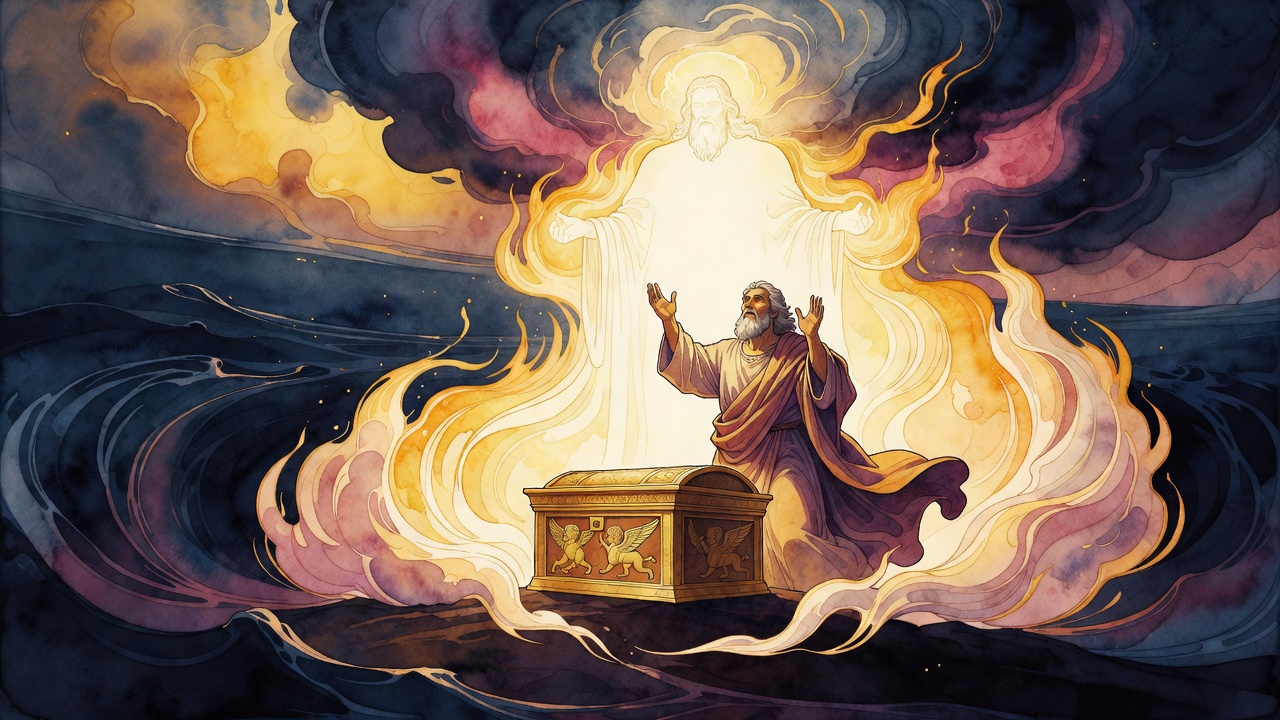
In Rome, far from the wreck of Jerusalem, Rabbi Eliezer son of Rabbi Yosé stood before an ark cover and saw drops of blood on the gold. He asked why blood sat on the kapporet. They answered that this was some of the blood the high priest sprinkled on the Day of Atonement. Therefore this cover must have been on the ark Bezalel made.
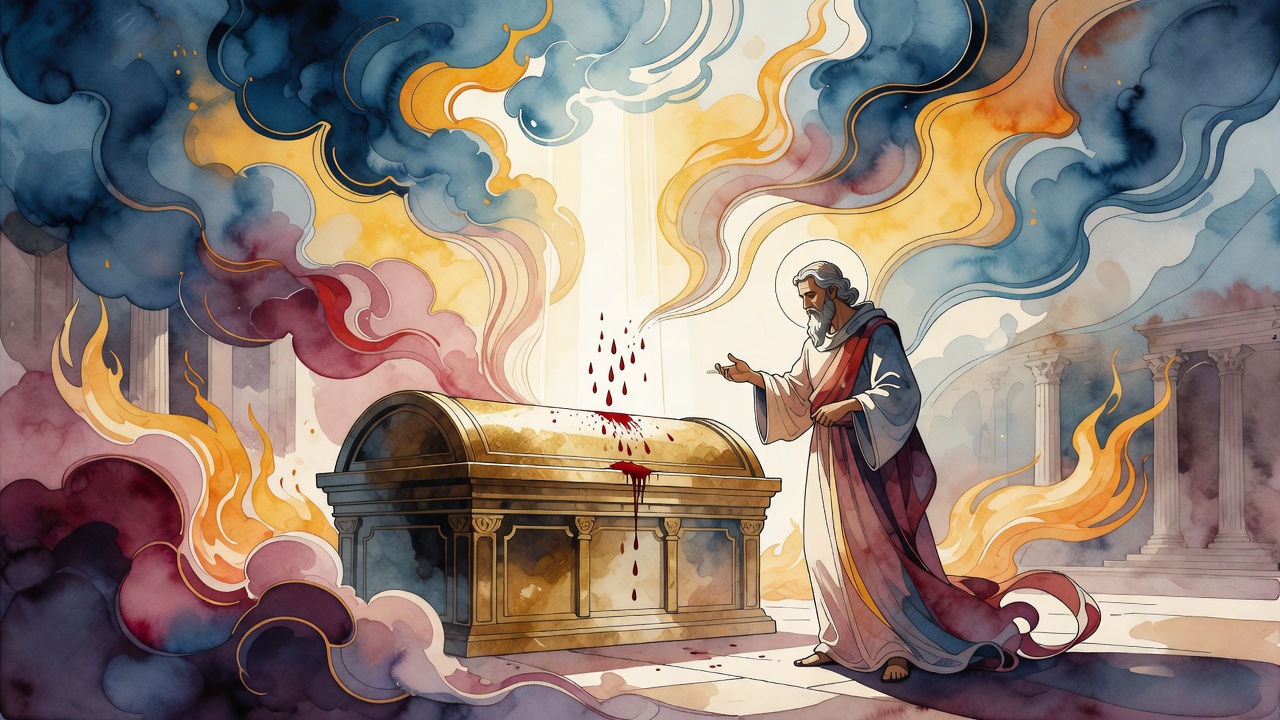
Atonement Blood Spotted on the Ark Cover in Rome Click for full size

A piece of the Tent of Meeting in a foreign capital, still wearing the stain of Israels most careful day. The exile had taken the furniture. It had not erased the evidence of atonement.

Marble halls and foreign crowds framed the gold. The rabbi did not bow to Rome. He read a Jewish object with Jewish eyes and forced the loot to confess its origin.

Bezalel Made, and Made, and Made

Scripture keeps saying "And Bezalel made." Did one man do every board and curtain alone? Not so. But he devoted himself so zealously to the work that the Holy One would not deprive him of his reward, and named him again and again. Boards first, then the goats hair tent, then the ark, then the cover of pure gold, then the table, then the menorah (the lampstand) that lit the table. Order like a king equipping a house.

Why is the cover called kapporet? Because it effects atonement, mekapper, for Israel. The name is a function. Gold that reconciles.

Zeal gets written into the text as repetition. Lazy craft would have been anonymous. Bezalels name becomes a drumbeat because his hands would not rest while the house of the Presence was unfinished.

Rabbi Eliezer leaned close enough to see that the drops were not fresh. They were history clinging to metal in a city that preferred trophies to memory.

Named With Honor

Resh Lakish watched how Scripture names people. Bezalel is introduced with his father Uri and left in honor. Achan is named with a full pedigree so guilt has an address. Some names protect. Some names expose. Bezalels name is a clean door. The blood on the cover in Rome is not a stain of crime. It is the residue of a rite that kept a people alive another year.

Honor can look like gold. It can also look like dried drops that prove a high priest once stood where you are standing now only in memory.

Achan steals and is named for shame. Bezalel builds and is named for praise. Rome can hold the gold and still not reverse that grammar.

Someone in the hall laughed that Jews would find holiness in loot. He answered without raising his voice. Holiness is not canceled by theft. It only waits for a reader who knows the rite.

Coverings Over Presence

Later mystical teaching sees other coverings over sacred space. The rainbow after the storm is read beside the tachash skins that covered the mishkan (the portable sanctuary Israel carried through the wilderness). A bow of promise shelters creation the way a tent sheltered the Presence. Blessing over fruit is not only taste. It is health in the body and a plea that shefa, divine flow, return after the covenant has been damaged and the rains of goodness held back.

Cover, bow, fruit, blood, each is a surface where heaven touches what can be seen.

When a mouth blesses fruit, it lights the source the mystics call the Life of the Worlds. When a priest once sprinkled blood, he marked the cover that still, in Rome, refused to become mere treasure.

What Rome Could Not Wash Off

Empire can loot a sanctuary. Empire can parade sacred furniture in triumph halls. Empire cannot make the kapporet into an ordinary plate. The blood keeps saying Yom Kippur. The name Bezalel keeps saying wilderness craft under Moses. The rabbi who asks the question keeps saying Israel still knows how to read its own objects even in a foreign museum of power.

The drops are small. The claim is not. Somewhere in Rome the Day of Atonement still clung to gold.

Tourists of empire saw spoils. Rabbi Eliezer saw a calendar of mercy dried into metal.

Order That Outlasts the Tent

Bezalel built in sequence because a king equips a house in sequence. When the house is gone and only a cover remains, the sequence still matters in memory, ark, cover, table, light. The midrash will not let the craftsman dissolve into anonymous labor. God wrote his name on every stage so zeal would not go unpaid.

Rabbi Eliezer left Rome with an image that travel cannot blur, blood on the cover, and a sentence that tied that blood to the priest, the day, and the man who first shaped the gold. The Tent was gone. The story of who made its heart was not.


← All myths
From the tradition

Sources

3 sources

The texts behind this telling. Some cards carry a translation of the source; others are our own retelling of it, and each card says which. Every card links out to the original.

Midrash Tanchuma, Vayakhel 10Midrash Tanchuma

Retold in our words. Read the original at the link below.Townsend 1989 translation of Midrash Tanhuma, S. Buber Recension · CC-BY

And Bezalel made the ark (Exod. 37:1). You find that everything constructed for the Tabernacle was made in its proper order. First he made the boards and joined them together. After that he made the curtain of goats’ hair to spread over them, as it is said: And thou shalt make a curtain of goats’ hair for a tent over the Tabernacle (Exod. 26:7). When he completed the ark, he made the cover that was to be hung before the ark: After he made the ark, he made the ark cover of pure gold (ibid. 37:6).

R. Eliezer the son of R. Yosé said: I saw the ark covering in Rome and noticed drops of blood upon it. I asked them why this blood was upon the ark cover. They told me: This was some of the blood the high priest sprinkled on the Day of Atonement. Therefore this ark cover must have been on the ark made by Bezalel.

Why was the ark cover called a kapporet? Because it effected atonement (mekapper) for Israel. After he made the ark cover, he fashioned the table upon which the show-bread rested, which was placed before the ark. When he completed the table, he constructed the menorah that illuminated the table. Hence he made everything according to the usual practice of kings. Therefore it is written: And Bezalel made the ark of acacia-wood. Did Bezalel do all the work by himself, that Scripture should repeat each time And Bezalel made? Indeed not. But since he devoted himself so zealously to the work of the Tabernacle, the Holy One, blessed be He, would not deprive him of his reward, and so He mentioned him each time, as is written: And Bezalel made.

Another illustration of this is in the verse Only Jonathan the son of Asahel and Jahzeiah the son of Tikvah stood up against this matter (supporting Ezra’s decree that the Israelites were to send away their foreign wives); and Meshullam and Shabbethai the Levite helped them (Ezek. 10:15). Because Jonathan devoted himself zealously to this matter while the other only helped him, his name is mentioned first. Similarly in the case of Bezalel. All the wise men assisted him, but because he devoted himself most zealously to the erection of the Tabernacle, it is written: And Bezalel made the ark.

The Holy One, blessed be He, said: Be assured that because of the importance of the Tabernacle, I shall be a light unto you, and because of everything you did in constructing the Tabernacle, I will reward you. But do not imagine that it is for the Sanctuary alone that you will be rewarded. I will reward you, as well, for the garments worn by the high priest. Each one obtained forgiveness for the people.

The Holy One, blessed be He, said: Because you have made a curtain of goats’ hair to serve as a tent over the Tabernacle in order to cover Me, I will cover you with a cloud on high, and I will consider it as if you had repaid Me. Because, at the time you went forth from Egypt, I brought a cloud that was a kind of tent to protect you, and I will reward you (in the same fashion) in the time-to-come, as it is said: And the Lord will create over the whole habitation of Mount Zion, and over her assemblies, a cloud and smoke by day, and the shining of a flaming fire by night, for over all the glory shall be a canopy (Isa. 4:5). You made an ark cover for Me, so be assured, because of the ark cover I will forgive all your sins, as it is said: When I have forgiven thee all that thou hast done (Ezek. 16:63). Because you made an ark for Me from which light will go forth to the world, be assured I will illumine for you the world-to-come, as it is said: The light of the moon shall be as the light of the sun (Isa. 30:26), and it is written elsewhere: Arise, shine, for thy light is come (Isa. 60:1).

The Holy One, blessed be He, declared; Because of all the things you did and the commandments you performed, I will repay you in the world-to-come. Because of the ark you made, in which the law is placed, I will be a light unto you and will bestow upon you the good that is stored up for the righteous, as it is said: Oh how abundant is Thy goodness, which Thou has laid up for them that fear Thee; which Thou hast wrought for them that take refuge in Thee, in the sight of the sons of men (Ps. 31:20). And it is also written: Light is sown for the righteous, and gladness for the upright in heart (Ps. 97:11).

Full source
Yalkut Shimoni on Torah 390:1Yalkut Shimoni on Torah

Translation of the source text.Torat Emet (Yalkut Shimoni) · CC-BY-NC

Rabbi Shimon ben Lakish said: There are names that Scripture mentions and lets rest [with honor], and names that Scripture mentions and treats with scorn. It mentions and lets rest: "See, I have called by name Bezalel son of Uri." It mentions and treats with scorn: "Achan son of Carmi son of Zabdi son of Zerach" (Joshua 7:1).

It mentions and lets rest: "And there was a certain man of Ramatayim" (the father of Samuel). It mentions and treats with scorn: "And there was a certain man from the hill country of Ephraim, and his name was Micah" (Judges 17:1).

It mentions and lets rest: "Number the sons of Levi" (Numbers 3:15). It mentions and treats with scorn: "Remember what Amalek did to you" (Deuteronomy 25:17).

It mentions and lets rest: "And David was the son of that Ephrathite man." It mentions and treats with scorn: "And Jeroboam son of Nebat, an Ephrathite" (I Kings 11:26).

It mentions and lets rest: "There was a certain Jewish man in Shushan the capital" (Mordecai). It mentions and treats with scorn: "A foe and an enemy" (Esther 7:6, of Haman). It mentions and lets rest: "For Mordecai the Jew" (Esther 10:3). It mentions and treats with scorn: "For Haman son of Hammedatha."

It mentions and lets rest: "And with him was Oholiav son of Achisamach of the tribe of Dan" (Exodus 38:23). It mentions and treats with scorn: "And his mother's name was Shelomith daughter of Dibri of the tribe of Dan" (Leviticus 24:11).

Full source
Peri Etz Hadar 3:10Peri Etz Hadar

Retold in our words. Read the original at the link below.Pri Etz Hadar, Aharon N. Varady transcription and Miles Krassen translation · CC-BY

This blessing, this goodness, isn't just about the taste in our mouths. It's about the health that flows through our bodies, whether we eat a little or a lot. As the Psalmist sings in (Psalm 133:3), "There YHVH commanded blessing, eternal life."

There's a deeper, more mystical layer to this blessing, too. The Peri Etz Hadar suggests that these blessings illuminate the very source of all blessings: Tsaddik, often translated as "Righteous One," who is also described as the "Life of the Worlds."

What about the rainbow? It's not just a beautiful arc in the sky after a storm. The Peri Etz Hadar draws a parallel to the tachash, the mysterious animal whose skins were used to cover the Tabernacle, the mishkan. the author here beautifully connects Creation with the mishkan. Rabbi David Seidenberg suggests that the rainbow becomes the covering of the sacred tent, the ohel, that is our Earth. Just as the Tabernacle sheltered the divine presence, the rainbow shelters and blesses creation. The Talmud in Shabbat 28a hints at this, too.

From this point of illumination, may shefa – abundance, divine flow – favor, and compassion pour down upon us. This is a plea for forgiveness, a recognition that we've fallen short. We've "violated the covenant and damaged the fruit of Tsaddik," causing the rains of blessing to be withheld. This isn't just about literal rain, but about the flow of goodness being disrupted. All the sources of shefa, the channels of divine abundance, have been affected.

Now, we pray for restoration. We ask that everything return to its original strength, that the bow of promise, as mentioned in (Genesis 49:24), remains taut, ready to release blessings. "For You, YHVH, bless the Tsaddik; favor crowns him like a shield," as we read in (Psalm 5:13). next time you enjoy a piece of fruit. It's not just a snack. It's a small act with the potential to illuminate the entire world.

Full source