5 min read

When the Sun Went Dark Israel Did Not Tremble

Darkness slid across the sun and nations read omens, but Rabbi Yonathan taught eclipses as signs for them, not for Israel under the Name.

Curated by Arthur · Told by Maggid ·
Table of Contents
  1. Signs Relegated to the Nations
  2. When the Name Is Exalted or Dragged
  3. Who Is Like You Among the Mighty
  4. Dismay That Belongs Elsewhere

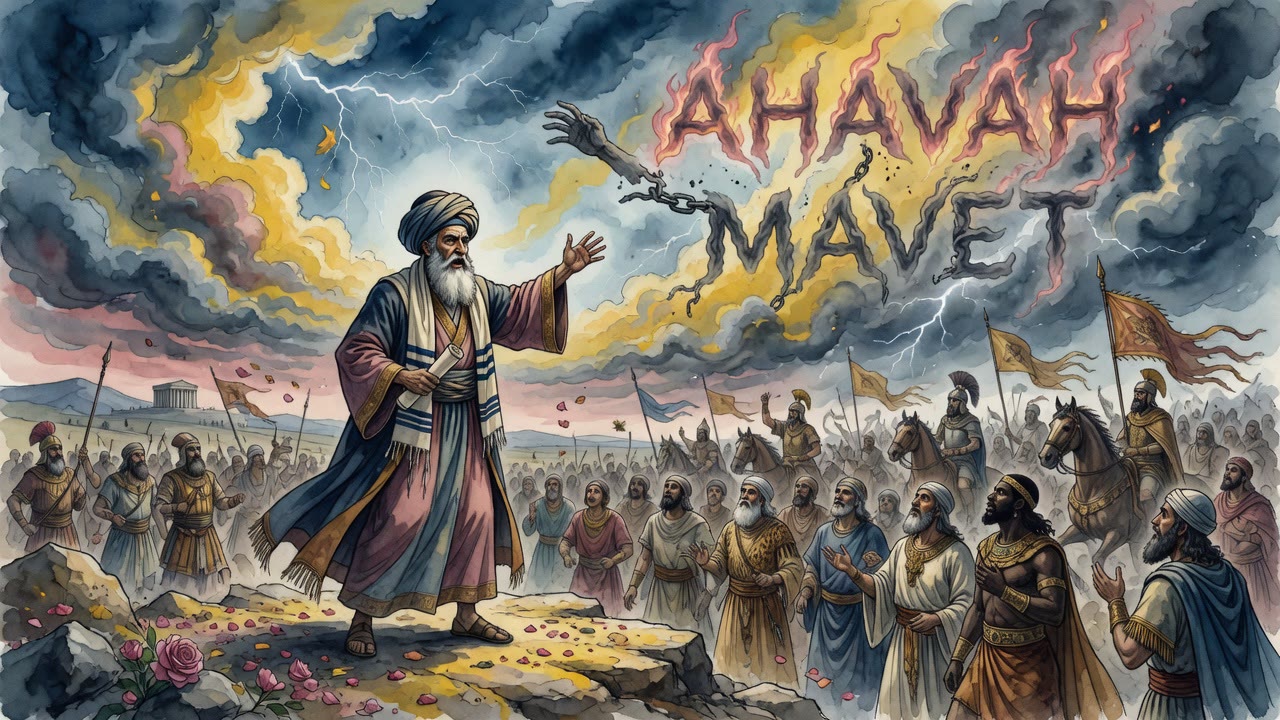
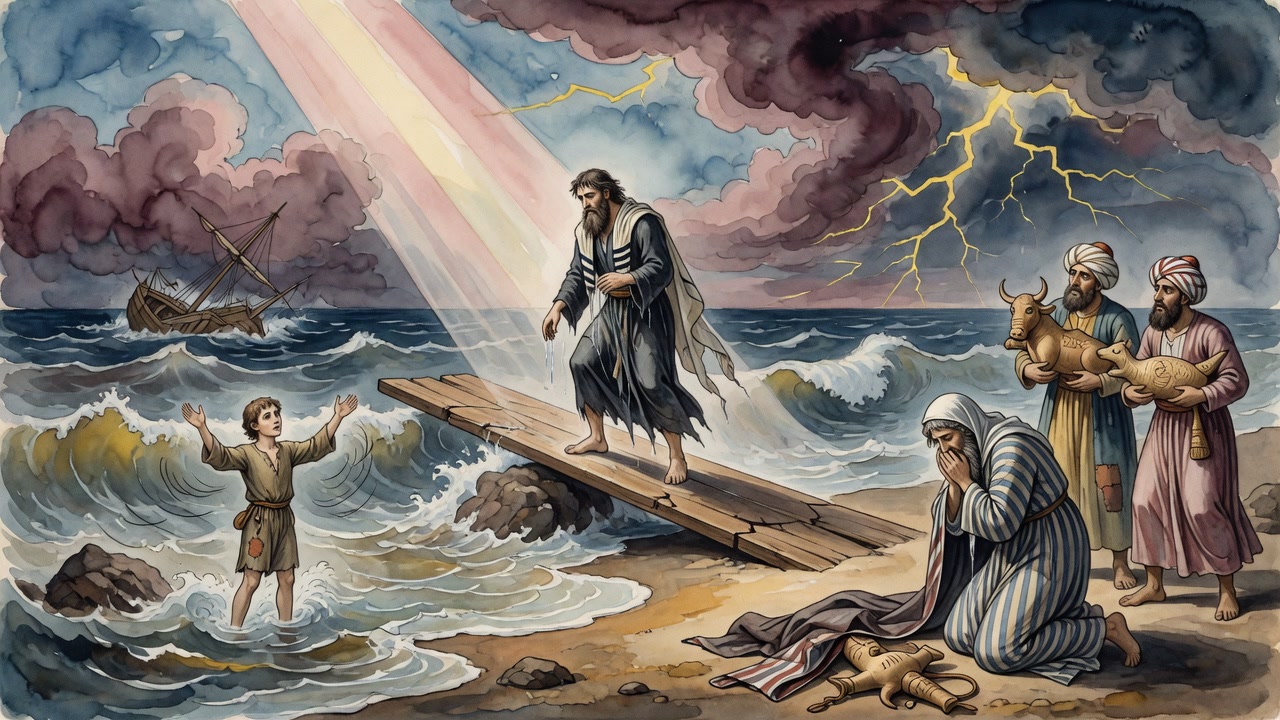
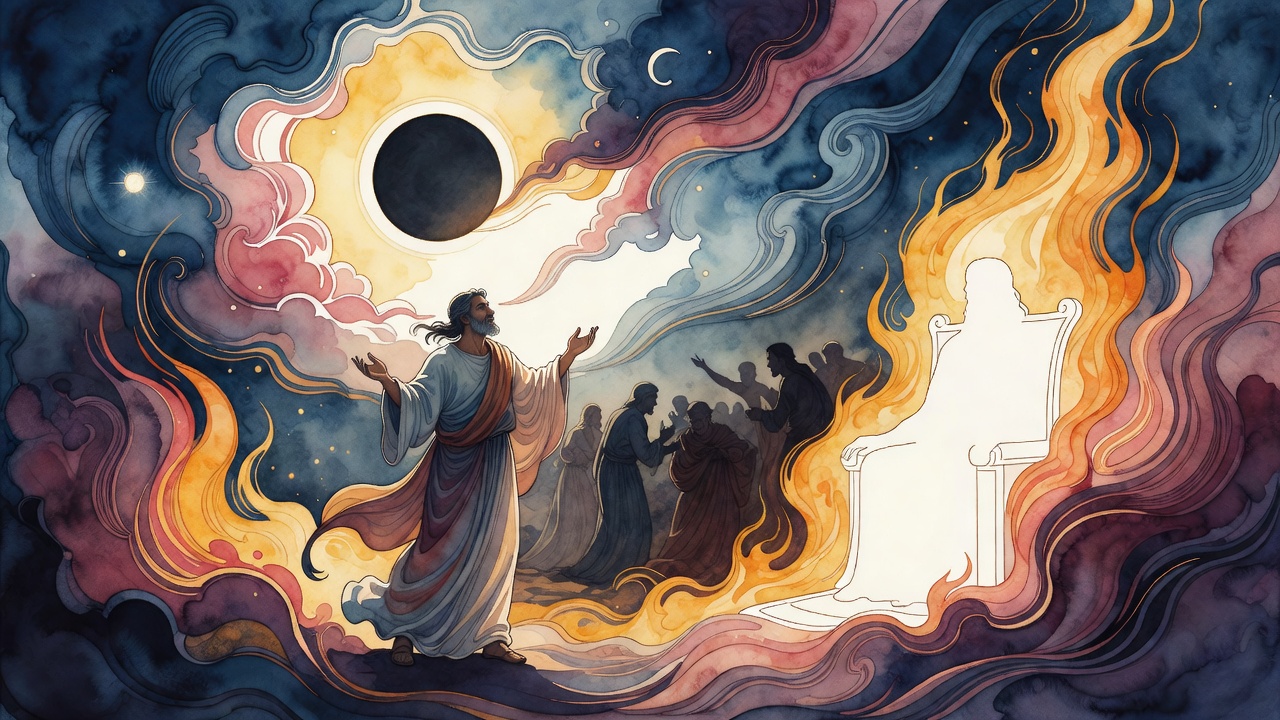
The light thinned at noon as if someone had drawn a lid across the world. Chickens went to roost. Dogs barked at nothing. In the market of a coastal town, sailors touched amulets and named old sky-gods. A Jewish porter set down his load, looked up once, and went back to the strap on his shoulder.
When the Sun Went Dark Israel Did Not Tremble Click for full size

Around him the nations clanged like a bell of fear. They read the blackened sun as a sentence on kings and harvests. He had been taught a different sentence. The darkness was real. The panic was optional. His account, he had learned from teachers who named Jeremiah, was open in a court that did not take sky-signs as exhibits against the covenant.

Signs Relegated to the Nations

Rabbi Yonathan taught the line without softness. Solar eclipse and lunar eclipse are signs. They are not signs for Israel. They were given over entirely to the nations of the world. Jeremiah had already drawn the border: do not emulate the ways of the nations, and do not be dismayed at the signs of the heavens. Let the nations be dismayed by them.

The teaching was not astronomy for its own sake. It was a claim about who holds a people's fate. The nations, in this view, rise and fall with the wheels of the sky. Israel stands under direct providence. No shadow on the sun renegotiates the covenant. No alignment of planets overrides the Mouth that spoke at Sinai. A man may still plan crops by seasons. He may not sell his peace to an omen as if the omen were a second god.

When the Name Is Exalted or Dragged

That does not mean Israel walks free of consequence. Rabbi Shimon ben Elazar taught another scale. When Israel does the will of the Lord, His name is exalted in the world. Kings of the Emori heard and melted. Rahab told the spies that hearts failed when the report of the dried sea arrived. When Israel does not do His will, the Name is, as it were, demeaned among the nations. "These are the people of the Lord," the exile-watchers say, "and from His land they went forth," and the mockery sticks to the Name until He sanctifies it again.

So the porter's calm was not arrogance. It was a refusal to let a sky-sign bully him into the nations' panic. His fear, if he had any, belonged to deeds and exile and the honor of the Name, not to a shadow crossing a disk of fire. A people can be safe from omens and still unsafe from their own betrayal of the One who claims them.

Who Is Like You Among the Mighty

At the sea, when Pharaoh's army sank, the song asked who is like You among the gods. The sages heard the nations themselves renouncing idols that could not speak, see, or save. Mouths of silver stayed mute while the living God spoke Ten Words in one utterance. Eyes of gold saw nothing while His eyes ranged the whole earth. Hands of wood could not stretch out the heavens or set a presence on a mountain. Feet of stone could not walk the ages. Ears of bronze could not hear a widow's prayer.

An eclipse is a grand show. It is still only light and blockage. It cannot answer prayer. It cannot harden or soften a heart. It cannot lift a people from brick pits or drop them into exile. Those acts belong to the One the song praised while bodies floated among the reeds. The sailors in the market who named sky-gods at noon-night were practicing the old mistake of the idol: treating a visible wonder as a master instead of a tool in a larger hand.

Dismay That Belongs Elsewhere

The nations may chart the dark and tax their fears. Israel is told to keep the calendar by moon and season for festivals, not to kneel to the calendar as a god. The difference is thin in the street and thick in the soul. Two men can watch the same noon-night. One sells his peace to an omen. The other checks his strap and walks on, because his account is open in a different court.

When the light returned, the sailors laughed too loudly, the way men laugh when terror has made them small. The porter did not join them. He had not been holding his breath for the sky's permission to live. He lifted the load, felt the familiar bite of the strap, and moved toward the lane where his children waited, under a sun that was only a sun again, and under a Name that had never needed the sun's approval.

A child in the market tugged his father's sleeve and asked if the dark meant the end of the world. The father, who had never opened a scroll of Mekhilta, still answered with the inheritance of a people that refuses to rent its fear to the heavens. "It means the sun is blocked," he said. "It does not mean we are sold." That plain speech carried more theology than a dozen omen charts, and it left the child free to watch the light return without learning to kneel to a shadow.


← All myths
From the tradition

Sources

3 sources

The texts behind this telling. Some cards carry a translation of the source; others are our own retelling of it, and each card says which. Every card links out to the original.

Mekhilta Tractate Pischa 2:11Mekhilta DeRabbi Yishmael

Retold in our words. Read the original at the link below.Mechilta, translated by Rabbi Shraga Silverstein · CC-BY

Rabbi Yonathan taught a striking principle about eclipses. Both solar and lunar eclipses, he declared, were given as signs. But not for Israel. They were relegated entirely to the nations of the world.

His proof comes from the prophet Jeremiah, who warned: "Do not emulate the ways of the nations, and do not be dismayed at the signs of the heavens. Let the nations be dismayed by them!" (Jeremiah 10:2). The verse draws a sharp line. The nations may tremble at celestial phenomena, reading them as omens and portents. But Israel is commanded not to fear them at all.

This teaching from the Mekhilta DeRabbi Yishmael reflects a broader principle in rabbinic thought about the relationship between Israel and the natural world. The nations, according to this tradition, are governed by the stars and the movements of the heavens, their fortunes rise and fall with celestial events. Israel, by contrast, stands under God's direct providence. No eclipse can determine their fate. No alignment of planets can override God's covenant.

Rabbi Yonathan's teaching was not merely astronomical. It was theological. It meant that when darkness crossed the face of the sun, the people of Israel were to remain unmoved, not because eclipses were meaningless, but because Israel's destiny operates on a different plane entirely. The nations look up at the sky and see their future. Israel looks to the Torah and sees theirs.

Full source
Mekhilta Tractate Shirah 3:20Mekhilta DeRabbi Yishmael

Retold in our words. Read the original at the link below.Mechilta, translated by Rabbi Shraga Silverstein · CC-BY

R. Shimon b. Elazar says: When Israel do the will of the L–rd, His name is exalted in the world, as it is written (Joshua 5:1) "And it was, when all the kings of the Emori heard, etc." And thus did Rachav say to Joshuah's emissaries, (Ibid. 2:10) "for we heard how the L–rd dried up, etc.", and (Ibid. 17) "and we heard and our hearts melted, and no man's spirit endured within him before you. For the L–rd, He is G–d in the heavens above, etc." And when they do not do His will, His name, as it were, is demeaned in the world, viz. (Ezekiel 36:20) "And they came to the nations … and they profaned My holy name when it was said of them: These are the peoples of the L–rd, and from His land did they go forth …" and (Ibid. 23) "And I shall sanctify My great name which has been profaned among the nations, etc."

Full source
Mekhilta DeRabbi Shimon Ben Yochai 15:11Mekhilta DeRabbi Shimon Ben Yochai

Translation of the source text.Mechilta de-Rabbi Simon b. Jochai, ed. D. Hoffmann, Frankfurt 1905 · Public Domain

"Who is like You among the gods, O LORD?" (Exodus 15:11). When they saw that Pharaoh and his army perished in the sea, and the kingdom of Egypt was destroyed, and judgments were executed upon their idols, they all opened their mouths and acknowledged the Omnipresent and said, "Who is like You among the gods, O LORD?" And not Israel alone, but even the nations of the world, when they saw what befell Egypt and its idols, denied their idolatry and acknowledged the Omnipresent and said, "Who is like You among the gods, O LORD?" And so Rahab says, "For we have heard how the LORD dried up the water of the Red Sea before you... and as soon as we heard it our hearts melted" (Joshua 2:10-11). And so you find for the time to come, that the nations of the world will yet deny their idolatry, as it is said, "In that day a man shall cast away his idols of silver and his idols of gold which they made for him to worship, to the moles and to the bats, to go into the clefts of the rocks... for fear of the LORD and for the glory of His majesty, when He arises to shake the earth" (Isaiah 2:20-21). What does it say [of the idols]? "And the idols shall utterly pass away" (Isaiah 2:18).

Another interpretation: "Who is like You among the gods, O LORD?" Who is like You in the miracles and mighty deeds You did for us at the sea, as it says, "terrible things by the Red Sea" (Psalms 106:22)? Another interpretation: Who is like You, who sees the humiliation of His children and keeps silent, as it says, "I have long held My peace, I have been still, and refrained Myself; now will I cry like a travailing woman" (Isaiah 42:14)? Another interpretation: Who is like You among those who stand before You on high, as it says, "For who in the skies can be compared unto the LORD?" (Psalms 89:7)? Another interpretation: Who is like You among those who called themselves gods? Pharaoh called himself a god, as it says, "My river is my own, and I have made myself" (Ezekiel 29:3); what is written of him? "Behold, I am against you, and against your rivers." Sennacherib called himself a god, as it says, "Who are they among all the gods of the countries that have delivered their country out of my hand, that the LORD should deliver Jerusalem?" (2 Kings 18:35); what is written of him? "As he was worshipping in the house of Nisroch his god, Adrammelech and Sharezer his sons smote him with the sword" (2 Kings 19:37). So too Nebuchadnezzar, and so too Hiram king of Tyre.

Another interpretation: "Who is like You among the gods" -- among those whom others call gods. What is their nature? "They have mouths but they speak not" (Psalms 115:5). But He who spoke and the world came into being is not so; rather, He spoke the Ten Commandments in a single utterance, as it says, "And God spoke all these words, saying" (Exodus 20:1), and it says, "Is not My word like fire? says the LORD" (Jeremiah 23:29). "Eyes they have but they see not" (Psalms 115:5); but He who spoke and the world came into being is not so, rather, "The eyes of the LORD that range to and fro through the whole earth" (Zechariah 4:10), and "In every place the eyes of the LORD keep watch upon the evil and the good" (Proverbs 15:3). "Ears they have but they hear not" (Psalms 115:6); but He is not so, rather, "O You that hear prayer, unto You shall all flesh come" (Psalms 65:3), and "You will direct their heart, You will incline Your ear" (Psalms 10:17). "Noses they have but they smell not" (Psalms 115:6); but He is not so, rather, "an offering made by fire, of a sweet savor unto the LORD" (Leviticus 1:13), and "the LORD smelled the sweet savor" (Genesis 8:21). "Hands they have but they handle not" (Psalms 115:7); but He is not so, rather, "My hand also has laid the foundation of the earth, and My right hand has spanned the heavens" (Isaiah 48:13), and "I, even My hands, have stretched out the heavens" (Isaiah 45:12). "Feet they have but they walk not" (Psalms 115:7); but He is not so, rather, "Then shall the LORD go forth and fight against those nations" (Zechariah 14:3), and "His feet shall stand in that day upon the Mount of Olives" (Zechariah 14:4). "Neither speak they through their throat" (Psalms 115:7); but He is not so, rather, "His mouth is most sweet, yea he is altogether lovely" (Song of Songs 5:16), and "a sound goes out of His mouth" (Job 37:2).

"Who is like You, glorious in holiness" (Exodus 15:11). You are exalted and glorious in holiness, for the measure of the Omnipresent is not like the measure of flesh and blood. Flesh and blood cannot speak two things at once, but He who spoke and the world came into being spoke the Ten Commandments in a single utterance, as it says, "And God spoke all these words." Another interpretation: the measure of the Omnipresent is not like flesh and blood; flesh and blood cannot listen to two people at once, but all who come into the world stand and pray before Him and He hears their prayer as one, as it says, "O You that hear prayer." Another interpretation: a hired laborer works for a householder and the householder sows with him, plows with him, weeds with him, and pays him once; but He who spoke and the world came into being is not so; one who desired children, He gave them, as it says, "Lo, children are a heritage of the LORD" (Psalms 127:3); one who desired wisdom, He gave it, as it says, "For the LORD gives wisdom" (Proverbs 2:6); one who desired wealth, He gave it, as it says, "Both riches and honor come of You" (1 Chronicles 29:12).

"Fearful in praises" (Exodus 15:11). The measure of the Omnipresent is not like flesh and blood. A mortal's awe is greater upon the distant than the near, but with Him the awe upon the near is greater than upon the distant, as it says, "and round about Him it stormeth mightily" (Psalms 50:3), and "A God dreaded in the great council of the holy ones, and feared by all them that are round about Him" (Psalms 89:8), and "Dominion and fear are with Him" (Job 25:2), and "I will be sanctified in them that come near Me" (Leviticus 10:3).

"Doing wonders" (Exodus 15:11). The measure of the Omnipresent is not like flesh and blood. Flesh and blood builds the lower part first and then the upper, but He who spoke and the world came into being is not so; He built the upper first and then the lower, as it says, "In the beginning God created the heavens and the earth" (Genesis 1:1). Another interpretation: flesh and blood, when it roofs, roofs with wood and stones and earth, but He roofs only with water, as it says, "Who lays the beams of His chambers in the waters" (Psalms 104:3). Another interpretation: flesh and blood cannot form an image in water, but He forms an image in water, as it says, "And God said, Let the waters swarm with swarms of living creatures" (Genesis 1:20). Another interpretation: flesh and blood cannot form an image in darkness, but He forms an image in darkness, as it says, "when I was made in secret, wrought in the lowest parts of the earth" (Psalms 139:15). Another interpretation: flesh and blood, when it forms an image, begins from its head or its feet or from one of its limbs, but He forms it all as one, as it says, "for He is the former of all things" (Jeremiah 10:16), and "there is no rock like our God" (1 Samuel 2:2) -- there is no former like our God. Flesh and blood forms an image and must put dye among pigments, but the Holy One, blessed be He, formed the human from a single substance: the eyeball's pupil is black, surrounded by white, and the teeth white surrounded by red. Flesh and blood cannot form an image within an image, but the Holy One, blessed be He, formed the human within its mother's womb. Flesh and blood forms an image and it does not move from its place, but He formed the human and it walks from one end of the world to the other. Flesh and blood forms an image and it does not see or hear or speak, but He formed the human and it sees and hears and speaks. Flesh and blood forms an image and cannot make it a soul and innards, but the Holy One, blessed be He, formed the human and made for it a soul and innards; this is what David means when he says, "Bless the LORD, O my soul, and all that is within me, bless His holy name" (Psalms 103:1). Another interpretation: "doing wonders" -- it is not written "did a wonder" but "doing a wonder"; He did wonders with the fathers and will yet do wonders with the children, as it says, "As in the days of your coming out of the land of Egypt I will show him marvelous things" (Micah 7:15), and "I will praise You, for I am fearfully and wonderfully made; wonderful are Your works" (Psalms 139:14).

Full source