5 min read

The Wife Who Saved On From Korah's Open Grave

Korah's rebellion dragged families toward a living grave, but On slept while his wife blocked the tent, held the bed, and prayed him back.

Curated by Arthur · Told by Maggid ·
Table of Contents
  1. Korah's Fire Entered the Tent
  2. The Oath Had Teeth
  3. Loose Hair Closed the Door
  4. The Bed Began to Slide
  5. Faces Fell Into the Dust
  6. The Sea Returned Another Man

On came home with Korah's oath still warm in his mouth.

Outside the tent, the camp had turned hard and loud. Men who had eaten manna together now spoke as if the wilderness were a courtroom and every neighbor had to choose a side. Korah had gathered names, rank, anger, and grievance. On, son of Peleth, had given him a promise.

Korah's Fire Entered the Tent

On's wife listened. She did not shout over him. She did not flatter the rebellion by treating it as a grand cause. She cut it down to its actual size.

If Moses remained master, On would still be a disciple. If Korah became master, On would still be a disciple. The throne would move above his head, not into his hands. The danger was real. The prize was air.

Across the camp, another wife had taken the opposite path. Korah's wife fed the fire under her husband's pride. On's wife put her hands around the wick and pinched. One woman built her house. One woman pulled at the beams until the roof was ready to fall.

The Oath Had Teeth

On heard the sense in her words, but the oath held him. A vow can become a collar when a man gives it to the wrong cause. He had pledged himself before Korah's company, and shame stood guard at the door.

His wife found the only road left. She poured wine. Not a cup for joy, not a cup for blessing, but a cup heavy enough to drag him below the noise of the camp. On drank, and sleep took him. His body lay inside the tent while his name was still expected outside it.

Then she went to the entrance and uncovered her hair.

Loose Hair Closed the Door

Korah's men came for him. They came ready to pull On back into the circle, back into the shout, back toward the place where the earth was already waiting. They reached the tent and stopped.

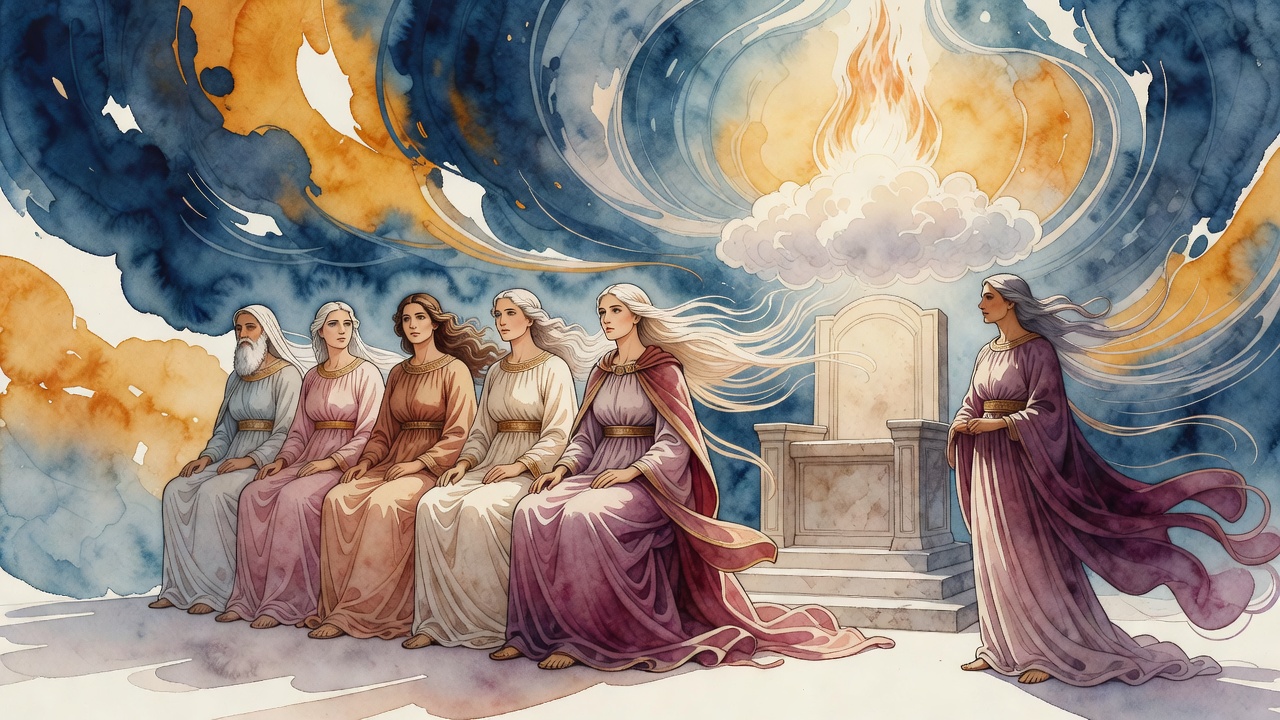
There she sat, hair streaming loose at the door.

Those men had called the whole congregation holy. So she used their holiness against them. One by one they turned away rather than pass a woman in that state. Their own claim became her wall. No spear blocked them. No angel blocked them. A wife, a doorway, and loose hair held back a rebellion.

Inside, On slept through his rescue.

The Bed Began to Slide

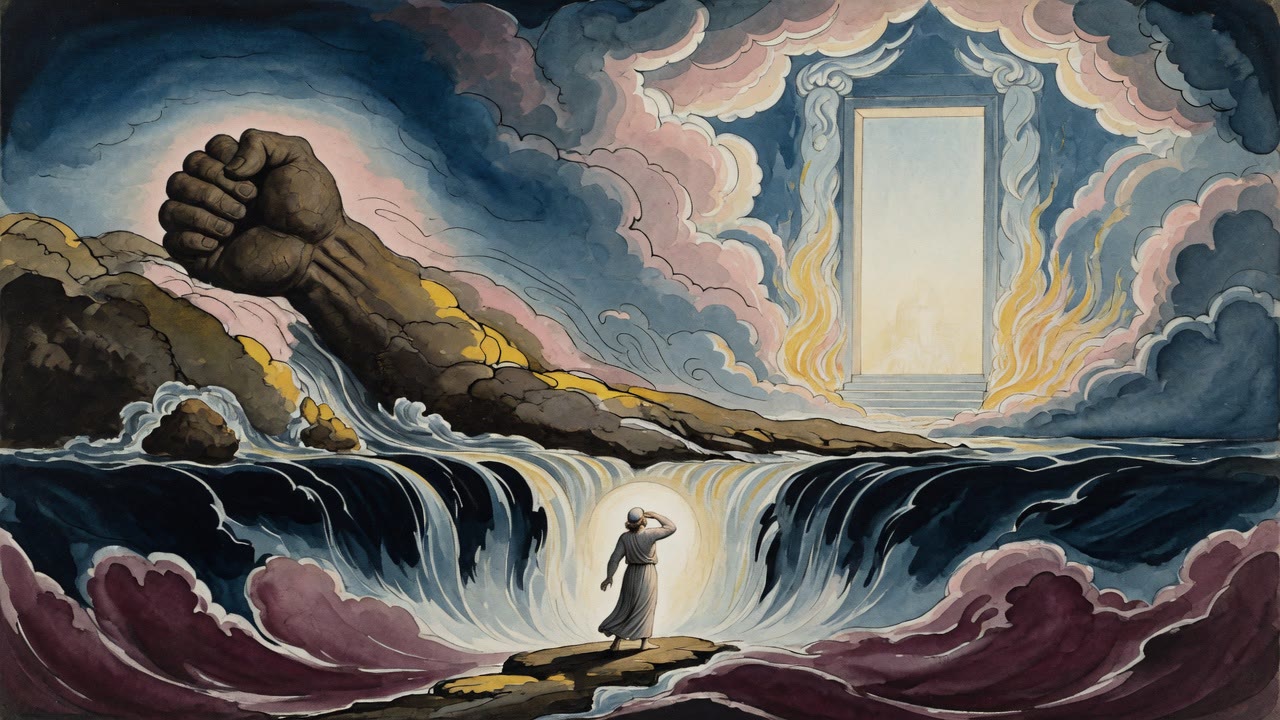
Then the ground opened.

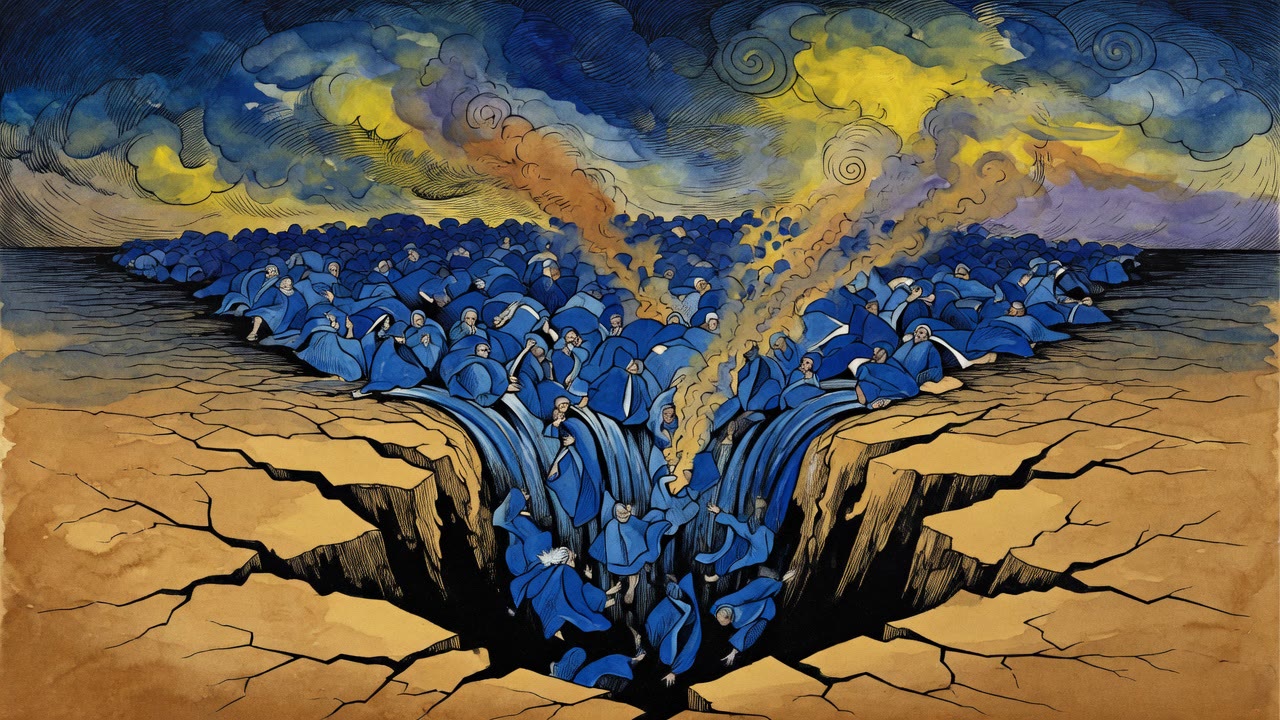
It did not crack politely. It split with a mouth. Korah's company went down alive, men, women, children, even infants who had barely tasted the world. Fire took the 250 men with their incense. The camp shook with the kind of fear that leaves dust on the tongue.

On's bed began to move.

The bed rocked, rolled, and dragged toward the opening as if the earth had remembered his signature. His wife seized it. The sleeper could not plead, so she pleaded over him.

Master of the world, she cried, he has vowed never again to join dissension. If he breaks it, You live forever and can punish him then. Do not take him now.

The bed stopped. The earth lost its grip.

Faces Fell Into the Dust

All around the camp, panic rose. Moses and Aaron fell on their faces and spoke toward heaven: God of the spirits of all flesh, shall one man sin and the whole congregation burn?

A human king might send legions into a rebel province and kill the loyal with the guilty because he cannot see the secret chambers of the heart. God can. God knows the counsel of the kidneys, the bend of each spirit, the difference between the man who raised his fist and the man who slept behind a guarded door.

The answer came with terrible precision. The guilty would be made known. The innocent would not be buried under another man's shout.

On lived. He was too ashamed to face Moses, so his wife went in his place. She wept until Moses came to the tent and called him out by name. Step forth, On son of Peleth. God will forgive your sin.

He stepped out of the house his wife had built around him.

The Sea Returned Another Man

Far from that wilderness pit, Rabbi Akiba once stood beside the sea and watched a man disappear under the waves. The water took him so completely that mourning began in the sage's body before the man returned. Then the drowned man came walking out alive, wet and breathing.

The waves had carried him back.

His merit was charity. Bread cast out into the world had become a hand under the water. What swallowed him could not keep him.

So it was with On. Not every open mouth gets to finish its meal. Sea, earth, mob, oath, and shame all had claims on him. His wife's wisdom reached him first.


← All myths

From the tradition

Sources

4 sources

The texts this telling draws on, in full. Open a card to read inline, or expand it for a wider, quieter read.

Legends of the Jews 5:25Legends of the Jews

A fascinating story from the book of Numbers, and elaborated upon in the classic work, Legends of the Jews by Louis Ginzberg, a compilation of centuries of Jewish tradition, that explores just that, focusing on the rebellion of KORAH.

The story starts with a stark warning: God deals severely with discord. We read that the earth swallowed alive not only the ringleaders but even children, some just a day old! A chilling detail that emphasizes the gravity of the sin. But amidst this devastation, there are survivors. Out of the entire company of Korah, only four people escaped: ON, the son of Peleth, and Korah's three sons. And the reason for On's survival? His wife.

The tale paints a vivid picture of two women, contrasting their wisdom. "Every wise woman buildeth her house," the proverb goes, "but the foolish plucketh it down with her own hands." According to Ginzberg's retelling, it was Korah’s wife who, through her words, pushed her husband to his doom. Conversely, On’s wife is credited with his salvation.

On, apparently a man of some distinction, had initially joined Korah’s rebellion. When he told his wife about it, she posed a simple, yet profound, question: "What benefit shalt thou reap from it? Either MOSES remains master and thou art his disciple, or Korah becomes master and thou art his disciple." A no-win situation!

On, seeing the truth, felt trapped. He had sworn an oath to Korah. His wife, however, was not about to let her husband be dragged down with the rebels. She told him to stay home. Then, to make absolutely sure, she plied him with wine until he fell into a deep, oblivious sleep.

Now comes the truly ingenious part. Knowing that "all the congregation are holy, and being such, they will approach no woman whose hair is uncovered," she stood at the entrance of their tent with her hair disheveled. (Remember, modesty customs were very strict then.) Any of Korah’s followers who came to fetch On were immediately repelled. Her strategic impropriety kept her husband from participating in the rebellion.

When the earth opened up, the bed on which On slept began to tremble. But On's wife grabbed the bed and cried out to God, reminding Him of On’s vow to abstain from dissension. "Thou that livest and endurest to all eternity canst punish him hereafter if ever he prove false to his vow." We find in Midrash Rabbah how powerful a wife's intercession can be on behalf of her husband, especially when coupled with genuine remorse.

God heard her plea, and On was spared.

Ashamed to face Moses, On refused to go to him. So, his wife went in his stead. Initially, Moses rebuffed her, wanting nothing to do with women, but her bitter weeping moved him. After hearing her story, he accompanied her to her house and called out, "On, the son of Peleth, step forth, God will forgive thee thy sins."

From that day forward, this former follower of Korah was known as On, "the penitent," son of Peleth, "miracle." Ginzberg tells us his true name was Nemuel, son of Eliab, a brother of Dathan and Abiram.

What are we to make of this story? It’s a reminder that even in moments of great upheaval and divine judgment, individual choices matter. It highlights the power of a wise woman to steer her husband away from destruction. And it offers a glimmer of hope: even after rebellion, repentance and forgiveness are possible. Perhaps the most profound aspect is that salvation often comes in unexpected forms – a wife’s cleverness, a drunken sleep, and a heartfelt prayer. It's a story that resonates even today, reminding us of the enduring power of wisdom, repentance, and the bonds of love.

Full source
Bamidbar Rabbah 18:11Bamidbar Rabbah

Bamidbar Rabbah turns to The Earth Opened and Swallowed Korah's Entire Assembly.

The people, understandably, were terrified. They feared that God's wrath would extend to the entire community, even those who hadn't participated in the rebellion. And that's where our text from Bamidbar Rabbah 18 comes in. Bamidbar Rabbah is a Midrash, a collection of rabbinic interpretations and elaborations on the Torah. It takes the biblical text and expands upon it, giving us deeper insights into the stories and the characters.

In (Numbers 16:22), we read: "They fell on their faces, and said: God, God of the spirits of all flesh, shall one man sin, and You will rage against the entire congregation?" It's a desperate plea, a cry for justice. The people are prostrate, begging God not to punish everyone for the sins of a few.

Bamidbar Rabbah really digs into the meaning of this verse. It imagines the people saying to God: "Master of the universe, a flesh and blood king against whom a province rebelled… he sends his legions there and introduces chaos among them and kills the good with the wicked, because he does not identify who among them rebelled." for a second. The Midrash is pointing out a fundamental difference between human justice and divine justice. A human king, limited by his own understanding, might punish indiscriminately. He might not be able to tell who is truly guilty and who is innocent. But God? Ah, that's a different story.

As the Midrash continues, "But You, who knows a person’s thoughts and what the heart and the kidneys counsel, You understand the inclinations of Your creations, You know who sinned and who did not sin, who rebelled and who did not rebel, and You know the spirit of each and every one of them.’ That is why it is stated: “God of the spirits of all flesh, shall one man sin…?”"

The phrase "God of the spirits of all flesh" is key here. It emphasizes God's intimate knowledge of each individual. God isn't just dealing with a faceless mass of people; He knows each person's heart, their intentions, their very spirit. He knows who is truly culpable and who is not. As the commentator Rashi notes, this phrase highlights God's understanding of every individual's unique temperament and motivations.

And God's response? According to the Midrash, He says to them: "You have spoken well. I will divulge who has sinned and who has not sinned." It's a reassurance that justice will be served, that the innocent will not suffer for the guilty. God will reveal the truth.

So, what does this all mean for us? It reminds us that even when faced with collective responsibility, we are still individuals in the eyes of God. Our intentions, our actions, our very spirits are known to Him. And while we may sometimes feel the weight of others' mistakes, we can take comfort in the knowledge that ultimate justice rests with a God who sees and understands everything. It's a powerful message of hope and reassurance, isn't it?

Full source
Exempla of the Rabbis, No. 99Exempla of the Rabbis (Gaster, 1924)

Rabbi Akiba was standing by the shore when he witnessed something terrible. A man, someone Rabbi Akiba knew, fell into the sea. The waves swallowed him instantly. One moment he was there; the next, the churning water had pulled him under and carried him away. Rabbi Akiba assumed he was dead.

The sage began to mourn. He tore his garments as the law requires for one who witnesses a death. He prepared to recite the prayers for the dead. But then, to his astonishment, the man appeared again, alive, walking on dry land, soaking wet but breathing.

Rabbi Akiba ran to him. "How is this possible?" he demanded. "I saw you swallowed by the sea. No one survives that."

The man told his story. As the waves pulled him under, he felt something pushing him back. Not a current, something deliberate, something with purpose. Wave after wave carried him not deeper into the sea but closer to shore, as though the ocean itself had been commanded to deliver him safely to land.

"What merit do you have?" Rabbi Akiba asked. "What have you done that could possibly warrant such a miracle?"

The man thought for a moment. "I give charity," he said simply. "Every day, without fail, I give what I can to the poor. I have never missed a day."

Rabbi Akiba seized on this. "That is what saved you," he declared. The verse says: "Cast your bread upon the waters, for you shall find it after many days" (Ecclesiastes 11:1). This man had been casting his bread, his charity, upon the waters of the world for years. And when the literal waters tried to take his life, the merit of his giving pushed him back to shore.

The story entered the folk tradition as one of the most vivid illustrations of tzedakah's protective power: charity does not just help the poor. It builds an invisible shield around the giver.

Full source
Midrash Aggadah, Numbers 16:1Midrash Aggadah

"And Korah took, etc." What did he take? He took a bad purchase for himself. Another interpretation: "And he took" is a term of strife, as it is said, "Why does your heart carry you away, etc." (Job 15:12). "Son of Izhar", they were all called by a name of evil. "Korah" (Korach) teaches that a baldness (korchah) was made in Israel. "Izhar" (Yitzhar), that he made the world seethe like noon (tzohorayim). "Son of Kohath", that the teeth of his children were set on edge (kahu). "Son of Levi", that he became an escort (levayah) to Gehinnom. And why was he not reckoned "son of Jacob"? Because Jacob prayed concerning this matter, that his name should not be mentioned in the dispute, as it is said, "Let my soul not come into their council, etc." (Genesis 49:6); and as it is said, "And Korah assembled against them, etc." (verse 19). And in what place is his name written? At the time when they were reckoned by genealogy upon the platform, there it is written "son of Jacob." "And Dathan and Abiram", as you say, "And the copy of the writing of the decree (dat)" (Esther 4:8). "And Abiram", that he did not wish (abah) to come into the heights of the world. Another interpretation: "Abiram," that his heart was mighty (abir) and he did not heed the words of Moses. "Sons of Eliab", that they did not wish (abu) to listen to Moses, and they disputed against him. "And On son of Peleth", he was a mourner (onen), were it not that wonders (pela'ot) were performed and he was saved by means of his wife; and concerning her it is said, "The wisdom of women builds her house" (Proverbs 14:1), and concerning the wife of Korah it is said, "but folly tears it down with her hands" (ibid.). "The wisdom of women", this is the wife of On, who said to On her husband, "What is it to you to enter into this dispute? If Moses is leader, you are a commoner; and if Korah is leader, you are a commoner." He said to her, "What shall I do, for I am mixed in with them in this dispute?" She said to him, "Go lie down upon your bed." He went and did as she commanded him, and she sat at the entrance of her house with the hair of her head loose. And when they came to call On and saw her with her hair loose, they would turn back. And thus she sat at the entrance of her house until her husband was saved and the earth swallowed them. And when he arose from his sleep, they were all swallowed and burned, and he was saved from the swallowing and from the burning.

Full source