5 min read

The Woman Who Ate Her Son in Samaria's Siege

Siege walls closed on Samaria until a mother cried out to the king over a bargain of children, and the curse of Leviticus took a body.

Curated by Arthur · Told by Maggid ·
Table of Contents
  1. The Cry at the Wall
  2. The Bargain Between Mothers
  3. Doeg Son of Joseph
  4. What the Soul Owes the Hungry
  5. The King Who Could Not Answer
The Woman Who Ate Her Son in Samaria's Siege Click for full size

The Cry at the Wall

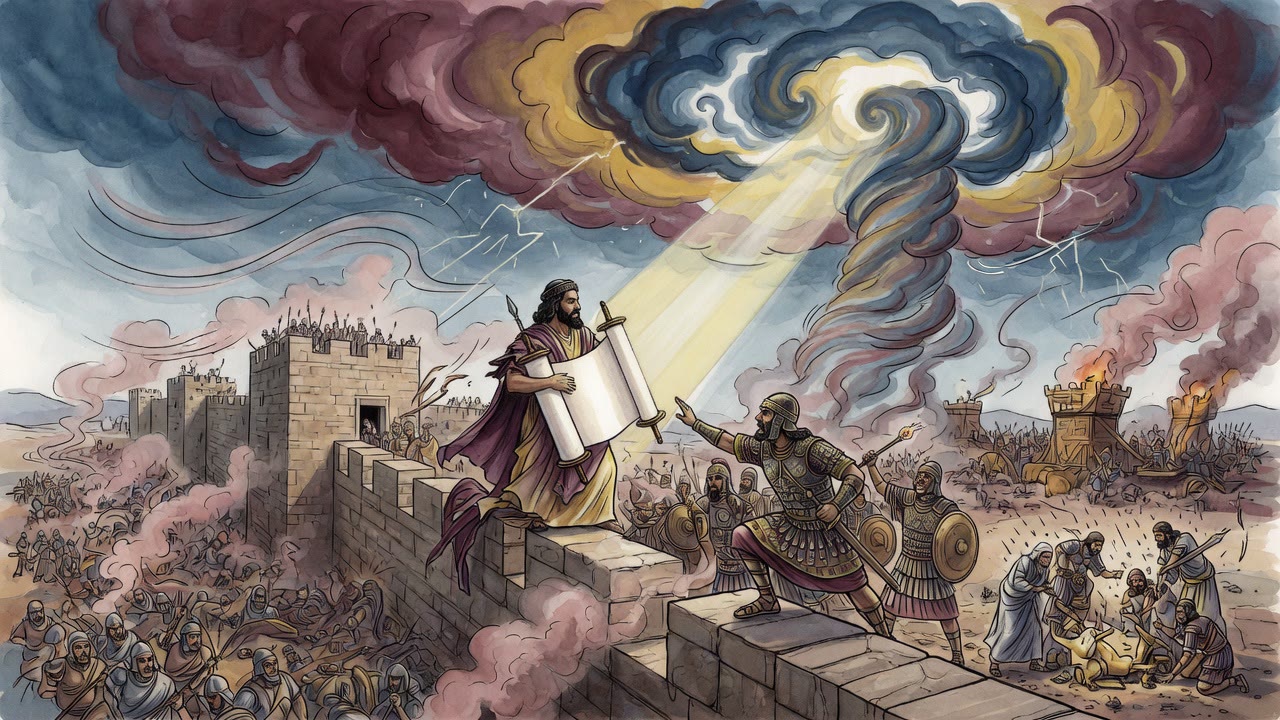
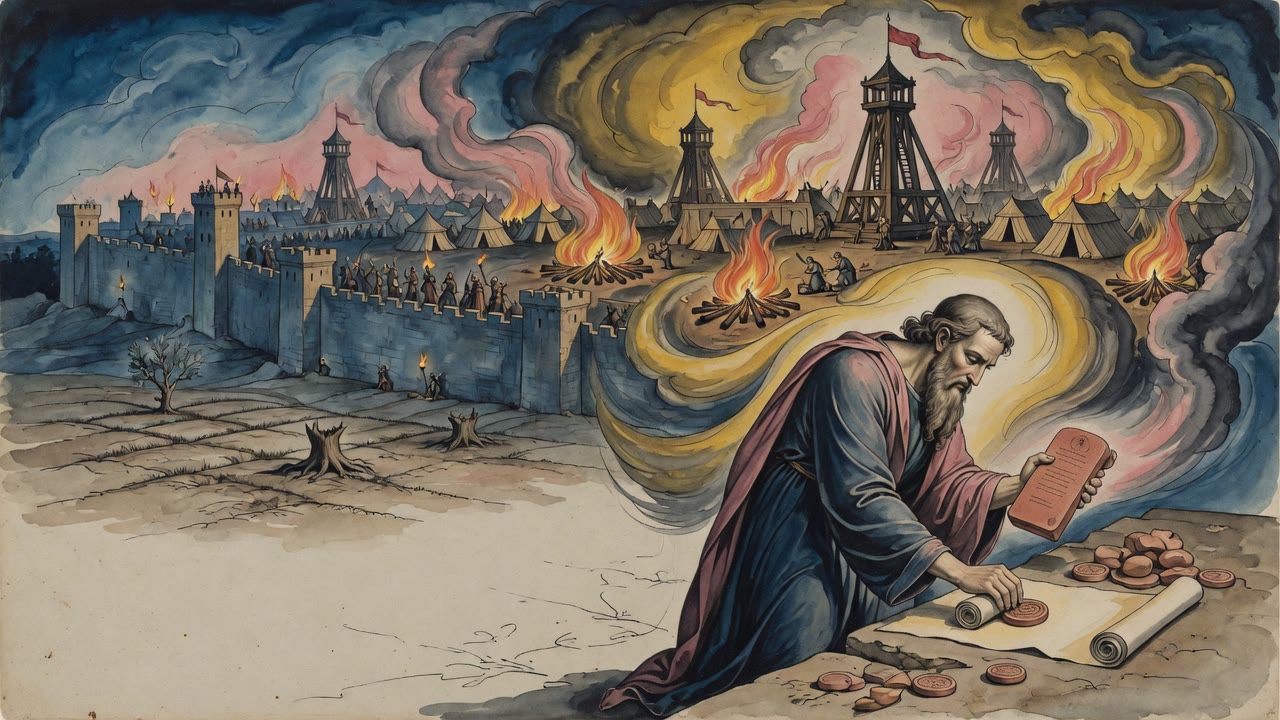
Jehoram son of Ahab rode the rampart while Samaria starved. The Aramean siege had turned grain into rumor and rumor into dust. Donkeys that once hauled sacks now stood with hollow flanks. Mothers counted beans the way other cities counted days. Below the king a woman clawed at the stones and screamed until her throat tore. She was not asking for bread. She was demanding he keep a bargain between two mothers who had already eaten hope.
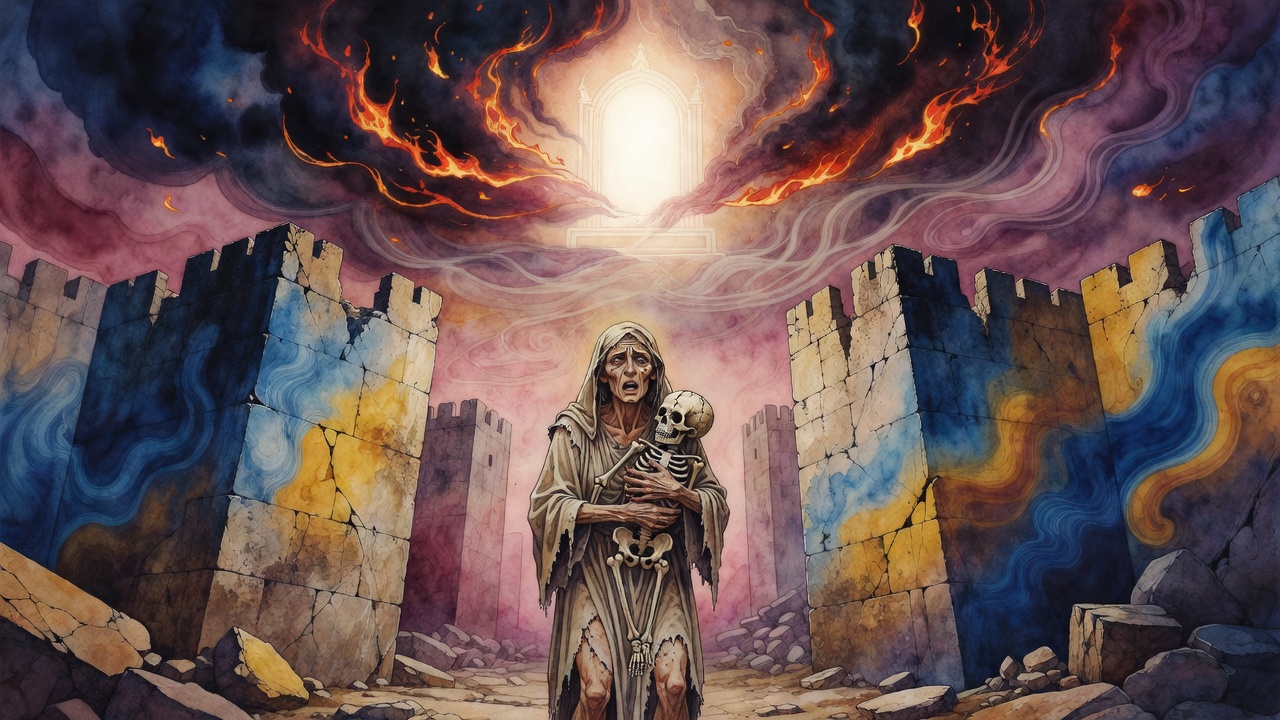
One child had been cooked. The other was hidden. The second mother would not bring her son to the pot. The first mother stood empty-handed under a closed sky and named the king as witness. Jehoram tore his clothes. The sackcloth underneath did not feed the city. His hand on the wall felt cold stone, not policy.

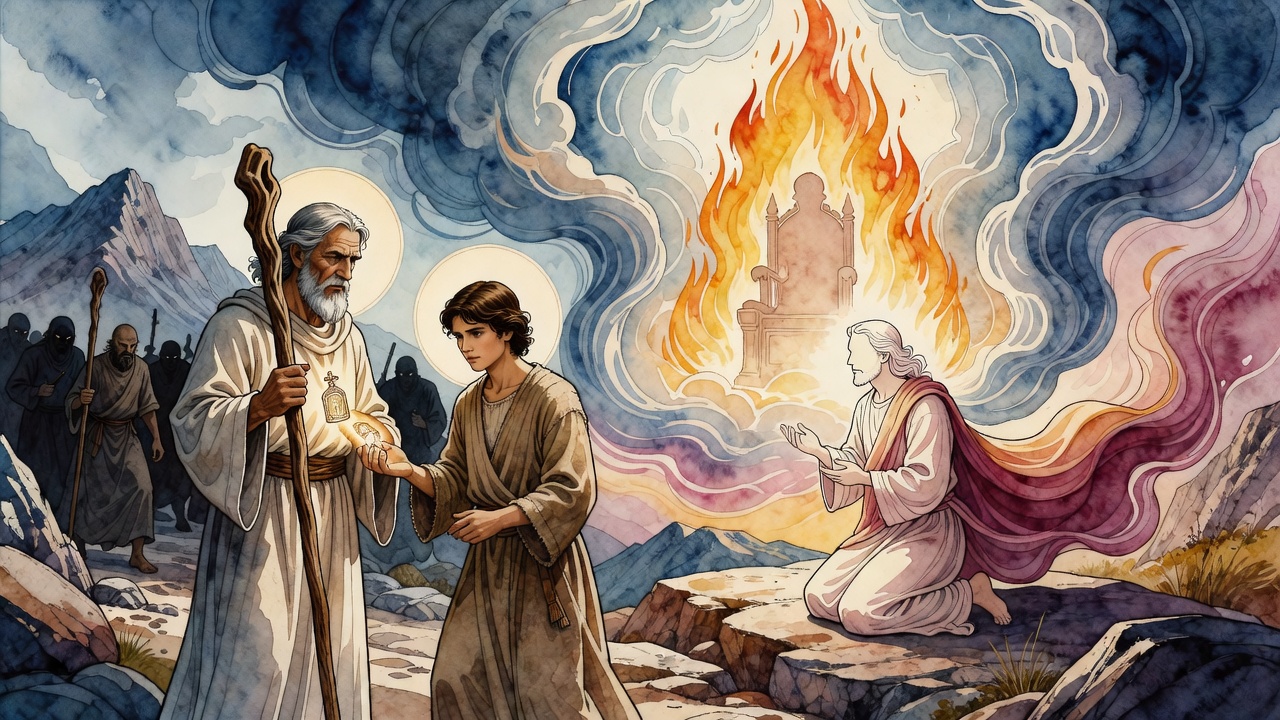
The curse had been waiting for a room. Moses had warned that covenant-breaking would end with parents eating their children (Leviticus 26:29). Samaria made the verse walk on two legs. The midrash does not soften the scene. It points at the gate and says: this is what the words meant when the walls finally closed.

The Bargain Between Mothers

The agreement had been simple in the way only hunger can make simple. Today your son. Tomorrow mine. They boiled what they had and shared the unspeakable meal. Then morning came and the second woman looked at her sleeping child and discovered she still had a heart. She hid him. The first woman, already emptied, climbed toward the palace with a scream that was half law and half howl.

Siege law is not Torah law. Siege law is arithmetic with bodies. The woman wanted a judge. She got a king who could only tear cloth. Around them the city pretended not to hear, because hearing would make every household a courtroom.

The midrash keeps her voice. Without her cry the verse stays ink. With her cry the ink becomes smoke over a pot no one wants to remember and no one is allowed to forget.

Doeg Son of Joseph

The same horror returned in the days of the Second Temple. A man named Doeg ben Joseph lived through a hunger so complete that the household crossed the last line. The sages set his name beside the verse so no generation could claim the warning was only poetry. Daughters, sons, even a father: the language of the curse opens wide enough to cover every unthinkable meal siege invents.

Hunger rearranges law. A city that once debated purity begins to debate who is still a person. The walls do not care. The army outside does not care. Only the closed gate holds the argument, and the argument ends when the last stored grain is gone and the first forbidden idea becomes dinner.

Doeg's story is short in the midrash and endless in the ear. One household. One collapse. A name kept so the later reader cannot pretend Samaria stood alone in history. The Second Temple era proves the curse is portable. Whenever the covenant is abandoned hard enough, the pot can reappear.

What the Soul Owes the Hungry

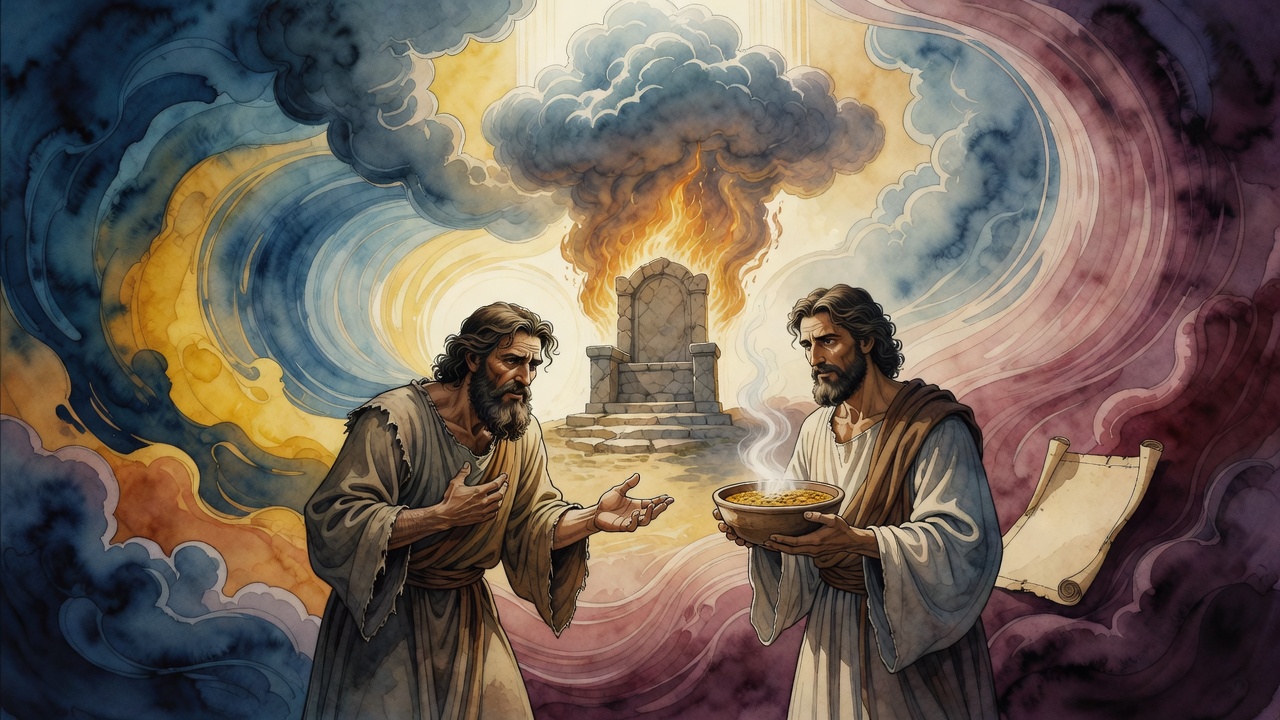
Centuries later the teachers of Vayikra Rabbah read Isaiah as if the prophet were standing in that same street. "Offer your soul to the hungry," he says (Isaiah 58:10). Not a coin flicked from a full purse. Not a crust tossed without looking. The soul. Presence. A body that stops walking and stays with the person who cannot stand. A face that meets another face before the hand opens.

They warn that refusal has a price. If Israel will not give to the hungry of Jacob, the wealth goes to the "sated of Esau," the empire that already eats well. Refuse the poor, and the wretched poor arrive at your door as tax collectors and soldiers. Charity withheld becomes confiscation returned. The midrash is not gentle about the swap.

A blind man is called "full of light" by a euphemism that softens what everyone sees. The teachers say poverty works the same way. Dignity drains first. Then property. Then the house itself fills with the people you would not feed when you still had a table. "Bringing home the wretched poor" becomes a sentence that turns inward.

The King Who Could Not Answer

Jehoram had no policy left. He walked the wall. He wore sackcloth. He heard the woman's case and had nothing to give but grief. That is the shape of a city under the verse. Leadership becomes theater. The true judgment is already written in empty jars and quiet courtyards where cooking smells wrong.

The woman wanted justice between two mothers, not a sermon. The midrash gives her both. Her scream is Torah applied to a locked gate. The king becomes a prop. Heaven has already rendered the sentence through famine, and the only remaining question is whether anyone still living will feed the next empty hand before the walls invent another bargain.


← All myths

From the tradition

Sources

2 sources

The texts behind this telling. Some cards carry a translation of the source; others are our own retelling of it, and each card says which. Every card links out to the original.

Midrash Aggadah, Leviticus 26:29Midrash Aggadah

Translation of the source text.Midrash Aggadah (Buber), Public Domain, on Sefaria · CC-BY-SA

"And you shall eat the flesh of your sons" (Leviticus 26:29), as in the deed that occurred in Samaria concerning the woman who cried out to Jehoram son of Ahab, king of Israel (2 Kings 6:25-26), and as in the deed concerning Doeg son of Joseph in the [time of the] Second Temple. "And the flesh of your daughters you shall eat" (Leviticus 26:29), [this comes] to include sons who ate the flesh of their father.

Full source
Vayikra Rabbah 34:13Vayikra Rabbah

Retold in our words. Read the original at the link below.The Sefaria Midrash Rabbah, 2022 · CC-BY

Vayikra Rabbah, a fascinating collection of rabbinic interpretations on the Book of Leviticus, explores this very question, challenging us to examine our motivations and the impact of our actions.

The passage begins with a powerful verse from Isaiah (58:10): "And offer [your soul] to the hungry." But what does it mean to offer your soul? It’s not just about handing over a few coins, but about connecting with the humanity of the person in need. The text goes on to say that if you merit it, you give to the hungry of Jacob (meaning, your fellow Jews). And if not. well, you might end up giving to the "sated of Esau."

Who is this "sated of Esau"? The text explains that in the time of the Sages, this referred to Rome, seen as a descendant of Esau. In other words, if you don't give willingly to those who truly need it, your resources might be taken from you by external forces. It’s a sobering thought.

Then, the passage shifts to another verse from Isaiah (58:7): "And bringing home the wretched poor." Who are these "wretched poor"? One interpretation suggests they are those who appear needy, even if they aren't anymore. Another interpretation, according to Etz Yosef, is even more pointed: It refers to governmental authorities who demand payment as though they were poor! The message? If you don't actively help those in need, you might find yourself at the mercy of those who exploit vulnerability.

Rabbi Yitzḥak offers a poignant analogy: "Like that blind person that they call full of light." This was a common euphemism, a way to soften the reality of blindness. Similarly, the "wretched poor" might be those who have lost their dignity and property. Why? Because they didn't extend a hand to the poor themselves, failing to fulfill the will of their Father in Heaven. The text emphasizes that if you don't "offer your soul to the hungry," you might just find yourself bringing "the wretched poor" into your own home – meaning, becoming poor yourself.

But there's more! The Vayikra Rabbah offers alternative interpretations. The "wretched poor" could also be mourners and embittered souls. What do they need? Not just food, but comfort, solace, and connection. That's why the passage quotes (Proverbs 31:6): "Give intoxicating drink to the desolate and wine to embittered souls." Sometimes, offering someone a drink, a listening ear, and a sense of belonging is the most profound act of charity.

And then, the text takes a surprising turn. "And bringing home the wretched poor" – these could also be Torah scholars! These wise individuals enter the homes of the ignorant and fill them with the light of Torah. They teach ritual purity and impurity, what is forbidden and permitted, guiding people to perform the will of their Father in Heaven. In this view, inviting a Torah scholar into your home is akin to offering the most precious gift you can give: knowledge and guidance.

Rabbi Avin beautifully concludes this segment. He says that anyone who hosts a Torah scholar in their house, it’s as if they are offering bikkurim, the first fruits. He draws a parallel between the word "bringing" (tavi) used in the verse about the "wretched poor" and the word "bring" (tavi) used in (Exodus 23:19): "You shall bring [tavi] to the house of the Lord your God." Just as bikkurim were the first and best of the harvest, so too, welcoming a Torah scholar is an act of profound generosity and spiritual nourishment.

So, what's the takeaway? The Vayikra Rabbah challenges us to broaden our understanding of charity. It's not just about giving money. It's about offering our souls, connecting with the humanity of others, comforting the mourners, and seeking wisdom. It’s about recognizing that our actions have consequences, and that by giving generously and compassionately, we not only help others but also enrich our own lives.

Full source